
Among 1,616 medical students in northern China, stressful life events were linked to more depression symptoms, partly through higher phone-addiction scores, and that phone pathway was stronger in night owls than in early risers.1 The data come from a single survey, so they show how these things travel together, not what causes what.
Research Highlights
- Stress and depression moved together: each 1-point higher score on a 4-to-16 life-stress scale went with about 1.15 points higher on the PHQ-9 depression questionnaire (0 to 27), after adjusting for background factors.1
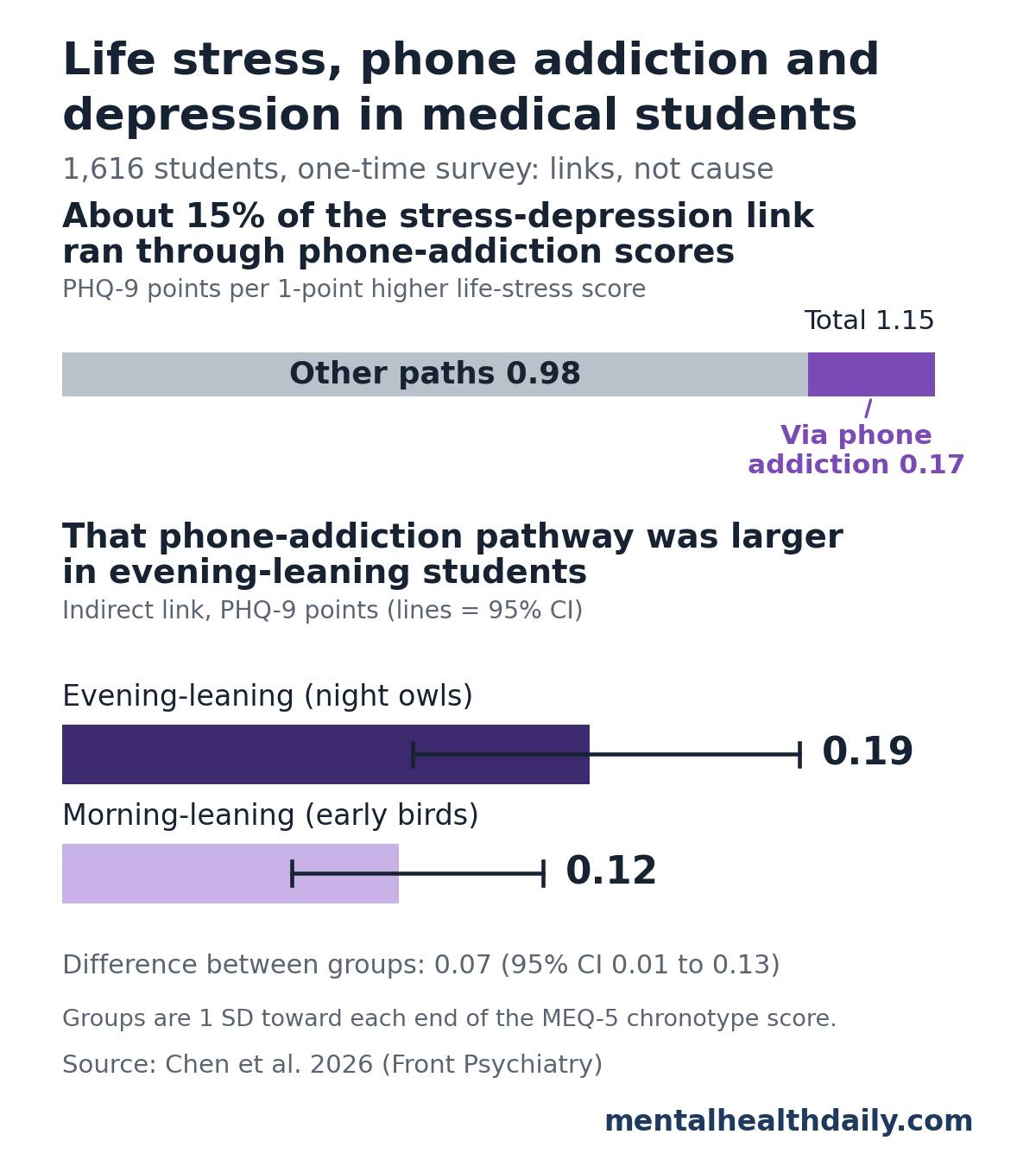
- Phone addiction carried a small share: about 15% of that association ran statistically through phone-addiction scores (0.17 of the 1.15 points; 95% CI 0.12 to 0.23).1
- Night owls showed the stronger phone pathway: the phone pathway was 0.19 PHQ-9 points in evening-leaning students vs. 0.12 in morning-leaning students, a modest but statistically significant difference.1
- Career and exam worries stood out: employment pressure and study pressure had the strongest links to depression; family adverse events had no significant link once other stressors were accounted for.1
- Mostly mild symptoms: 33.9% scored 5 or more on the PHQ-9 (at least mild symptoms), and 6.8% scored in the moderate range or higher.1
What the Medical Student Survey Measured
Chen et al. surveyed students at one medical college in northern China in October 2025, drawing equal random samples from 4 departments: public health, clinical medicine, medical technology and anesthesiology, and stomatology (dentistry). Of 1,706 who responded, 1,616 had complete data; 66% were women.1
Everything was self-reported online, using 4 questionnaires:
- Negative life events: a short 4-item scale the researchers built, asking how much each of 4 stressors had affected the student over the past 6 months (family problems such as divorce or a death, study pressure, relationship setbacks, and job-market worries). Each item ran from 1 (no event) to 4 (severe impact), for a total of 4 to 16.
- Depression: the PHQ-9 (Patient Health Questionnaire-9), a widely used 9-question screen scored 0 to 27. A score of 5 or more flags at least mild symptoms; it is a screening threshold, not a diagnosis.
- Mobile phone addiction: a 13-item scale the team developed, rated 1 (completely disagree) to 5 (completely agree) per item, with higher totals meaning more addiction-like phone use.
- Chronotype: the MEQ-5, a 5-question short form of the Morningness-Eveningness Questionnaire, scored 4 to 25.
Chronotype is a person’s natural timing preference: when they tend to feel alert, sleepy, and at their best. Morning types (early birds) wake easily and fade early in the evening; evening types (night owls) hit their stride late and struggle with early starts. On the MEQ-5, lower scores mean a stronger evening lean.
Students averaged 5.6 on the life-stress scale, so most reported few or mild events. The average PHQ-9 score was 3.6, below the mild-symptom cutoff.1
Employment and Study Pressure Had the Strongest Links to Depression
All 4 stressors correlated with depression scores, but not equally. Employment pressure (r = 0.48) and study pressure (r = 0.45) had the strongest correlations, followed by relationship setbacks (r = 0.34) and family adverse events (r = 0.19).1
When all 4 were entered together with background factors such as sex, year of study, and parents’ education, study pressure, relationship setbacks, and employment pressure each remained significantly linked to depression (all P < 0.001). Family adverse events did not (P = 0.18).1
The researchers suggest that college students’ daily lives center more on school than family, and that new family events within a 6-month window were uncommon. Medical training adds its own load: long programs, clinical placements, and a competitive job market. Second-year students had the highest average PHQ-9 score (4.49).1
About 15% of the Stress-Depression Link Ran Through Phone Addiction
To test whether phone addiction could sit between stress and depression, the researchers used a mediation model, a statistical method that splits one association into a part that runs through a third variable (the indirect path) and the rest (the direct path).1
- Total link: each 1-point higher life-stress score went with 1.15 points higher PHQ-9
- Through phone addiction: 0.17 points (95% CI 0.12 to 0.23), or 14.5% of the total
- Everything else: 0.98 points, the large majority
In plain terms, students reporting more stressful events also scored higher on phone addiction, and higher phone-addiction scores went with more depression symptoms. Phone addiction explained a real but small slice of the stress-depression association.
The researchers frame this with compensatory internet use theory: people under strain turn to the internet, and here the phone, to escape bad feelings, and the habit can harden into compulsive use that worsens mood.1 A single survey cannot confirm that order of events. The same pattern would appear if depressed students reached for their phones more, or if depression made events feel more stressful.
Night Owls Showed a Stronger Link Between Phone Addiction and Depression
Next, the researchers checked whether chronotype changed the strength of the phone-depression link. It did: the interaction between phone-addiction score and chronotype score was statistically significant (P < 0.001), with the link growing stronger as students leaned more toward evening type.1
Comparing students 1 standard deviation toward each end of the chronotype scale:
- Evening-leaning students: the phone-addiction pathway was 0.19 PHQ-9 points per life-stress point (95% CI 0.13 to 0.27)
- Morning-leaning students: 0.12 points (95% CI 0.08 to 0.17)
- Difference: 0.07 points (95% CI 0.01 to 0.13)
So for night owls, the phone pathway was about 1.6 times as large. Both numbers are small on a 27-point scale, and the lower end of the confidence interval for the difference sits close to zero.
These “evening” and “morning” groups are points on a continuous score, not students sorted into chronotype categories. The researchers did not report how many students met standard cutoffs for evening or morning type.
Proposed explanation: evening types often live out of step with early classes and shifts, a mismatch called social jetlag. They may also use phones later at night, when bright screens can delay sleep and the body clock. The survey did not measure sleep, bedtime phone use, or social jetlag, so this mechanism remains untested here.1
How the Findings Fit Earlier Research on Phones, Chronotype and Depression
Each piece of the model has support from earlier reviews, mostly from cross-sectional data as well:
- Phone addiction and depression: a 2017 systematic review of 23 papers found depression severity was consistently related to problematic smartphone use, with at least medium effect sizes, and somewhat smaller effects after adjustment for other factors.2 A 2019 meta-analysis covering 41,871 children and young people linked problematic smartphone use to about 3 times higher odds of depression (OR 3.17) and about 2.6 times the odds of poor sleep quality (OR 2.60).3
- Chronotype and depression: a 2017 meta-analysis of 36 studies (15,734 people) found a small overall association between eveningness and more depressive symptoms, with no sign of publication bias.4
- Phones and chronotype: a 2-year study that followed 999 Chinese college students found that students whose problematic phone use stayed high over time were more likely to be evening types, a link that held only in women after splitting by sex.5
That last finding complicates the picture. If heavy phone use pushes people toward later sleep timing, chronotype is partly an outcome of phone habits, not only a fixed trait that changes how phones affect mood.
Limitations of This Phone Addiction and Chronotype Survey
- One time point. Mediation from a single survey is a statistical split, not evidence of sequence. The researchers acknowledge that their cross-sectional design cannot establish causal relationships.1
- Homemade scales. The life-stress and phone-addiction measures were built for this study and checked mainly for internal consistency, so results may not match studies using established instruments.
- One college. All students came from a single medical college in northern China, and two-thirds were women.
- Screening scores, not diagnoses. Most students with elevated PHQ-9 scores were in the mild range.
- Small numerical inconsistencies. A few coefficients differ between the paper’s tables and text, for example the path from life stress to phone addiction (1.217 in one table, 1.127 in another), which calls for some caution with exact values.
The abstract states that morning chronotype “can buffer” depression and evening chronotype “can increase” it. That causal wording goes further than a one-time survey allows; what the study showed is a stronger association among evening-leaning students.
What This Means for Medical Students and Night Owls
- Career and exam pressure deserve attention. In this sample they were the stressors most closely linked to depression symptoms.
- Phone habits are one piece. Compulsive phone use accounted for about 15% of the stress-depression association, which leaves most of it to other factors.
- Night owls may be worth watching. The researchers suggest colleges add chronotype and phone-use questions to freshman mental health screening and encourage morning outdoor light and regular exercise. These are their proposals, not interventions the study tested.1
- Next step: following students over time, with sleep and bedtime phone use measured, would show which comes first.
Low mood that lasts 2 weeks or more, or any thoughts of self-harm, warrants a conversation with a doctor or counselor. In the US, call or text 988 for the Suicide & Crisis Lifeline.
References
- Chen Y, Wang Q, Zhu Y, Li S, Hu Y, Liu Z. Negative life events and depression: a moderated mediation model of mobile phone addiction and chronotype among medical undergraduate students in North China. Frontiers in Psychiatry. 2026;17:1916367. doi:10.3389/fpsyt.2026.1916367
- Elhai JD, Dvorak RD, Levine JC, Hall BJ. Problematic smartphone use: a conceptual overview and systematic review of relations with anxiety and depression psychopathology. Journal of Affective Disorders. 2017;207:251–259. doi:10.1016/j.jad.2016.08.030
- Sohn SY, Rees P, Wildridge B, Kalk NJ, Carter B. Prevalence of problematic smartphone usage and associated mental health outcomes amongst children and young people: a systematic review, meta-analysis and GRADE of the evidence. BMC Psychiatry. 2019;19:356. doi:10.1186/s12888-019-2350-x
- Au J, Reece J. The relationship between chronotype and depressive symptoms: a meta-analysis. Journal of Affective Disorders. 2017;218:93–104. doi:10.1016/j.jad.2017.04.021
- Li T, Zhang D, Qu Y, et al. Association between trajectories of problematic mobile phone use and chronotype among Chinese college students. Addictive Behaviors. 2022;134:107398. doi:10.1016/j.addbeh.2022.107398