
A 2026 study from Turkey found that close relatives of people with schizophrenia or bipolar disorder reported more autistic traits than healthy controls, even though none of them had autism or any psychiatric disorder themselves.1
Research Highlights
- Higher autistic trait scores in both relative groups: median Autism Spectrum Quotient (AQ) scores were 19 in schizophrenia relatives and 18 in bipolar relatives, vs. 16 in healthy controls (p = 0.003 and p = 0.015 vs. controls).1
- More relatives crossed the elevated-trait cutoff: 17.8% of schizophrenia relatives and 13.3% of bipolar relatives scored 26 or higher, compared with 2.2% of controls (1 person).1
- Imagination differed in both groups: both sets of relatives reported more difficulty on imagination-related items than controls.1
- Communication differed only in schizophrenia relatives: their scores for everyday conversation difficulties were higher than controls; bipolar relatives did not differ.1
- Small, self-report study: 45 people per group at a single clinic, with traits measured by questionnaire and no effect sizes reported.1
What the Study of Relatives Measured
Autistic traits are the social, communication and thinking-style features of autism, such as preferring routines or finding small talk hard, spread across the whole population in milder forms. Most people with some of these traits do not have autism.
Parlakkaya Yildiz et al. recruited 135 adults through the psychiatry outpatient clinics of an Istanbul city hospital between June 2024 and June 2025:1
- 45 relatives of people with schizophrenia
- 45 relatives of people with bipolar disorder
- 45 healthy controls with no personal or family history of psychiatric illness
All relatives were first-degree relatives (a parent, sibling or child) of a patient being treated at the clinic. Anyone who had ever had a psychiatric diagnosis, seen a psychiatrist or taken psychiatric medication was excluded. A structured clinical interview ruled out current and past psychiatric disorders, and a clinician evaluated everyone for autism using a developmental history from the participant and a family member. None met criteria for autism.1
The 3 groups were well balanced: average age was 45 in each, and about 73% of each group were women.1
The questionnaire: the Autism Spectrum Quotient (AQ) is a 50-item self-report scale where each item scores 0 or 1, so totals run from 0 to 50 and higher scores mean more autistic traits. It has 5 parts of 10 items each: social skills, attention switching, attention to detail, communication and imagination. The study used a score of 26 or higher as the marker for clinically elevated traits.1
Relatives of People With Schizophrenia or Bipolar Disorder Scored Higher on Autistic Traits
Total AQ scores differed across the 3 groups (p = 0.002). Each relative group scored higher than controls, and the 2 relative groups did not differ from each other.1
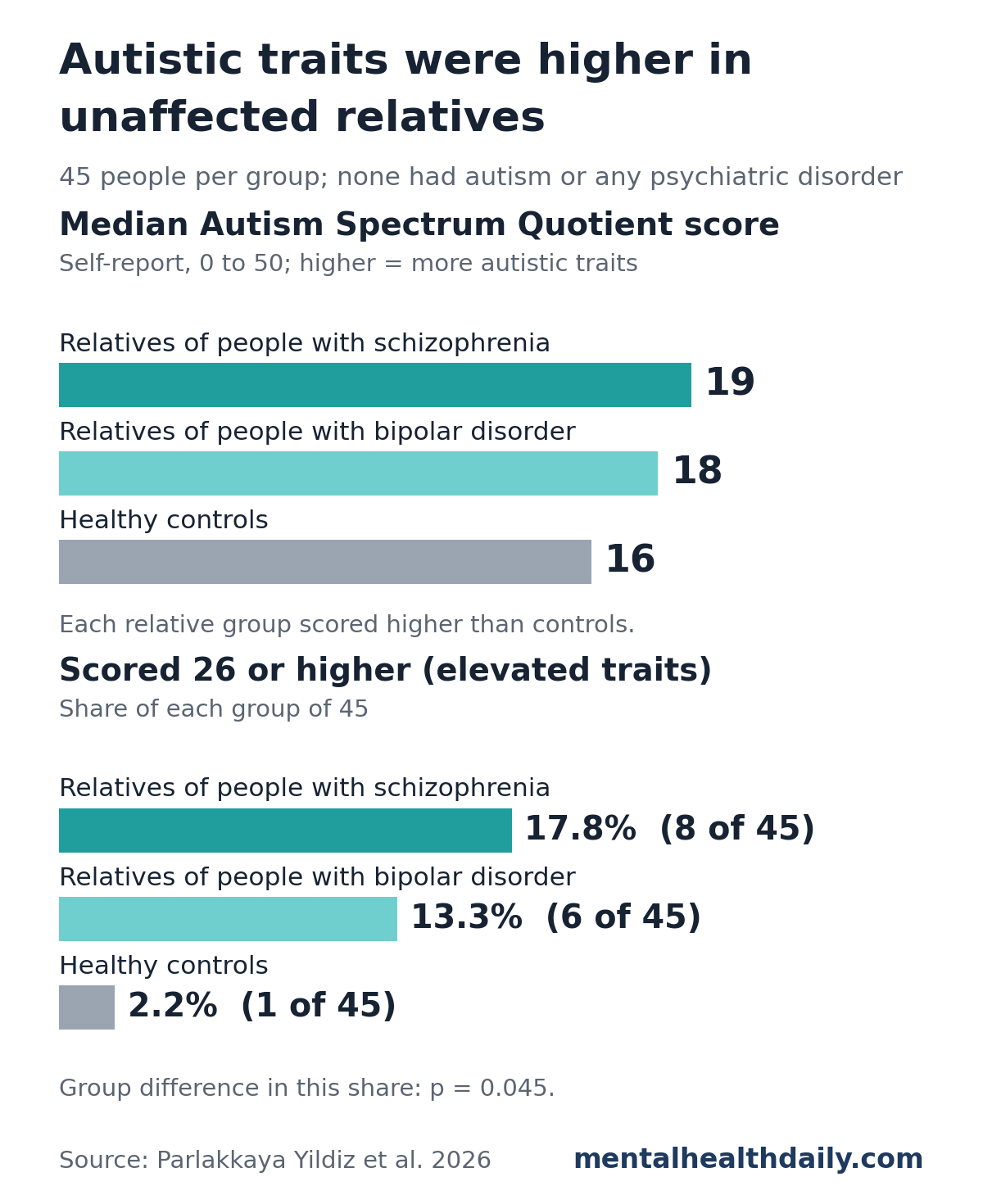
A 2- to 3-point gap in median score is modest. The bigger contrast was at the high end: 8 of 45 schizophrenia relatives and 6 of 45 bipolar relatives scored 26 or higher, compared with 1 of 45 controls. The 3-group test for that difference was p = 0.045, just under the usual cutoff, and the paper did not report pairwise tests for it.1
A score of 26 or higher on the AQ is a screening flag, not a diagnosis. Everyone in the study had already been evaluated and found not to have autism.
Imagination and Communication Drove the Difference
The higher totals came from 2 of the 5 AQ areas. The other 3 — social skills, attention switching and attention to detail — did not differ between groups.1
- Imagination (both relative groups). This part of the AQ covers inventing stories, imagining alternative scenarios and engaging with fiction or creative play. Median scores were 4 in both relative groups and 3 in controls (schizophrenia relatives p < 0.001, bipolar relatives p = 0.016 vs. controls).
- Communication (schizophrenia relatives only). This part covers the back-and-forth of conversation, understanding implied meaning and non-literal language. Median scores were 3 in schizophrenia relatives and 1 in controls (p = 0.003). Bipolar relatives, at a median of 2, did not differ significantly from either group.
The researchers pointed out that difficulties with pragmatic language (the social use of language, such as understanding hints and non-literal meaning) have been reported before in unaffected relatives of people with schizophrenia. These communication items may also capture broader social-thinking differences that are not specific to autism.1
Autism, Schizophrenia and Bipolar Disorder Share Genetic and Family Links
The study fits a long line of evidence that these 3 conditions overlap in families and in genes.
- Shared genes: the Cross-Disorder Group of the Psychiatric Genomics Consortium estimated how much common genetic variation 5 disorders share. Schizophrenia and bipolar disorder overlapped heavily (genetic correlation 0.68), schizophrenia and autism overlapped modestly (0.16), and the bipolar–autism overlap was not significant.2
- Family registers: Sullivan et al. analyzed national registers from Sweden and Israel and found that having a parent with schizophrenia was linked to roughly 3 times the odds of an autism diagnosis (odds ratio 2.9 in both Swedish samples). Bipolar disorder in a parent or sibling showed the same pattern at a smaller size.3
- Relatives of people with schizophrenia: a larger Italian study of 342 unaffected first-degree relatives, using a clinician-rated scale, found autistic symptoms in 44.9%. Relatives with more of these symptoms had weaker working memory and social cognition and poorer day-to-day functioning.4
The stronger schizophrenia–autism genetic overlap is consistent with communication differences showing up only in schizophrenia relatives. Bipolar relatives have been studied much less: family registers link bipolar disorder to autism, but the common-variant genetic overlap was not significant, and this study is one of the few to measure autistic traits in that group directly.
What a Familial Vulnerability Finding Can and Cannot Show
The finding is consistent with the idea of a shared familial neurodevelopmental vulnerability: a partly inherited tendency, shaped early in brain development, that can show up as schizophrenia, bipolar disorder, autism or milder traits in different family members.
What it can support: unaffected relatives of people with schizophrenia or bipolar disorder, as a group, reported somewhat more autistic traits than people with no family history. That matches family, register and genetic studies.234
What it cannot show:
- Genes vs. upbringing: a cross-sectional comparison cannot separate inherited risk from growing up or living with someone who has a serious mental illness.
- Individual risk: a modestly higher group score says nothing about whether a particular relative will develop schizophrenia, bipolar disorder or autism.
- Full autism profile: the differences were limited to imagination and communication, so relatives did not show a broad autism-like pattern.
Limitations of the Autistic Traits Study
- Small groups. With 45 people per group, the size of each difference is uncertain, and the paper reported medians and p-values without effect sizes or confidence intervals.
- Self-report only. Traits came from a questionnaire; no clinician-rated autism instrument is validated for adults in Turkey.
- Single clinic. All relatives were family members of patients followed at one Istanbul hospital, and controls were recruited as volunteers rather than individually matched.
- Unreported details. The paper did not break down results by type of relative (parent, sibling or child).
- Missing measures. Social cognition, IQ, psychosis-like traits and everyday functioning were not assessed, so the study cannot say whether the higher scores affect daily life.
For families, the study is a reminder that some social and communication differences can run in families without amounting to a diagnosis. Anyone worried about their own symptoms, or a relative’s, should talk with a clinician rather than rely on a self-report score.
References
- Parlakkaya Yıldız FB, Kurtulmuş A, Çelik Z, Ereğli B, Görmez A. Autistic traits in unaffected first-degree relatives of individuals with schizophrenia and bipolar disorder: implications for shared familial neurodevelopmental vulnerability. Frontiers in Psychiatry. 2026;17:1933974. doi:10.3389/fpsyt.2026.1933974
- Cross-Disorder Group of the Psychiatric Genomics Consortium; Lee SH, Ripke S, Neale BM, et al. Genetic relationship between five psychiatric disorders estimated from genome-wide SNPs. Nature Genetics. 2013;45(9):984–994. doi:10.1038/ng.2711
- Sullivan PF, Magnusson C, Reichenberg A, et al. Family history of schizophrenia and bipolar disorder as risk factors for autism. Archives of General Psychiatry. 2012;69(11):1099–1103. doi:10.1001/archgenpsychiatry.2012.730
- Vita A, Barlati S, Deste G, et al. Autistic symptoms in unaffected first-degree relatives of people with schizophrenia: results from the Italian Network for Research on Psychoses multicenter study. European Psychiatry. 2023;66(1):e85. doi:10.1192/j.eurpsy.2023.2455