
Medical students who took Mental Health First Aid training at an Irish medical school called it a missing piece of their education and a skill every future doctor needs. A 2026 qualitative study gathered their views in 3 focus groups after the course.1
Research Highlights
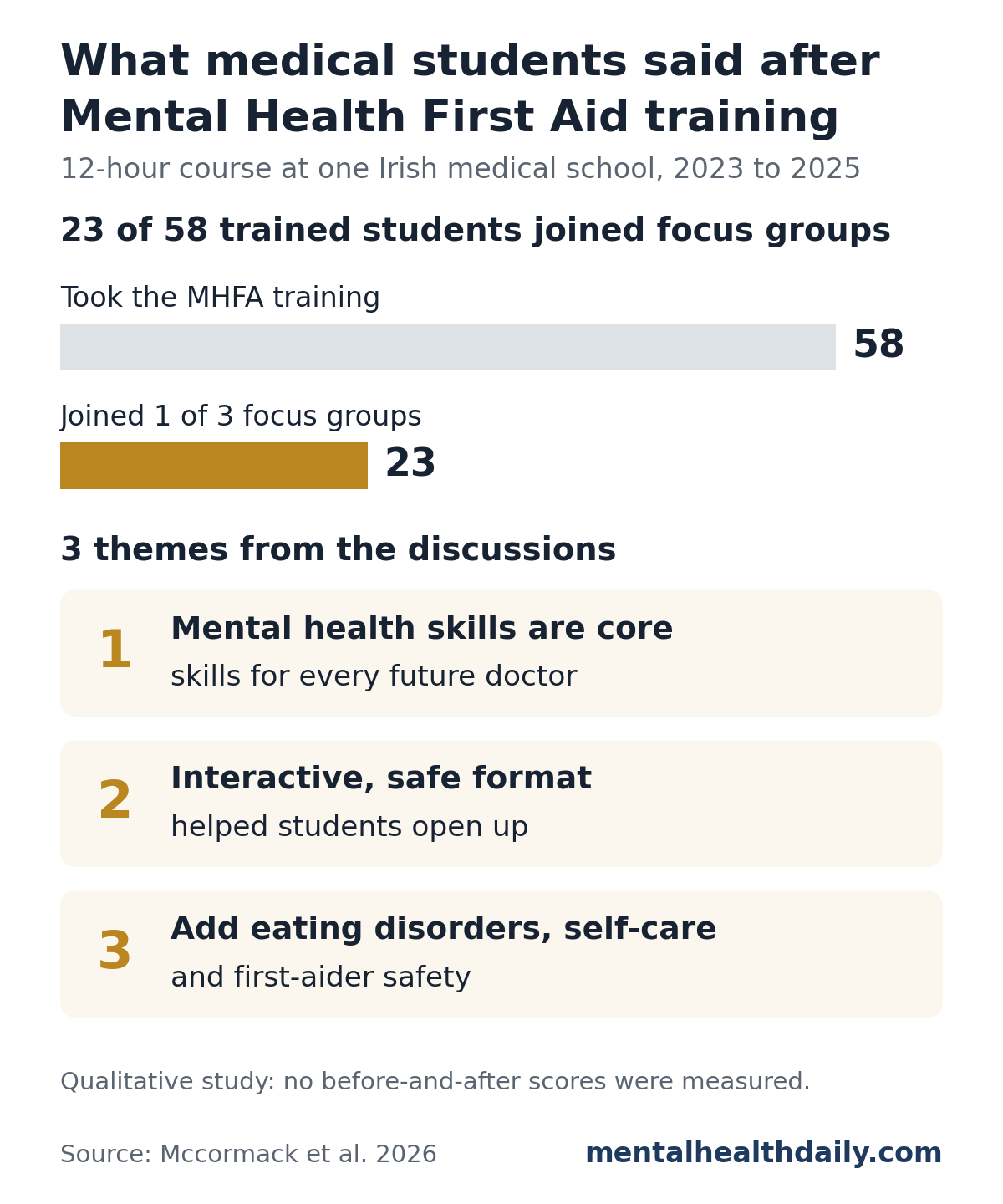
- Small, focused sample: 23 of the 58 students who chose the 12-hour course at RCSI University of Medicine and Health Sciences in Dublin joined focus groups between 2023 and 2025.1
- A gap in the curriculum: students said they learn to recognize depression and schizophrenia but not how to approach a person who is struggling or what to say first.1
- The format worked for them: interactive activities, videos and instructors who set a respectful tone made it easier to talk openly, and several students shared their own family experiences.1
- What students want added: eating disorders, self-care for future doctors and more on the first-aider’s own safety.1
- Views, not measured outcomes: the study did not test knowledge, stigma or confidence before and after training. Controlled trials elsewhere show MHFA improves knowledge and confidence, with weaker evidence for real-world helping.35
What Mental Health First Aid Teaches
Mental Health First Aid (MHFA) is a standardized course, first built for the general public, that teaches people how to give initial support to someone who is developing a mental health problem or going through a mental health crisis, until professional help is available. It works the way physical first aid does: a short, practical framework that a layperson can use in the first conversation.
The Irish version of the course runs 12 hours and covers depression, anxiety, psychosis and substance misuse through lectures, discussion, case studies and videos of people describing their own experiences.1 Its core tool is the ALGEE action plan:
- Approach the person, assess and assist with any crisis
- Listen nonjudgmentally
- Give support and information
- Encourage appropriate professional help
- Encourage other supports
The course aims to raise mental health literacy: knowing enough about mental health problems to recognize them, respond well and know where help is available.
How the Student-Led MHFA Study at RCSI Worked
The project started with 2 final-year medical students who felt their training left out practical mental health skills. They proposed the study through a university student engagement program and helped design it, run the first focus group and analyze the transcripts alongside staff researchers.1
- Training 1: an optional, extracurricular 2-day course open to medical students from every year
- Trainings 2 and 3: the same 12-hour course split into 3-hour sessions over 4 days within an elective for second-year students, plus a fifth day of simulated practice in which students took turns playing the first-aider and the person in distress
- Focus groups: 3 groups of 6 to 9 students; the first was online with students from foundation to final year, and the other 2 were in person with second-year students
- Analysis: thematic analysis, a standard qualitative method in which several researchers code the transcripts independently and then agree on recurring patterns
The MHFA manual and course content were not adapted for medical students. The study asked how they experienced the standard adult version and what they would change.1
Medical Students Called Mental Health Skills a Core Clinical Skill
Across all 3 groups, students described mental health literacy as something every doctor needs, whatever specialty they choose. One second-year student put the comparison simply:
“Last year all of us had to do conventional first aid training. So personally, I don’t really see why mental health first aid training shouldn’t be treated the same.”1
Students said medical school teaches them the features of depression and schizophrenia but not how to start the conversation — “what are the correct phrases to use and then like how to take the first steps to talking to them.” They saw ALGEE as a framework they could carry into clinical work and use with patients who might otherwise turn down help.1
Medical students also have their own reasons to want these skills. A 2016 meta-analysis in JAMA estimated that 27.2% of medical students have depression or depressive symptoms, pooling data from more than 120,000 students.2
Health professionals often find it hard to seek support for their own mental health and prefer informal help from colleagues or friends, so knowing how to help a peer is part of the job.1
An Interactive, Safe Format Helped Students Open Up
The second theme was about how the course is taught. Students liked moving between activities, video clips and discussion instead of sitting through lectures, and several said that applying ALGEE right after each video helped it stick.1
Many described the room as a safe place to talk. Instructors opened with icebreakers and a group agreement, and respected everyone’s opinions and boundaries. The researchers framed this as psychological safety: a setting where people feel free to ask questions, disagree and admit what they do not know.
Lived experience came up often. Several students talked about supporting relatives or friends with mental illness, and one said learning these skills felt like claiming something back after a family had struggled without that knowledge. Personal experience was also a common reason students signed up, which bears on how far the findings generalize.1
Students Asked for Eating Disorders, Self-Care and First-Aider Safety
The third theme was about tailoring the course for medical students. Three requests stood out:1
- Eating disorders. The standard adult course does not cover them, and students in several groups said they should be added, noting how common eating disorders are among young people.
- Self-care for future doctors. Students raised burnout and the mental health risks of residency, and wanted practical skills for managing their own stress. “We’re going to be future healthcare professionals but that doesn’t exclude us from the conditions as well,” one said.
- The first-aider’s own safety. One student asked for “more emphasis on your own safety when you’re doing mental health first aid.”
The eating disorder request has a precedent. When MHFA Australia tailored the course for medical and nursing students in 2013, it added an eating disorders section from the youth version of the course, because many students are in the typical age range for onset. In that evaluation, 434 students (142 of them in medicine) completed surveys before and after the course and showed better first aid intentions, more knowledge, more confidence and less personal stigma toward depression.4 That study had no control group either.
The RCSI researchers suggest that deeper self-care teaching may fit better in other professional development courses, since a 12-hour MHFA course leaves little room for it.1
What Controlled Trials Show About MHFA
The wider MHFA research base fills in what this study could not measure:
- Knowledge and confidence improve. A 2018 meta-analysis of 18 controlled trials with 5,936 adults found small-to-moderate gains in first aid knowledge, recognition of mental disorders, confidence in helping and intentions to help, plus small reductions in stigma, lasting up to 6 months.3
- Helping in real life is less clear. The same review found a small increase in the amount of help trainees gave (d = 0.23), but the quality of that help was unclear.3
- Effects on the people being helped are unproven. A 2022 systematic review in Psychiatric Services found 9 studies that could test this. MHFA had mixed effects on whether trainees used their skills and no shown effect on the helpfulness of their actions or the mental health of the people they helped.5
In controlled trials, MHFA consistently leaves people better informed and more willing to step in. Whether that turns into better outcomes for a struggling classmate or patient has not yet been shown.
Limitations of This MHFA Focus-Group Study
The study captures how a group of interested students experienced the course. It cannot show that MHFA changed what they know or do. Key limits, most of them noted by the researchers:1
- No measured outcomes: no before-and-after scores for mental health literacy, stigma or confidence, and no follow-up into clinical training
- Self-selected students: 23 of 58 trainees volunteered, and the course itself was optional or an elective, so participants likely had a stronger interest in mental health than their classmates
- One school: all students came from a single medical school in Dublin, and 2 of the 3 groups were second-year students only
- Group setting: peer pressure and the wish to give expected answers can mute criticism in focus groups
- Close ties to MHFA: the lead researcher is a licensed MHFA instructor who helped implement the course, and MHFA Ireland helped fund the PhD research; the team says it examined this risk of favoring positive interpretations during analysis
What This Means for Mental Health Teaching in Medical School
For students, the message is consistent: they want a practical way to start a mental health conversation, taught in an interactive setting, before they reach the wards. MHFA gave this group that framework, and they found it worthwhile.
For medical schools weighing MHFA, this study shows the course appealed to the students who chose it and fits into an elective. The next step the researchers call for is a measured evaluation of mental health literacy, stigma, help-seeking and longer-term effects in medical students.1
References
- Mccormack Z, Yousif K, Abramova E, Arora S, Prabnoor J, Keating D, Strawbridge J. Student-led implementation of Mental Health First Aid training in undergraduate medical education. Frontiers in Psychiatry. 2026;17:1893636. doi:10.3389/fpsyt.2026.1893636
- Rotenstein LS, Ramos MA, Torre M, et al. Prevalence of depression, depressive symptoms, and suicidal ideation among medical students: a systematic review and meta-analysis. JAMA. 2016;316(21):2214–2236. doi:10.1001/jama.2016.17324
- Morgan AJ, Ross A, Reavley NJ. Systematic review and meta-analysis of Mental Health First Aid training: effects on knowledge, stigma, and helping behaviour. PLoS One. 2018;13(5):e0197102. doi:10.1371/journal.pone.0197102
- Bond KS, Jorm AF, Kitchener BA, Reavley NJ. Mental health first aid training for Australian medical and nursing students: an evaluation study. BMC Psychology. 2015;3:11. doi:10.1186/s40359-015-0069-0
- Forthal S, Sadowska K, Pike KM, Balachander M, Jacobsson K, Hermosilla S. Mental Health First Aid: a systematic review of trainee behavior and recipient mental health outcomes. Psychiatric Services. 2022;73(4):439–446. doi:10.1176/appi.ps.202100027