
In a 2026 survey of 110 Ukrainian adults living in Ukraine or as refugees in Austria, symptoms of continuous traumatic stress lined up more closely with depression and complex PTSD than with classic PTSD.1 The researchers say this supports treating ongoing-threat stress as its own clinical picture.
Research Highlights
- Strongest overlap with depression: continuous traumatic stress scores correlated r = .70 with depression symptoms and r = .66 with the self-organization symptoms of complex PTSD, compared with r = .53 for classic PTSD symptoms.1
- Sense of danger was higher at home: people still in Ukraine scored higher on “feeling a sense of danger” than refugees in Austria (effect size d = 0.71).1
- Exhaustion and anger were higher in refugees: those in Austria scored modestly higher on the exhaustion/rage symptom group (d = 0.42).1
- 2 symptom groups, not 3: the 11-item questionnaire split into exhaustion/rage and fear/betrayal, rather than the 3 groups proposed when the scale was built in Israel.13
- Small online sample: mostly university-educated women, with self-report questionnaires only and no clinical interviews.1
What Continuous Traumatic Stress Means, and How It Differs From PTSD
Post-traumatic stress disorder (PTSD) describes lasting symptoms after traumatic exposure. The core symptoms include reliving the event, avoiding reminders, and feeling constantly on guard. PTSD can occur while danger is still ongoing.
Continuous traumatic stress (CTS) describes life when the danger is still going on. South African psychologists Gillian Eagle and Debra Kaminer developed this framework in 2013 for people living with ongoing community violence or political conflict.2 Their concept rests on 4 features:
- Ongoing conditions: the stressful situation has not ended.
- Threat in the present and future: the fear is about what could happen next, not only what already happened.
- Hard-to-judge danger: it is difficult to tell real threat from perceived threat, because real threat is common.
- No reliable protection: outside systems that normally keep people safe are missing or weakened.
That last point changes what “symptoms” mean. Staying alert in a place that is still dangerous is partly a realistic response, which is one reason PTSD criteria fit awkwardly.
The 2026 paper, by Andreas Maercker, Lukas Steinkämper and Brigitte Lueger-Schuster at the Universities of Zurich and Vienna, uses the abbreviation ConTS for the same idea. According to the researchers, the World Health Organization has signaled it would consider adding a ConTS reaction or disorder to its ICD-11 diagnostic system if more research supported it.1
How the Ukraine and Austria Survey Was Done
This was a cross-sectional online survey with a psychometric goal: checking how well a questionnaire hangs together and what it relates to. It was not a treatment study, and the analysis plan was preregistered.1
- In Ukraine: 46 adults (average age 43) from 6 regions
- In Austria: 64 Ukrainian refugees (average age 37), reached through counseling services and support organizations
- Who took part: civilians only; about 87% women, about 85% with a university degree, and just over 90% forcibly displaced by the war
- Excluded: anyone with a past or current mental disorder diagnosis, and current or former military personnel
- When: May to July 2025
The main tool was the Continuous Traumatic Stress Response (CTSR) scale, an 11-item questionnaire built by Goral et al. in 2021. They developed it with 313 adults living in Israeli communities near the Gaza Strip, where residents may have 30 seconds or less to reach shelter during rocket attacks.3 Items cover feelings such as mental exhaustion, a sense of danger, difficulty trusting people, feeling betrayed, and feeling unable to protect oneself or others.
Participants also completed standard questionnaires for PTSD and complex PTSD, depression, generalized anxiety, emotion regulation difficulties, and lifetime traumatic events.1
Continuous Traumatic Stress Overlapped Most With Depression and Complex PTSD
Researchers correlated the total CTSR score with each of the other measures. A correlation runs from −1 to 1, with 0 meaning no linear link; in psychology, values around .5 and above are large.
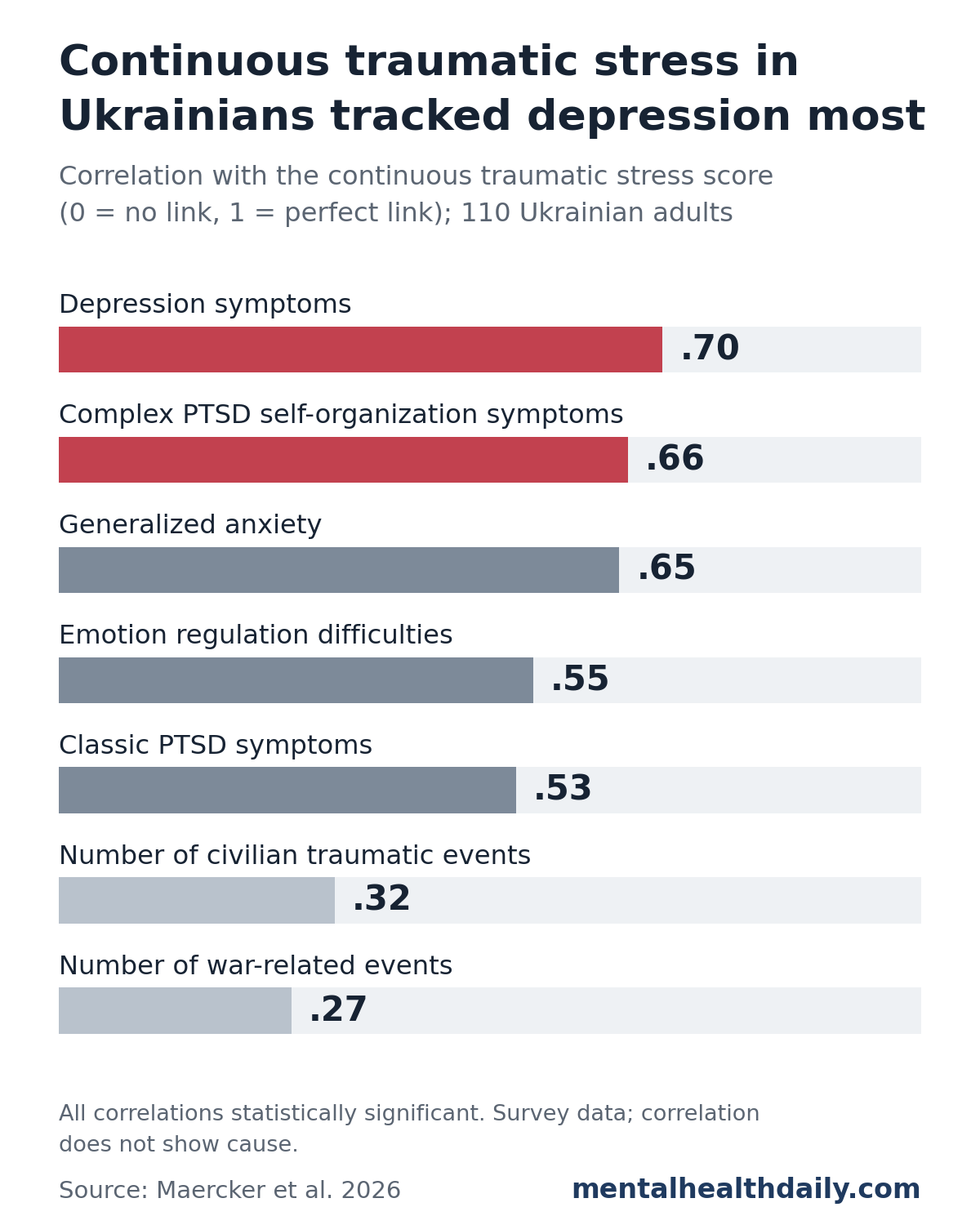
Complex PTSD is a diagnosis in the WHO’s ICD-11 system. It includes the core PTSD symptoms plus 3 “disturbances in self-organization”: trouble managing emotions, a persistently negative view of oneself, and difficulty feeling close to others. Those 3 symptoms correlated .66 with the CTSR, higher than the .53 for the classic PTSD symptoms of reliving, avoidance, and feeling on guard.1
The researchers read this as evidence that continuous traumatic stress and PTSD measure related but distinct problems. Both grow out of traumatic stress, but the researchers write that people affected by more severe trauma often do not recognize themselves in the classic PTSD picture. They note that many people in that situation say they do not need therapy for “post-traumatic” stress while the danger continues.1
Trauma counts mattered less. The number of traumatic events people had lived through correlated only weakly with CTSR scores (.27 for war-related events and .32 for other events), so the questionnaire captured more than exposure alone.1
Depression and anxiety scores often rise with general distress of any kind, so their strong overlap with the CTSR is partly expected. The researchers did not formally test whether the .70 and .53 correlations differ from each other.
Refugees in Austria vs. People Still in Ukraine
Total CTSR scores were similar in the 2 groups. 3 of the 11 items and 1 symptom group differed:1
- Higher in Ukraine: feeling a sense of danger (2.35 vs. 1.81 on a 0-to-3 scale), the largest gap between groups
- Higher in Austria: difficulty trusting people and feeling misunderstood (small-to-moderate differences)
- Higher in Austria: the exhaustion/rage symptom group overall (12.6 vs. 11.2 points)
The researchers suggest that once direct danger recedes, “secondary war” emotions may come forward: exhaustion that resembles mental defeat, and anger. Refugees in Austria also reported more non-war traumatic events in their lives (4.1 vs. 2.4 on average), while war-related events did not differ significantly between groups.1
The researchers also suggest that people carrying more past trauma may have been more likely to leave, an idea the survey cannot test.
The Questionnaire Split Into 2 Symptom Groups, Not 3
When Goral et al. built the scale in Israel, the items fell into 3 groups: exhaustion/detachment, rage/betrayal, and fear/helplessness.3 In the Ukrainian sample, a factor analysis (a method that sorts questionnaire items by which ones tend to rise and fall together) supported 2 groups instead:1
- Exhaustion/rage: feeling unmotivated, mentally exhausted, without meaning, and prone to anger, with trouble controlling emotions
- Fear/betrayal: feeling a sense of danger, fear, betrayal, and inability to protect
The 2-group version had better internal reliability (average Cronbach’s alpha .73 vs. .67 for the 3-group version), and an earlier Ukrainian study cited by the researchers also found 2 groups. The full 11-item scale was reliable as a whole (alpha .83), which the researchers take as a sign that the symptoms form a coherent clinical picture.1
PTSD and Complex PTSD Rates in Ukraine During the War
Earlier research shows how common trauma symptoms are in Ukraine during the war. A nationwide survey of 2,004 Ukrainian parents, conducted in 2022 and published in 2023, found that 25.9% met criteria for probable PTSD and 14.6% for probable complex PTSD, with rates rising alongside greater war exposure.4
The 2026 study did not estimate how many people have continuous traumatic stress. Its contribution is narrower: it describes what the symptoms look like and where they overlap with existing diagnoses.
Limitations of This Ukrainian Survey
The researchers call the study a building block rather than a definitive answer. The main limits:1
- Small, unrepresentative sample. 110 people reached online, mostly educated women, with no older adults.
- Self-report only. No clinical interviews, which would be needed before any new diagnosis.
- One snapshot in time. The survey cannot show how long symptoms last or what causes them.
- Exploratory analysis. A confirmatory factor analysis was not possible with this sample size, and some symptom groups had only modest reliability.
- Missing context. Time spent in Austria, legal status, and income were not recorded or adjusted for.
- Reporting inconsistencies. The published abstract swaps the depression and complex PTSD correlations and reverses which group scored higher on exhaustion/rage; the figures here follow the paper’s tables and results text.
For people living through war or displacement, ongoing-threat stress can look more like exhaustion, low mood, anger, and strained trust than like textbook PTSD. Anyone struggling with those symptoms can raise them with a doctor or mental health professional, even if the danger has not ended.
References
- Maercker A, Steinkämper L, Lueger-Schuster B. Ukrainians under continuous traumatic stress: towards increasing the diagnostic condition’s clinical utility. Frontiers in Psychiatry. 2026;17:1872305. doi:10.3389/fpsyt.2026.1872305
- Eagle G, Kaminer D. Continuous traumatic stress: expanding the lexicon of traumatic stress. Peace and Conflict: Journal of Peace Psychology. 2013;19(2):85–99. doi:10.1037/a0032485
- Goral A, Feder-Bubis P, Lahad M, Galea S, O’Rourke N, Aharonson-Daniel L. Development and validation of the Continuous Traumatic Stress Response scale (CTSR) among adults exposed to ongoing security threats. PLoS One. 2021;16(5):e0251724. doi:10.1371/journal.pone.0251724
- Karatzias T, Shevlin M, Ben-Ezra M, et al. War exposure, posttraumatic stress disorder, and complex posttraumatic stress disorder among parents living in Ukraine during the Russian war. Acta Psychiatrica Scandinavica. 2023;147(3):276–285. doi:10.1111/acps.13529