
In a 2026 survey of 179 university students in Turkey, higher social media addiction scores were linked to more ADHD symptoms and more social anxiety. The link with low self-esteem was weaker, and hours online explained less than these traits did.1
Research Highlights
- ADHD symptoms had the strongest link: addiction scores rose with scores on an adult ADHD screening scale (r = 0.412, p < 0.001), more for inattention (r = 0.44) than for hyperactivity and impulsivity (r = 0.254).1
- Social anxiety came a close second: students with more social media problems reported more fear and avoidance of social situations (r = 0.395, p < 0.001).1
- Self-esteem mattered less: lower self-esteem went with higher addiction scores (r = 0.221, p = 0.03) but was not linked to screen time.1
- Heavy use was the norm: students averaged about 5.9 hours of daily screen time (352 minutes), and 61.8% said they needed to cut down on social media.1
- Fake accounts went with more problems: the 30.2% who used social media under a hidden identity or fake account had higher addiction and social anxiety scores and more screen time.1
How the Ankara Study Measured Social Media Addiction, ADHD Symptoms and Social Anxiety
Gamze Gürcan and Latife Büşra Çokaslan of TOBB University of Economics and Technology in Ankara recruited students aged 18 to 25 through an announcement on the university’s faculty platform. Average age was 20.6, and 130 of the 179 participants (72.6%) were women.1
Students filled out an anonymous online survey once. It covered 4 standard questionnaires:
- Social media addiction: the 20-item Social Media Addiction Scale–Adult Form, scored from 20 to 100. Its 2 parts cover “virtual tolerance” (needing more and more time online) and “virtual communication” (relying on online contact), not hours spent.
- ADHD symptoms: the Adult ADHD Self-Report Scale (ASRS), an 18-item World Health Organization screening questionnaire with separate inattention and hyperactivity/impulsivity parts. It measures symptom level; it does not diagnose ADHD (attention-deficit/hyperactivity disorder), and no student was clinically assessed.
- Social anxiety: the Liebowitz Social Anxiety Scale, which rates fear and avoidance across 24 social and performance situations, such as speaking up in a meeting or eating in public.
- Self-esteem: the Rosenberg Self-Esteem Scale, short form.
Students also reported their daily screen time by platform and rated how anxious they felt when they couldn’t get on social media, from 0 to 10.1
Social Media Addiction Scores Rose With ADHD Symptoms and Social Anxiety
The researchers used Spearman correlations, which measure how closely 2 scores rise and fall together on a scale from 0 (no relationship) to 1 (perfect match). Values around 0.4 are moderate; values around 0.2 are weak.1
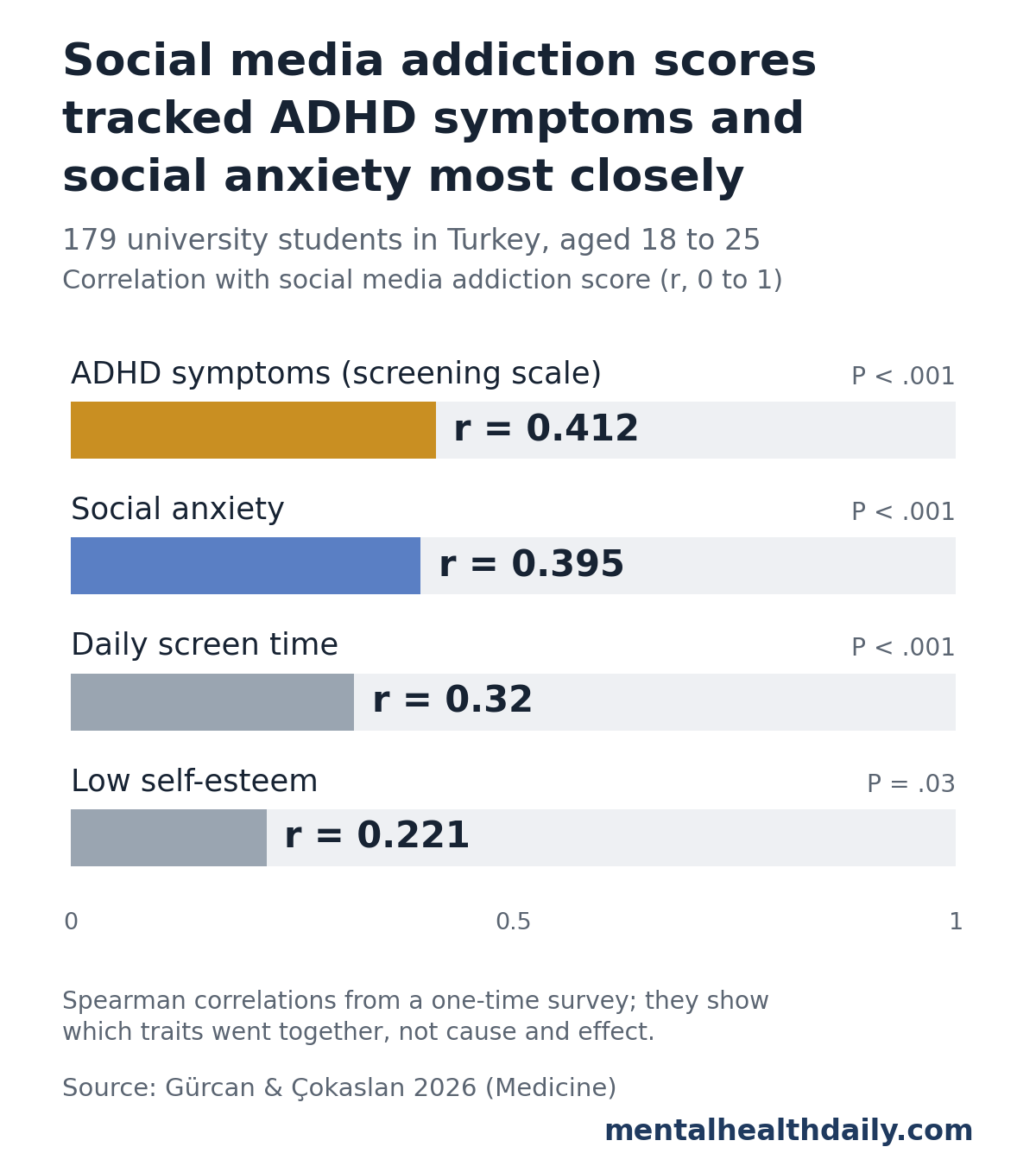
ADHD symptoms: the overall correlation was r = 0.412. Inattention drove most of it (r = 0.44), while hyperactivity and impulsivity showed a weaker link (r = 0.254, p = 0.001).1
Social anxiety: the correlation was r = 0.395, with similar links for fear of social situations (r = 0.382) and avoiding them (r = 0.366).1
These numbers fit the wider research. A 2024 meta-analysis pooling 53 studies and 59,928 participants found an average correlation of r = 0.335 between social anxiety and problematic social media use.2
Screen Time and Self-Esteem Had Weaker Links
Students averaged 352 minutes of daily screen time (median 330), led by Instagram at about 92 minutes a day. The authors compared this with a reported global average of 2 hours 20 minutes, though a volunteer sample may have drawn heavier users.1
- Screen time and addiction: more minutes online went with higher addiction scores (r = 0.32), a weaker link than ADHD symptoms or social anxiety showed.
- Screen time and ADHD symptoms: weakly linked to inattention (r = 0.196) and not significantly linked to hyperactivity/impulsivity (r = 0.109, p = 0.147).
- Screen time and self-esteem: no significant link (r = 0.106, p = 0.157).
- Anxiety when offline: feeling anxious without access to social media was linked to addiction scores more closely (r = 0.468) than any of the psychological questionnaires were.
Lower self-esteem was linked to higher addiction scores (r = 0.221, p = 0.03), but not to the “virtual communication” part of the addiction scale. The researchers concluded that problematic use reflects a person’s psychological traits and habits more than time online alone.1
Fake Accounts and Online Communication Preferences
About 30% of students (54 of 179) said they used social media with a hidden identity or a fake account. Compared with the other 125 students, they had:1
- Higher addiction scores: 59.96 vs. 53.19 (p < 0.001)
- More screen time: 398 vs. 333 minutes a day (p = 0.039)
- More social anxiety: 102.59 vs. 94.76 (p = 0.017)
- More inattention symptoms: 18.89 vs. 16.84 (p = 0.027), though total ADHD scores did not differ significantly
Women were more likely than men to use a fake account (34.6% vs. 18.4%). Women also scored higher on social media addiction and social anxiety, even though screen time did not differ by gender.1
Online vs. face-to-face: students who found it easier to communicate on social media than in person had the highest social anxiety scores (104.8, vs. 94.53 for those who found online harder). Their addiction scores, however, were not significantly different.1
Which Comes First: Social Media Problems or ADHD Symptoms?
A single survey cannot say. Students with attention problems or social fears may turn to social media to cope, heavy use may worsen those symptoms, or both may happen at once. The researchers consider it plausible that the relationship runs both ways.1
Longitudinal data offer one clue. A 3-wave study that followed 543 Dutch adolescents aged 11 to 15 found that addiction-like social media problems predicted later increases in ADHD symptoms, while the sheer intensity of use did not.3 That study involved younger teens, so it does not settle the question for university students.
Limitations of This Social Media Addiction Survey
- Cross-sectional design: everything was measured once, so the results show associations, not cause and effect.
- ADHD screening, not diagnosis: the ASRS reflects how many symptoms a student reports. The paper did not report how many students crossed the screening cutoff, and none had a clinical ADHD evaluation.
- Simple statistics: each correlation compared 2 measures at a time, without adjusting for gender, past mental health problems (reported by 42.5%), or overlap between ADHD symptoms and social anxiety.
- Many tests: the researchers ran dozens of comparisons, which raises the chance that some smaller findings, such as the fake-account differences, are false positives.
- One university, volunteers, self-report: a convenience sample from a single Turkish university, mostly women, with self-estimated screen time.
What the Findings Mean for College Students Who Struggle With Social Media
For students who feel hooked on their feeds, the pattern points toward attention and social anxiety rather than hours alone. The researchers suggest that campus mental health services screen for problematic social media use and focus on self-regulation, social skills and healthy digital habits.1
Anyone who notices persistent trouble focusing, or strong fear of everyday social situations, can raise it with a campus counselor or doctor. Both ADHD and social anxiety disorder are diagnosable and treatable, and a screening score alone is not a diagnosis.
References
- Gürcan G, Çokaslan LB. The relationship between problematic social media use and psychological factors among university students with evaluation of ADHD, social anxiety and self-esteem. Medicine (Baltimore). 2026;105(38):e50740. doi:10.1097/MD.0000000000050740
- Wu W, Huang L, Yang F. Social anxiety and problematic social media use: a systematic review and meta-analysis. Addictive Behaviors. 2024;153:107995. doi:10.1016/j.addbeh.2024.107995
- Boer M, Stevens G, Finkenauer C, van den Eijnden R. Attention deficit hyperactivity disorder-symptoms, social media use intensity, and social media use problems in adolescents: investigating directionality. Child Development. 2020;91(4):e853–e865. doi:10.1111/cdev.13334