
Patients who felt more depressed, anxious or stressed 6 to 12 weeks after a total knee replacement reported lower quality of life, according to a 2026 study of 140 patients at 2 government hospitals in Jordan.1
Research Highlights
- Distress was common: average depression and anxiety scores fell in the moderate range, and stress in the mild range, on a standard symptom questionnaire.1
- More distress, lower quality of life: patients with higher combined depression, anxiety and stress scores rated their quality of life lower (r = −0.27), a modest link.1
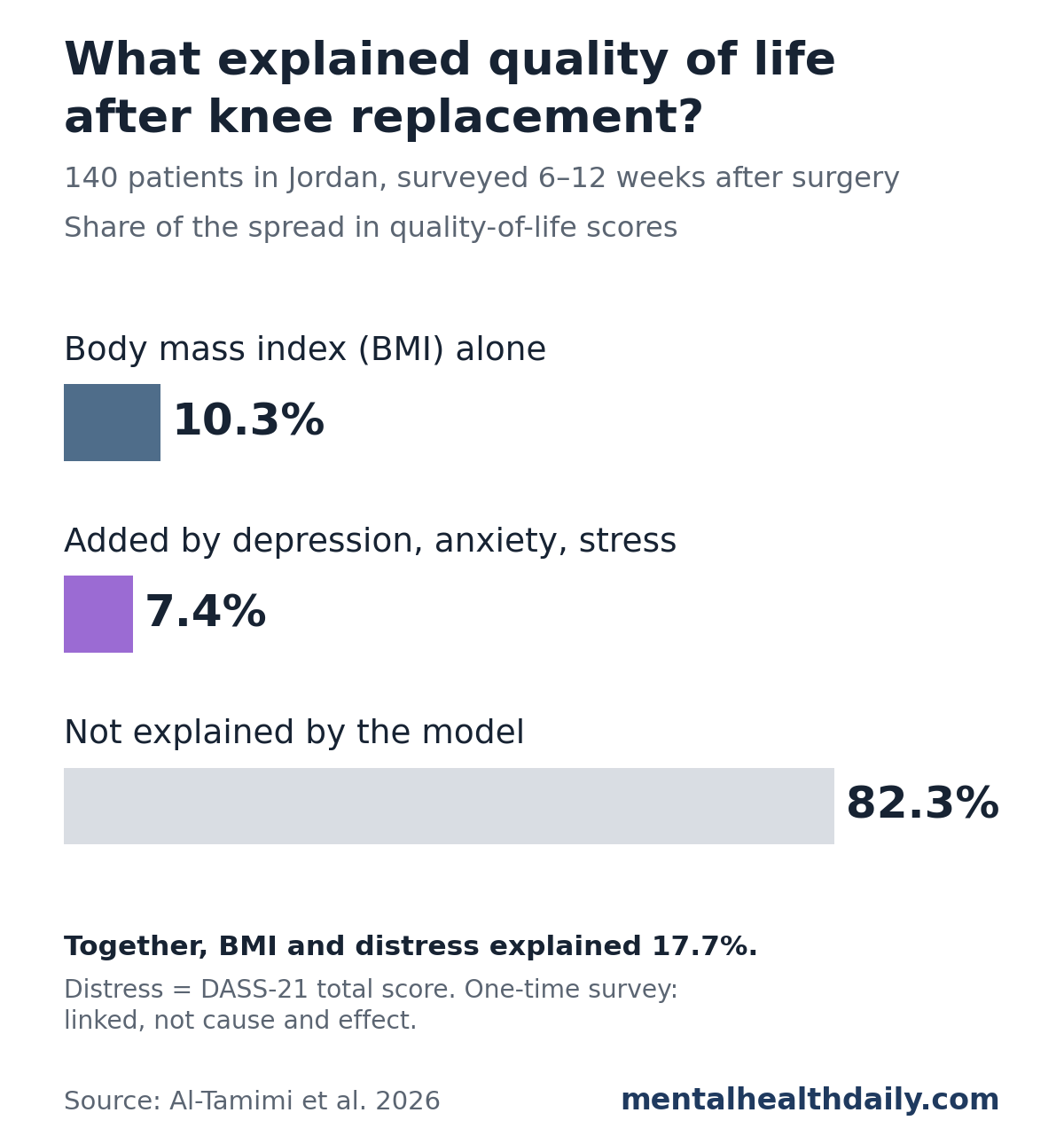
- BMI had the larger link: body mass index (BMI) alone explained 10.3% of the differences in quality of life; adding distress raised that to 17.7%.1
- Two background factors stood out: education level and having both high blood pressure and diabetes were the only patient characteristics linked to distress.1
- One-time survey: with no measurements before surgery, the study shows links, not cause and effect.1
Knee Replacement Does Not Bring Relief for Everyone
Total knee replacement swaps the worn-out surfaces of an arthritic knee joint for metal and plastic parts. It is one of the most common treatments for end-stage knee osteoarthritis, and most patients do well.
A meaningful minority do not. A 2012 systematic review of prospective studies found that 10% to 34% of people reported an unfavorable level of long-term pain after knee replacement.2
Mood tends to improve as recovery goes on. In a 2024 multicenter study of 1,852 knee replacement patients, the share reporting no anxiety or depression rose from 62.2% before surgery to 77.1% at 3 months.3
That same study found worsening anxiety and depression was more common among patients who felt unprepared to resume daily activities (17.7% vs. 4.4%).3 Less is known about how mood in the first weeks after surgery relates to how patients rate their overall well-being, and the Jordan study looked at exactly that window.
How the Jordan Study Measured Mood and Quality of Life
Wael Al-Tamimi et al. enrolled patients at their routine outpatient follow-up visit, 6 to 12 weeks after surgery, at Al-Salt Government Hospital and Al-Basheer Hospital in Amman during 2023. Each patient filled out the questionnaires once.1
- Patients: 140 adults, average age 66.7, 50.7% women, average BMI 28.1 (overweight range)
- Other health conditions: 25.7% had high blood pressure, 22.1% diabetes, 22.1% both, and 25.0% neither
- Excluded: people with cognitive impairment, unstable medical illness, or an active diagnosed psychiatric disorder such as major depression before surgery
The DASS-21 (Depression Anxiety Stress Scales) is a 21-item questionnaire that asks how often people felt symptoms such as hopelessness, panic or tension over the past week. It gives a separate score for depression, anxiety and stress, plus a total distress score. The researchers used a validated Arabic version.1
Health-related quality of life is a person’s own rating of how their physical and mental health affect daily life, from work and chores to energy, mood and social activities. The study measured it with the Arabic SF-12, a 12-item health survey, combined into a single score where higher means better.1
Depression and Anxiety Scores Averaged in the Moderate Range
On the DASS-21, the group’s average scores were:1
- Depression: 18.66 — moderate (14–20 is the moderate band)
- Anxiety: 14.13 — moderate, right at the upper edge of the 10–14 band
- Stress: 17.17 — mild (15–18)
These are average symptom scores, not diagnoses. The most strongly endorsed item was “I felt that I was using a lot of nervous energy,” and the least endorsed was “I felt that life was meaningless.”1
Quality-of-life scores averaged 39.56 but ranged widely, from 12 to 75. The researchers describe overall quality of life in the group as poor and say the wide range shows how much patients differed.1
More Distress Was Linked to Lower Quality of Life
Patients with higher total distress scores tended to report lower quality of life (r = −0.27, p = 0.001). A correlation (r) runs from 0 for no link to 1 for a perfect one, so −0.27 is a real but modest inverse link.1
To see which factors held up together, the researchers used stepwise regression, a method that adds predictors one at a time and keeps only those that improve the model. Two survived:1
- BMI: entered first and explained 10.3% of the differences in quality-of-life scores.
- Total distress: added another 7.4%, bringing the total to 17.7%.
In everyday terms: with BMI held constant, every 10-point rise in total distress score went with about half a point lower on the quality-of-life score. Every 5 extra BMI units went with roughly 2 points lower. Both are small next to the 12-to-75 spread in scores.1
Most of the picture is missing: 82.3% of the differences in quality of life were left unexplained. Pain and knee function were not measured.1
Who reported more distress: among background factors, only education level (r = 0.19) and having both high blood pressure and diabetes (r = 0.198) were linked to distress. Age, sex, marital status, income and BMI were not.1
Limitations of This Knee Replacement Survey
A cross-sectional study captures everyone at a single moment. It can show which measures move together, but not which came first. Specific limits here:1
- No baseline before surgery: the study cannot tell whether distress came from the surgery and recovery, or was already there beforehand.
- Direction unknown: distress could lower quality of life, a hard recovery could raise distress, or both.
- Early snapshot: 6 to 12 weeks is a period of fast change, and mood often improves over the following months.3
- No knee-specific measures: pain, knee function scores and pain catastrophizing (dwelling on and magnifying pain) were not assessed.
- One combined quality-of-life score: physical and mental health were not analyzed separately.
- Sample: a convenience sample from 2 public hospitals in one country.
- A reporting inconsistency: the regression table lists a standard error that does not fit the spread of quality-of-life scores reported elsewhere, so the exact model figures deserve some caution.
What This Means for People Recovering From Knee Replacement
Mood is part of recovery. Feeling low, anxious or tense in the weeks after surgery was common in this group, and those feelings went along with a worse sense of overall well-being.1
Screening is a suggestion, not a tested fix. The researchers recommend routine mood screening after knee replacement, alongside support for weight management. This study did not test whether screening or treatment improves quality of life.1
Anyone who feels persistently down, anxious or overwhelmed while recovering from knee surgery can raise it at follow-up visits with the surgical team, a physical therapist or a primary care doctor.
References
- Al-Tamimi W, Alhadidi M, Alqaisi O, Dibas M, Subih M, Al-Rawashdeh A, Tai P. Postoperative depression, anxiety, and stress in relation to health-related quality of life among patients undergoing total knee replacement in Jordan. Geriatric Orthopaedic Surgery & Rehabilitation. 2026;17. doi:10.1177/21514593261485351
- Beswick AD, Wylde V, Gooberman-Hill R, Blom A, Dieppe P. What proportion of patients report long-term pain after total hip or knee replacement for osteoarthritis? A systematic review of prospective studies in unselected patients. BMJ Open. 2012;2(1):e000435. doi:10.1136/bmjopen-2011-000435
- Tripuraneni KR, Anderson MB, Cholewa JM, Smith K, VanAndel DC, Redfern RE, Barnett SL. Is there a change in anxiety and depression following total knee arthroplasty? Journal of Arthroplasty. 2024;39(9 Suppl 2). doi:10.1016/j.arth.2024.02.009