
Researchers found a way to put depression answers from 2 different questionnaires, used by older adults in England and in São Paulo, Brazil, onto one comparable scale. The same approach failed for anxiety, so anxiety levels in the 2 groups still cannot be compared directly.1
Research Highlights
- Depression passed the strictest test: 5 matched symptom questions measured depression the same way in both cohorts, which is the level needed to compare average scores (model fit CFI 0.978, RMSEA 0.038).1
- Anxiety did not: with only 4 matched questions, the final cross-country anxiety model failed to run to a solution.1
- Each scale held steady over time: within each country, both depression and anxiety were measured consistently from survey wave to survey wave.1
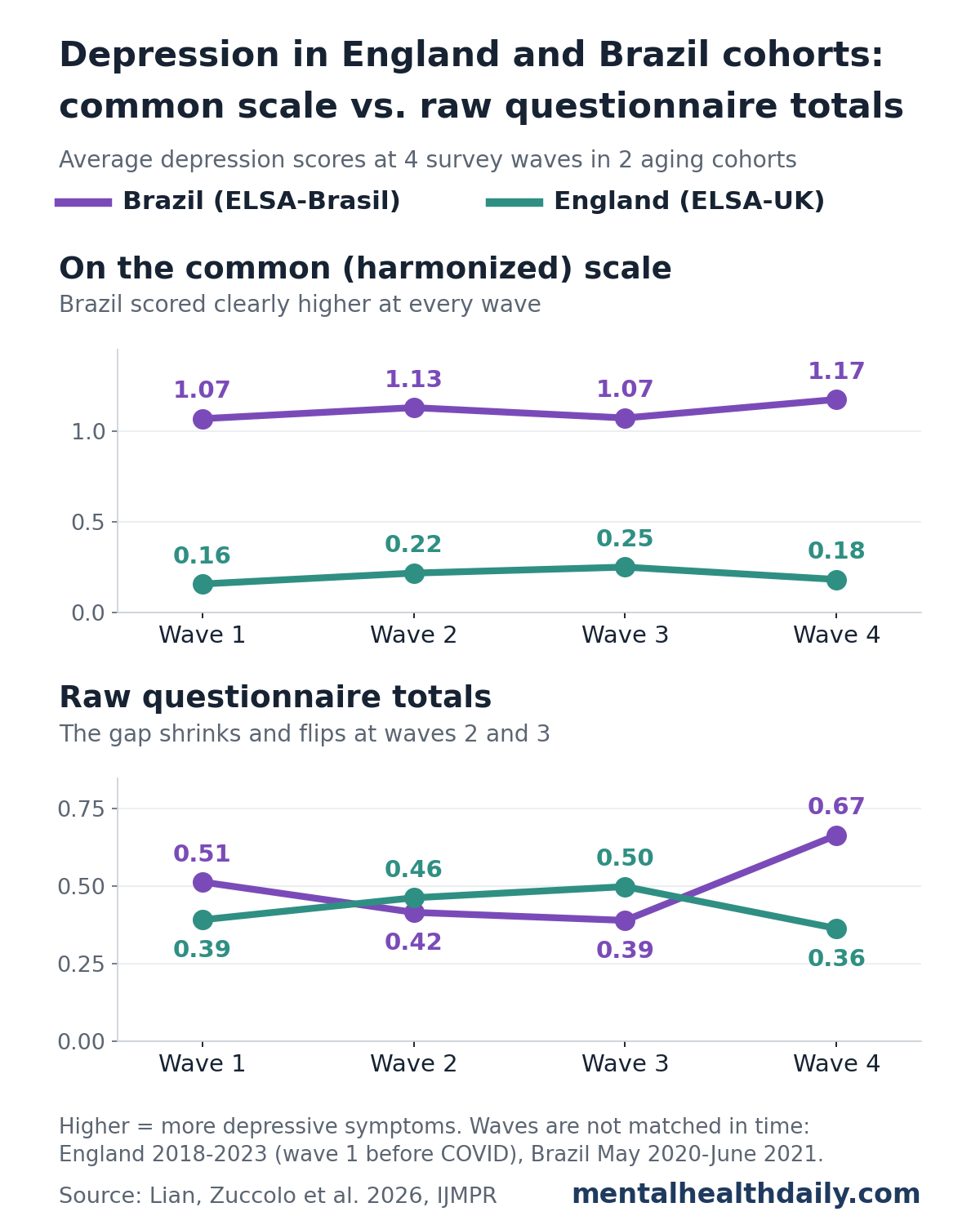
- Raw totals hid a gap: on the common scale, the Brazilian cohort scored higher at every wave (about 1.1 vs. 0.2), while raw questionnaire totals were close and even flipped at 2 waves.1
- Big samples, different people: roughly 13,700 English adults aged 50+ and about 2,600 São Paulo university employees, surveyed from 2018 to 2023.1
Why Different Depression Questionnaires Are Hard to Compare
Large health studies in different countries often ask different mental health questions. One study might ask whether you felt depressed much of the time in the past week, answered yes or no. Another asks people to rate “I felt down-hearted and blue” from 0 to 3.
Adding up each questionnaire and setting the totals side by side does not work. A score of 2 on one form and 2 on another may mean very different things, and people in different cultures can read the same words differently.
Harmonization is the work of turning those different questions into one shared measure, so studies can be pooled or compared. It lets researchers ask questions no single cohort can answer, such as whether depression rose more in one country than another during COVID-19.1
How Researchers Matched England’s and Brazil’s Depression Questions
Lian, Zuccolo et al. used 2 long-running aging studies with similar names but different questionnaires:1
- ELSA-UK (English Longitudinal Study of Ageing): a nationally representative sample of adults 50 and older in England. Depression was asked with the CES-D-8 (yes/no answers), anxiety with the GAD-7, plus quality-of-life and well-being questions.
- ELSA-Brasil COVID-19 Mental Health Cohort: active and retired university employees in São Paulo, aged 35 to 74 when the parent study began. Depression and anxiety were asked with the Brazilian Portuguese DASS-21, rated 0 to 3.
The English data came from 2018–2019, 2 COVID-era surveys in 2020, and 2021–2023. The Brazilian data came from 4 online surveys between May 2020 and June 2021.1
The harmonization ran in 4 steps:1
- Expert mapping: 2 independent teams sorted the relevant questions into DSM-5 symptom groups, such as low mood, loss of interest, or worry. A third expert settled disagreements.
- Common answer format: all answers were recoded to yes/no, the simplest format both studies shared.
- AI similarity check: an AI tool called Harmony scored how close each English and Brazilian question was in meaning, from 0 (unrelated) to 1 (nearly identical). Experts used the scores as a guide, not a cutoff.
- Statistical test of fairness: the matched questions were tested to see whether they measured the same thing across time and across countries.
The final match was 5 depression pairs (low mood, loss of interest, worthlessness, hopelessness, and lack of motivation) and 4 anxiety pairs (worry, general anxiety, irritability, and restlessness).1
Why experts stayed in charge: Harmony rated “I felt I wasn’t worth much as a person” and “To what extent do you feel the things you do in your life are worthwhile?” as moderately similar (about 0.52).
The researchers point out that the first is about self-worth and the second about a sense of purpose, a difference the algorithm missed.1
A 2024 validation study of the same AI approach found that, across 741 question pairs from 5 questionnaires, similarity scores predicted how strongly answers actually correlated with only a small error.2
Depression Could Be Compared Across England and Brazil
The key test is called measurement invariance: checking that a set of questions measures the same underlying condition in the same way in every group. It is tested in 3 steps, each stricter than the last:1
- Same structure (configural): the questions hang together as one condition in both groups.
- Same weight (metric): each question reflects depression equally strongly in both groups.
- Same starting point (scalar): people with the same level of depression are equally likely to say yes to each question. Only this level allows a fair comparison of average scores.
Depression passed all 3 steps between the 2 countries. Fit stayed acceptable through the strictest model (CFI 0.978, where 0.95 or higher is good; RMSEA 0.038, where 0.06 or lower is good). The largest drops in fit were at or within commonly used limits.1
Within each country, depression and anxiety also passed all 3 steps across the 4 survey waves. In Brazil, fit barely changed between models (CFI changed by 0.001 at most).1
Brazilian Cohort Scored Higher on the Common Depression Scale
Once both groups were on one scale, the Brazilian cohort’s average depression score was 1.07 to 1.17 across waves, compared with 0.16 to 0.25 in the English cohort. Scores changed only a little from wave to wave in either group.1
Raw totals told a different story. They ranged from 0.39 to 0.67 in Brazil and 0.36 to 0.50 in England, and England was higher at waves 2 and 3.1
The common scale weighs each answer by how strongly it signals depression, rather than counting every yes the same. That is one reason the two views can disagree, and why lining up raw totals from different questionnaires can mislead.
What this gap does not show: the 2 cohorts differed in age, education, job status, and survey timing. England’s first wave was before the pandemic, while all of Brazil’s waves fell during it. The study was built to test the method, not to explain why the groups differ.1
Why the Anxiety Questions Could Not Be Compared
For anxiety, the first 2 steps went well between countries, with near-perfect fit. The strictest model, the one needed to compare average anxiety levels, failed to converge, meaning the software could not reach a stable solution.1
The researchers point to the thin overlap. Only 4 anxiety questions matched, and they were less alike than the depression pairs. One Brazilian item about worrying over situations where one might panic and look foolish was paired with an English item about worrying too much about different things.1
The researchers count this as a strength of the method: it flagged that the anxiety data did not line up, rather than forcing a comparison that would have looked precise but meant little.1
Comparing Mental Health Across Countries Is Hard Even With One Questionnaire
Similar problems show up when every country uses the same form. In a study of pregnant women in 8 low-resource countries, the PHQ-9 depression questionnaire was internally consistent everywhere, but only partial metric invariance (equal question weights) held, and only across 4 of the countries.3
Results can be better with large, shared surveys of older adults. The EURO-D depression scale showed approximate scalar invariance (close enough to compare average levels) across 27 countries in the SHARE study of Europeans aged 50 and older, though about 30% of its measurement parameters still differed between countries.4
Against that background, getting 2 different depression questionnaires in 2 languages to pass the strictest step is a strong result, even with only 5 questions.
Limitations of This Harmonization Study
- Few questions: depression rested on 5 matched pairs and anxiety on 4, so the shared scale covers only part of each condition.
- Yes/no recoding: collapsing 0-to-3 ratings into yes/no made the forms comparable but threw away detail.
- Judgment calls: which questions count as “the same” depended on expert decisions, and translation can still shift meaning.
- Different people and times: a national sample of English adults 50+ vs. São Paulo university staff, with survey waves chosen by availability rather than matched dates.
- Borderline fit for depression: some changes in fit sat right at recommended limits, and the researchers judged invariance from the overall pattern.
- Inconsistent reporting: English sample sizes appear as 13,695, 11,004, and 7,361 in different parts of the paper, and the worthlessness pairing is described as both matched and excluded.
What This Means for Global Depression Research
The framework gives researchers a worked example and a step-by-step recipe for pooling depression data from cohorts that used different questionnaires, at least when enough questions overlap. Anyone reusing it can check each step, since the analysis code is public.1
The anxiety result points the other way: fixing mismatched questions after the fact has limits. The researchers argue that future international studies should agree on a shared core set of questions from the start.1
For readers, the plain lesson is to be wary of headlines comparing depression or anxiety rates between countries when the studies used different questionnaires and no one tested whether the scores mean the same thing.
References
- Lian J, Zuccolo PF, Ebrahimi OV, et al. Harmonising depression and anxiety measures across international cohorts: a framework validated using measurement invariance. International Journal of Methods in Psychiatric Research. 2026;35:e70102. doi:10.1002/mpr.70102
- McElroy E, Wood T, Bond R, et al. Using natural language processing to facilitate the harmonisation of mental health questionnaires: a validation study using real-world data. BMC Psychiatry. 2024;24(1):530. doi:10.1186/s12888-024-05954-2
- Murray AL, Hemady CL, Do H, et al. Measuring antenatal depressive symptoms across the world: a validation and cross-country invariance analysis of the Patient Health Questionnaire-9 (PHQ-9) in eight diverse low-resource settings. Psychological Assessment. 2022;34(11):993–1007. doi:10.1037/pas0001154
- Fong TCT, Chan RTH. Longitudinal measurement invariance of EURO-D scale across 27 countries in SHARE wave 8 and wave 9: a cross-country alignment study. Journal of Affective Disorders. 2025;390:119852. doi:10.1016/j.jad.2025.119852