
University students in Rome who completed 4 sessions of brief psychodynamic counseling reported fewer depression symptoms afterward and kept that improvement 3 months later, while anxiety only dropped by the 3-month check.1 The 108-student study had no control group, so counseling cannot get full credit for the change.
Research Highlights
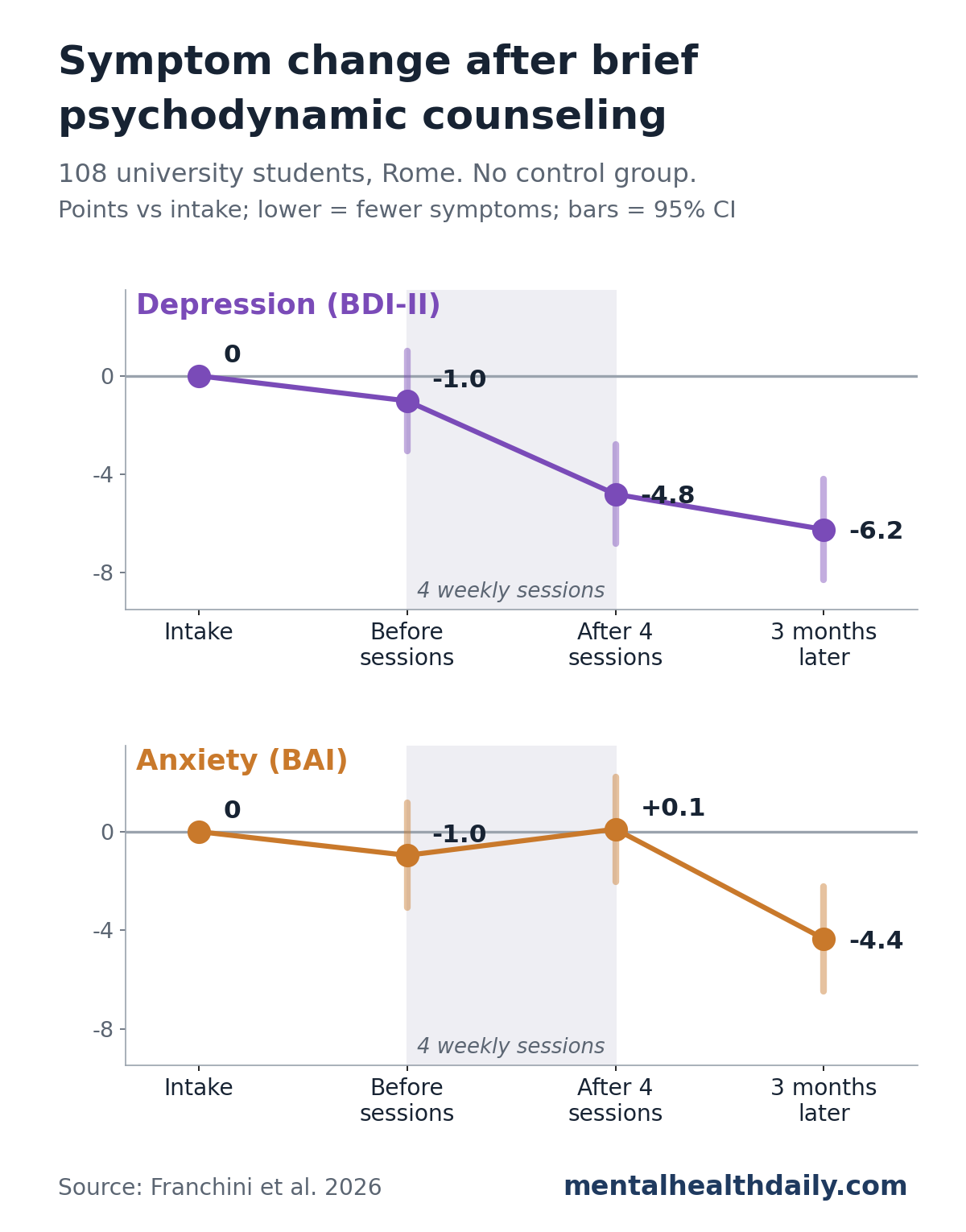
- Depression scores fell after counseling: compared with intake, BDI-II scores were 4.8 points lower after 4 sessions and 6.2 points lower 3 months later (both p < 0.001).1
- Little change while waiting: during the wait between intake and the first session, depression scores moved only 1.0 point (p = 0.322) and anxiety scores 1.0 point (p = 0.373).1
- Anxiety improved later: anxiety scores were flat right after the sessions but 4.4 points below intake at the 3-month follow-up.1
- Similar results across 34 counselors: none of the variation in outcomes traced back to which counselor a student saw.1
- No comparison group: the researchers state that their single-group design does not allow causal conclusions.1
What Brief Psychodynamic Counseling at Sapienza Involved
Psychodynamic counseling is a talking approach that helps people look at the feelings, relationships, and inner conflicts behind what is bothering them, rather than working through a fixed set of coping exercises. The idea is that understanding why a problem keeps showing up makes it easier to handle and to move forward.
The Sapienza University of Rome service follows the Tavistock Clinic model, a British psychoanalytic tradition that treats brief counseling as a time-limited space for reflection. Students explore what their current difficulties mean, which the service sees as especially relevant when young adults are working out identity, independence, and relationships.1
- Format: 4 weekly sessions, then 1 follow-up session 3 months after the last one.
- Counselors: 34 clinicians in the university’s postgraduate psychotherapy training program, with weekly supervision. Sessions shared one framework but were not scripted or manualized.
- Who was excluded: students with severe psychiatric conditions such as psychosis or bipolar disorder, who were referred elsewhere, and students already in psychotherapy.
How the Study Tracked 108 Students Over 4 Time Points
Franchini et al. followed 108 students (average age 22.7; 61% female) who came to the counseling center. Most came for emotional problems (59%), and about a third (32%) for problems with their studies.1
Students filled out 2 standard self-report questionnaires 4 times:
- Intake: right after the first consultation.
- Before sessions: just before counseling started, after a waiting period.
- After 4 sessions: at the end of the weekly sessions.
- 3 months later: at the follow-up session.
The Beck Depression Inventory-II (BDI-II) and Beck Anxiety Inventory (BAI) each have 21 items scored from 0 to 63, with higher scores meaning more symptoms. Researchers used mixed models, which follow each student’s own scores over time, and adjusted for age and sex.1
Why 2 measurements before counseling: if scores had already been falling during the wait, later improvement could just be the passage of time. A flat waiting period makes that explanation less likely, though it does not replace a control group.
Depression Scores Dropped After 4 Sessions and Stayed Lower
Depression scores barely moved during the wait (1.0 point lower, p = 0.322). After the 4 sessions they were 4.8 points below intake (95% CI 2.8 to 6.8 points lower), and at 3 months they were 6.2 points below intake (95% CI 4.2 to 8.3 points lower).1
Scores after the sessions and at 3 months did not differ significantly from each other (p = 0.998), so the gain held rather than fading.
In everyday terms: estimated average depression scores went from about 20 at intake to about 14 at follow-up. On the usual BDI-II bands, that is a shift from the edge of the moderate range (20 to 28) to the bottom of the mild range (14 to 19).
Anxiety Dropped Only by the 3-Month Follow-Up
Anxiety followed a different path. Scores were statistically flat across intake, the waiting period, and the end of the sessions. By 3 months they were 4.4 points below intake (95% CI 2.2 to 6.5 points lower), and also lower than right after the sessions (p < 0.001).1
Estimated average anxiety scores went from about 15 to about 11. The researchers expected anxiety to fall right after counseling, so this hypothesis was only partly supported.
Their psychodynamic explanation is that counseling first makes students more aware of the conflicts behind their distress, which may keep anxiety up for a while before the new understanding settles in. They note that they did not measure these processes, so this remains a theory.1
The other explanation: the researchers acknowledge that the late drop could reflect natural recovery, repeated testing, or changes in students’ lives or academic schedules during those 3 months.1
Female Students Reported More Anxiety; Counselor Made No Difference
- Sex: male students scored about 4.7 points lower on anxiety than female students across all time points (p = 0.014). Sex made no difference for depression, and age was unrelated to either outcome.1
- Counselor: outcomes did not vary by counselor at all. The researchers credit shared training and weekly supervision, which suggests trainees can deliver this model consistently.1
Earlier University Counseling Studies Found Similar Improvement
The same Sapienza team used the same 4-point design in an earlier study of 86 students, measuring general distress with the CORE-OM questionnaire. Distress stayed stable while students waited, improved after counseling, and held at follow-up.2
A 2025 systematic review of 42 studies found that university counseling helps overall functioning and some symptoms, especially depression and anxiety.3 Most of that research, as Franchini et al. point out, compares a single before score with a single after score.1
Stronger evidence for psychodynamic work comes from randomized trials in adults with depression. A meta-analysis of 54 studies (33 randomized trials, 3,946 people) found short-term psychodynamic psychotherapy beat control conditions on depression at the end of treatment and did about as well as other psychotherapies.4 Those were longer therapies in clinical settings, not 4-session campus counseling.
Limitations of This Counseling Study
Evidence strength: this is a single-group observational study of routine care. It shows that students improved during and after counseling, but not how much of that improvement counseling caused.
- No control group: students who waited longer or got a different kind of help were not tracked, so the passage of time, changes in academic schedules, and regression to the mean (people who seek help at a low point often improve anyway) cannot be ruled out.
- Self-report only: both questionnaires were filled out by students, with no clinician ratings.
- One service, milder cases: one Italian university, and students with severe illness or ongoing therapy were referred out.
- Missing details: the paper does not report how long students waited before sessions, how many missed assessments, or what other help they got during follow-up.
- Short follow-up: 3 months says nothing about the rest of the academic year or beyond.
What Students and Counseling Services Can Take From This
- Brief counseling is a reasonable first step: students who started near the mild-to-moderate border on depression improved after 4 sessions, and the gains held at 3 months.
- Anxiety may take longer to ease: in this study, anxiety at the last session was no lower than at intake but had dropped by the 3-month check.
- Services should measure later: a single end-of-treatment questionnaire would have missed the anxiety drop entirely.
- Severe symptoms need more: students with severe conditions such as psychosis or bipolar disorder were referred elsewhere and not studied. Anyone with severe depression or thoughts of suicide should seek fuller mental health care. In the US, call or text 988 for the Suicide & Crisis Lifeline.
References
- Franchini C, Sciabica GM, Andreassi S, Morelli M, Chirumbolo A, Speranza AM, Fortunato A. Change takes time: anxiety and depression following brief psychodynamic counseling in university students. Healthcare. 2026;14(17):2787. doi:10.3390/healthcare14172787
- Fortunato A, Franchini C, Sciabica GM, Morelli M, Chirumbolo A, Andreassi S, Speranza AM. Supporting student mental health: the effectiveness of university counseling services. Counselling Psychology Quarterly. 2026;39(2):251–274. doi:10.1080/09515070.2025.2534869
- Pizzo R, Esposito G, Passeggia R, Freda MF. Psychological counselling for students in higher education: a systematic review of its effectiveness on mental health and academic functioning. Counselling Psychology Quarterly. 2025;38(4):1082–1102. doi:10.1080/09515070.2024.2434533
- Driessen E, Hegelmaier LM, Abbass AA, et al. The efficacy of short-term psychodynamic psychotherapy for depression: a meta-analysis update. Clinical Psychology Review. 2015;42:1–15. doi:10.1016/j.cpr.2015.07.004