
A 2026 study of 2,596 Chinese women in the perimenopause age range (45 to 59) found that a score combining blood sugar, triglycerides and frailty was linked to depressive symptoms and, more weakly, to low scores on cognitive tests, all measured at the same visit.1
Research Highlights
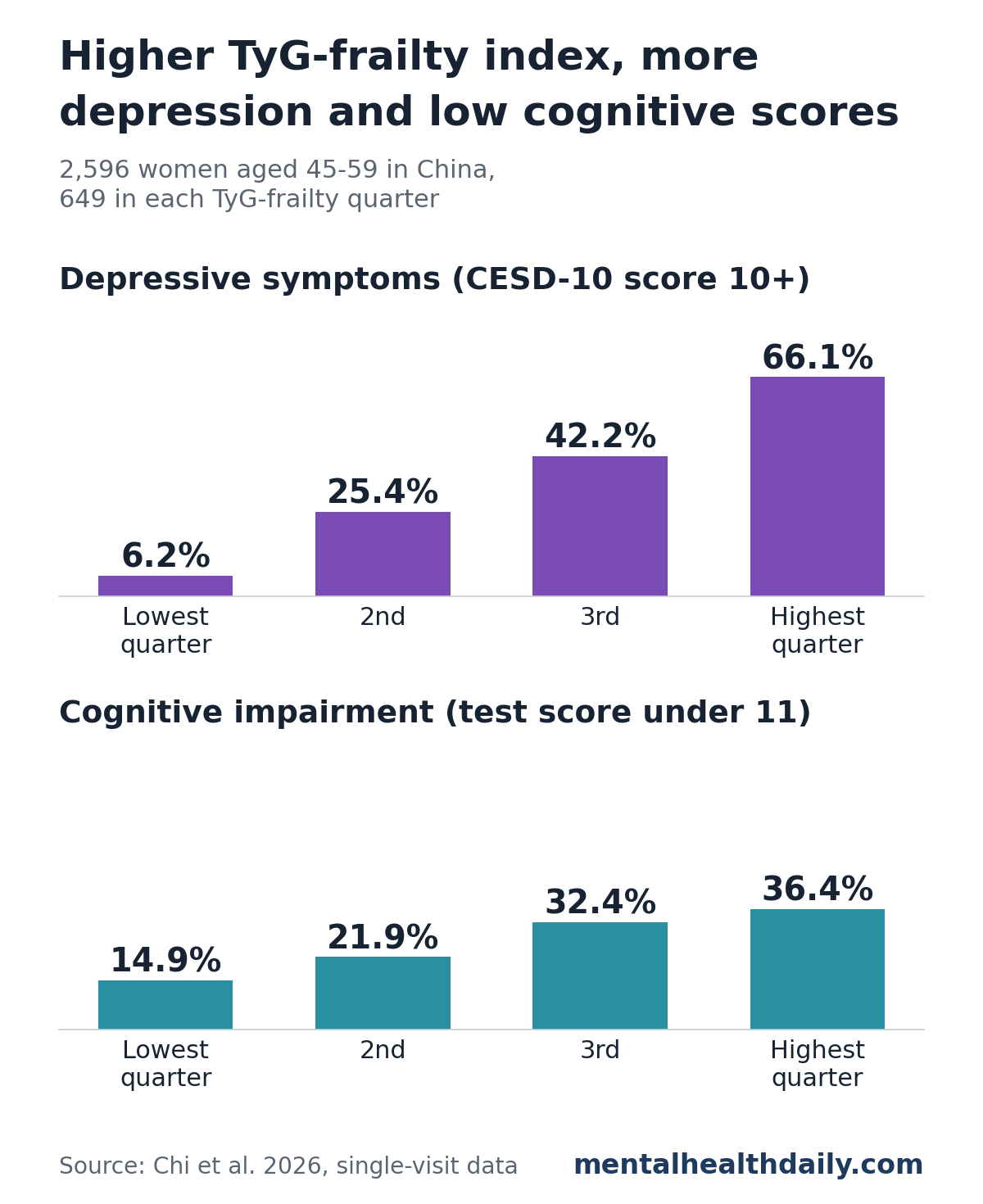
- Depression rose steeply with the score: 6.2% of women in the lowest quarter of the TyG-frailty index had depressive symptoms, compared with 66.1% in the highest quarter.1
- Adjusted odds stayed high: each one-point rise in the index was linked to 3.70 times the odds of depressive symptoms (95% CI 3.18–4.32) and 1.51 times the odds of cognitive impairment (95% CI 1.34–1.71).1
- Moderate sorting for depression, weak for cognition: the index separated women with and without depressive symptoms with an AUC of 0.786 (0.5 is chance, 1.0 is perfect), and cognitive impairment with an AUC of 0.634.1
- One snapshot in time: blood tests, frailty, mood and cognition were all measured in the 2015 survey wave, so the study cannot show that the index predicts who will become depressed later.1
- Age stood in for menopause stage: women were labeled perimenopausal by age alone, without menstrual or hormone data.1
What the TyG-Frailty Index Measures
The score has two parts, multiplied together. Each draws on routine blood tests or a health history.
- TyG index (triglyceride-glucose index): a formula built from fasting triglycerides (a blood fat) and fasting blood sugar. Higher values are a rough stand-in for insulin resistance, when the body needs more insulin to move sugar into cells.
- Frailty index: the share of 30 yes-or-no health problems a person has, covering chronic diseases, disabilities and trouble with daily tasks such as dressing or shopping. It runs from 0 (none) to 1 (all 30).
The TyG-frailty index (TyGFI) is simply TyG multiplied by the frailty index. The same formula was used in a 2025 study of heart disease and stroke, where adults in the top quarter of the index had far higher odds of cardiovascular disease than those in the bottom quarter, in both Chinese and US survey data.2
Because the frailty index is a fraction between 0 and 1, a one-point rise in TyGFI is a large step on this scale.
Women in China’s National Health and Retirement Survey
Chi et al. used the 2015 wave of the China Health and Retirement Longitudinal Study (CHARLS), a national survey of middle-aged and older adults that included fasting blood tests that year. Of 5,127 women aged 45 to 59, 2,596 had complete data; most exclusions (1,738 women) were for missing triglyceride or glucose results.1
- Average age: 51.9 years
- Depressive symptoms: a score of 10 or more on the CESD-10, a 10-question mood checklist scored 0 to 30; 35.0% of women met this cutoff
- Cognitive impairment: a score under 11 on a 0-to-21 test of word recall, orientation, simple subtraction and figure copying; 26.4% met this cutoff
Researchers split the women into 4 equal groups of 649 by TyGFI score and compared mood and test results across them.
Depressive Symptoms Rose From 6% to 66% Across TyGFI Groups
The pattern was steep and steady. Women in higher TyGFI groups were also a bit older (50.8 vs. 53.1 years on average from lowest to highest group), had higher blood pressure, and were far more likely to rate their own health as bad (2.5% vs. 47.0%).1
After adjusting for age, education, marital and retirement status, smoking, drinking, social activity, living with children, self-rated health and blood pressure, the links held.1
- Per one-point rise: OR 3.70 for depressive symptoms (95% CI 3.18–4.32) and OR 1.51 for cognitive impairment (95% CI 1.34–1.71). An odds ratio (OR) above 1 means higher odds.
- Highest vs. lowest quarter: OR 33.94 for depressive symptoms (95% CI 22.38–52.61) and OR 3.41 for cognitive impairment (95% CI 2.39–4.90)
- Shape of the curve: the odds of depressive symptoms climbed faster at high TyGFI values rather than in a straight line
The researchers caution that the 33.94 figure may be overestimated. Only 40 women in the lowest group had depressive symptoms, and comparisons against a small reference group can exaggerate odds ratios.1
Robustness checks: adding body mass index, waist size and diabetes barely moved the results (OR 3.68 and 1.50), and neither did filling in missing covariate data statistically (OR 3.73 and 1.49). The depression link was stronger in women with a high school education or more.1
How Well the Score Sorted Women With Depression
An AUC (area under the curve) measures how well a score separates two groups: 0.5 is a coin flip and 1.0 is perfect. TyGFI reached 0.786 for depressive symptoms and 0.634 for cognitive impairment.1
At the best depression cutoff (TyGFI of 0.849), the score caught 83.2% of women with depressive symptoms but also flagged about 40% of women without them (specificity 59.8%). For cognition, the cutoff of 0.671 caught 80.0% of cases while flagging nearly 60% of unaffected women (specificity 41.1%).1
These cutoffs were found and tested in the same women. Until they hold up in a separate group, they describe this dataset rather than a ready-made screening rule.
Why Blood Sugar and Frailty Could Relate to Mood in Midlife
The researchers point to plausible biology but did not test it. Insulin resistance has been linked to disrupted dopamine and serotonin signaling, chronic inflammation, stress-hormone overactivity, and reduced blood flow to the brain. Frailty brings its own inflammation and lower levels of BDNF (brain-derived neurotrophic factor, a growth factor that supports brain cells).1
The metabolic half fits earlier work. A 2024 systematic review of 7 studies with 58,981 people found that a higher TyG index was linked to higher odds of depression and of suicidal thoughts or attempts in most of the included studies.3
The links can also run the other way. Depression often brings poor sleep, less activity and changes in eating, which can raise blood sugar and triglycerides. Depression and low cognition can also make daily tasks harder, which raises a frailty score.
Limitations of This CHARLS Perimenopause Analysis
- Single time point. Everything was measured in the same survey wave. The word “predictive” in the paper’s title refers to sorting women at one visit, not forecasting future depression or dementia.
- Overlap between the score and the outcomes. The frailty index counts disabilities and trouble with daily tasks, which depression and cognitive problems themselves can cause. The paper does not list all 30 items, so readers cannot check how much the score overlaps with what it is linked to.
- No test of the combination. The study did not compare TyGFI against the TyG index or the frailty index alone, so it is unclear whether multiplying them adds anything. The researchers name this as a limitation.
- Menopause stage by age only. Women aged 45 to 59 were treated as perimenopausal, without menstrual history, surgical menopause or hormone levels. Some were likely before or well past the transition.
- Screening questionnaires, not diagnoses. A CESD-10 score of 10 or more marks depressive symptoms worth a closer look, not a clinical diagnosis of major depression.
- Many women dropped from the analysis. About half of eligible women were excluded for missing data, mostly blood tests, and those women may differ from the ones analyzed.
What the Findings Mean for Women in Perimenopause
- Physical and mental health travel together. In this sample, women with worse metabolic numbers and more health limitations were much more likely to report depressive symptoms.
- TyGFI is a research score. It is not a validated screening test, and a high value does not mean a woman has or will develop depression.
- Next step: following women over several CHARLS waves would show whether a high score comes before new depression or cognitive decline, and whether it beats simpler measures.
- Symptoms deserve attention on their own. Low mood, loss of interest or new memory trouble during midlife are worth raising with a clinician whatever a blood test shows.
References
- Chi H, Hu Q, Liang J, et al. Predictive value of the triglyceride-glucose-frailty index for depression and cognitive function in perimenopausal women: insights from CHARLS. International Journal of Women’s Health. 2026;18:614005. doi:10.2147/IJWH.S614005
- Zhao YC, Wu SQ, Li JK, et al. Predictive value of the combined triglyceride-glucose and frailty index for cardiovascular disease and stroke in two prospective cohorts. Cardiovascular Diabetology. 2025;24(1):318. doi:10.1186/s12933-025-02880-9
- Behnoush AH, Mousavi A, Ghondaghsaz E, Shojaei S, Cannavo A, Khalaji A. The importance of assessing the triglyceride-glucose index (TyG) in patients with depression: a systematic review. Neuroscience & Biobehavioral Reviews. 2024;159:105582. doi:10.1016/j.neubiorev.2024.105582