
When 17 parents in Spain talked about their child’s autism diagnosis, they described shock and sadness, sometimes mixed with relief, followed by a lonely “Now what?” moment with little guidance on next steps.1
Research Highlights
- Interview study: researchers held 40- to 80-minute online interviews with 15 mothers and 2 fathers of autistic children attending inclusive schools in Spain.1
- A long road to answers: parents often noticed early signs themselves, and some said health professionals first put them down to normal variation in development.1
- Mixed emotions at diagnosis: for some parents, shock and sadness sat alongside relief at finally having an explanation.1
- Family life reorganized: parents described tightly planned routines, a closer bond with their child, constant alertness and less time for siblings.1
- The biggest worry: who will understand and support their child in adulthood, after school ends and after the parents are gone.1
How Researchers Interviewed Parents of Autistic Children in Spain
Autism spectrum disorder (ASD) is a lifelong neurodevelopmental condition that shapes how a person communicates, interacts socially and responds to their surroundings. Support needs vary widely from one person to the next.
Gallego-Jiménez et al. published the study in Frontiers in Psychology in September 2026. Parents were recruited through autism associations and inclusive schools, and some passed the invitation on to other parents.1
- Parents: 17 (15 mothers, 2 fathers), aged 32 to 51, average age 45.5.
- Children: spread across all 3 DSM-5 support levels — about 4 in 10 at level 1 (needing support) and about 3 in 10 each at level 2 and level 3 (needing more substantial support).
- Interviews: one per parent, by video call, with open questions about the diagnosis, support, daily life, siblings, emotions and the future.
- Analysis: 2 researchers coded the transcripts independently, a third helped settle disagreements, and an outside researcher audited the process.
The team used qualitative content analysis, a method that sorts what people said into codes and then broader themes. It maps the range of experiences; it does not count how common each one is.1
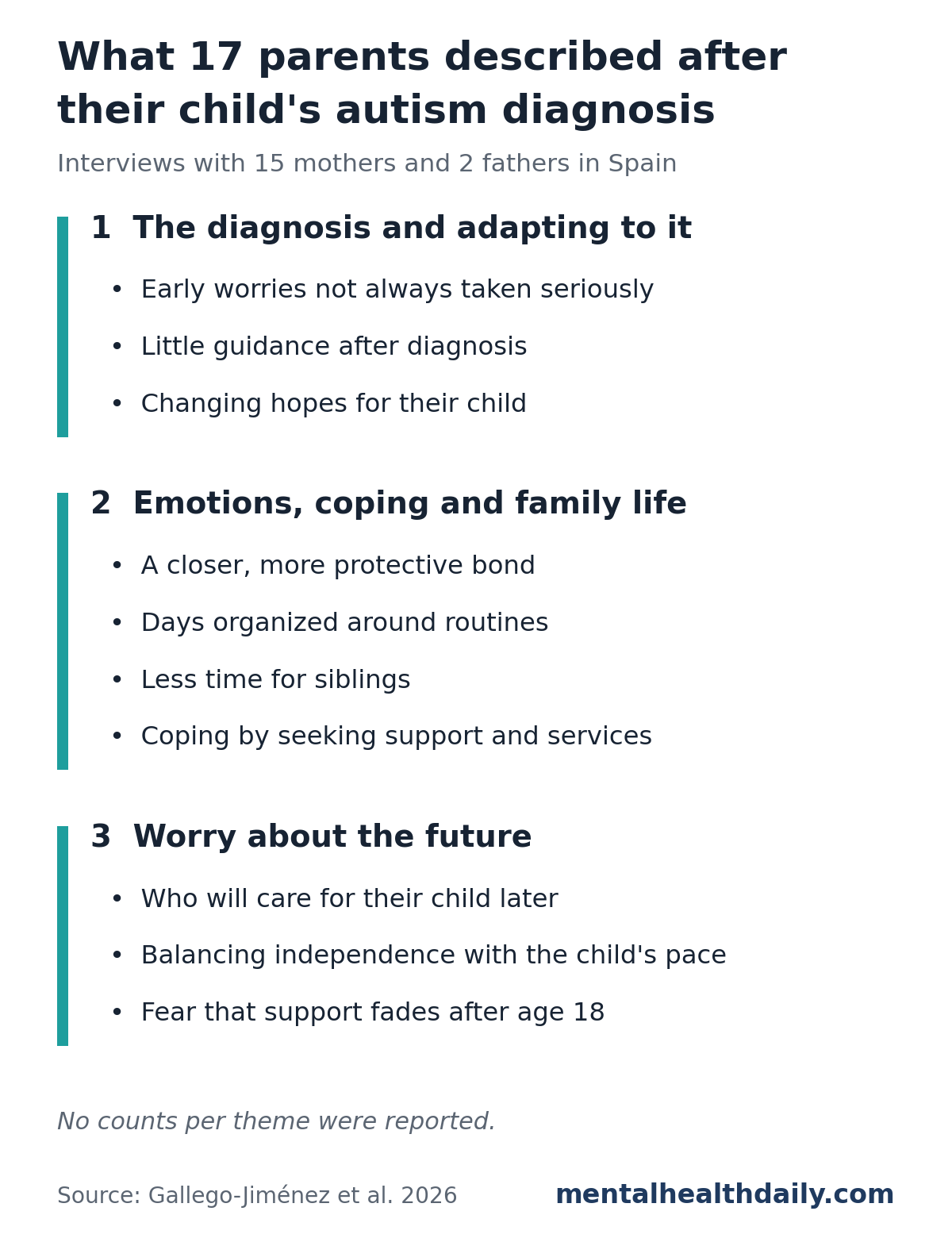
3 Themes in Parents’ Experience of an Autism Diagnosis
The interviews grouped into 3 themes with 10 subthemes in total. The paper did not report how many parents fit each one.1
Early Signs, a Hard Diagnosis and Relief at Having an Answer
Parents often spotted the first signs themselves, such as a child not responding to their name or making little eye contact. They described a sense that “something was not right” well before anyone confirmed it.1
Those early concerns were not always taken seriously. “The pediatrician said it was developmental delay,” one parent recalled, and the uncertainty dragged on.1
When the diagnosis came, one parent called it “a very hard blow.” In some accounts, relief came at the same time: finally there was an explanation for what they had been seeing. Relief did not cancel out the distress; both could be felt at once.1
“Hearing the word autism completely changes how you see your child’s future.”
Grief that comes and goes: parents described grieving the future they had pictured, not the child. This feeling did not move in a straight line, and it could come back at new stages of their child’s development.1
“Now What?” Parents Got Little Guidance After the Diagnosis
Many parents left the appointment with a diagnosis but no clear plan. They described a widespread lack of guidance on services, support and next steps:1
- “You go home with the diagnosis and you say ‘Now what?’”
- “Nobody tells you what steps to take.”
- “You find out by talking to other families.”
Parents often turned to other families for answers and described the search for help as a solitary one through a complicated system.1
Changing hopes: parents described shifting from trying to make their child’s development look typical toward accepting their child’s own path. “You learn to value advances that seem small to others,” one said. Another put it simply: “If he points to the pictogram to tell me he wants something, that’s enough for me.”1
How an Autism Diagnosis Reorganized Family Routines and Affected Siblings
A closer bond: parents described a stronger, more protective connection with their autistic child. They took on roles beyond ordinary parenting — advocate, coordinator and interpreter of their child’s needs.1
Planned days: family life came to revolve around predictable routines. “Practically every afternoon is planned,” one parent said. Trying to head off every possible upset left some feeling “constantly on alert,” with less room for spontaneous outings and some social isolation.1
Siblings: parents felt guilty about the time siblings lost.
“Sometimes siblings are the ones who are forgotten, and they suffer as well.”
Parents said siblings tended to mature early and took on extra responsibilities, and some wondered whether a brother or sister would one day become a caregiver.1
Coping: parents leaned on other families, set flexible goals, arranged as many hours of personal assistance as they could and planned around likely triggers. These strategies helped, but they also took constant effort and often filled gaps left by formal services.1
Parents’ Biggest Worry: Support for Their Child in Adulthood
Concern about the future ran through the interviews. “The biggest worry is what will happen when we’re gone,” one parent said. Another described feeling like their child’s “only voice.”1
Parents perceived a sharp drop in support once schooling ends. “Once they turn 18, they disappear from the administration’s radar,” one said. Others worried about work: “Who will give them a chance knowing that they need different timings?”1
Independence: parents wanted their child to become as independent as possible but also tried not to push too hard. One worried that focusing too much on a skill like writing could stress their child out.1
Parents in Other Countries Report Similar Autism Diagnosis Experiences
These accounts match earlier research. A 2019 meta-synthesis pooled 22 qualitative studies covering 1,178 parents of autistic children. It found 2 overarching themes: confusion and not feeling heard on the way to diagnosis, and resilience and commitment in pursuing one.2
That review also found that good early experiences with first-line professionals set the tone for families’ later relationships with services.2
The Spanish researchers called for clear, well-paced communication when a diagnosis is given, explicit next steps and referral pathways, and emotional support for parents, not only services for the child. They also urged planning for adulthood to start before school ends.1
Limitations of This Autism Parent Interview Study
- Small, mostly mothers: 15 of 17 parents were mothers, too few fathers to compare views.
- Recruited through associations and schools: families connected to autism groups and inclusive schools in Spain may differ from families with less support or in other countries.
- Looking back: parents recalled the diagnosis after the fact, and the date of diagnosis was not recorded, so the researchers could not tell how time since diagnosis shaped their accounts.
- One interview, no before-and-after: the study cannot show that the diagnosis itself caused changes in family life. The researchers note that caregiving did not start with the diagnosis; parents were already watching closely and seeking help before it.
- Parents only: what parents said about siblings reflects their view, not siblings’ own experience.
- Perceptions of services: the study did not measure what adult services actually exist in Spain.
What This Means for Families and Clinicians
- Relief and grief can coexist: some parents in this study felt relief and grief at the same time, and those feelings could return at later stages.
- Other parents are a key resource: many learned their next steps from families who had been through it.
- A diagnosis should come with a plan: parents wanted clear next steps, referrals and emotional support at the time of diagnosis.
- Plan for adulthood early: the gap parents feared most opens when school ends.
References
- Gallego-Jiménez MG, Torrecilla-Manresa S, García-Bravo C. “Listening to the word autism changes everything”: the impact of an autism spectrum disorder diagnosis on families. Frontiers in Psychology. 2026;17:1919815. doi:10.3389/fpsyg.2026.1919815
- Boshoff K, Gibbs D, Phillips RL, Wiles L, Porter L. A meta-synthesis of how parents of children with autism describe their experience of advocating for their children during the process of diagnosis. Health and Social Care in the Community. 2019;27(4):e143–e157. doi:10.1111/hsc.12691