
Among 3,419 Arabic-speaking women with a history of sexual violence, those with more severe PTSD symptoms felt less supported by the people around them, and trauma-related shame accounted for more of that link than guilt or self-blame.1
Research Highlights
- Large, underrepresented sample: 3,419 treatment-seeking women born in 18 Arabic-speaking countries who signed up for an online PTSD and depression program, published in the European Journal of Psychotraumatology.1
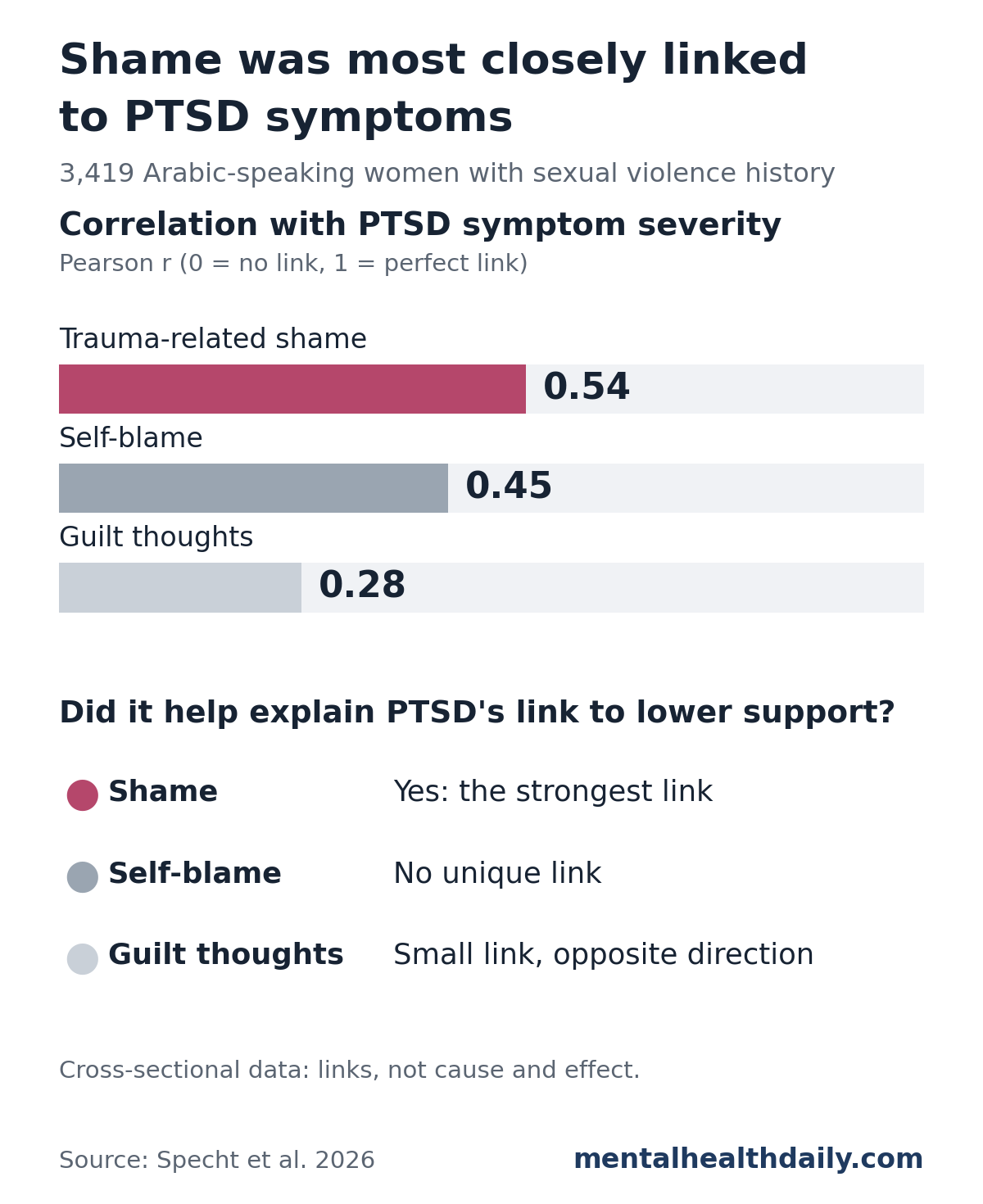
- Shame tracked PTSD most closely: PTSD symptom severity correlated with trauma-related shame (r = .54), self-blame (r = .45) and guilt thoughts (r = .28).1
- More PTSD, less perceived support: women with higher PTSD scores reported lower support from family, friends and partners, a small association.1
- Shame was the strongest link: in a model testing all 3 factors together, shame partly explained the PTSD–support association; self-blame added nothing unique, and guilt showed a small effect in the opposite direction.1
- One snapshot in time: everything was measured once, so the study cannot show which came first.1
Who Was Studied: Arabic-Speaking Women Seeking Online PTSD Care
Freya Specht et al. at Freie Universität Berlin and Center Überleben Berlin analyzed baseline questionnaires from a free, Arabic-language online therapy program for posttraumatic stress and depression. Women signed up between February 2021 and May 2024 through social media, local organizations, word of mouth and the program’s website.1
Of 11,668 women born in 18 Arab World countries who completed screening, 3,419 (31.0% of those with usable data) reported at least one experience of sexual violence. These women formed the study sample.1
- Age: 23.5 years on average (range 18 to 56)
- Where they lived: 58 countries, most often Egypt (31.1%) and Saudi Arabia (19.0%)
- Type of sexual violence reported: by a partner or family member (75.2%), by a stranger (65.3%), or both (40.5%)
- Symptom level: every woman in the sample met screening criteria for probable PTSD, with an average score of 53 out of 80 on the PCL-5 checklist
- Past care: only 18.7% had ever received psychotherapy or psychiatric treatment
The PCL-5 is a 20-item questionnaire that rates how much each PTSD symptom, such as intrusive memories, avoidance, negative mood and feeling on edge, bothered someone in the past month.
Shame, Guilt and Self-Blame: 3 Different Reactions to Trauma
These three reactions overlap, but psychologists treat them as distinct. Each was measured with a standard questionnaire translated into Arabic and checked through back-translation; the support scale used an existing Arabic version.1
- Trauma-related shame is a painful sense that the whole self is flawed, dirty or humiliated because of what happened. The Arabic version included words for honor-related shame and social embarrassment, not only private feelings.
- Guilt thoughts focus on specific actions: beliefs that one should have done something differently or could have prevented the event.
- Self-blame is the belief that the event happened because of something about oneself, such as not being careful enough.
Perceived social support was measured with a 12-item scale asking how much women felt they could count on family, friends and a significant other. It captures a sense that help is available, not how often others actually helped.1
Shame Was Most Strongly Linked to PTSD Symptoms
All three reactions rose with PTSD severity. Shame had the strongest correlation (r = .54), significantly stronger than guilt thoughts (r = .28). Self-blame fell in between (r = .45).1
A correlation of .54 is large for psychology research. In practical terms, women with more severe PTSD symptoms also tended to report more shame about their most distressing traumatic event.
How Shame Linked PTSD to Lower Social Support
Higher PTSD scores went with lower perceived support (standardized β = −0.21). PTSD symptoms alone explained about 4% of the differences in support between women, in line with a meta-analysis of studies mostly from the US.1
The researchers then used a mediation model, a statistical test of whether a third factor sits on the path between two others. Shame, guilt and self-blame were entered together, so each factor’s contribution was measured after accounting for the other two.1
- Shame: a significant indirect link. Women with more PTSD symptoms reported more shame, and more shame went with feeling less supported.
- Self-blame: no unique link once shame and guilt were in the model, which the researchers attributed to its heavy overlap with both (r = .66 with shame, .68 with guilt).
- Guilt thoughts: a small link in the unexpected direction, with more guilt going with slightly more perceived support.
Shame’s indirect effect was significantly larger than both of the others. Even so, PTSD symptoms still had their own direct link to support, so shame explained only part of the association.1
About the guilt result: on its own, guilt had a slightly negative correlation with support (r = −.06). The positive effect only appeared once shame and self-blame were accounted for, which the researchers said may be a statistical artifact of overlapping measures. They noted that guilt tends to focus on actions and repair, which could also draw people toward others.1
Why Shame Might Push Survivors Away From Support
Shame tends to make people hide and withdraw to avoid expected judgment. That protects against rejection in the short term but can also cut people off from the comfort and practical help that aid recovery.1
The researchers pointed to qualitative work from the Middle East and North Africa in which survivors described fear of being shamed for losing their honor or harming their family’s reputation. Some feared community shame even when they did not blame themselves.1
The pattern fits earlier research. A study of 202 women who survived intimate partner violence found that shame linked PTSD symptoms to negative beliefs about relying on others for support.2
A 2025 meta-analysis of 53 studies (15,110 people) found that people exposed to sexual violence reported more shame than unexposed people, a medium-sized difference.3
The arrow could also point the other way. Low or unreliable support may deepen shame and an internal sense of “I am wrong,” which in turn could worsen PTSD symptoms. One-time survey data cannot separate these possibilities.1
Limitations of This Shame and PTSD Survey
- Cross-sectional design: all measures were collected at one time point, so the mediation model shows a statistical pattern consistent with shame as a pathway, not proof that PTSD causes shame or that shame reduces support.
- Small effects: PTSD symptoms plus the 3 factors explained just 5.5% of the variation in perceived support; most of what shapes support lies elsewhere.
- Not specific to sexual violence: shame, guilt and self-blame were rated for each woman’s most distressing event, which was not always the sexual violence.
- Who signed up: participants were young (almost half were students) and actively seeking online help, so the results may not apply to older women, women without internet access, or survivors not seeking care.
- Self-report measures: the questionnaires were developed in Western settings and translated, and concepts like shame and guilt may not carry over exactly.
What This Means for Survivors and Clinicians
For clinicians and support services, the findings point to shame as something worth asking about directly and gently. The researchers recommended a nonjudgmental, shame-sensitive approach in therapy that lets survivors look at painful beliefs about themselves without feeling judged again.1
They also noted that online programs offer anonymity, which may lower the barrier for survivors who fear stigma. Whether treating shame directly improves social connection still needs to be tested in longitudinal studies and trials.1
Shame after sexual violence is a common response, and the responsibility for the harm belongs to the person who caused it. If you have experienced sexual violence and want support, you can contact a local sexual assault service or crisis line; in the US, the RAINN National Sexual Assault Hotline is available at 800-656-4673 or online at rainn.org.
If you are having thoughts of suicide or are in crisis, the US 988 Suicide & Crisis Lifeline is available by call or text at 988; outside the US, contact your local emergency number or crisis service.
References
- Specht F, Stenz J, Nesterko Y, et al. The burden of shame: PTSD symptoms and social support in Arabic-speaking women survivors of sexual violence. European Journal of Psychotraumatology. 2026;17(1):2715186. doi:10.1080/20008066.2026.2715186
- Dodson TS, Beck JG. Posttraumatic stress disorder symptoms and attitudes about social support: does shame matter? Journal of Anxiety Disorders. 2017;47:106–113. doi:10.1016/j.janxdis.2017.01.005
- Hassanpour P, Buchwald S, Mehta AHP, Goldberg SB, Walsh K. Sexual violence and shame: a meta-analysis. Trauma, Violence, & Abuse. 2026;27(1):240–255. doi:10.1177/15248380241308828