
Older Australians with dementia or mild cognitive impairment said they wanted doctors to start talking about giving up driving early, and to be clear and kind when the time came. None of those who had already stopped driving reported any follow-up support from a health professional.1
Research Highlights
- Interview study, not a trial: researchers interviewed 12 memory-clinic patients aged 65 to 83 in South Australia — 9 with mild cognitive impairment and 3 with dementia.1
- 4 phases of stopping driving: preparing early, deciding whether someone is fit to drive, hearing the recommendation to stop, and adjusting to life without a car.1
- Doctors over family: most participants said that if they could not decide for themselves, they would rather a doctor make the call than their family.1
- Straight talk, delivered kindly: people wanted plain, direct language, time to ask questions and, for serious news, a face-to-face visit.1
- No professional help afterward: everyone who had stopped driving relied on family for rides or emotional support, and participants described loneliness and lost independence.1
Who Was Interviewed About Dementia and Driving
Mild cognitive impairment (MCI) means memory or thinking problems that are noticeable on testing but do not yet stop someone from handling daily life. Dementia is a decline serious enough to interfere with everyday function. Both are linked to more driving errors, and experts agree that everyone with dementia will eventually need to stop driving.1
In Australia, people with dementia can keep only a conditional license, reviewed at least once a year. People with MCI can still hold an ordinary license.1
Spargo et al. recruited participants from a public memory clinic at a hospital in South Australia that shares space with a specialized driving-fitness service. A researcher interviewed each person for 20 to 40 minutes between March 2021 and June 2022.1
- Sample: 12 people, 8 men and 4 women, average age 77.
- Diagnosis: 9 with MCI, 3 with dementia.
- Thinking test: average Mini-Mental State Examination (MMSE) score of 25 out of 30; everyone scored at least 20, so this was a group with milder impairment.
- Driving status: 4 still drove with no restrictions, 4 drove on a conditional license limited to a set distance from home, and 4 had stopped driving.
- Support: all 12 had family or social support.
The team used reflexive thematic analysis, a qualitative method in which researchers code interview transcripts and build them into broader patterns. It maps the range of experiences; it does not count how many people held each view.1
4 Phases of Giving Up Driving, as Patients Described Them
The interviews fell into a sequence of 4 phases. The paper reports no counts for each phase, describing views with words like “some,” “many” and “most.”1
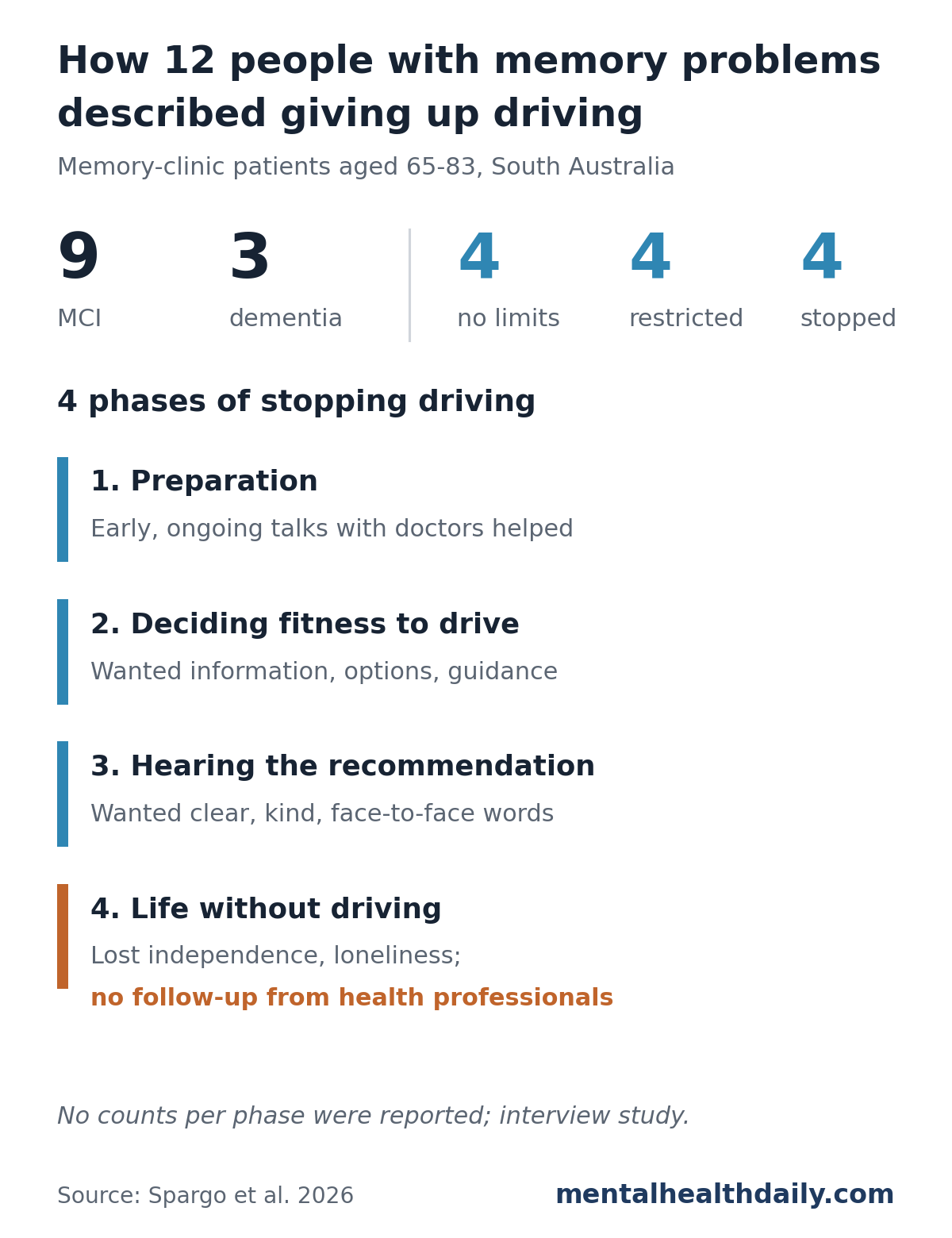
1. Preparation: early and ongoing talks. Participants said a gradual lead-up with their GP or geriatrician helped them accept that driving would end. One woman with MCI expected her doctor would not “suddenly say about the driving… There would…be a lead up to that.”1
Some current drivers had already limited themselves to local trips or stopped rushing, often because of stress or age rather than memory changes. Others changed their habits only after a doctor raised the issue, often with advice to restrict driving.1
Talks did not change everyone’s mind. One man with dementia, already on a restricted license, said: “I want to drive at top speed right up until the last moment.”
2. Deciding fitness to drive: information, options and guidance. Many were comfortable with family taking part in the conversation. Still, most said that if they could no longer decide, they wanted a doctor to make the call. “My family…sometimes they are trying to take over… I would like the doctor to tell me,” one woman said.1
When guidance was missing, people felt it. One former driver said a specialist thought he should stop, but nobody followed up or gave direction; his family let his license lapse, and he still wanted an on-road test: “I’m feeling it’s been ripped away when maybe it didn’t need to be.”1
Another man’s GP mentioned he might need a driving test; then a letter arrived requiring one, with no real discussion of his options. He felt it was all done “behind my back,” and the stress led him and his family to stop driving rather than sit the test. A participant seen at the specialized driving clinic, by contrast, praised how clearly the options were explained.1
3. Hearing the recommendation: clear and compassionate. Participants wanted doctors to say it plainly. “Be straight up… Not blunt, but nicely,” one man said. Others asked for:
- time to process the news and ask questions
- a doctor who showed they cared
- an in-person visit, not a video call, for a serious driving conversation
When the process was clear and thorough, including GP advice and an on-road assessment, one woman who had stopped 3 weeks earlier said it was “probably the right time for me.”1
4. Life without driving: lost independence and loneliness. Buses, taxis and lifts from family were less convenient and offered less freedom. “They are all busy… before I’d drive up to the coffee shop…and meet people… here by myself it gets…lonely,” one woman said.1
Another former driver stopped going to her golf club, even though she had taxi vouchers: “I’ve given up. Isn’t that awful?” A man with plenty of transport options still felt “my independence has just been…taken away.”1
Everyone who had stopped driving had emotional or practical help from family. None reported any follow-up from a health professional.1
How These Findings Fit Earlier Driving and Dementia Research
Earlier studies often blended the views of patients, families and clinicians. This one heard only from people with the diagnosis, which is its main strength.1
- Stages of driving cessation: a 2013 study of 4 retired drivers with dementia, 11 caregivers and 15 health professionals described 3 stages — worried waiting, a crisis stage with risky driving and family conflict, and a long post-cessation adjustment with a shrinking life space.2 The 2026 interviews add what patients themselves want from clinicians at each step.
- Advance driving directives: an advance driving directive is a document, like an advance care directive, in which a driver names who should help decide when they stop. In a US survey of 168 drivers aged 55 and older, only 21% had discussed their wishes for when their driving declined, but 54% said they would complete a directive if one were recommended.3
Spargo et al. suggest directives, shared decision-making and post-cessation programs such as CarFreeMe, which health professionals deliver to help with emotional adjustment and transport planning. Their study did not test any of these approaches.1
Limitations of This Dementia Driving Interview Study
- Small, specific sample: 12 people from 1 memory clinic that sits next to a specialized driving service, so their care may differ from what people get elsewhere.
- Mostly MCI: 9 of 12 had MCI, and everyone scored at least 20 on the MMSE, so people with more advanced dementia were not heard.
- Everyone had support: all 12 had family or social support; people facing this alone may have different needs.
- Diagnosed patients only: people with undiagnosed memory problems were excluded, though they are estimated to make up over 60% of people with dementia or MCI.
- Self-selection and recall: volunteers chose to take part, and views of doctors may have been colored by whether an assessment let them keep driving.
- Older rules: interviews ended in 2022, before updated Australian standards that now say MCI may also need a fitness-to-drive assessment.
What This Means for Families and Clinicians
- Raise driving early: participants found it easier to accept stopping when the topic came up gradually, well before a final decision.
- Explain the options: a surprise letter or an unexplained test left people upset and feeling shut out of the decision.
- Say it plainly and in person: direct words, time for questions and a face-to-face visit were what participants asked for.
- Plan for after: loneliness and lost independence came after the keys were handed over, and in this group only families helped with it.
References
- Spargo C, Laver K, Adey-Wakeling Z, Berndt A, George S. Insights from older people with dementia and mild cognitive impairment on the management of driving cessation by health professionals: a qualitative study. Australasian Journal on Ageing. 2026;45:e70215. doi:10.1111/ajag.70215
- Liddle J, Bennett S, Allen S, Lie DC, Standen B, Pachana NA. The stages of driving cessation for people with dementia: needs and challenges. International Psychogeriatrics. 2013;25(12):2033–2046. doi:10.1017/S1041610213001464
- Betz ME, Lowenstein SR, Schwartz R. Older adult opinions of “advance driving directives.” Journal of Primary Care & Community Health. 2013;4(1):14–27. doi:10.1177/2150131912447082