
Adults who remembered being thinner than other kids at age 10 but had a high body mass index (BMI) in midlife had the highest rates of later depression and anxiety in a UK Biobank study involving 447,821 people.1
Research Highlights
- Thinner child, heavier adult had the highest risk: compared with people who were average-sized at both ages, this group had a 90% higher rate of hospital-diagnosed depression (HR 1.90, 95% CI 1.79–2.01) and a 58% higher rate of anxiety (HR 1.58, 1.48–1.68).1
- Adult size carried most of the signal: all 3 groups with a high adult BMI had the highest risks, whatever their childhood size.1
- Symptom surveys matched the diagnoses: the same group scored highest on depression and anxiety questionnaires completed years later.1
- Lifestyle and chronic disease explained about a fifth: roughly 22% of the extra risk was statistically accounted for by lifestyle habits, high blood pressure, type 2 diabetes, and cardiovascular disease.1
- Observational, with recalled childhood size: childhood body size came from adults’ memories, and the design shows associations, not cause and effect.1
How the UK Biobank Study Grouped Childhood and Adult Body Size
Ke Peng et al. at Huazhong University of Science and Technology in Wuhan, China, analyzed data from the UK Biobank, a long-running study that enrolled more than 500,000 UK adults between 2006 and 2010. The results were published in 2026 in the journal Depression and Anxiety.1
Childhood body size came from a single question asked at enrollment, when participants averaged about 57 years old: at age 10, were you thinner than average, about average, or plumper than average? About a third chose thinner, half chose average, and 16% chose plumper.1
Adult size came from measured height and weight. To match the childhood answers, the researchers split adult BMI into 3 groups of the same proportions, after accounting for age and sex:
- Higher adult size: the top 16%, average BMI about 35
- Average adult size: the middle 51%, average BMI about 28
- Lower adult size: the bottom 33%, average BMI about 23
These are relative groups, not clinical categories. In this mostly middle-aged sample, two-thirds of people met the standard definition of overweight or obesity, so “average” adult size here already sits in the overweight range.1
Crossing the 3 childhood groups with the 3 adult groups produced 9 size-change patterns. People who already had a depression or anxiety diagnosis at enrollment were excluded, and the analysis was limited to participants of European ancestry.
Thinner-at-10, Higher-BMI Adults Had the Most Depression and Anxiety
Over a median of 12.6 years, 22,396 participants (5.0%) received a first hospital-record diagnosis of depression and 19,142 (4.3%) a first diagnosis of anxiety. The models adjusted for age, sex, education, neighborhood deprivation, and assessment center.1
Results are reported as hazard ratios (HRs), which compare how often a diagnosis appeared in each group over time. An HR of 1.90 means a 90% higher rate than the reference group of people who were average-sized both as children and as adults.
Depression, compared with average-to-average:
- Thinner at 10, higher adult size: HR 1.90 (1.79–2.01)
- Plumper at 10, higher adult size: HR 1.82 (1.73–1.92)
- Average at 10, higher adult size: HR 1.49 (1.42–1.57)
- Average at 10, lower adult size: HR 0.86 (0.82–0.90), the lowest of all 9 groups
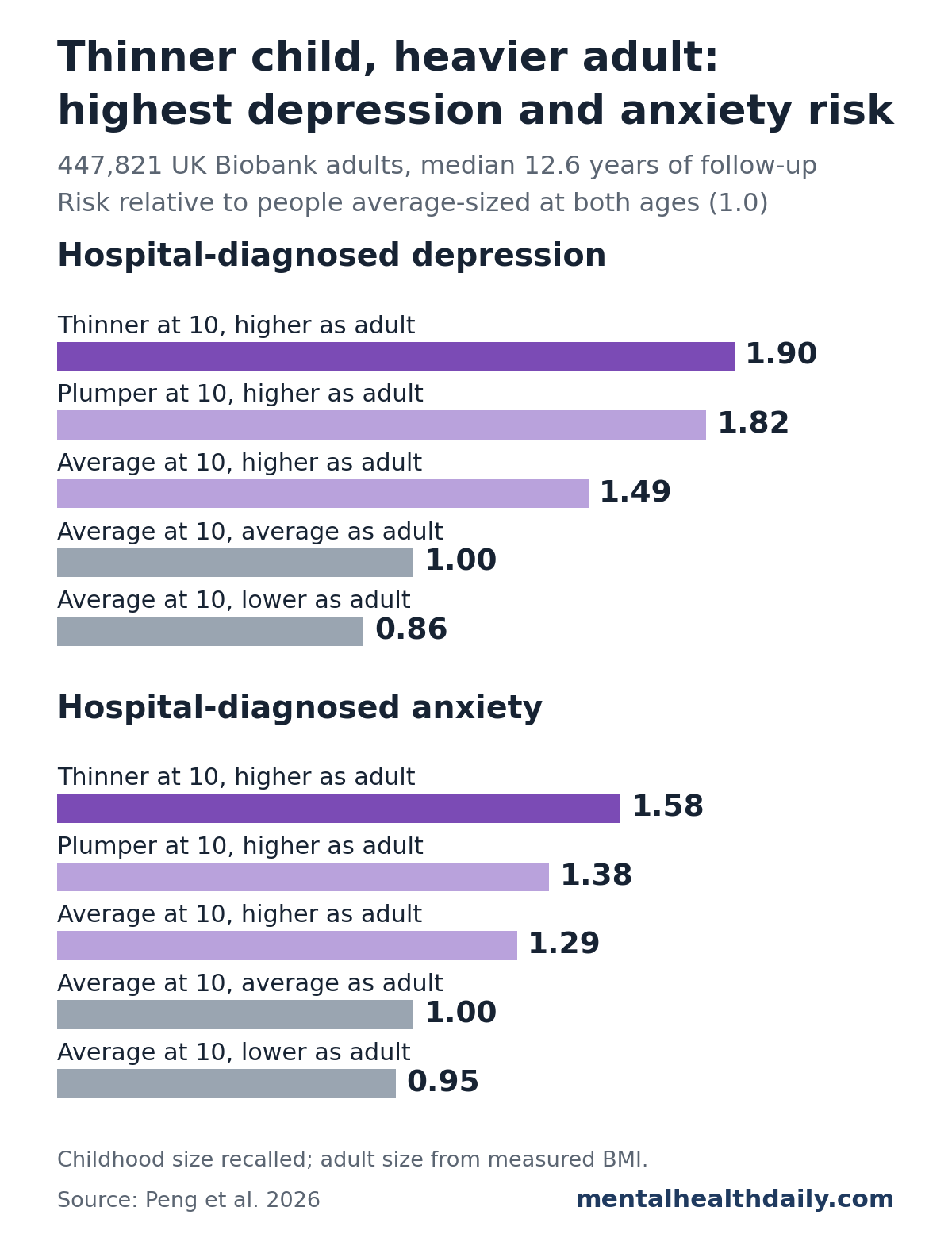
Anxiety followed a similar but flatter pattern: HR 1.58 for thinner-to-higher, 1.38 for plumper-to-higher, and 1.29 for average-to-higher.1
In raw counts, 1,604 of the 16,851 people in the thinner-to-higher group (about 9.5%) received a depression diagnosis during follow-up, compared with 5,321 of 122,455 (about 4.3%) in the average-to-average group. UK Biobank volunteers are healthier than the general population, so these are not population rates.
Why Childhood Leanness Stood Out
Being thinner than average at 10 carried little extra risk by itself. People who stayed thinner as adults had about the same depression rate as the reference group (HR 0.95, 0.91–1.00) and a slightly higher anxiety rate (HR 1.09, 1.04–1.15).1
The extra risk showed up when childhood leanness was followed by a high adult BMI, and that combination carried slightly more depression risk than being plumper at both ages (HR 1.90 vs. 1.82). The researchers suggest that a large shift in body size may bring changes in self-image, weight stigma, and health worries, alongside metabolic changes.1
A 2024 UK Biobank analysis using the same 9-group design found a parallel pattern for type 2 diabetes. Among 364,695 participants, those who were thinner at 10 and heavier as adults had the highest diabetes risk (HR 4.73), above people who were plumper at both ages (HR 4.05). Cardiovascular disease risk, by contrast, followed adult size alone.2
Women and men: the thinner-to-higher group generally had the highest risks in both sexes. For depression in women, people who were plumper at both ages had a similar risk.1 An earlier Spanish cohort of university graduates found a related pattern: women who were heavy as children and whose body shape rose sharply in early adulthood had higher depression risk (HR 1.92), with no link in men.3
Questionnaire Scores Showed the Same Pattern
Hospital records mostly capture more serious cases. To check the result, the researchers also looked at 143,147 participants who completed an online mental health survey in 2016–2017.1
- Depression symptoms: the thinner-to-higher group scored 1.55 points higher on the PHQ-9 (a 0–27 depression questionnaire) than the average-to-average group
- Anxiety symptoms: the same group scored 0.73 points higher on the GAD-7 (a 0–21 anxiety questionnaire)
Those are modest differences for an individual, but they point the same way as the diagnosis data.
Lifestyle, Blood Pressure, and Diabetes Explained About 22% of the Link
The researchers ran an exploratory mediation analysis, a statistical method that estimates how much of a link runs through factors in between. They built an unhealthy lifestyle score from 6 habits: smoking, daily drinking, low physical activity, too little or too much sleep, long TV time, and a poor diet.1
For depression in the thinner-to-higher group, these factors together accounted for 21.9% of the association:
- Lifestyle score: 9.3%
- High blood pressure: 7.9%
- Type 2 diabetes: 3.0%
- Cardiovascular disease: 1.7%
For anxiety the total was 22.2%, with high blood pressure the largest share (11.4%) and no measurable contribution from diabetes.1 Body size, habits, and these conditions were all measured at the same visit, so the analysis cannot show what came first.
The remaining 78% may reflect things the study could not measure, such as childhood poverty, childhood mental health, genetics, weight stigma, and body dissatisfaction.1
Limitations of This Body Size and Depression Study
- Recalled childhood size: middle-aged adults judged their size at 10 relative to peers. Memory can be colored by current weight or health, and this is not a measured childhood BMI.
- Relative adult groups: “higher” and “lower” adult size are study-specific bands, not clinical obesity or underweight.
- Narrow population: White UK Biobank volunteers, who tend to be healthier and better off than the wider UK population.
- Hospital diagnoses: milder or untreated depression and anxiety were likely missed in the main analysis.
- Reverse causation: undiagnosed low mood or anxiety before enrollment could have affected weight, habits, or recall.
- Observational design: the hazard ratios show associations, and the study was not pre-registered.
What the Findings Mean for Mental Health
The study adds a life-course view to a well-known link between higher adult weight and depression: the change from childhood to adulthood may carry information that a single adult BMI misses. The researchers call for studies with repeated measurements from childhood onward to sort out the reasons.1
Weight stigma and body dissatisfaction are themselves linked to poorer mental health, so these findings are best read as a reason for attention and support, not blame. Anyone dealing with persistent low mood or anxiety, whatever their size, should talk with a doctor or mental health professional.
References
- Peng K, Peng J, Xu M, Liu Y, Gong Y. Child-to-adult body size change and risk of depression and anxiety: a large prospective cohort study. Depression and Anxiety. 2026;2026:6154705. doi:10.1155/da/6154705
- Carrasquilla GD, Ängquist L, Sørensen TIA, Kilpeläinen TO, Loos RJF. Child-to-adult body size change and risk of type 2 diabetes and cardiovascular disease. Diabetologia. 2024;67(5):864–873. doi:10.1007/s00125-023-06058-4
- Sayon-Orea C, Bes-Rastrollo M, Song M, et al. Body shape trajectories and incidence of depression in the “Seguimiento Universidad de Navarra” (SUN) prospective cohort. Journal of Affective Disorders. 2019;251:170–179. PubMed 30925268