
People with bipolar I disorder who still had mild, lingering depression symptoms between mood episodes reported poorer daily functioning, more self-stigma, more impulsivity, and more anxiety than patients with few or no symptoms, in a 2026 study of 133 outpatients in Turkey.1
Research Highlights
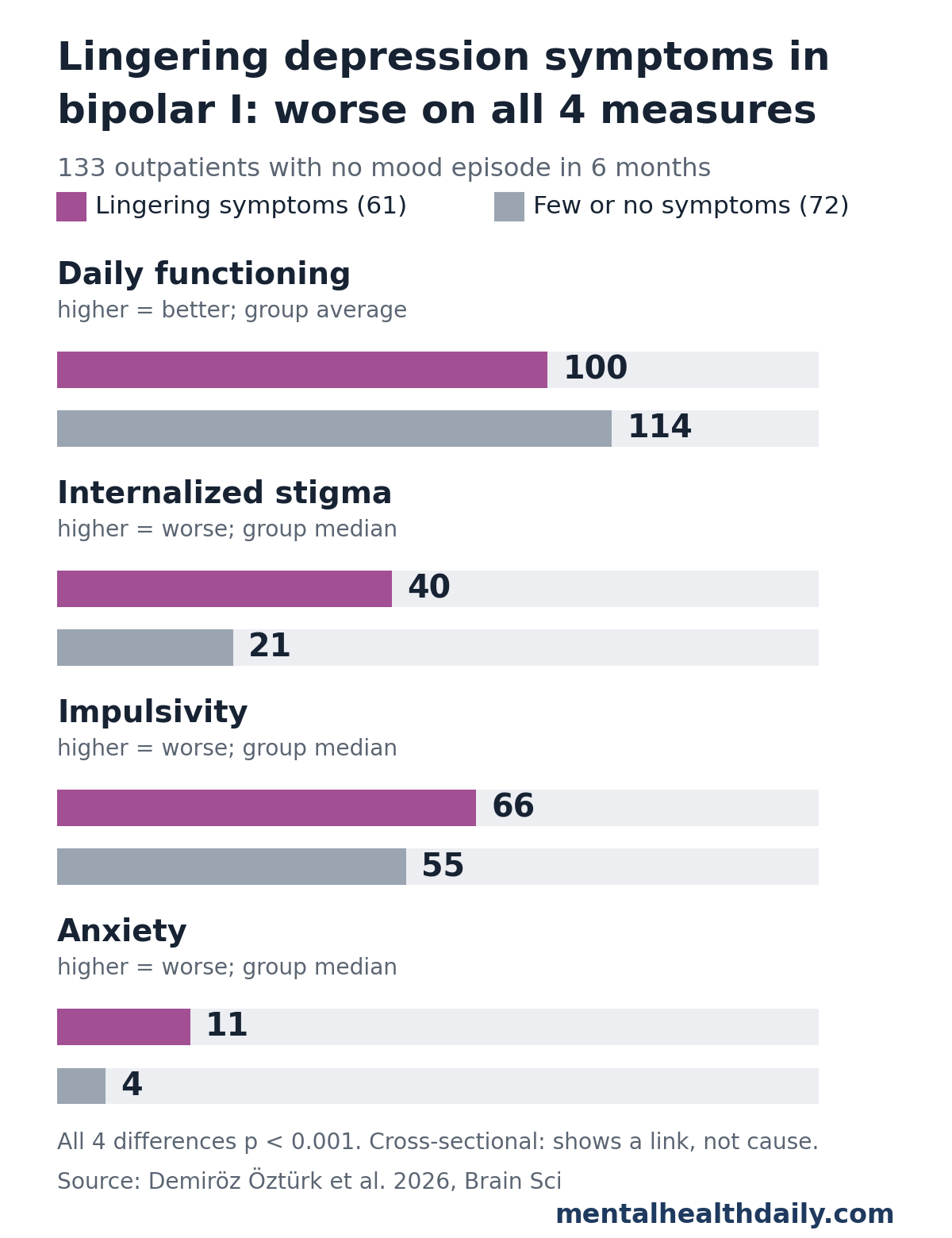
- Poorer functioning: average functioning scores were 100.4 in the 61 patients with lingering symptoms vs. 113.6 in the 72 patients with few or no symptoms (p < 0.001).1
- Nearly double the self-stigma: median internalized stigma scores were 40 vs. 21, with higher scores for alienation, stereotype endorsement, perceived discrimination, and social withdrawal.1
- More impulsivity and anxiety: median impulsivity was 66 vs. 55, and median anxiety was 11 vs. 4 (both p < 0.001).1
- Heavier illness history: the lingering-symptom group had more past depressive episodes and more lifetime suicide attempts (31.1% vs. 12.5%).1
- Snapshot design: the study measured everyone once, so it shows a link, not which problem comes first.1
What “Subsyndromal” Depression Means in Bipolar Disorder
Bipolar I disorder involves at least one full manic episode, usually alongside depressive episodes. The stretches between episodes are often called euthymia, meaning a stable, roughly normal mood.
Many people are not fully symptom-free in those gaps. Subsyndromal depressive symptoms are depression symptoms that linger below the level of a full depressive episode, such as low mood or low energy that is real but not severe enough for a diagnosis.1
Earlier research has already linked these leftover symptoms to trouble at work, at home, and with family and friends.2 They have also been linked to a faster return of full mood episodes.3
How the Bipolar I Outpatient Study Was Set Up
Demiröz Öztürk et al. recruited adults aged 18 to 65 from a psychiatry outpatient clinic in Konya, Turkey, between October 2023 and March 2024.1
- Sample: 133 outpatients with bipolar I disorder, out of 162 screened
- Stability rule: no full depressive, manic, or mixed episode and no psychiatric hospitalization in the previous 6 months
- Exclusions: any other full psychiatric disorder, past alcohol or substance use disorder, intellectual disability, severe physical illness, or current mild manic symptoms
- Lingering-symptom group (61): clinician-rated Hamilton Depression Rating Scale (HDRS) score of 8 to 14, the range an international bipolar task force uses for subsyndromal depression
- Comparison group (72): HDRS below 8, meaning few or no depressive symptoms
Both groups were similar in age, sex, employment, illness duration, and current medication mix. The median HDRS score was 10 in the lingering-symptom group and 3 in the comparison group.1
Lingering Depression Symptoms Linked to Worse Functioning, Stigma, Impulsivity, and Anxiety
Patients filled out 4 questionnaires, and the lingering-symptom group scored worse on every one:1
- Daily functioning (Bipolar Disorder Functioning Scale, where higher is better): 100.4 vs. 113.6 on average
- Internalized stigma (how much a person applies negative stereotypes about mental illness to themselves): median 40 vs. 21
- Impulsivity (Barratt Impulsiveness Scale): median 66 vs. 55
- Anxiety (Beck Anxiety Inventory): median 11 vs. 4
Where functioning dipped: the lingering-symptom group scored lower on emotional, cognitive, sexual, and home-life functioning, and on stigma and social withdrawal items within the functioning scale. Work, friendships, social activities, hobbies, and initiative did not differ significantly.1
Where stigma rose: 4 of the 5 internalized stigma areas were higher. Only stigma resistance (pushing back against stereotypes) was similar, at a median of 14 vs. 15.1
Impulsivity: all 3 types were higher — attentional (trouble staying focused), motor (acting without thinking), and non-planning (not thinking ahead).1
A Heavier Bipolar Illness History in the Lingering-Symptom Group
The groups also differed in their past course of illness:1
- Mood episodes: median 4 vs. 3 total, and 1 vs. 0 depressive episodes
- Antidepressant-induced manic switch (a manic episode triggered while taking an antidepressant): 22.9% vs. 6.9%
- Lifetime suicide attempt: 31.1% vs. 12.5%
- First episode was manic: 55.7% vs. 80.5%
The suicide-attempt figure refers to lifetime history. The researchers note that it does not show current lingering symptoms raise suicide risk. If you or someone you know is in crisis, in the US you can call or text 988 to reach the Suicide & Crisis Lifeline.
More Severe Lingering Symptoms Went With More Anxiety and Alienation
Within the 61 patients with lingering symptoms, the researchers checked whether higher HDRS scores tracked with each measure. Most links were modest, and several overall scores showed none.1
- Anxiety: the strongest link (r = 0.465, p < 0.001)
- Sexual functioning: lower with more symptoms (r = −0.341, p = 0.005)
- Attentional impulsivity: higher with more symptoms (r = 0.315, p = 0.009)
- Home-life functioning: lower with more symptoms (r = −0.289, p = 0.017)
- Alienation (feeling like an outsider because of mental illness): higher with more symptoms (r = 0.249, p = 0.047)
Total functioning, total impulsivity, and total stigma scores were not significantly linked to symptom severity within this group. The researchers also flag that medication side effects, which can affect sexual function, were not measured separately.1
Limitations of This Bipolar Subsyndromal Depression Study
This was a cross-sectional study, meaning everyone was measured once. It can show that lingering symptoms and these problems occur together, but it cannot show that one causes the other. Self-stigma or anxiety could also feed low mood.
- One snapshot: symptoms were rated once, so a passing dip could not be separated from a lasting one.
- Unadjusted comparisons: the lingering-symptom group had a heavier illness history, and the analyses did not account for it.
- Many tests, no correction: the researchers ran dozens of comparisons without adjusting for multiple testing, so borderline results such as alienation (p = 0.047) are less certain.
- Selected sample: a single clinic, outpatients only, bipolar I only, and people with other psychiatric disorders were excluded.
- Self-report: functioning, stigma, impulsivity, and anxiety were all self-rated questionnaires.
The main group differences were consistent across all 4 questionnaires and match earlier, larger studies.23 The within-group correlations are best treated as leads for future research.
Why Lingering Symptoms Deserve Attention Between Bipolar Episodes
A large multisite study of 759 bipolar outpatients found that people with subsyndromal depression reported work, home, and relationship problems at rates closer to people in full depression than to people without symptoms.2
A Madrid study that followed 225 outpatients who were between episodes for up to 5 years found that those with lingering symptoms relapsed sooner: median 35 weeks to a new mood episode vs. 109 weeks for symptom-free patients.3
The 2026 study adds stigma, impulsivity, and anxiety to that picture. For people with bipolar disorder and their clinicians, “no current episode” and “doing well” are not always the same thing, and mild ongoing low mood is worth raising at follow-up visits.1
References
- Demiröz Öztürk H, Gıynaş Ayhan M, İnanlı İ. Subsyndromal depressive symptoms in bipolar disorder: associations with functioning, internalized stigma, impulsivity, and anxiety. Brain Sciences. 2026;16(9):943. doi:10.3390/brainsci16090943
- Altshuler LL, Post RM, Black DO, et al. Subsyndromal depressive symptoms are associated with functional impairment in patients with bipolar disorder: results of a large, multisite study. Journal of Clinical Psychiatry. 2006;67(10):1551–1560. doi:10.4088/JCP.v67n1009
- De Dios C, Ezquiaga E, Agud JL, et al. Subthreshold symptoms and time to relapse/recurrence in a community cohort of bipolar disorder outpatients. Journal of Affective Disorders. 2012;143(1–3):160–165. doi:10.1016/j.jad.2012.05.047