
Autistic adults who started prescribed medical cannabis at private UK clinics reported less anxiety and better sleep within a month, according to an 18-month registry study of 130 people.1
Those gains shrank over the following year as THC doses climbed, and with no comparison group, the study cannot show that cannabis caused the improvement.
Research Highlights
- Anxiety fell fastest in month 1: average GAD-7 scores dropped from 13.5 to 8.9 out of 21, then drifted back to 10.8 by 18 months.1
- Sleep followed the same arc: self-rated sleep quality rose from 3.7 to 5.3 out of 10 at 1 month and stood at 4.8 at 18 months.1
- Gains were modest by the study’s own yardstick: the average anxiety improvement fell below the 4-point threshold for a meaningful change from 12 months on, and sleep never reached its 2.6-point threshold.1
- THC doses rose nearly tenfold: the median daily THC dose went from 20 mg at baseline to about 192 mg at 18 months.1
- Side effects clustered in a minority: 25 of 130 adults reported a combined 232 adverse events; 105 reported none.1
What the UK Medical Cannabis Registry Tracked in Autistic Adults
Cannabis-based medicinal products (CBMPs) are prescription cannabis medicines, such as oils taken by mouth or dried flower that is vaporized. They contain varying amounts of 2 main compounds: THC (delta-9-tetrahydrocannabinol), which acts on the brain’s cannabinoid receptors and produces the high, and CBD (cannabidiol), which is not intoxicating.
Both act on the endocannabinoid system, a signaling network that helps regulate mood, anxiety, sleep and social behavior. Researchers have proposed that this system works differently in autism, which is part of the rationale for testing cannabinoids.
The UK Medical Cannabis Registry collects outcomes from patients prescribed CBMPs in the UK and Crown Dependencies. A research team from Imperial College London and Curaleaf Clinic pulled records from 19,763 registry patients and kept those whose main reason for treatment was autism, who had started at least 18 months before the December 2023 data pull, and who had completed baseline questionnaires.1
- Who: 130 adults, average age 34; 88 men and 42 women. No children were included.
- Mental health background: 84 (65%) also had anxiety or depression.
- Prior cannabis use: 90 were already using non-prescribed cannabis when they started, and 22 more were former users. Only 18 had never used it.
- Products: dried flower alone was the most common prescription, used by about half the group at every time point.
- Check-ins: questionnaires before treatment and at 1, 3, 6, 12 and 18 months.
Participants rated their own symptoms on 3 main scales. The GAD-7 is a 7-question anxiety measure scored 0 to 21, where 10 or more signals moderate anxiety. The Single-Item Sleep Quality Scale (SQS) asks people to rate the past week’s sleep from 0 (terrible) to 10 (excellent). The EQ-5D-5L summarizes health-related quality of life as an index where 1 means full health.
Anxiety and Sleep Improved Most in the First Few Months
Average anxiety scores started at 13.5, in the moderate range. After 1 month on CBMPs they averaged 8.9, then crept up to 10.2 at 12 months and 10.8 at 18 months.1 Every follow-up score was still significantly lower than baseline, but anxiety at 18 months was significantly higher than at 1 or 3 months.
Sleep quality traced a similar curve: 3.7 out of 10 before treatment, 5.3 at 1 month, a peak of 5.5 at 6 months, and 4.8 at 18 months.1
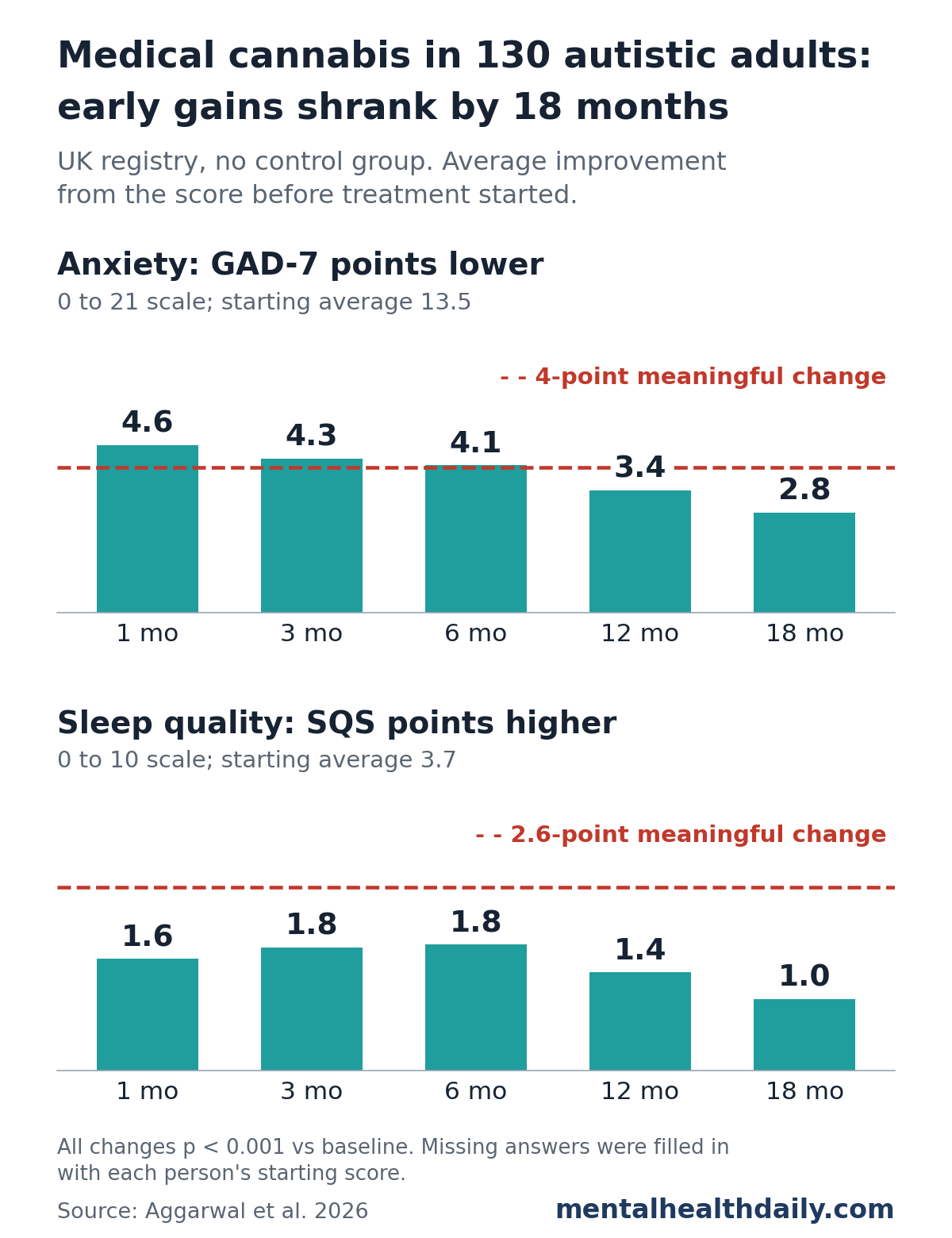
How big were these changes? The researchers used a 4-point GAD-7 drop as the minimal clinically important difference, the smallest change considered meaningful to patients, and 2.6 points for sleep quality. The average anxiety improvement cleared 4 points through 6 months and then slipped to 3.4 at 12 months and 2.8 at 18 months. The largest average sleep improvement was 1.8 points.1
Quality of life moved the same way. The EQ-5D-5L index rose from 0.43 to 0.58 by 3 months and was 0.51 at 18 months. Mobility scores did not change significantly.1
How missing answers were handled: when someone skipped a questionnaire or stopped treatment, the researchers filled in their pre-treatment score. That makes late averages more conservative, because anyone who dropped out counts as unchanged. The paper does not report how many people actually completed each follow-up.1
THC Doses Rose Nearly Tenfold as the Benefits Faded
The median daily THC dose was 20 mg at the start, 100 mg at 1 month, 152 mg at 6 months and 192 mg at 18 months. CBD doses stayed far lower, around 20 to 30 mg a day after the first month.1
The researchers gave 3 explanations for the steep climb:
- Inhaled flower: most people used vaporized dried flower, which delivers less THC into the bloodstream per milligram than oil swallowed by mouth, so the doses cannot be compared directly with oral products.
- Clinician titration: specialists adjusted doses over time while looking for the lowest dose that worked for each person.
- Tolerance: the fading of anxiety and sleep benefits between 3 and 18 months fits with the body adapting to THC’s calming and sedating effects.
They wrote that prescribers starting dried flower should expect dose increases and should warn patients about the risks of long-term high-THC use, including dependence, effects on thinking, and heart and metabolic effects.1
Side Effects: 25 of 130 Adults Reported 232 Events
Most participants (105 of 130) reported no adverse events. The other 25 reported 232 between them, so side effects were concentrated in a small group of people who often reported several.1
- Severity: 88 events were rated mild, 99 moderate, 42 severe, and 3 life-threatening or disabling (2 reports of depression and 1 of anxiety).
- Most common: insomnia (18 reports), dry mouth (16), lethargy (16), trouble concentrating (14) and fatigue (13).
- No clear risk factor: age, sex, prior cannabis use, route of use, and THC or CBD dose did not predict who had a side effect.
Insomnia topping the side-effect list sits awkwardly next to the sleep findings. The researchers noted that sleep problems and anxiety are already common in autism, which makes it hard to tell a drug effect from the underlying condition in self-reports.1
Why This Registry Study Cannot Show Cannabis Caused the Improvement
Evidence strength: this is an uncontrolled case series. It can describe how a group of self-selected patients felt over time. It cannot separate a drug effect from expectation, natural ups and downs in symptoms, or the tendency for people to start treatment when they feel worst. The researchers state this directly in their conclusion.1
- No placebo or comparison group, no randomization and no blinding. Everyone knew they were getting cannabis.
- Self-reported general scales. No autism-specific measure was used, and no clinician-rated outcome.
- A cannabis-experienced group. 86% were current or former users of non-prescribed cannabis. People who already felt helped by cannabis are more likely to seek a prescription, which can inflate apparent benefit.
- Unknown dropout. Attrition was not reported, so there is no way to know how many people were still being treated at 18 months.
- One private, self-funded clinic network. Patients paid for treatment, so the group probably underrepresents people with fewer resources.
- Commercial links. Curaleaf Clinic privately owns the registry, most authors list it as an affiliation, and the most-prescribed products were Curaleaf brands. The paper declares no conflicts of interest. In a 2022 registry paper, this study’s senior author disclosed being Chief Medical Officer at Curaleaf International.2
The same registry previously reported on 74 autistic adults followed for 6 months. That analysis found a similar early pattern: anxiety improved significantly at 1 and 3 months but not at 6 months, and questionnaire completion fell from 81% at 1 month to 42% at 6 months.2 The new paper does not say how many people appear in both analyses.
What Randomized Trials of Cannabinoids in Autism Have Found
The study team noted that no randomized controlled trial of CBMPs has been done in autistic adults.1 The controlled evidence comes from children and young people, and it is mixed.
- Israel, ages 5 to 21: a placebo-controlled trial in 150 participants tested a CBD-rich whole-plant extract (20 parts CBD to 1 part THC) for 12 weeks. A parent questionnaire on disruptive behavior, one of 2 primary outcomes, showed no difference from placebo. On a clinician rating, 49% improved much or very much on the extract vs 21% on placebo. Sleepiness and reduced appetite were more common with cannabinoids. The researchers called the efficacy evidence “mixed and insufficient.”3
- Australia, ages 5 to 12: a small crossover trial gave 29 children near-THC-free CBD oil or placebo for 12 weeks each. CBD did not significantly improve the primary social responsiveness score. Parent-rated anxiety on one checklist and parenting stress improved with CBD; a second anxiety measure did not reach significance.4
Both trials used CBD-dominant products. The UK registry adults were mostly on high-THC dried flower, so even the pediatric trial results do not translate to that treatment.
Takeaways From the UK Autism Cannabis Registry
- Early improvement, then fading: self-rated anxiety and sleep were best in the first 6 months and moved back toward baseline by 18 months.
- Rising THC exposure: doses climbed to a median of about 192 mg a day, and the long-term risks of that exposure in autistic adults are unknown.
- Not proof of benefit: without a control group, the registry cannot show cannabis caused the changes. Trials in adults are still needed.
References
- Aggarwal A, Erridge S, Varadpande M, et al. UK Medical Cannabis Registry: a clinical outcomes analysis for autism spectrum disorder. Neuropsychopharmacology Reports. 2026;46:e70146. doi:10.1002/npr2.70146
- Erridge S, Kerr-Gaffney J, Holvey C, et al. Clinical outcome analysis of patients with autism spectrum disorder: analysis from the UK Medical Cannabis Registry. Therapeutic Advances in Psychopharmacology. 2022;12:20451253221116240. doi:10.1177/20451253221116240
- Aran A, Harel M, Cassuto H, et al. Cannabinoid treatment for autism: a proof-of-concept randomized trial. Molecular Autism. 2021;12:6. doi:10.1186/s13229-021-00420-2
- Parrella NF, Hill AT, Enticott PG, et al. Effects of cannabidiol on social relating, anxiety, and parental stress in autistic children: a randomized controlled crossover trial. Autism Research. 2026. doi:10.1002/aur.70159