
Autistic children in China sorted into 4 distinct social functioning profiles, ranging from broad social difficulty to relative social strength, in a 2026 study of 479 children aged 2 to 17.1
The most socially engaged group also had the most trouble with peers, a reminder that social skill and friendship are not the same thing.
Research Highlights
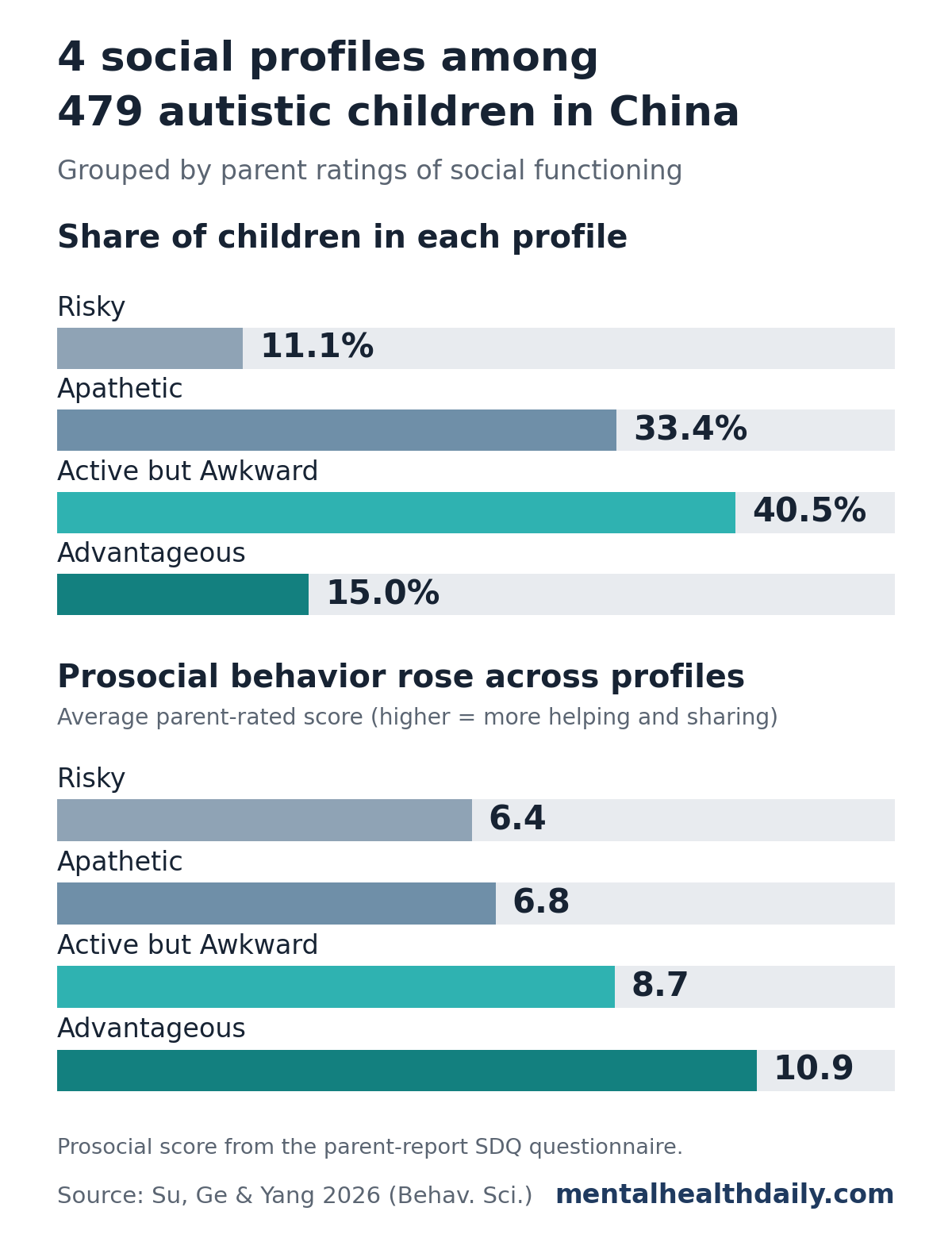
- 4 social profiles: Risky (11.1% of children), Apathetic (33.4%), Active but Awkward (40.5%) and Advantageous (15.0%), based on parent ratings of 5 areas of social functioning.1
- Prosocial behavior rose across profiles: average parent-rated helping and sharing scores went from 6.4 in the Risky profile to 10.9 in the Advantageous profile.1
- Peer problems ran the other way: children in the Advantageous profile had the highest peer-problem scores, and the Risky profile had the lowest.1
- Age and gender did not differ: the 4 profiles had similar ages and boy-girl mixes; IQ, available for only 110 children, was highest in the Advantageous profile.1
- Preliminary: the profiles came from one parent-report survey and have not been replicated in a second sample.1
How Researchers Grouped 479 Autistic Children by Social Skills
Xueyun Su, Jiajia Ge and Xiao Yang at East China Normal University recruited families online through special schools, regular schools and autism intervention centers across China. Parents reported that a clinician had diagnosed their child with autism spectrum disorder (ASD), a developmental condition marked by differences in social communication plus restricted or repetitive behaviors and interests.1
- Sample: 479 children, 405 boys and 74 girls, average age about 9
- Main questionnaire: a Mandarin version of the Stanford Social Dimensions Scale, completed by parents
- Published: Behavioral Sciences, September 2026
The Stanford Social Dimensions Scale (SSDS) is a 71-item parent questionnaire built to capture social functioning in more detail than standard autism checklists. It scores 5 separate areas:1
- Social motivation: how much a child seeks out and enjoys being with other people
- Social affiliation: forming and keeping bonds with others
- Expressive social communication: using words, gestures and expressions to connect
- Social recognition: reading social cues and other people’s feelings and intentions
- Unusual approach: social approaches that feel odd in intensity or content, such as starting conversations about an intense interest or routine
To find groups, the team used latent profile analysis, a statistical method that looks for children whose scores across all 5 areas follow a similar shape. Instead of ranking children from mild to severe on one line, it asks whether there are natural clusters, and how many.1
Researchers tested models with 1 to 8 groups and chose 4, weighing statistical fit, how cleanly children were sorted (entropy 0.962, where 1 is perfect), group size and how interpretable each group was. One standard test did not favor 4 groups over 3, so the final number was partly a judgment call.1
4 Social Functioning Profiles in Autistic Children
The research team named each profile after its pattern. They describe the names as shorthand for the group’s relative pattern in this sample, not diagnostic categories or fixed autism subtypes.1
- Risky (11.1%): lowest scores on motivation, affiliation, expressive communication and social recognition, and the highest unusual-approach score. These children had the broadest social difficulties.
- Apathetic (33.4%): moderate scores overall, with social motivation as low as the Risky group but the lowest unusual-approach score of any profile. These children showed the fewest odd or intense social approaches.
- Active but Awkward (40.5%): the largest group, with second-highest scores on the 4 core social areas. They engaged fairly well but showed more unusual approaches than the Apathetic group.
- Advantageous (15.0%): highest scores on all 4 core social areas.
Social motivation scores, for example, averaged 27.5 in the Risky profile, 27.6 in the Apathetic profile, 38.5 in the Active but Awkward profile and 50.9 in the Advantageous profile.1
The Most Social Group Still Had the Most Peer Problems
Parents also completed the Strengths and Difficulties Questionnaire (SDQ), a widely used behavior checklist with a prosocial scale (helping, sharing, kindness) and a peer-problems scale (being picked on, having few friends, getting along better with adults).1
- Prosocial behavior: 6.4 (Risky), 6.8 (Apathetic), 8.7 (Active but Awkward) and 10.9 (Advantageous), a large difference across profiles
- Peer problems: 8.2 (Risky), 8.8 (Apathetic), 9.1 (Active but Awkward) and 9.5 (Advantageous), a small but significant difference in the opposite direction
The researchers offer 2 possible explanations. Some autistic children may learn interaction strategies that get them into social situations without building close, two-way friendships. Peer trouble may also reflect mutual misunderstanding between autistic and non-autistic children, an idea known as the “double empathy problem.”1
Both ideas are untested here, since the survey did not measure friendship quality or interaction style.
The profiles did not differ in emotional symptoms, conduct problems, hyperactivity or total SDQ difficulties.1
IQ and Autism Symptom Scores Differed by Profile
IQ: among the 110 children whose parents reported a prior hospital IQ test, average full-scale IQ was 41 in the Risky profile, 51 in the Apathetic profile, 68 in the Active but Awkward profile and 88 in the Advantageous profile. Only 9 children in the Risky profile had IQ data, so these averages are rough.1
Autism symptom checklists: 2 other parent questionnaires measured autism-related difficulties, and they did not line up as a simple severity ladder.1
- Social Communication Questionnaire (SCQ): social interaction difficulties were highest in the Risky profile and lowest in the Advantageous profile, with the other 2 profiles in between
- Social Responsiveness Scale (SRS-2): social communication and interaction difficulties, and repetitive behaviors, were highest in the Apathetic profile and lowest in the Advantageous profile
Age and gender: no differences between profiles, so the groups were not simply younger vs. older children or boys vs. girls.1
How the China Profiles Compare With Earlier Autism Subtype Studies
A 2020 study by Uljarević et al. used the same 5-area questionnaire and the same profile method in 164 autistic children and teens with an average age of about 7.5. It found 5 profiles that differed in their pattern of social strengths and weaknesses, not just in overall severity.2
That matches the main message of the China study. One detail differed: according to the 2026 researchers, the best-functioning profile in that earlier study had the highest unusual-approach scores, while the Advantageous profile in China had relatively low ones. They suggest cultural expectations about appropriate social behavior may play a part, but sample and measurement differences could explain it too.1
Much larger subtyping work, using different data, has also landed on 4 groups. A 2025 analysis by Litman et al. of 5,392 autistic children and teens in the US SPARK study sorted them into 4 classes across many traits, including social, behavioral and developmental ones, and found distinct genetic patterns in each.3
Limits of These Preliminary Social Subtypes
These profiles are a first pass. They emerged from one sample and need to be found again in new groups of children before anyone treats them as real subtypes. Specific limits:
- Parent report only: diagnosis, social ratings and symptom scores all came from parents, with no direct clinical assessment.
- Online convenience sample: families with limited internet access may be under-represented.
- One snapshot: the survey captured children at one time point, and social patterns in autism can change with development.
- Wide age range: children from 2 to 17 were rated on the same questionnaire.
- Sparse IQ data: IQ was available for 110 of 479 children and came from earlier tests reported by parents.
Practical use: the profiles describe patterns, not a child’s fixed type. For a parent or teacher, the useful idea is that social motivation, communication, reading cues and friendship can each be a separate strength or need, so support can be matched to the areas where a child struggles. The researchers call for that kind of profile-based support, but this survey did not test it.
References
- Su X, Ge J, Yang X. Social functioning profiles in children with autism spectrum disorder in China: a preliminary identification of subtypes. Behavioral Sciences. 2026;16(9):1616. doi:10.3390/bs16091616
- Uljarević M, Phillips JM, Schuck RK, et al. Exploring social subtypes in autism spectrum disorder: a preliminary study. Autism Research. 2020;13(8):1335–1342. doi:10.1002/aur.2294
- Litman A, Sauerwald N, Green Snyder L, et al. Decomposition of phenotypic heterogeneity in autism reveals underlying genetic programs. Nature Genetics. 2025;57(7):1611–1619. doi:10.1038/s41588-025-02224-z