
A 2026 study involving 202 outpatients in Tokyo found that anxious distress, a cluster of tension and worry symptoms that can come with depression, was about as common in bipolar disorder as in major depression: roughly 43% in each group.1
In both conditions, people with anxious distress reported more severe depression, but the symptoms did not help tell the 2 disorders apart.
Research Highlights
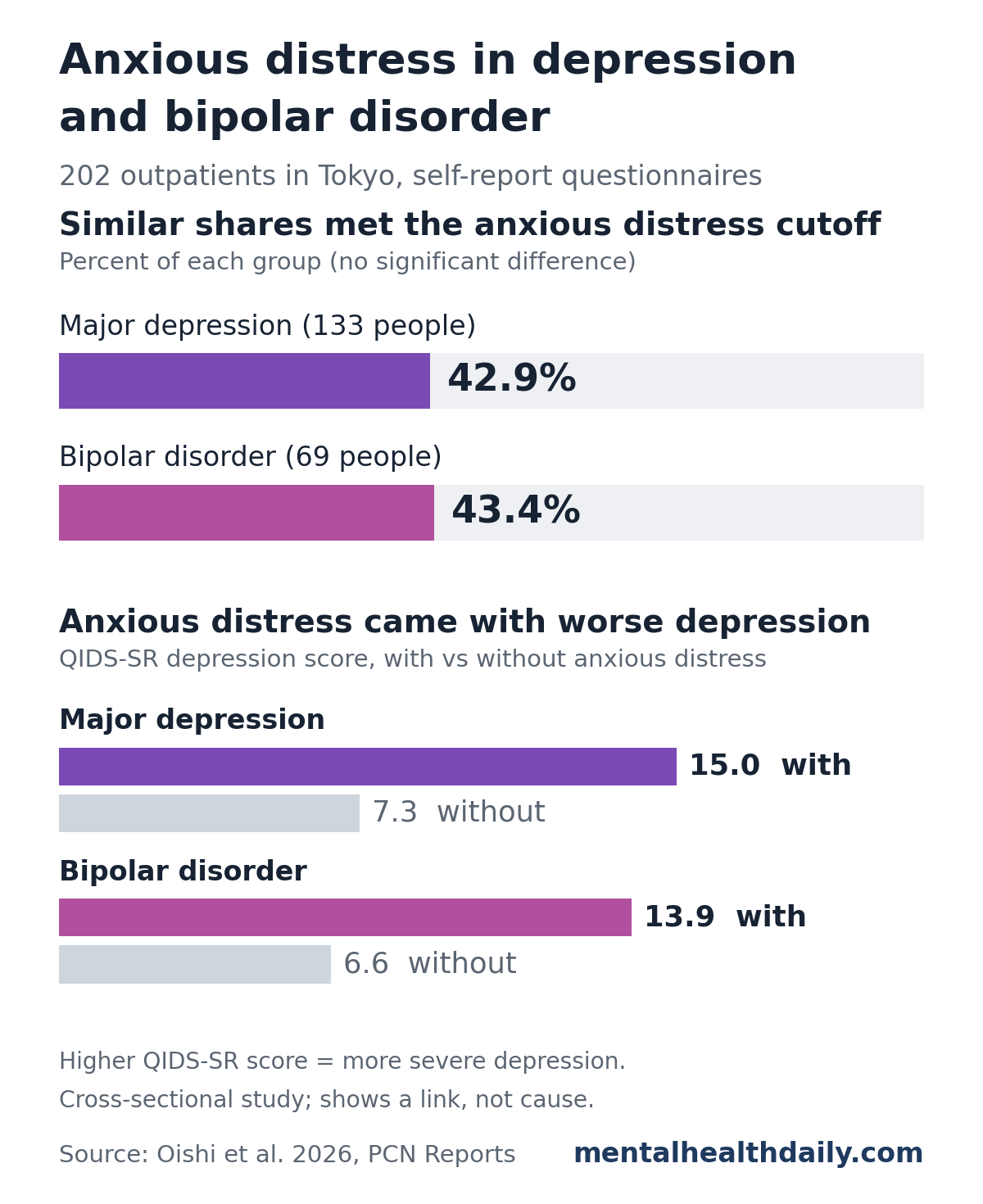
- Similar rates of anxious distress: 42.9% of people with major depression and 43.4% of people with bipolar disorder met the questionnaire cutoff (p = 0.95).1
- No symptom-by-symptom difference: none of the 22 questionnaire items, from low mood and sleep to worry and restlessness, differed significantly between the 2 diagnoses.1
- Anxious distress came with heavier depression: depression scores were roughly double in people with anxious distress (15.0 vs 7.3 in major depression; 13.9 vs 6.6 in bipolar disorder).1
- Lower rates than interview studies: earlier studies using clinician interviews found anxious distress in roughly 50% to 80% of patients, and one found it more often in bipolar disorder.1,3,4,5
- A snapshot, not a forecast: the cross-sectional design captured 1 point in time, and the current mood state of people with bipolar disorder was not recorded.1
What Is Anxious Distress in Depression?
Anxious distress is a label, called a specifier, that the DSM-5 (the American Psychiatric Association’s diagnostic manual) added to describe depressive episodes that come with prominent anxiety. A specifier does not create a new diagnosis. It flags a feature of the current episode that may affect how a person does and how treatment goes.
The specifier applies when a person has at least 2 of these 5 symptoms on most days of a depressive episode:
- Feeling keyed up or tense
- Feeling unusually restless
- Trouble concentrating because of worry
- Fear that something awful might happen
- Feeling that one might lose control
Anxious distress differs from having a separate anxiety disorder, such as generalized anxiety disorder or panic disorder. It describes anxiety woven into the depressive episode itself. Previous research has linked it to a higher risk of suicide, longer illness and poorer treatment results in major depression.1
Depressive episodes happen in both major depressive disorder (often called unipolar depression) and bipolar disorder, where depressive episodes alternate with periods of mania or hypomania (elevated, energized or irritable mood). Because the 2 conditions can look alike during a low period, clinicians have looked for symptom patterns that could help tell them apart.
How Researchers Measured Anxious Distress With a Questionnaire
A research team led by Kazufumi Oishi at Kyorin University in Tokyo asked outpatients to fill out the Clinically Useful Depression Outcome Scale with anxious distress items (CUDOS-A). This self-report questionnaire was developed by Mark Zimmerman et al., who found it reliable and valid in 773 US outpatients with major depression.2 A Japanese version also showed strong reliability in 131 outpatients with major depression.6
The CUDOS-A has 22 questions, each rated from 0 (not at all) to 4 (almost every day):
- Items 1–15: core depression symptoms such as low mood, loss of interest, sleep and appetite changes, guilt and hopelessness
- Items 16–20: the 5 anxious distress symptoms listed above
- Items 21–22: social functioning and quality of life
The researchers counted someone as having anxious distress if they scored 2 or higher on at least 2 of the 5 anxious distress items. Participants also completed the QIDS-SR (Quick Inventory of Depressive Symptomatology, Self-Report), a widely used questionnaire that scores overall depression severity.1
Study snapshot:
- Who: 202 adults aged 20 to 65 (133 with major depression, 69 with bipolar disorder), average age 45
- Where and when: 7 psychiatric outpatient clinics in Tokyo, January to December 2021
- Excluded: people with current manic or psychotic symptoms, substance use disorders, dementia, severe physical illness or active suicidal thoughts
- Group differences: the bipolar group had more women (62.3% vs 45.9%); age, education, medication use and overall depression scores were similar
About 43% of Both Groups Had Anxious Distress
Anxious distress showed up at nearly identical rates: 42.9% in major depression and 43.4% in bipolar disorder. The difference was far from statistically significant (p = 0.95).1
Total CUDOS-A scores were also close (28.0 in major depression vs 27.0 in bipolar disorder; p = 0.57), and none of the 22 individual items differed significantly. Overall depression severity on the QIDS-SR did not differ between the groups either.1
The 5 anxious distress items looked especially alike. Average scores on the 0-to-4 scale, major depression vs bipolar disorder:
- Keyed up or tense: 1.6 vs 1.8
- Restless: 0.7 vs 0.8
- Trouble concentrating because of worry: 1.2 vs 1.3
- Fear that something awful might happen: 1.1 vs 1.0
- Feeling one might lose control: 1.0 vs 0.9
The closest any item came to a difference was insomnia, which scored slightly higher in major depression (1.5 vs 1.2; p = 0.06).1
Checking people who were still depressed: some outpatients had mild or remitted symptoms, which could blur group differences. When the researchers repeated the analyses only in people with a QIDS-SR score of 6 or higher (not in remission), the results were virtually the same.1
Anxious Distress Came With More Severe Depression in Both Disorders
Within each diagnosis, people with anxious distress had about twice the QIDS-SR depression score of people without it:
- Major depression: 15.0 with anxious distress vs 7.3 without (p < 0.001)
- Bipolar disorder: 13.9 with vs 6.6 without (p < 0.001)
The same pattern held in the subgroup that was still depressed. This link was already known in major depression, including from the Japanese CUDOS-A validation work.1,6 The 2026 study extends it to bipolar disorder.1
Because everything was measured at one time point, the result does not show which comes first. Anxiety could worsen depression, severe depression could bring anxiety with it, or both could reflect a heavier overall illness.
Why Earlier Studies Found Higher Rates of Anxious Distress
Earlier research using clinician interviews found anxious distress more often, and disagreed on whether bipolar disorder or major depression had more of it:
- No difference, high rates: a US study by Zimmerman et al. compared 49 patients with bipolar depression and 369 with major depression and found that most patients in both groups met the specifier, with no significant difference between them.1,3
- More common in bipolar disorder: an Italian multicenter cohort found anxious distress in 66.9% of depressed patients with bipolar disorder vs 51.2% with major depression.4
- Linked more to major depression: among 206 Italian inpatients hospitalized for a depressive episode, 66.5% had anxious distress, and it was associated with a major depression diagnosis as well as with mixed features (some manic symptoms during depression) and psychotic features.5
Oishi et al. suggest 2 reasons for their lower rate of about 43%.1
- Self-report vs interview. A questionnaire captures how patients rate their own symptoms, while an interview adds the clinician’s observation and judgment.
- Stable outpatients vs acutely ill inpatients. Anxious distress tracks with depression severity, and several earlier studies enrolled hospitalized patients.
Taken together, the evidence does not support anxious distress as a reliable way to separate bipolar depression from major depression. It appears across both conditions.
Limitations of This Anxious Distress Comparison
Evidence strength: a cross-sectional questionnaire study can show how common symptoms are and which ones travel together. It cannot show cause, predict outcomes or prove that the 2 groups are truly the same.
- Bipolar mood state unknown: the researchers did not record whether people with bipolar disorder were depressed, hypomanic or stable at the time, which could change their anxiety scores.
- Small bipolar group: with 69 people, the study could miss modest differences. “No significant difference” is not the same as a formal test showing equivalence.
- Routine diagnoses: diagnoses came from regular clinical interviews rather than a structured diagnostic interview, and bipolar I and bipolar II were not separated.
- Questionnaire definition: anxious distress was defined by a self-report cutoff, not a clinician’s DSM-5 assessment, and severity levels of the specifier were not evaluated.
- Unmeasured factors: medication, length of illness and life stress were not fully accounted for.
- One setting: all participants were outpatients in the Tokyo metropolitan area, so results may differ for inpatients or other countries.
What This Means for People With Depression or Bipolar Disorder
Tension, restlessness and worry during a low period are common whether the diagnosis is major depression or bipolar disorder. In this study, they did not point toward one diagnosis over the other.
Worth mentioning to a clinician: anxious distress came with noticeably heavier depression in both conditions. The researchers recommend checking for it routinely in mood disorders, and a short questionnaire like the CUDOS-A is one quick way to do that.1
Telling bipolar depression apart from major depression still depends on a person’s full history, especially any past periods of elevated mood or unusual energy, rather than on anxiety symptoms.
If anxiety and low mood ever bring thoughts of suicide, contact a crisis line right away. In the US, call or text 988.
References
- Oishi K, Matsumoto Y, Aoki Y, et al. Comparison of depressive symptoms and anxious distress between major depressive disorder and bipolar disorder using the CUDOS-A. Psychiatry and Clinical Neurosciences Reports. 2026;5:e70403. doi:10.1002/pcn5.70403
- Zimmerman M, Chelminski I, Young D, et al. A clinically useful self-report measure of the DSM-5 anxious distress specifier for major depressive disorder. Journal of Clinical Psychiatry. 2014;75:601–607. doi:10.4088/JCP.13m08961
- Zimmerman M, Kerr S, Balling C, Kiefer R, Dalrymple K. DSM-5 anxious distress specifier in patients with bipolar depression. Annals of Clinical Psychiatry. 2020;32(2). doi:10.1177/104012372003200216
- Tundo A, Musetti L, de Filippis R, et al. Is there a relationship between depression with anxious distress DSM-5 specifier and bipolarity? A multicenter cohort study on patients with unipolar, bipolar I and II disorders. Journal of Affective Disorders. 2019;245:819–826. doi:10.1016/j.jad.2018.11.024
- Bartoli F, Bachi B, Callovini T, et al. Anxious distress in people with major depressive episodes: a cross-sectional analysis of clinical correlates. CNS Spectrums. 2024;29(1):49–53. doi:10.1017/S1092852923002377
- Aoki Y, Takaesu Y, Matsumoto Y, et al. A psychometric analysis of the Japanese version of the clinically useful depression outcome scale supplemented with questions for the DSM-5 anxious distress specifier (CUDOS-A). Neuropsychopharmacology Reports. 2024;44:526–533. doi:10.1002/npr2.12432