Exercise for Depression and Anxiety: 2025 Evidence Synthesis
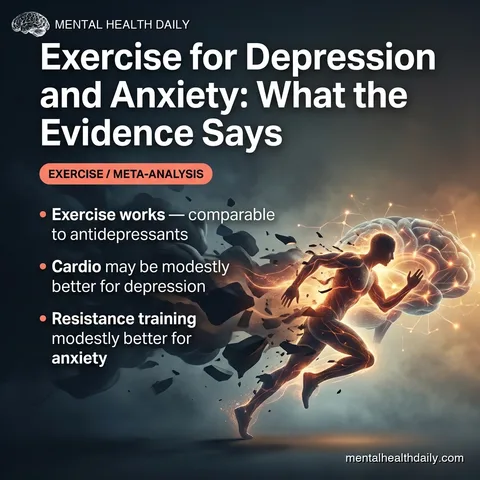
Exercise reliably reduces depression and anxiety symptoms — but the cardio-vs-resistance gap and antidepressant parity claims are overstated.
Read article Mental Health DailyResearch. Evidence. Perspective.
Published research on bdnf.
Exercise reliably reduces depression and anxiety symptoms — but the cardio-vs-resistance gap and antidepressant parity claims are overstated.
Read articleParkinson’s disease (PD), a degenerative disorder that predominantly affects the motor system, has long been a challenging condition to manage due to its complex pathology and the limited ef…
Read articleThe widespread use of corticosteroids (CCSs) across the globe for treating inflammatory conditions has led to an increased incidence of corticosteroid-induced neuropsychiatric disorders (NPD…
Read articleSuicide remains a leading cause of death worldwide, with its prevention a top priority for both public health initiatives and individual care strategies. Recent research in the US Army offer…
Read articleResearchers have uncovered a critical role for the metabolic enzyme acetyl-CoA synthetase short-chain family member 2 (ACSS2) in depression, identifying it as a novel target for rapid-acting…
Read articleNiacin (vitamin B3) is a colorless hydrophilic organic compound classified as an essential dietary nutrient among humans. Foods highest in niacin include: organ meat (liver, heart, kidneys),…
Read articleCurcumin is considered a diarylheptanoid, or secondary metabolite derived from the plant turmeric (a member of the ginger family). As a diarylheptanoid, curcumin is chemically composed of tw…
Read article