
Children with jaw and teeth deformities who worried more about how others judge their looks also reported more aggressive behavior, in a 2026 survey of 482 young patients at a dental hospital in Beijing, China.1
The 11.7% of children with the most appearance anxiety and self-stigma (negative beliefs about themselves) scored about 2 times as high on aggression as the roughly half with the lowest levels.1
Research Highlights
- More appearance anxiety, more aggression: children’s appearance anxiety scores correlated with their aggression scores at r = 0.615, a strong link (p < 0.01).1
- Aggression doubled from the lowest to the highest profile: average aggression was 1.50 in the low appearance anxiety and self-stigma group (51.8% of children) and 3.08 in the high group (11.7%), on a 1–7 scale.1
- Self-stigma carried much of the link: the statistical path running through self-stigma (0.35) was larger than the direct path from appearance anxiety to aggression (0.13).1
- Family support weakened the direct link: among children with high family support, appearance anxiety was no longer significantly linked to aggression through the direct path.1
- A one-time survey: all data came from children’s own answers at a single hospital, so the results show links, not causes.1
What Are Dentofacial Deformities, and Who Was Studied?
Dentofacial deformities are problems with the shape, position or function of the teeth, jaws and face that come from abnormal jaw growth. Examples include a badly misaligned bite or an upper or lower jaw that is too far forward or back.
Visible dental features like these can draw teasing.
A 2020 systematic review of 9 observational studies found that children and teens with very protruding upper front teeth, a very deep bite, or gaps and missing front teeth were more often bullied, mostly verbally. The review rated that evidence as very low certainty.2
A team led by Wenjun Wang at Peking University School and Hospital of Stomatology in Beijing surveyed 482 patients aged 6 to 18 (average age 11) between September 2025 and March 2026.
Orthodontic specialists had confirmed each child’s diagnosis with an exam, X-rays and dental casts. Children with cleft lip or palate or other craniofacial syndromes were excluded.1
Children answered 4 questionnaires, each scored here as an average from 1 (strongly disagree) to 7 (strongly agree):
- Social appearance anxiety: worry that others will judge or dislike you because of how you look (16 items, such as fearing people may dislike you because of your appearance)
- Self-stigma: turning negative social stereotypes against yourself, such as feeling ashamed (6 items)
- Family support: how much emotional help the child feels they get from family (4 items, such as “I can obtain the emotional help and support I need from my parents”)
- Aggressive behavior: physical aggression, verbal aggression and anger (11 items)
How Strongly Was Appearance Anxiety Linked to Aggression?
Average scores were low overall. Appearance anxiety averaged 2.90 and aggression 2.09, both below the scale’s midpoint of 4. Family support was high, averaging 5.34.1
Even so, scores on the questionnaires were closely linked:1
- Appearance anxiety and aggression: r = 0.615
- Self-stigma and aggression: r = 0.688
- Appearance anxiety and self-stigma: r = 0.847
- Family support and aggression: r = −0.120 (a weak link in the other direction)
A correlation (r) runs from −1 to 1, and values above about 0.5 are usually called strong.
How severe children rated their own deformity was not significantly linked to aggression (p = 0.058). Girls reported slightly more aggression than boys (2.19 vs. 1.97, a small but significant gap).1
3 Profiles of Appearance Anxiety and Self-Stigma
The team also sorted children into groups with a method called latent profile analysis, which finds clusters of people who answer questionnaires in similar ways. The analysis found 3 clear groups, based on how children answered the appearance anxiety and self-stigma items:1
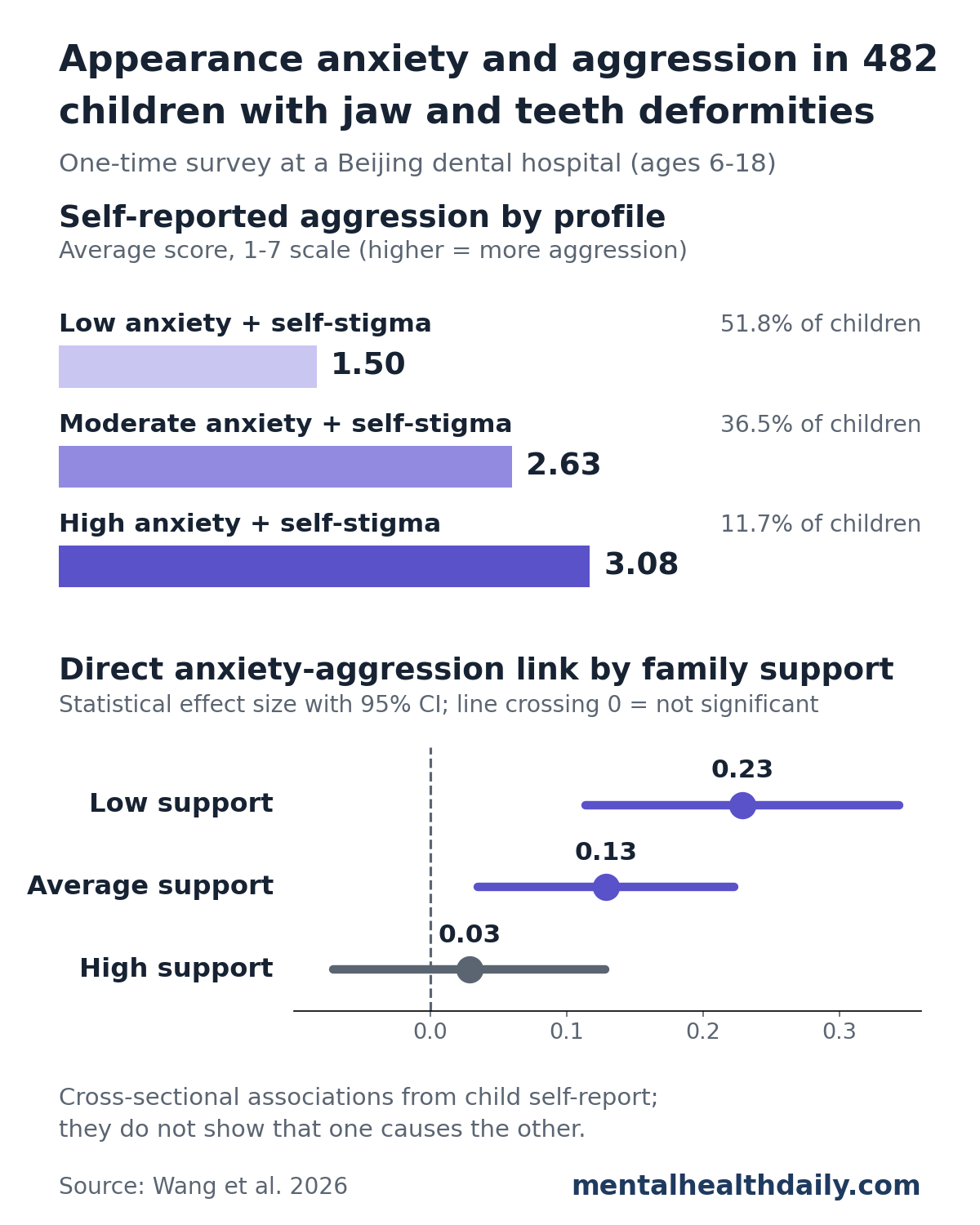
- Low appearance anxiety and self-stigma: 51.8% of children; average aggression 1.50
- Moderate appearance anxiety and self-stigma: 36.5%; average aggression 2.63
- High appearance anxiety and self-stigma: 11.7%; average aggression 3.08
All 3 groups differed significantly from each other on aggression (p < 0.001). Group membership accounted for about 32% of the spread in aggression scores.1
Did Self-Stigma Explain Part of the Link to Aggression?
Researchers tested a statistical model in which appearance anxiety relates to self-stigma, and self-stigma in turn relates to aggression. The model adjusted for sex, schooling, urban or rural home, family structure and caregiver education.1
At average family support, each 1-point rise in appearance anxiety went with:1
- 0.35 points more aggression through the self-stigma path (95% CI 0.23 to 0.48)
- 0.13 points more aggression through the direct path (95% CI 0.04 to 0.22; p = 0.007)
In other words, most of the statistical link between appearance anxiety and aggression ran through self-stigma.
Wang and colleagues suggest that children who are anxious about their looks may come to see themselves as flawed, and that shame and anger then come out as aggression.
Because all measures came from 1 survey, this is a pattern in the data rather than a tested sequence.
The order could also run the other way: aggressive behavior can draw peer rejection, which could feed both anxiety and self-stigma. Wang and colleagues note that such reverse or 2-way paths are possible.1
Did Family Support Weaken the Link Between Appearance Anxiety and Aggression?
Family support changed the direct link more than the self-stigma path. The direct link between appearance anxiety and aggression was:1
- Low family support: 0.23 (95% CI 0.11 to 0.34), significant
- Average family support: 0.13 (95% CI 0.04 to 0.22), significant
- High family support: 0.03 (95% CI −0.07 to 0.13), no longer significant
The self-stigma path stayed significant at every level of family support. It shrank only slightly, from 0.38 at low support to 0.32 at high support. That small drop was still statistically significant (index of moderated mediation −0.020, 95% CI −0.038 to −0.005).1
An extra analysis by age found that the link between more family support and less aggression was strongest in children aged 6 to 9 (r = −0.184).
It was weaker at ages 10 to 13 (r = −0.124) and absent at ages 14 to 18 (r = 0.076, not significant). Only 69 children were in the oldest group, and the authors call this analysis exploratory.1
A Surprising Result for Family Support
Children in the high appearance anxiety and self-stigma group reported the most family support (5.67), and the moderate group the least (5.15). The low group fell in between (5.41).1
Only the gap between the moderate and high groups was significant (p = 0.048), and group membership explained just 1.4% of the spread in family support scores. Wang and colleagues call it a weak result and offer 3 possible explanations:1
- Families respond to distress. Parents may step up support after they see a child struggling, so the most distressed children get the most support.
- Overprotection. Close parental monitoring can feel like support to a child while also reinforcing a sense of being vulnerable.
- Measurement limits. Most children rated family support near the top of the scale, which leaves little room to detect real differences.
Why These Results Show Links, Not Causes
The authors list several limits, and a few more follow from the study’s design:1
- One time point. A single survey cannot show whether appearance anxiety came before aggression or the other way around.
- Self-report only. Children may have under-reported aggression or over-reported family support. No parent or teacher ratings were collected.
- Overlapping measures. Appearance anxiety and self-stigma correlated at r = 0.847, so the 2 scores capture much of the same thing. The self-stigma items were also borrowed from a questionnaire about mental health stigma rather than one built for appearance.
- A narrow sample. All children came from 1 top-tier hospital in Beijing; 95.2% lived in cities, 96.7% lived with both parents, and 79.0% had a caregiver with a bachelor’s degree or higher.
- No detail on diagnosis. Specific types of deformity and objective severity were not recorded, so the results cannot be broken down by condition.
- Low aggression overall. Even the high group averaged about 3 out of 7, below the midpoint, so most children reported little aggression.
Should Dental Clinics Check Children for Appearance Anxiety?
Earlier research has linked visible dental differences to teasing.2 This survey adds a link between worry about appearance and self-reported aggression in children being treated for these conditions.1
The authors recommend that pediatric dental and orthodontic clinics screen for appearance anxiety and self-stigma, and that support for children involve their families. The study did not test screening or any family program, so whether these steps reduce aggression is still unknown.1
For parents, the practical point is simple: a child’s worry about their teeth or jaw can be worth asking about, alongside the dental treatment itself.
A pediatrician or child mental health professional can help when anxiety about looks, shame or anger seems to be affecting daily life.
References
- Wang W, Zhang J, Xia B, Zhu J. Social appearance anxiety and aggressive behavior in children with dentofacial deformities: a mediation and profile analysis of family support and self-stigma. Frontiers in Public Health. 2026;14:1914699. doi:10.3389/fpubh.2026.1914699
- Tristão SKPC, Magno MB, Pintor AVB, et al. Is there a relationship between malocclusion and bullying? A systematic review. Progress in Orthodontics. 2020;21:26. doi:10.1186/s40510-020-00323-7