
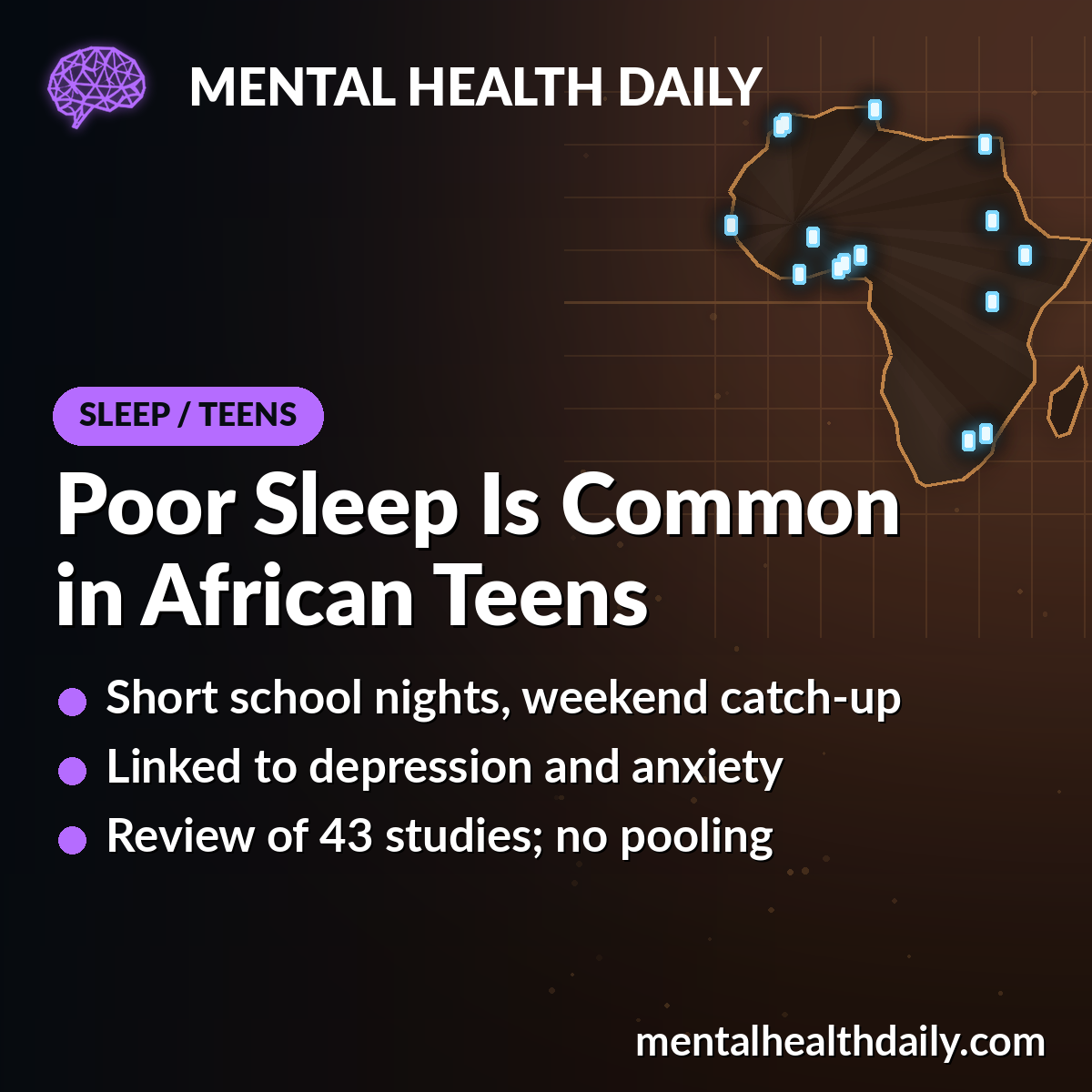
Poor sleep is common among teens across Africa, and it shows up alongside depression, anxiety and weaker school performance. That is the picture from the first scoping review to map the continent’s adolescent sleep research, which found 43 studies.1
Research Highlights
- Small evidence base: 43 studies of 10- to 19-year-olds from 2000 to early 2025, about two-thirds of them cross-sectional surveys, and none from Central Africa.1
- Short school nights: weekday sleep usually fell below the recommended 8 to 10 hours, with longer catch-up sleep on weekends.1
- Poor sleep quality was widespread: 38% to 94% of teens scored as poor sleepers in 5 studies that used the same questionnaire.1
- Screens at bedtime stood out: device use near bedtime, a hot or noisy bedroom, school schedules and chronic illness were the main risk factors the review identified.1
- Mental health links: poor sleep went along with depression and anxiety, but this rests on a handful of one-time surveys that cannot show which came first.1
What the Review Covered
A scoping review maps what research exists on a topic. It does not grade study quality or pool results into one number, so it shows patterns and gaps rather than effect sizes.
The team, led by Oluwatosin Olorunmoteni at Obafemi Awolowo University in Nigeria and the University of the Witwatersrand in South Africa, searched 5 databases from their start dates to early 2025. After screening 921 titles and 78 full texts, they kept 43 studies on adolescents aged 10 to 19 living in Africa. The review was published in PLOS One in September 2026.1
- Where: 19 studies from North Africa, 13 from West Africa, 7 from Southern Africa, 3 from East Africa and none from Central Africa. Nigeria, South Africa, Egypt and Tunisia contributed the most.
- When: one study in 2000, rising to 22 published from 2021 to 2025.
- How: 67.4% were cross-sectional, and most relied on questionnaires. Only 6 used polysomnography (an overnight lab sleep study), and a handful used activity trackers or other wearable sensors.
School Nights Run Short, Weekends Make Up the Difference
Sleep duration was the most studied topic. Most studies reported average school-night sleep below the 8 to 10 hours recommended for teens, followed by longer sleep on weekends.1
- Southeastern Nigeria: 7.8 hours on weekdays vs. 8.7 hours on weekends
- Southwestern Nigeria: 44.4% slept too little on weekdays, compared with 5.5% on weekends
- Morocco: 7.8 hours on weekdays, 9.6 hours on weekend nights and 9.5 hours over summer break
- South Africa: 7.5 hours in bed on school nights vs. 7.9 hours on weekend nights among 825 students
That weekday-to-weekend swing reflects weekend catch-up sleep: teens build up sleep debt during the school week and pay it back on days off. The same pattern shows up in teens elsewhere in the world, the authors note.1
City teens tended to sleep less. In a southwestern Nigerian study of 900 students, 79% had insufficient sleep overall, and urban teens averaged 6.55 hours a night vs. 7.23 hours for rural teens. Across studies, though, rural teens more often reported worse sleep quality, and bedtime patterns by location were inconsistent.1
Poor Sleep Quality Was Widespread
The Pittsburgh Sleep Quality Index (PSQI) was the most common validated sleep questionnaire in the review. A score above 5 marks someone as a poor sleeper. Five studies reported how many teens crossed that line, and the share ranged from 38% in Ethiopia to 94% in Tunisia.1
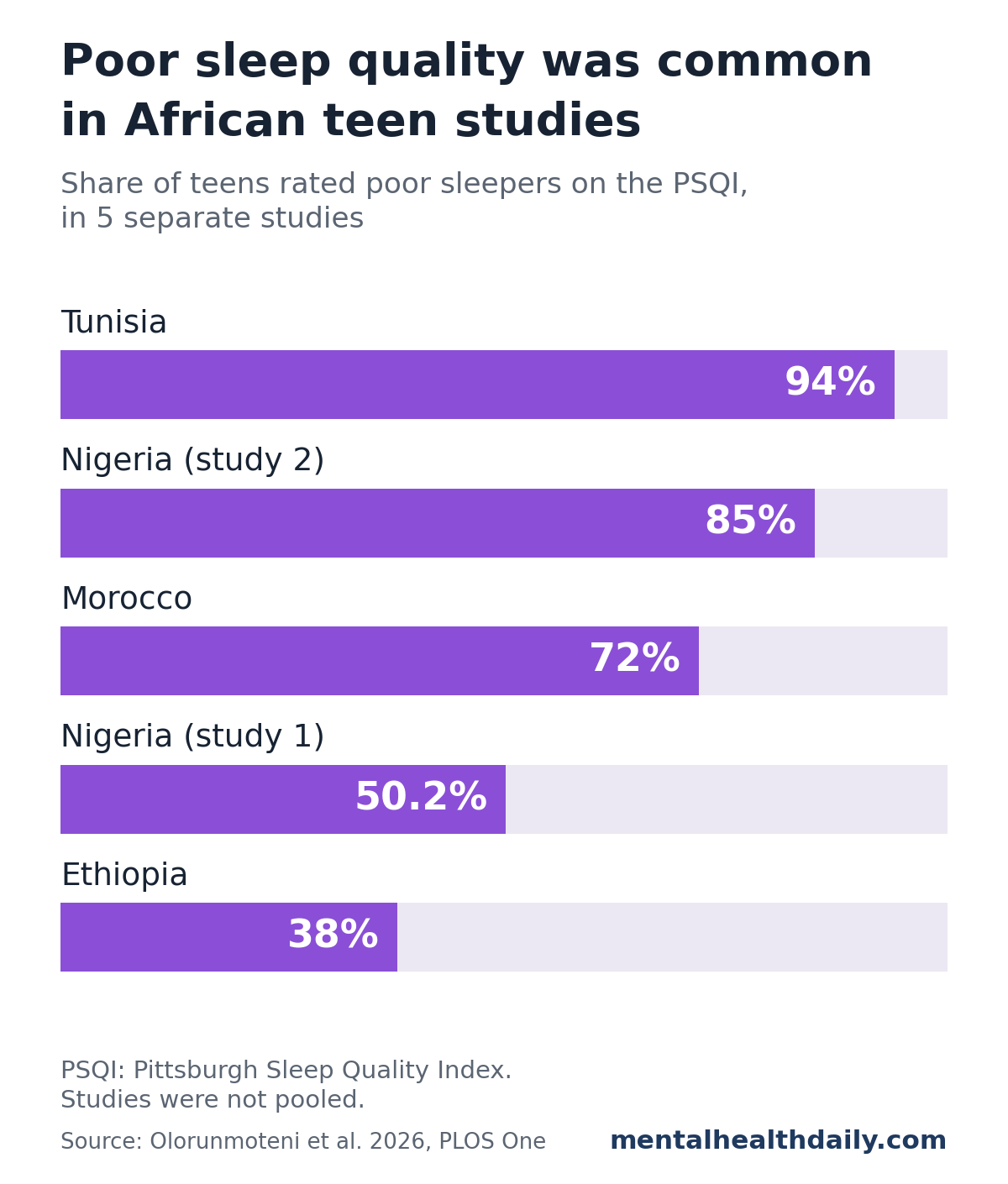
These numbers come from different schools, ages and years, so the spread partly reflects how each study sampled and measured. Even so, 4 of the 5 found poor sleep quality in at least half of the teens surveyed.
Sleep problems beyond quality also turned up. Among 765 Egyptian children and teens, 65.6% had symptoms suggesting a sleep disturbance, most often trouble falling or staying asleep. Insomnia, parasomnias (such as sleepwalking and sleep talking) and sleep-related breathing problems such as snoring were the most commonly reported disorders.1
Screens, Stimulants and School Schedules
Using electronic devices near bedtime was the most consistent risk factor. Device use within an hour of bedtime was reported by 78% of Moroccan teens and by 62.9% and 80.9% of teens in two Nigerian studies.1
- Phones late at night: linked to poor sleep quality in Morocco, and not using a screen at bedtime predicted getting enough sleep in Nigeria
- Internet addiction and substances: in 799 Ethiopian teens, internet addiction (adjusted odds ratio 3.33), inhalant use disorder (1.98) and khat use disorder (1.74) were each linked to poor sleep quality; khat is a stimulant leaf chewed in East Africa
- School timing: in Nigeria, later school closing times and private school attendance were linked to worse sleep quality, and 81.7% of students said daytime sleepiness made it hard to concentrate in class
- The bedroom: noise from household power generators, sharing a bed and a hot room also came up as barriers to good sleep
Evening light from screens delays the body clock, so teens fall asleep later but still have to get up for school. The authors point to that mechanism, described in research outside Africa, as the likely reason screen use and short sleep travel together.1
How Sleep Lined Up With Depression and Anxiety
Mental health was one of the review’s stated outcomes, and the evidence on it is thin but consistent in direction.
Depression. In a 2023 survey of 448 secondary school students in southwestern Nigeria, 85% had poor sleep quality, and depression scores on the PHQ-9 questionnaire were the only factor that stayed significantly linked to sleep quality in the final statistical model.2
Anxiety. In the Egyptian study of 765 young people, conducted during COVID-19 lockdowns, 48% had anxiety symptoms, and sleep disturbance scores were linked to anxiety.1
Childhood adversity. In a Tunisian study of older teens, those with 3 or 4 adverse childhood experiences (such as abuse or witnessing violence at home) had about 3 times the risk of sleep disturbance, and those with 5 or more had 11.9 times the adjusted odds. Internet addiction explained part of that link (18.3% overall and 30% in girls).1
Each of these comes from one cross-sectional survey, so none can show whether poor sleep feeds low mood or the other way around. Longer-term studies elsewhere suggest both. A 2024 meta-analysis of longitudinal teen studies found that better sleep predicted fewer later internalizing symptoms, such as anxiety and depression (r = −0.20), and those symptoms predicted worse sleep later (r = −0.21).3
One trial so far. The only trial in the review with a mental-health focus was a South African pilot in 61 teens with PTSD and disturbed sleep. A group sleep program run by nurses and counselors did not beat the control group on sleep quality, since both groups improved. Its effect on PTSD symptoms was mixed: the overall group-by-time difference was not significant, but PTSD scores were about 9 points lower than the control group’s after treatment and 11 points lower one month later. About 3 in 10 participants dropped out.4
Limitations
- No quality grading or pooled effects. As a scoping review, it lists findings study by study, and the authors did not assess the strength of the evidence.
- Mostly snapshots. Two-thirds of the studies were one-time surveys, so links between sleep, mood and grades cannot show cause.
- Self-report and mixed tools. Most studies used questionnaires, some with only a few home-made questions, which makes comparisons across countries hard.
- Uneven coverage. Most studies came from North and West Africa, with very few from East Africa and none from Central Africa, and most samples were small.
- Thin mental-health evidence. The depression, anxiety and childhood-adversity findings each rest on a single study.
- Language and source limits. Grey literature was excluded, and all but one included study was in English.
What Comes Next for Teen Sleep Research in Africa
The authors call for larger, longer studies using objective measures such as actigraphy (a wrist sensor that tracks sleep and wake) and lab sleep studies, plus questionnaires adapted to local realities like mosquitoes, khat and household noise. They also flag school schedules and bedtime screen use as practical targets for future programs.1
For families, the findings echo what is known about teen sleep elsewhere: short school nights are common, and screens at bedtime make them shorter. A teen with ongoing sleep trouble or persistent low mood should see a doctor or mental health professional.
References
- Olorunmoteni OE, Popoola BO, Daniel JOI, et al. Patterns, determinants and associated outcomes with adolescent sleep health in Africa: a scoping review. PLOS One. 2026;21(9):e0353671. doi:10.1371/journal.pone.0353671
- Olorunmoteni OE, Fehintola FO, Seun-Fadipe C, Komolafe MA, Mosaku KS. Sleep quality and its relationship with school schedules and mental health of Nigerian secondary school adolescents. Journal of Clinical Sleep Medicine. 2023;19(11):1895–1904. doi:10.5664/jcsm.10708 (PubMed)
- Bacaro V, Miletic K, Crocetti E. A meta-analysis of longitudinal studies on the interplay between sleep, mental health, and positive well-being in adolescents. International Journal of Clinical and Health Psychology. 2024;24(1):100424. doi:10.1016/j.ijchp.2023.100424 (PubMed)
- Rossouw J, Suliman S, Nothling J, et al. A pilot randomised control study to investigate the effect of the South African Adolescence Group Sleep Intervention (SAASI) on adolescent sleep and PTSD. European Journal of Psychotraumatology. 2024;15(1):2350217. doi:10.1080/20008066.2024.2350217