
Family members who care for someone with severe or advanced COPD commonly report anxiety, depression, fatigue and isolation, according to a 2026 narrative review of 96 publications. Support aimed at caregivers themselves is still thinly tested.1
Research Highlights
- Distress is common on both sides: caregivers report anxiety, depression, poor sleep, fatigue and constant vigilance, and in some studies their distress approaches or exceeds the patient’s. Long care hours stood out: in one study, caregivers giving more than 20 hours a week were at particular risk of depression.1
- Breathlessness drives much of it: patients describe fear and loss of control during breathless episodes, and caregivers describe helplessness when they cannot relieve them.1
- Patients and caregivers often read symptoms differently: agreement was only fair to moderate for individual pairs, and weakest for breathlessness, anxiety and depression.1
- Research on caregivers is mostly descriptive: an earlier systematic review found 27 quantitative caregiver studies, but only 1 tested an intervention and only 2 followed caregivers over time.1
- Family-inclusive rehab has the best support so far: a randomized trial of family-based pulmonary rehabilitation improved family coping, while caregiver-specific psychological, digital and long-term support remains under-tested.1
What Caregivers Do at Home for People With Severe COPD
Chronic obstructive pulmonary disease (COPD) is a long-term lung disease, most often caused by smoking, in which damaged airways and air sacs make it progressively harder to breathe. People with mild COPD often manage on their own. Severe or advanced disease can make everyday life depend on another person.1
Yi Zu et al., at Tianjin Medical University in China, reviewed what is known about these patient–caregiver dyads: the pair formed by a person with COPD and the unpaid family member or friend who helps them. They searched PubMed and guideline sources through March 2026 and drew on 96 publications, from small interview studies to randomized trials and clinical guidelines.1
The review focused on people most likely to need help at home, including those with:1
- Disabling breathlessness and loss of independence
- Frequent flare-ups (exacerbations), the sudden worsening episodes that often lead to hospital care
- Long-term oxygen therapy for persistently low blood oxygen
- Home non-invasive ventilation (NIV), a machine that pushes air through a mask, often overnight, to help clear carbon dioxide
- Frailty, several other illnesses, or a move toward palliative care
For these patients, caregivers may help with walking, medications, transport, talking with clinicians, spotting early signs of a flare-up, and running oxygen or ventilation equipment. Night-time tasks such as checking breathing or answering machine alarms can be especially draining.1
Anxiety, Depression and Constant Alertness in COPD Caregivers
Across studies from Europe, Asia and North America, caregivers of people with advanced COPD reported anxiety, depression, sleep problems, fatigue and a state of ongoing alertness. Some interview studies describe this as being “never at ease,” especially when professional help is fragmented or hard to reach.1
Caregiver distress was heavier in some situations:1
- Severe breathlessness or frequent flare-ups in the patient
- Caregivers who were older, female or socially isolated
- Many hours of care: in a study of caregivers of patients hospitalized for a flare-up, the patient’s dependence after discharge predicted caregiver depression, and more than 20 hours of care a week was a particular risk
After intensive care: in a multicenter study, caregivers of COPD patients who survived an ICU stay reported high anxiety at discharge, and clinically important symptoms were still present 90 days later. Post-traumatic stress symptoms were also common.1
Isolation and money worries add to the strain. Caregivers cut back on work, friends and leisure as the patient becomes more homebound, and they absorb costs such as oxygen electricity, transport and lost earnings.1
How Common Is Anxiety Among COPD Caregivers?
The review did not pool prevalence figures, but a French study shows the scale. Among 138 caregivers of mostly severe COPD patients joining a home rehabilitation program, 40.6% had probable clinical anxiety, 45.6% had abnormal fatigue and 39.1% reported high burden. Probable depression was less common, at 11.6%.2
A study of 80 patient–caregiver pairs found similar levels of anxiety in patients and caregivers, while patients had more depression symptoms. Caregivers’ anxiety was linked to worse physical quality of life in the patient they cared for.3 That study was cross-sectional, so it shows a link rather than a direction of cause.
COPD Patients and Caregivers Often See Symptoms Differently
In advanced COPD, patients and caregivers agreed reasonably well as groups, but agreement within individual pairs was only fair to moderate. It was weakest for symptoms that are hard to see from outside: breathlessness, anxiety and depression. Reports from caregivers who are anxious, depressed, not living with the patient, or not a spouse may overestimate the patient’s distress.1
These gaps shape real decisions, such as whether a flare-up needs emergency care. Caregivers often decide when to seek help, and conflict can arise when the patient wants to stay home.1
Well-meant help can also backfire:1
- Overprotection: doing too much for the patient or restricting activity, which can lower confidence and increase dependence
- Protective buffering: hiding one’s own worries to avoid upsetting the partner, which can shut down open conversation
In a study of patients and partners, disagreement between the two about these unsupportive behaviors was linked to more patient distress. Dyadic coping, the way a couple talks, solves problems and keeps a sense of “we,” is associated with better quality of life and less distress, but the evidence comes mainly from small, self-report studies.1
Which Support Has Been Tested for COPD Patients and Caregivers
Psychological distress is common in both partners but is under-recognized and undertreated. The review found that evidence is strongest for programs built around the patient that also bring in the family, and weakest for support designed for caregivers.1
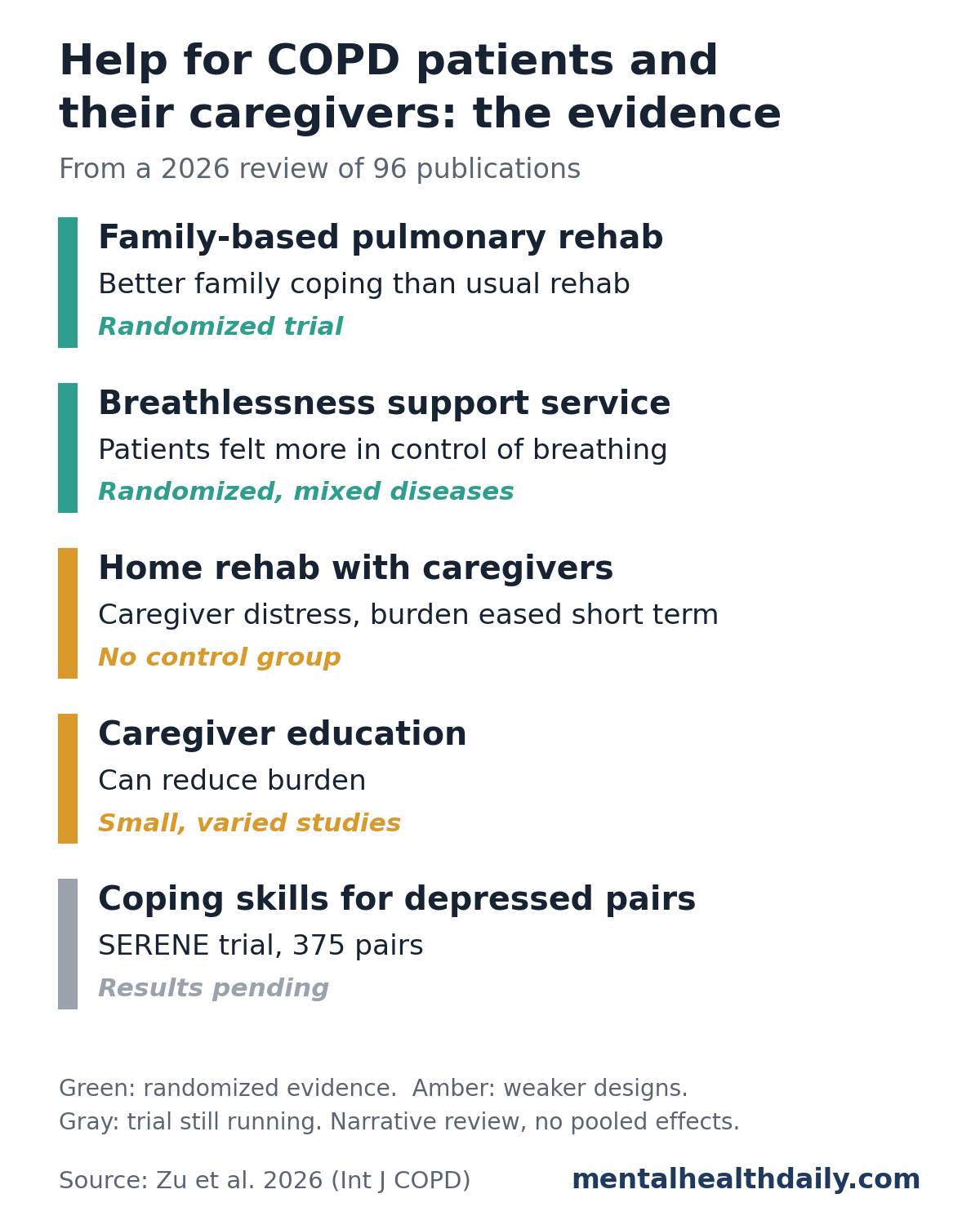
Pulmonary rehabilitation is a supervised program of exercise, breathing techniques and education for people with lung disease. In a randomized trial, adding family psychosocial support and education to rehabilitation improved family coping more than standard rehabilitation.1
A French home-based program went further and offered caregivers their own support, including cognitive behavioral techniques, counseling and mindfulness. Caregiver anxiety scores fell from 9.5 to 8.5 and depression scores from 5.2 to 4.3 over 8 weeks, with burden and fatigue also improving. There was no comparison group of caregivers, so the change cannot be credited to the program with confidence.2
Other options the review covered:1
- Breathlessness services: an integrated palliative and respiratory service helped patients feel more in control of breathlessness in a randomized trial, though it included several diseases and caregiver outcomes were not central.
- Caregiver education: structured teaching on symptoms, medications, equipment and flare-up plans can reduce burden, but studies are small, varied and short.
- Digital support: telehealth and online support may help homebound families, though technology problems, time and privacy concerns limit use.
- Palliative care: caregivers value education, breathlessness support and having someone to contact, but trial results in COPD are mixed and often underpowered.
A large trial is now testing therapy for both partners. The SERENE trial in the United States will enroll 375 patient–support-person pairs in which the patient has elevated depressive symptoms. It compares 12 weeks of family-partnered Coping Skills Training with COPD education, by phone or video, and will also track caregiver distress, loneliness and relationship quality. Results are not yet available.1
Common Caregiver Burden Scale Fits COPD Poorly
Much of this research measures strain with the Zarit Burden Interview, a 22-item questionnaire that was not developed for COPD. When researchers asked COPD caregivers to talk through each item, many items did not fit their lives:1
- Canada: 3 of 22 items were not understood, and 8 were irrelevant to at least one-third of caregivers.
- Portugal: 1 item was not understood, and 20 were irrelevant to at least one-third.
Two alternatives look more promising. The Informal Caregiver Burden Assessment Questionnaire (QASCI) tracked closely with the Zarit scale and with anxiety and depression scores in 50 COPD caregivers, though that validation came from a single country. The Carer Support Needs Assessment Tool asks what help caregivers need rather than scoring burden, and COPD carers rated all 15 of its areas as relevant.1
Limitations of This COPD Caregiver Review
- Narrative, not systematic: the researchers searched mainly PubMed and followed citations, without pooling numbers or formally rating study quality, so selection and language bias cannot be ruled out.
- Weak underlying studies: many caregiver studies are small, cross-sectional convenience samples that show links, not causes.
- Mixed severity: disease stage is inconsistently reported, so findings for oxygen users, ventilation users or frail patients are hard to separate.
- Imperfect measures: the most widely used burden scale fits COPD caregiving poorly.
- Narrow interventions: few programs were designed for caregivers, tested long term, or adapted for low-resource settings.
What This Means for Families Living With Severe COPD
Caregiver mental health deserves its own check. The review recommends that clinicians ask who helps the patient, what that person does, and how they are coping, including their sleep, anxiety, mood, finances and understanding of the emergency plan.1
Oxygen and home ventilation should come with training. When these are started, the review calls for structured caregiver education, written troubleshooting and emergency instructions, and a follow-up check on how the caregiver is managing.1
More involvement is not always better. Some patients live alone or prefer formal services, and some caregivers are frail or distressed themselves. The researchers argue for assessing the pair together when a caregiver is present, while protecting the patient’s independence.1
Caregivers with persistent worry, low mood or exhaustion can raise it with their own doctor or ask the patient’s respiratory team about family-inclusive rehabilitation or caregiver support services.
References
- Zu Y, Sun H, Luo D, Du Y. Patient–caregiver dyads in severe and advanced COPD: relationships, caregiving burden, and intervention support: a narrative review. International Journal of Chronic Obstructive Pulmonary Disease. 2026;21:624594. doi:10.2147/COPD.S624594
- Grosbois JM, Gephine S, Kyheng M, Le Rouzic O, Chenivesse C. Improving the wellbeing of caregivers of patients with COPD using a home-based pulmonary rehabilitation programme. ERJ Open Research. 2022;8(4):00255-2022. doi:10.1183/23120541.00255-2022
- Ivziku D, Clari M, Piredda M, De Marinis MG, Matarese M. Anxiety, depression and quality of life in chronic obstructive pulmonary disease patients and caregivers: an actor–partner interdependence model analysis. Quality of Life Research. 2019;28:461–472. doi:10.1007/s11136-018-2024-z