
Weekly team medication reviews on psychiatric wards were linked to patients leaving the hospital on slightly fewer drugs, with the clearest drops in benzodiazepines and other psychiatric medications. A French hospital study compared 120 inpatients’ stays before and after the reviews began.1
Research Highlights
- About 1 fewer drug per patient: before the reviews, patients were discharged on 0.4 more drugs than they arrived with; after, on 0.7 fewer, a difference of 1.1 drugs (p = 0.045).1
- Small overall effect: the standardized effect size was d = 0.18, and results varied widely from patient to patient (SD 6.0).1
- Bigger drops in targeted drugs: psychiatric drugs overall fell by 1.5 per patient, benzodiazepines by 0.8, and anticholinergic drugs by 0.7 compared with the earlier stay.1
- No change in antidepressants or mood stabilizers: these classes, along with painkillers, did not change significantly.1
- Observational design: a single-center before-and-after comparison with no control wards, and no measures of symptoms, side effects, or readmissions.1
What a Multi-Professional Medication Review Is
A multi-professional medication review (MPMR) is a scheduled meeting where the whole care team goes through every drug a patient takes and asks whether each one still earns its place. The goal is to catch drugs that no longer help, add side effects, or interact badly with other prescriptions.
At Le Vinatier Hospital near Lyon, France, the reviews started on January 1, 2020, on 4 psychiatric wards.1 They ran like this:
- Who: clinical hospital pharmacists, psychiatrists, general practitioners, nurses, and other staff involved in care
- When: weekly, for about 1.5 to 2 hours, covering every inpatient on the ward
- How: a nurse summarized each patient’s current state (and, when possible, the patient’s own view), then the team discussed symptoms, physical health problems, and side effects before updating the treatment plan together
- Follow-up: the pharmacist answered any drug questions in writing within the week
That simultaneous, whole-ward format differs from the usual sequence in which a pharmacist flags a problem, a nurse adds context, and a physician decides later.1
How the Study Compared Stays Before and After the Reviews
Lebrat et al. searched hospital records from August 2017 to December 2023 for adults who had one psychiatric stay before the reviews began and a later stay in the same ward with at least one review. Each patient served as their own comparison.1
- Sample: 120 patients, 59% men, median age about 45
- Diagnoses: schizophrenia and related disorders (47%), mood disorders (14%), stress-related and anxiety disorders (9%), personality disorders (9%), substance use disorders (8%), other (13%)
- Stay length: at least 2 weeks; median 42 days before and 36 days after, not a significant difference
- Main outcome: the change in the number of prescribed drugs from admission to discharge, compared between the 2 stays
Measuring the change within each stay, rather than just the discharge list, captures what the team actually added or removed during the hospitalization.
Patients Left on 1.1 Fewer Drugs After Reviews Began
During stays before the reviews, patients typically went home on slightly more drugs than they arrived with (+0.4). During stays with reviews, that reversed: they went home on 0.7 fewer. The paired difference was 1.1 drugs.1
An adjusted model that accounted for age, sex, length of stay, number of reviews, and ward confirmed the link (p = 0.001). None of those factors, including how many reviews a patient received, significantly changed the result.1
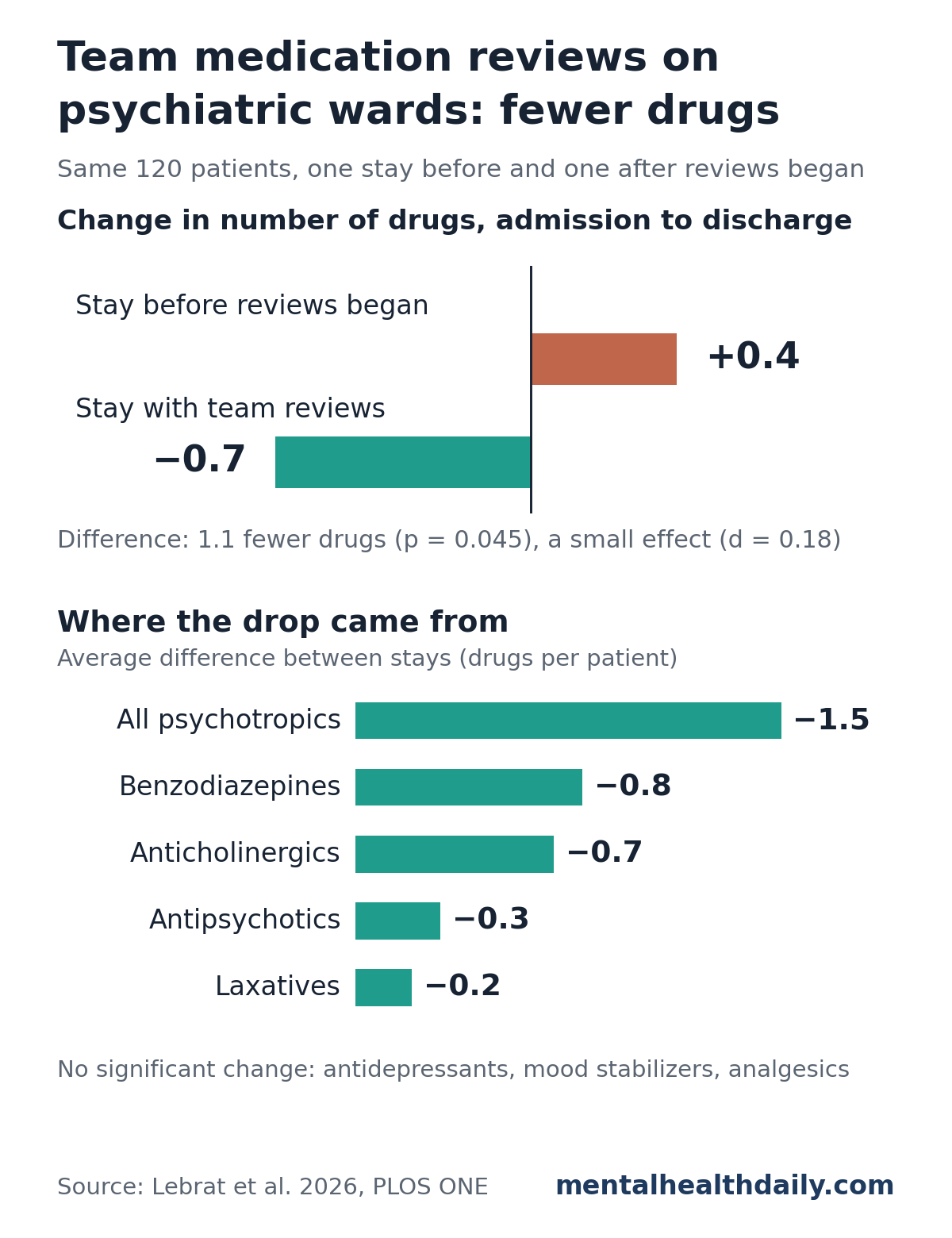
The overall effect was small (d = 0.18, where 0.2 is conventionally called small). The spread was wide, so some patients lost several drugs while others gained some.
Benzodiazepines and Anticholinergic Drugs Drove the Drop
The drop was concentrated in the drug classes that psychiatric deprescribing usually targets. Compared with the earlier stay, the average change per patient was:1
- All psychotropics: −1.5 (p < 0.001), confirmed in the adjusted model
- Benzodiazepines: −0.8 (p < 0.001)
- Anticholinergic drugs: −0.7 (p = 0.009)
- Antipsychotics: −0.3 (p = 0.009)
- Laxatives: −0.2 (p = 0.013)
Antidepressants, mood stabilizers, and painkillers showed no significant change.1
Benzodiazepines are sedatives such as lorazepam and diazepam, used for anxiety, agitation, and sleep. Long-term use can lead to dependence and oversedation. The researchers note that benzodiazepine use in France is considered excessive.1
Anticholinergic drugs block the chemical messenger acetylcholine. On psychiatric wards they are mainly given to counter antipsychotic side effects such as movement problems or drooling, but they can dull memory and thinking.1
A 2025 meta-analysis of 40 studies found that a heavier anticholinergic drug burden was linked to worse overall thinking ability in people with psychosis (r = −0.37). In 9 tapering studies (186 patients), reducing these drugs improved working memory, verbal learning, and executive function.2 Those authors also called for randomized trials to confirm the benefit.
The researchers suggest the small antipsychotic drop reflects a common goal: moving patients from 2 or more antipsychotics toward a single one, rather than stopping treatment.1
A sex difference: in the adjusted model, men had a larger drop in psychiatric drugs than women. The study was not designed to explain why.1
Other Medication Review Studies: Prescriptions Change, Hard Outcomes Less Clear
- Pharmacist on psychiatric ward rounds: a Slovenian before-and-after study of 224 psychiatric inpatients found that psychiatrists accepted 94% of a clinical pharmacist’s 315 recommendations, and the number of identified actual and potential drug-related problems fell by about 94%. The most common recommendations concerned antipsychotics and antidepressants.3
- Randomized trials of medication review: a meta-analysis of 31 randomized trials, mostly outside psychiatry, found that medication reviews reduced drug-related problems and led to fewer drugs than usual care, but did not change mortality, hospital admissions, physical or cognitive functioning, or quality of life.4
The French result is consistent with both. Team reviews reliably change prescriptions, and the harder question is whether those changes make patients better off.
Limitations of This Before-and-After Study
Evidence strength: a single-hospital observational study. It shows prescriptions fell after the reviews started, but it cannot prove the reviews caused the drop or that patients benefited.1
- No control wards. Every “before” stay came before 2020 and every “after” stay came later. Broader prescribing trends over those years could explain part of the change, and the design cannot separate them from the reviews.
- Illness changes over time. A patient’s second admission may involve a different phase of illness, which alone can change what drugs they need.
- Repeat patients only. Requiring 2 admissions may have favored more severe or complex cases.
- Counts, not outcomes. The study did not track symptoms, side effects, falls, relapse, or readmission. It also did not capture dose reductions or changes to as-needed drugs.
- Many comparisons. Only the total drug count and psychotropic count were checked with adjusted models; the other drug classes relied on simpler tests without correction for multiple comparisons.
The researchers conclude that randomized studies with patient outcomes are needed to confirm the benefit.1
What This Means for Patients and Families
- Ask for a full medication review. During a psychiatric hospital stay, it is reasonable to ask whether the team has looked at every drug, including sleep aids and side-effect medications.
- Do not stop drugs on your own. Benzodiazepines in particular can cause withdrawal if stopped suddenly; changes should be planned with the prescriber.
- Fewer drugs is a means, not the goal. The aim is the right drugs at the right doses; this study shows fewer prescriptions, not yet better health.
References
- Lebrat M, Cohen A, Megard R, Franck N, Dussart C, Perin-Dureau M. Impact of multi-professional medication reviews (MPMRs) on medication prescriptions in psychiatry. PLOS ONE. 2026;21(9):e0358539. doi:10.1371/journal.pone.0358539
- Mancini V, Latreche C, Fanshawe JB, et al. Anticholinergic burden and cognitive function in psychosis: a systematic review and meta-analysis. American Journal of Psychiatry. 2025;182(4):349–359. doi:10.1176/appi.ajp.20240260
- Stuhec M, Tement V. Positive evidence for clinical pharmacist interventions during interdisciplinary rounding at a psychiatric hospital. Scientific Reports. 2021;11:13641. doi:10.1038/s41598-021-92909-2
- Huiskes VJB, Burger DM, van den Ende CHM, van den Bemt BJF. Effectiveness of medication review: a systematic review and meta-analysis of randomized controlled trials. BMC Family Practice. 2017;18:5. doi:10.1186/s12875-016-0577-x