
Toddlers moved out of Romanian orphanages into foster care handled everyday life better at age 18 than those left in the usual system, scoring 12 points higher on a standard measure of real-world skills in the first randomized trial of foster care vs. institutional care.1, 9 Both the foster care and care-as-usual groups still lagged far behind peers never placed in an institution.
Research Highlights
- Foster care had a lasting effect: 16 years after randomization, the foster care group averaged 88.7 on the Vineland adaptive behavior scale vs. 76.5 for care as usual (p = .019), on a scale where the population average is 100.1
- Nearly 3 years of everyday-skills age: At an actual age of about 19, the foster care group functioned like typical 15-year-olds and the care-as-usual group like 12.5-year-olds; 41% of the care-as-usual group rated below age 12.1
- Communication and social skills moved most: Foster care scored about 12 points higher on both. Daily living skills, such as self-care, were 9 points higher, a gap that did not reach significance.1
- The gap with never-institutionalized peers stayed large: Young adults who had ever lived in an institution scored 24 points (1.6 standard deviations) below Bucharest peers raised at home.1
- Timing mattered less by 18 than caregiving: Among children placed in foster care between about 6 and 31 months of age, the age at placement did not predict adult functioning, while caregiving quality in adolescence accounted statistically for about 74% of the foster care advantage.1
Adaptive functioning is the practical side of development: holding a conversation, reading social cues, looking after yourself, getting through a day without someone managing it for you. For a young adult leaving care, those skills often decide whether independent living is possible at all.
Earlier research had already shown that orphanage rearing lowers IQ. Whether it also damages everyday competence into adulthood, and whether a family placement can prevent that, is a separate question. Hare et al. used the Bucharest Early Intervention Project to answer it with a randomized design.1
How the Bucharest Early Intervention Project Worked
The Bucharest Early Intervention Project (BEIP) began in the early 2000s, when Romania still housed large numbers of abandoned infants in state institutions.
Researchers assessed 136 children living in all 6 institutions for young children in Bucharest, then randomly assigned half to a foster care program and half to care as usual.1, 5 The children were about 22 months old on average when randomized, with a range of roughly 6 to 31 months.
Foster care was extremely limited in Bucharest at the time, so the investigators built and financed their own network.4 Their program had several features ordinary foster systems often lack:1
- Screened, trained parents: Foster parents passed background checks and were trained by a Bucharest nonprofit on the behavior and routines of children coming out of institutions.
- Weekly home visits: Social workers followed a manual on sensitive caregiving, attachment, and behavior problems, with supervision from US clinicians.
- A handoff at 54 months: When the formal trial ended, the families moved into government-supported foster care, where support was not always kept up.
"Care as Usual" Often Meant Leaving the Institution Later
Care as usual did not mean 18 years in an orphanage. Children in that group stayed in institutions at first, but over the following years many were placed in newly created government foster care. Some children from both groups returned to their biological parents, and some in the foster care group moved back into institutions.4
The age-18 informants show how scattered the care-as-usual group became. Their Vineland ratings came from institutional caregivers in 26% of cases, biological mothers in 22%, foster mothers in 13%, and adoptive parents in 7%.1
The analysis followed an intent-to-treat design, meaning children were compared by the group they were randomized to, not the care they ended up receiving. That makes the result a test of offering early, well-supported foster care against the usual path. Because many care-as-usual children eventually left institutions too, the true benefit of family care over prolonged institutional life is probably larger than the measured gap.
Foster Care Raised Everyday Functioning by About 12 Points
At a mean age of 18.9, the researchers reassessed 134 young adults: 46 from care as usual, 47 from foster care, and 41 Bucharest peers who had never lived in an institution.1
They used the Vineland Adaptive Behavior Scales, a structured interview in which someone who knows the person well rates how often they perform everyday skills. Scores are set so the population average is 100 and 1 standard deviation is 15 points. Results by domain:1
- Overall (composite): 88.7 foster care vs. 76.5 care as usual, a 12-point gap (p = .019)
- Communication: 85.3 vs. 72.5, a 12.8-point gap (p = .014)
- Socialization: 90.4 vs. 78.8, an 11.6-point gap (p = .025)
- Daily living skills: 91.2 vs. 82.1, a 9.1-point gap that was not statistically significant (p = .112)
Measured against the scale's own spread, the communication gap equals about 0.85 standard deviations and the socialization gap about 0.77. In practical terms, almost 60% of the care-as-usual group scored in the "moderately low to low" range, while the foster care group averaged within 1 standard deviation of the population norm.1
The paper's discussion describes foster care as improving daily living scores as well. On the standard scores, that difference was not confirmed. On the age-based scores covered next, it was.
Care-as-Usual Group Functioned Like 12-Year-Olds
The Vineland also converts raw scores into age equivalents: the age at which a typical person shows the same level of skill. Because these scores top out near the late teens, the researchers used Tobit models, a statistical method that estimates how far scores would have gone without that ceiling.1
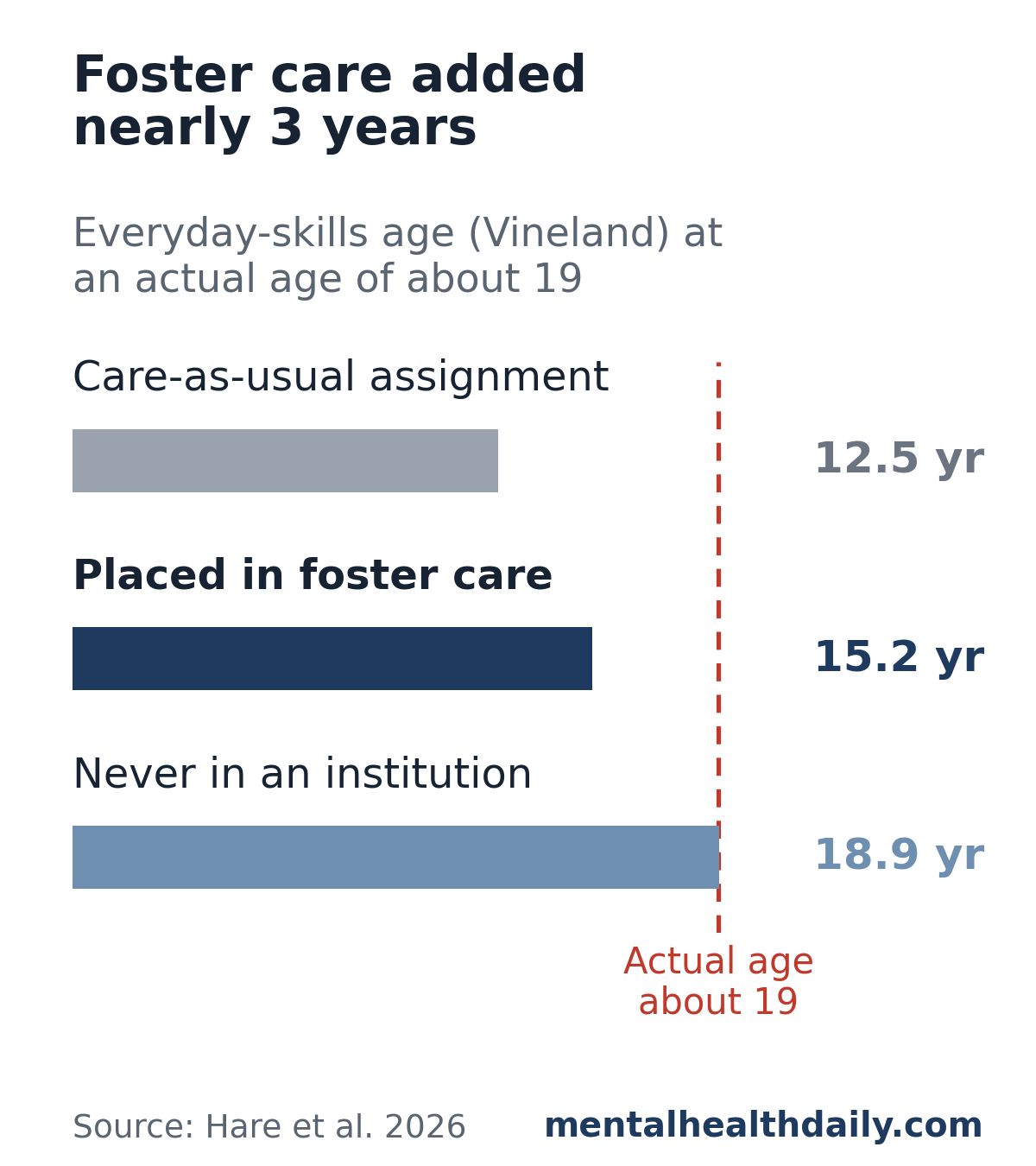
Foster care placed participants 2.7 years ahead on the overall age-equivalent score (p = .006), and the advantage held in every domain:1
- Communication: about 13 vs. 10 years
- Socialization: about 16 vs. 12 years
- Daily living: about 16.7 vs. 15.6 years
One Vineland item makes the socialization gap concrete. Asked whether the young adult responds to indirect hints in conversation, almost half of the care-as-usual raters answered "never," while over 60% of foster care raters answered "usually."1
Averages hide a wide spread. Care-as-usual age equivalents ranged from about 9 to 18 years across the Vineland composites, vs. about 12.5 to 17 in the foster care group, and the researchers noted that not every institution-exposed participant had adaptive difficulties.1
Foster Care Narrowed the Gap With Home-Raised Peers but Did Not Close It
Taken together, the young adults who had ever lived in an institution averaged 82.7 on the overall Vineland score vs. 106.6 for never-institutionalized peers. Their overall age equivalent was about 13.8 years vs. 18.9.1 That comparison is not randomized, since home-raised children differed in many ways besides institutional care, but its size is hard to explain away.
Earlier BEIP waves show the same pattern of real but partial recovery:
- IQ at 54 months: The first major report found care-as-usual cognition markedly below both the foster care and never-institutionalized groups.2
- Competence at 12: Across 7 domains including mental health, peer relations, and school performance, 56% of the foster care group vs. 23% of the care-as-usual group met the threshold for competent functioning.3
- Psychiatric symptoms at 12 and 16: Foster care lowered behavior-problem symptoms at 12 but not anxiety, depression, or ADHD symptoms.5 At 16, the care-as-usual group had more than twice the odds of any psychiatric disorder (odds ratio 2.48).6
- IQ at 18: The foster care group scored 9 points higher (73.5 vs. 64.7), yet the ever-institutionalized group still averaged 26 points below home-raised peers.4
A different kind of study reaches a similar adult picture. The English and Romanian Adoptees study followed Romanian children adopted from institutions into UK families. Those who had spent more than 6 months in an institution still had elevated autism-like symptoms, inattention and overactivity, and indiscriminate friendliness toward strangers at ages 22 to 25, along with more unemployment and mental health service use than UK adoptees.7
That study also found hopeful signals. Rates of cognitive impairment (IQ below 80) in the longer-deprivation group had returned to normal levels by young adulthood, and about 1 in 5 of those adoptees were free of problems at every assessment.7 Recovery is uneven, not absent.
Does Age at Placement Matter?
Earlier placement looked clearly better in childhood. By 18, the evidence is more mixed.
- At 42 and 54 months, cognitive gains were most marked in the children placed youngest.2
- At age 12, 79% of children placed in foster care before 20 months met the competence threshold, vs. 46% of those placed later.3
- At age 18, each month of later placement was linked to slightly lower IQ, about 0.8 points, a borderline result (p = .050).4
- At age 18 on the Vineland, age at placement and placement stability did not predict adaptive functioning within the foster care group. Across all ever-institutionalized participants, a larger share of childhood spent in institutions was linked to worse functioning.1
A global review of institutional care found the same tension. Longer institutional stays predicted worse outcomes and less recovery, but the available studies could not separate how long children stayed from how old they were when they left.8
BEIP cannot fully settle this either. Every child spent months in an institution before randomization, placement ages spanned only about 2 years, and these timing analyses were exploratory rather than randomized. The defensible reading: less time in institutional care is better, and very early placement helped most in childhood, but no sharp cutoff after which family care stops helping has been established.
Caregiving Quality Explained Most of the Foster Care Effect
At ages 12 and 16, 2 BEIP staff members who knew each family rated the quality of each child's caregiving on a 5-point scale from "dangerous" to "acceptable," based on many hours of observation. The groups differed sharply:1
- Care as usual: 13% acceptable; 17% dangerous
- Foster care: 42% acceptable; 0% dangerous
- Never institutionalized: 83% acceptable; 0% dangerous
In a mediation analysis, which tests how much of a group difference runs through a middle variable, caregiving quality accounted for about 74% of the foster care advantage in adaptive functioning. Once caregiving was included, the direct effect of group assignment was no longer significant. For the ever- vs. never-institutionalized comparison, caregiving accounted for about 39%, and a large direct gap remained.1
The age-18 IQ analysis found a parallel pattern: caregiving quality in early childhood explained about 49% of the foster care effect, and attachment security at 42 months about 71%.4
The mediation result is a strong lead, not a proven mechanism. The foster care effect itself was randomized; the caregiving explanation was not. Two things limit it:
- Timing and raters: caregiving quality was rated by staff who knew the families, years after placement.
- Reverse direction: a teenager who functions better may also draw out, or stay in, a better home.
Limits of the Age-18 Bucharest Follow-Up
- Attrition: 93 of the 136 randomized children were analyzed. Those lost did not differ at baseline on cognition, age, or sex, but the sample leaves little statistical power.1
- Different raters by group: 98% of never-institutionalized participants were rated by parents, while care-as-usual participants were rated by a mix of institutional staff, relatives, foster and adoptive parents, and others. Seven participants rated themselves; excluding them did not change the results.
- US norms, Romanian sample: The Vineland was translated and back-translated, but its scores are normed on US populations, and the Romanian version has no separate validation data.
- An unusually strong program: BEIP foster families had training and weekly professional visits. Poorly supported foster care in other countries may not produce the same results.
- Not preregistered: The analysis plan was not registered in advance, though data and code are publicly posted.
Ethics of Randomizing Children in Orphanages
Randomizing abandoned children has been debated since the trial began. The investigators' own ethics case study addressed the children's vulnerability, the study's social value, its risks and benefits, and what researchers owed participants after the trial ended.9
Two facts shaped that debate. Romania faced urgent decisions about the care of tens of thousands of institutionalized children, and foster care was extremely limited in Bucharest, so the trial added family placements that the city's system could not yet provide.4
The study was approved by the investigators' institutional review boards and by Bucharest's local child protection commissions, and the participants themselves gave consent at the age-18 visit.1 Its findings also carry a policy weight few developmental studies have. The paper cites a 2020 estimate of 5.4 million children living in institutional care worldwide.1
Questions About Foster Care After Orphanage Deprivation
Do children adopted or fostered from orphanages catch up completely?
On average, not in these studies. Foster care produced a clear, lasting advantage, yet at 18 both BEIP groups still scored well below home-raised peers.1 Individual outcomes varied widely, and in the UK adoptee study about 1 in 5 long-deprived adoptees had no problems at any assessment.7
Is placement before age 2 necessary?
Earlier looked better in childhood, including 79% vs. 46% competence at age 12 for placement before vs. after 20 months.3 At 18, age at placement no longer predicted everyday functioning, while total time spent in institutions did.1 Nothing in these data suggests a later placement comes too late to help.
Which everyday skills were hit hardest?
Communication and socialization. Care-as-usual participants' communication age equivalent was about 10 years at an actual age of 19. Self-care and daily living skills were closer to age-typical in both groups.1
Does ordinary foster care produce the same benefit?
Unknown. BEIP foster care came with screening, training, and weekly social worker support. The mediation results suggest that the quality of the caregiving relationship carried much of the effect, beyond the fact of living in a family.1, 4
Were the care-as-usual children still in orphanages at 18?
Most apparently were not. Many later entered government foster care, adoption, or their biological families; institutional caregivers rated only about a quarter of that group at 18.1, 4 The trial therefore compared early, high-quality foster care against a mixed and often later path out of institutions.
References
- Adaptive Functioning at Age 18 Years Following Severe Early Deprivation: Results of a Randomized Controlled Trial. Hare MM, et al. Dev Psychol. 2026;62(7):1393-1402. doi:10.1037/dev0002029
- Cognitive recovery in socially deprived young children: the Bucharest Early Intervention Project. Nelson CA, et al. Science. 2007;318(5858):1937-1940. doi:10.1126/science.1143921
- Foster care promotes adaptive functioning in early adolescence among children who experienced severe, early deprivation. Humphreys KL, et al. J Child Psychol Psychiatry. 2018;59(7):811-821. doi:10.1111/jcpp.12865
- Foster care leads to sustained cognitive gains following severe early deprivation. Humphreys KL, et al. Proc Natl Acad Sci U S A. 2022;119(38):e2119318119. doi:10.1073/pnas.2119318119
- Effects of institutional rearing and foster care on psychopathology at age 12 years in Romania: follow-up of an open, randomised controlled trial. Humphreys KL, et al. Lancet Psychiatry. 2015;2(7):625-634. doi:10.1016/S2215-0366(15)00095-4
- Psychiatric outcomes following severe deprivation in early childhood: Follow-up of a randomized controlled trial at age 16. Humphreys KL, et al. J Consult Clin Psychol. 2020;88(12):1079-1090. doi:10.1037/ccp0000613
- Child-to-adult neurodevelopmental and mental health trajectories after early life deprivation: the young adult follow-up of the longitudinal English and Romanian Adoptees study. Sonuga-Barke EJS, et al. Lancet. 2017;389(10078):1539-1548. doi:10.1016/S0140-6736(17)30045-4
- Institutionalisation and deinstitutionalisation of children 1: a systematic and integrative review of evidence regarding effects on development. van IJzendoorn MH, et al. Lancet Psychiatry. 2020;7(8):703-720. doi:10.1016/S2215-0366(19)30399-2
- The Bucharest Early Intervention Project: case study in the ethics of mental health research. Zeanah CH, Fox NA, Nelson CA. J Nerv Ment Dis. 2012;200(3):243-247. doi:10.1097/NMD.0b013e318247d275