
A positive HPV test can shake a relationship as much as it shakes the person who gets the result. A 2026 randomized trial in China tested an 8-week coping program that brought both partners into the room. Women with HPV who went through it with their husbands had a larger drop in anxiety, depression, and stress than women who got routine care alone.1 Their relationships and shared coping improved too. The program did not significantly change how many women cleared the virus.
Research Highlights
- Distress fell more with the couples program: scores on the DASS-21 (a 0-to-63 depression, anxiety, and stress scale) dropped 8.24 points with the program vs. 3.26 points with routine care alone, a difference of 4.98 points (Cohen’s d = −0.65, p < 0.001).1
- Both partners reported gains: women and their husbands each reported better illness communication, relationship adjustment, and shared coping than couples in routine care.1
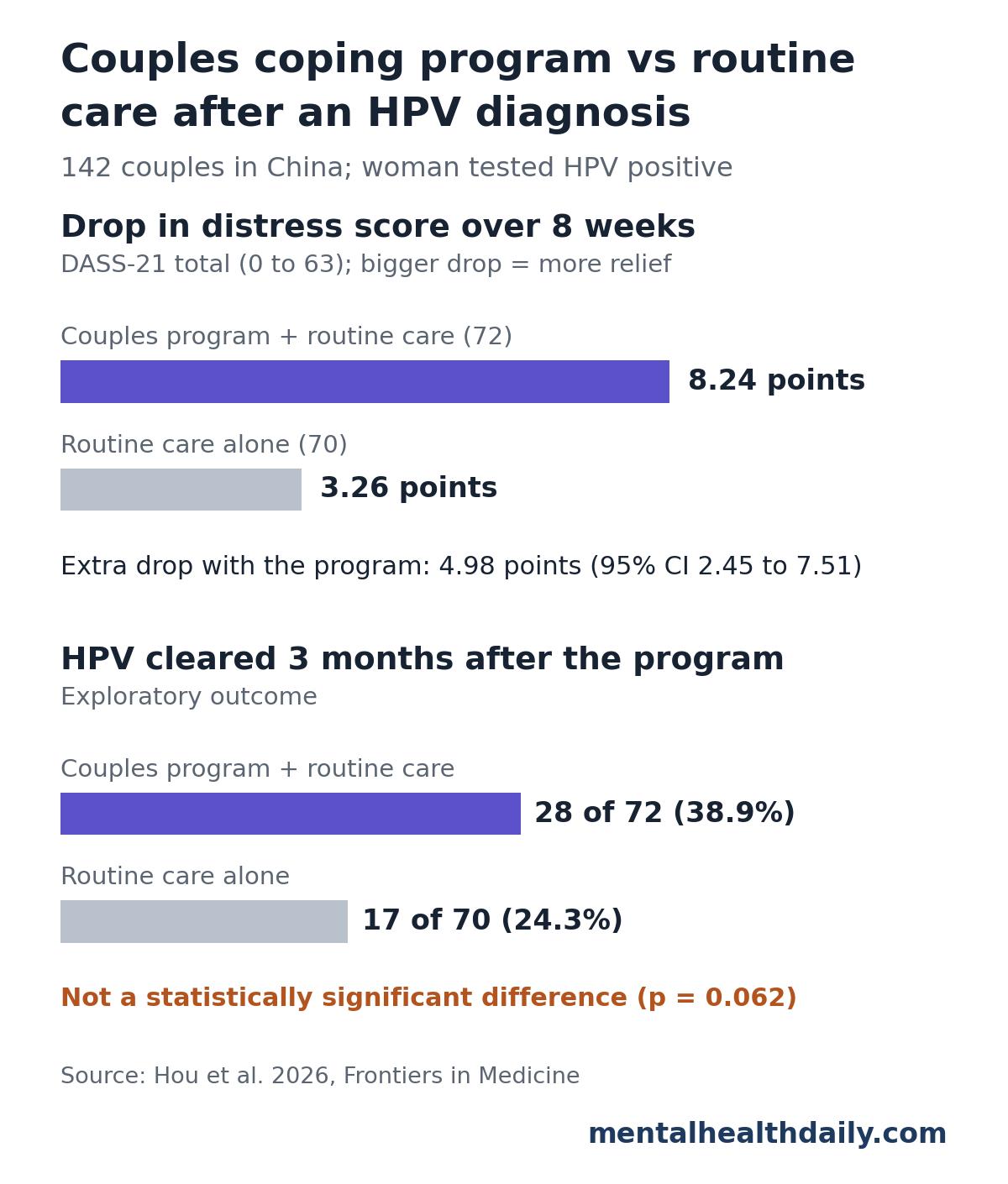
- No significant effect on the virus: 38.9% of women in the program and 24.3% in routine care had cleared HPV 3 months later (p = 0.062), an exploratory result the authors say needs testing in its own right.1
- Short, single-site trial: 148 married heterosexual couples at one hospital, with distress measured only up to 8 weeks.1
Why an HPV Result Can Strain a Couple
Human papillomavirus (HPV) is one of the most common sexually transmitted infections. Most infections clear on their own, but high-risk types can persist and lead to cervical and other cancers, so a positive result usually means repeat testing and a period of waiting.1
That wait is stressful. In a survey of 1,127 women screened in England, women who learned for the first time that they had high-risk HPV with normal cervical cells scored higher on anxiety than women with a normal cell test and no HPV test (mean difference 3.5 points on a 20-to-80 scale). Anxiety was not significantly higher in women who still had HPV at their 12-month repeat test.2
Because HPV spreads through sex, the result also lands on the partner. The trial authors point to partner blame, mistrust, sexual avoidance, stigma, and worries about who gave it to whom. Their program was built on dyadic coping, the idea from psychologist Guy Bodenmann that couples handle stress as a unit: one partner signals stress, the other supports, and both solve problems together.1
What the Couples Program Involved
Researchers at West China Second University Hospital in Chengdu enrolled 148 married couples between March 2022 and February 2024. In each couple, the wife had tested positive for high-risk HPV within the past 6 months and had normal cervical cells on cytology. Couples were randomly split into 2 arms:1
- Couples program plus routine care (74 couples): weekly 90-minute group sessions with 6 to 8 couples for 8 weeks, a weekly 30-minute phone call with each couple, and homework. Two nurses with psychotherapy training and a gynecologist ran the program.
- Routine care alone (74 couples): HPV health education, regular follow-up exams, medication guidance, and other standard care.
The 8 weeks moved through 4 two-week phases:
- Education: facts about HPV, clearing up misconceptions, and an introduction to coping as a couple
- Communication skills: active listening, expressing concerns, and resolving conflict, including talk about sex and transmission
- Joint coping plans: shared problem-solving and emotion regulation
- Strengthening the relationship: rebuilding intimacy and keeping the new habits going
Attendance was high. Couples in the program came to 7.6 of 8 sessions on average, and 142 couples (72 in the program and 70 in routine care) completed the 8-week assessment.1
Distress Dropped More in the Couples Program
The main outcome was the change in each woman’s DASS-21 total score over 8 weeks. Both arms improved, but the drop in the couples program was about 2.5 times larger: 8.24 points vs. 3.26 points. The 4.98-point difference (95% CI 2.45 to 7.51) is a medium-sized effect, and it held up when the researchers adjusted for baseline scores, age, education, relationship length, and HPV type (4.89 points) and when they filled in missing data (4.77 points).1
Depression, anxiety, and stress subscores were each lower in the program group at 8 weeks. Scores on the HPV Impact Profile, a questionnaire about how HPV affects worry, emotions, sex life, self-image, and concerns about a partner, fell 13.28 points in the program vs. 3.73 points in routine care (d = −0.89). The one area that did not differ significantly was how women felt about dealing with health care providers.1
Husbands Reported Better Communication and Coping Too
Both partners filled out relationship questionnaires. For wives and husbands alike, the program group improved more on 3 total scores:1
- Talking about the illness (Couples’ Illness Communication Scale): d = 0.85 for wives and 0.78 for husbands
- Overall relationship adjustment (Dyadic Adjustment Scale): d = 0.81 and 0.85
- Coping as a couple (Dyadic Coping Inventory): d = 0.68 and 0.77
All 6 comparisons stayed significant after correction for multiple testing. Women whose distress fell the most also tended to report the biggest gains in communication and coping, although this kind of correlation cannot show that better communication caused the drop in distress.1
The results are consistent with a larger randomized trial of a similar 6-week dyadic coping program in 226 Chinese couples facing colorectal cancer, which improved shared coping, marital satisfaction, and mental health and reduced depression compared with usual care.3
HPV Clearance Did Not Differ Significantly
The team also tracked whether women cleared the virus, defined as 2 negative HPV tests at least 4 weeks apart. Three months after the program, 28 of 72 women in the couples program (38.9%) and 17 of 70 in routine care (24.3%) had cleared HPV. That gap was not statistically significant (p = 0.062), and the authors state plainly that it should not be taken as evidence that the program helps clear the virus.1
Psychological stress is known to affect immune function, and some studies have linked stress with HPV persistence, so the idea is worth a proper test.1 This trial did not measure stress hormones, immune markers, or viral load, and it was not designed or powered to answer the clearance question.
One more difference showed up in follow-up visits. Three months later, 75.0% of women in the program had kept all their scheduled checkups on time vs. 45.7% in routine care. Extra contact with the clinic team and a supportive partner may both have helped.1
Limits of the Trial
- No attention-matched control: the program arm got far more time with professionals than routine care, so some of the benefit may come from extra attention and expectations rather than the specific skills taught.
- Open treatment: couples and facilitators knew who was in the program, although the assessors who collected 8-week data did not.
- Self-reported outcomes: all psychological and relationship scores came from questionnaires about sensitive topics, which can invite socially desirable answers.
- Narrow sample: one hospital department in China, married heterosexual couples only, and only couples in which the woman had HPV. Results may not apply to men with HPV, same-sex couples, or people without a partner.
- Short follow-up: distress was measured only at 8 weeks, so it is unknown how long the benefit lasts. The paper reports no trial registration.
What It Means for People Facing an HPV Diagnosis
This trial gives a solid early signal that a structured program for couples can ease the emotional fallout of an HPV diagnosis and help partners talk about it, at least in the short term. It is a coping program, not an HPV treatment. Routine follow-up testing and care remain the way HPV is managed.
For couples dealing with a new result, the program’s core ideas are simple: learn the facts together, talk openly about fears around sex and transmission, and plan how to handle the waiting as a team. Larger multicenter trials with an attention-matched control arm and longer follow-up would show whether the benefit holds and whether it reaches the virus itself.
References
- Hou D, He J, Luo R, Zhou L. Effectiveness of a couple-based dyadic coping intervention on psychological distress and relationship functioning in HPV patients: a randomized controlled trial in China. Frontiers in Medicine. 2026;13:1867371. doi:10.3389/fmed.2026.1867371
- McBride E, Marlow LAV, Forster AS, et al. Anxiety and distress following receipt of results from routine HPV primary testing in cervical screening: the psychological impact of primary screening (PIPS) study. International Journal of Cancer. 2020;146:2113–2121. doi:10.1002/ijc.32540
- Wang Z, Chen M, Gong J, et al. A couple-based dyadic coping intervention for colorectal cancer patient-spousal caregiver dyads: a randomized controlled study. European Journal of Oncology Nursing. 2024;70:102565. doi:10.1016/j.ejon.2024.102565