
Pesticide suicides in Taiwan fell 74% between 1987 and 2017, but rural farming areas still carried a far heavier burden, a national study shows. One herbicide, paraquat, accounted for most cases where the product was recorded, until Taiwan phased it out in 2018–2020.1
Research Highlights
- Big long-term drop: the age-standardized pesticide suicide rate in Taiwan fell 74%, from 7.7 to 2.0 per 100,000 people, between 1987 and 2017.1
- One herbicide led: paraquat accounted for 59.9% (2,268 of 3,786) of pesticide suicides where the product was named on the death certificate, and at least 4.0% of all suicides.1
- Rural burden: in Taiwan’s most agricultural areas, pesticides accounted for 24.4% of suicides from 2002 to 2017, compared with 5.0% in cities.1
- Who was affected: pesticide suicides were more common among men, adults 65 and older, and rural residents; paraquat deaths skewed younger than other pesticide deaths.1
- Prevention context: Taiwan phased out the herbicide in 2018–2020. National bans on highly hazardous pesticides have been followed by fewer suicides in several other countries.23
Why Researchers Tracked Pesticide Suicides in Taiwan
Pesticide self-poisoning accounts for an estimated 14% to 20% of suicides worldwide, mostly in rural parts of Asia.12 A small number of products are involved in a large share of these deaths, so removing a few of them from the market can prevent many.
This approach is called means restriction: making the most dangerous means of suicide harder to reach. The World Health Organization and the Food and Agriculture Organization recommend regulating or banning highly hazardous pesticides as one of the most effective suicide prevention strategies.1
Taiwan banned paraquat in 2 stages. Import and production stopped in February 2018, and sale and use stopped in February 2020. Researchers at National Taiwan University and colleagues in the UK wanted a clear national picture of the burden before the ban, to show where it was likely to matter most.1
How the Study Worked
The team used Taiwan’s national cause-of-death files for people 15 and older. Data covered 1987, 1992, 1997, and every year from 2002 to 2017.1
- What counted as suicide: certified suicides plus deaths recorded as undetermined intent or certain accidents, which earlier Taiwanese research found often hide suicides. A check using certified suicides only gave similar results.
- Which pesticide: the researchers read the free-text cause of death on death certificates to identify the product, which was possible for 1987–1997 and 2002–2012.
- Where: Taiwan’s 23 cities and counties were grouped as urban, semi-rural, or rural by their share of agricultural workers.
Pesticide Suicides Fell 74% Over 30 Years
The age-standardized pesticide suicide rate dropped from 7.7 per 100,000 in 1987 to 2.0 per 100,000 in 2017. Over the same period, Taiwan’s overall certified suicide rate rose about 15%, from 10.9 to 12.5 per 100,000.1
Paraquat’s share of pesticide suicides with a named product stayed fairly steady, between 50.0% and 65.3% in each year with product data. The authors read this as a sign that the long decline came from forces affecting all pesticides, such as a shrinking farm population, rather than anything specific to paraquat.1
That fits earlier work. Taiwan banned several other pesticides between 1987 and 2010, but those bans did not include paraquat and were not linked to a drop in pesticide suicides.1
One Herbicide Accounted for Most Pesticide Suicides
Among 3,786 pesticide suicides where the product was recorded, paraquat accounted for 2,268, or 59.9%. The next largest groups were organophosphate insecticides (19.8%) and carbamate insecticides (8.1%).1
Many death certificates did not name the pesticide at all. Counting those as non-paraquat deaths gives a floor of 26% of all pesticide suicides and 4.0% of all suicides. If unnamed cases followed the same 59.9% pattern, paraquat would account for about 9.3% of all suicides in those years.1
Rural Areas Carried the Heaviest Burden
From 2002 to 2017, Taiwan recorded 70,039 suicides. Pesticides were involved in 12.9% of them and paraquat in 4.1%.1
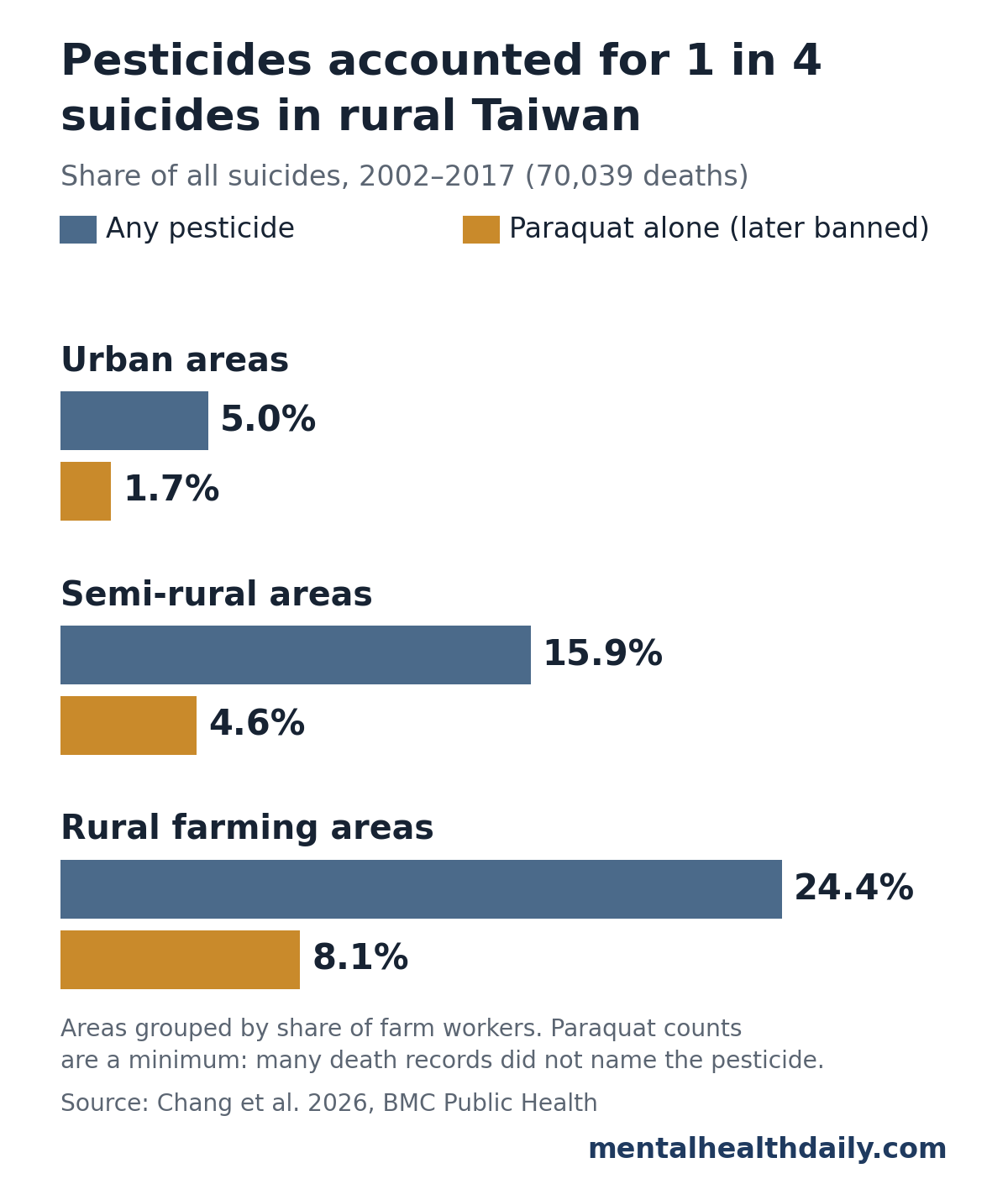
In the most agricultural areas, pesticides accounted for about 1 in 4 suicides and paraquat for about 1 in 12. Across individual cities and counties, paraquat’s share of all suicides ranged from 0.4% to 15.6%.1
Rates were highest in counties in central and eastern Taiwan and lowest in major cities. Paraquat suicide rates varied 62-fold between the highest and lowest areas, and both pesticide and paraquat suicide rates tracked closely with the share of local farm workers (correlations of 0.76 and 0.68, where 1 would be a perfect match).1
Who Was Most Affected
Compared with other suicides from 1987 to 2012, pesticide suicides were more likely to involve:1
- Men: adjusted odds ratio (aOR) 1.13 compared with women.
- Older adults: people 65 and older made up 31.1% of pesticide suicides but 20.5% of other suicides. Pesticides were involved in 21.0% of suicides in this age group from 2002 to 2017.
- Rural residents: aOR 4.80 for rural areas and 3.29 for semi-rural areas, compared with cities.
Paraquat deaths looked much like other pesticide deaths in sex and season. The main difference was age: people 15 to 24 (aOR 2.43) and 25 to 44 (aOR 2.00) were more likely than people 65 and older to have died from paraquat rather than another pesticide.1
The authors suggest one reason may be awareness. Paraquat received more media coverage in Taiwan than other pesticides, which may have made it more familiar to younger people. They note this idea still needs direct study.1
What Pesticide Bans Have Done Elsewhere
This study ends in 2017 and does not measure the effect of Taiwan’s ban. Evidence from other countries suggests what to expect.
- South Korea: after paraquat was regulated and then banned in 2011–2012, the pesticide suicide rate halved from 5.26 to 2.67 per 100,000 by 2013. That drop accounted for 56% of the fall in overall suicides over the same 2 years, and crop yields were unaffected.3
- International review: a 2017 systematic review of 27 studies in 16 countries found that national bans on commonly ingested, highly hazardous pesticides were followed by fewer pesticide suicides in 5 of the 6 countries studied, and fewer suicides overall in 3 of them. Evidence for sales restrictions alone was less consistent.2
The Taiwan data point to where a ban would matter most: rural counties, older adults, and men.
Limitations
- Descriptive design. The study maps patterns over time and place and cannot show what caused the decline.
- Unnamed products. More than half of pesticide suicides (56.5%) did not record the specific product, so paraquat’s exact share is uncertain. The authors found no sign that recording practices differed by area.
- Gaps in the timeline. Data were missing for most years before 2002, and product-level detail was unavailable after 2012.
- Official records. Death certificates can undercount suicide, and autopsies and toxicology tests are not routine in Taiwan.
- No post-ban data. The effect of the 2018–2020 ban was reported separately and is not part of this analysis.
Why This Matters Beyond Taiwan
Taiwan has already acted, so the authors see the main value of the study in guiding other countries where highly hazardous pesticides are still sold. The pattern is consistent with a large body of evidence: when the most dangerous products leave rural communities, fewer people die.12
If you are struggling: in the US, call or text 988 to reach the 988 Suicide & Crisis Lifeline. In Taiwan, the Ministry of Health and Welfare’s free, 24-hour 1925 line offers crisis support. Elsewhere, contact your local crisis services or emergency number.
References
- Chang HY, Tu CY, Lin CY, et al. The burden of suicide by paraquat poisoning in Taiwan (1987–2017): trends, geographic variations, and demographic characteristics. BMC Public Health. 2026;26:2684. doi:10.1186/s12889-026-29134-x
- Gunnell D, Knipe D, Chang SS, et al. Prevention of suicide with regulations aimed at restricting access to highly hazardous pesticides: a systematic review of the international evidence. Lancet Global Health. 2017;5(10):e1026–e1037. doi:10.1016/S2214-109X(17)30299-1 (PubMed)
- Cha ES, Chang SS, Gunnell D, et al. Impact of paraquat regulation on suicide in South Korea. International Journal of Epidemiology. 2016;45(2):470–479. doi:10.1093/ije/dyv304 (PubMed)