
Chinese teens who reported closer friendships and better relationships with their parents went on to report more helping, sharing and comforting a year later. A stronger sense of meaning in life carried part of that link; relationships with head teachers showed no connection to meaning at all.1
Research Highlights
- Friendships had the strongest link: of 3 relationship types measured in 671 junior high students, friendship quality showed the largest total link to prosocial behavior 1 year later (coefficient 0.104, p < 0.01).1
- Meaning in life sat in the middle: good friendships and parent bonds were linked to a stronger sense of purpose 6 months later, and that sense of purpose was linked to more helping 6 months after that.1
- Head teachers stood apart: teacher relationships had the weakest link to helping and no significant link to either part of meaning in life.1
- Searching for meaning showed no independent link to helping: teens with good friends and parent bonds searched more for meaning, but searching itself showed no independent link to later prosocial behavior in the mediation model.1
- Observational survey: all measures were the teens’ own ratings, taken once each, at 1 school in Hunan Province, so the study shows links over time, not cause and effect.1
What Prosocial Behavior and Meaning in Life Mean
Prosocial behavior means voluntary actions meant to benefit other people: helping, sharing, comforting, stepping in when someone is in trouble. Research links it to later well-being and academic success, so researchers want to know what builds it in teens.1
Meaning in life is the sense that your life makes sense, has direction and matters. Psychologists split it into 2 parts:
- Presence of meaning: feeling that your life already has purpose and significance
- Search for meaning: actively looking for that purpose, which can reflect healthy exploration or a feeling that something is missing
The idea behind the study is simple. Warm relationships give teens a sense of belonging, belonging feeds a sense of purpose, and a purpose that includes other people should make helping feel like the natural thing to do.1
How the 3-Wave Study of 671 Teens Worked
Meng et al. followed students from 1 junior high school in Hunan Province, China, recruited class by class. Of the valid first-wave sample, 97.4% were matched across all 3 surveys, and the 18 who dropped out did not differ from those who stayed.1
- Sample: 671 students, 347 boys and 324 girls, average age 13.3 (range 11 to 15)
- Wave 1 (May 2021): closeness with mother and father, relationship with the head teacher (the main class teacher in Chinese schools), and friendship quality
- Wave 2 (November 2021): presence of meaning and search for meaning, using the Chinese version of the Meaning in Life Questionnaire
- Wave 3 (May 2022): prosocial behavior, using a 26-item questionnaire covering helping in public, anonymously, out of pure concern, when asked, in emotional moments and in emergencies
Spacing the measures 6 months apart puts them in time order: relationships first, meaning second, helping last. The researchers then ran a mediation analysis, a statistical test of whether the link between a starting factor and an outcome partly runs through a middle factor, here meaning in life.1
Friendships Showed the Strongest Link to Helping Others
All 3 relationship types were linked to more prosocial behavior a year later. Friendship quality had the largest total link (0.104), followed by parent-child closeness (0.078) and the head-teacher relationship (0.067). In plain correlations the links were small, between r = 0.13 and 0.16.1
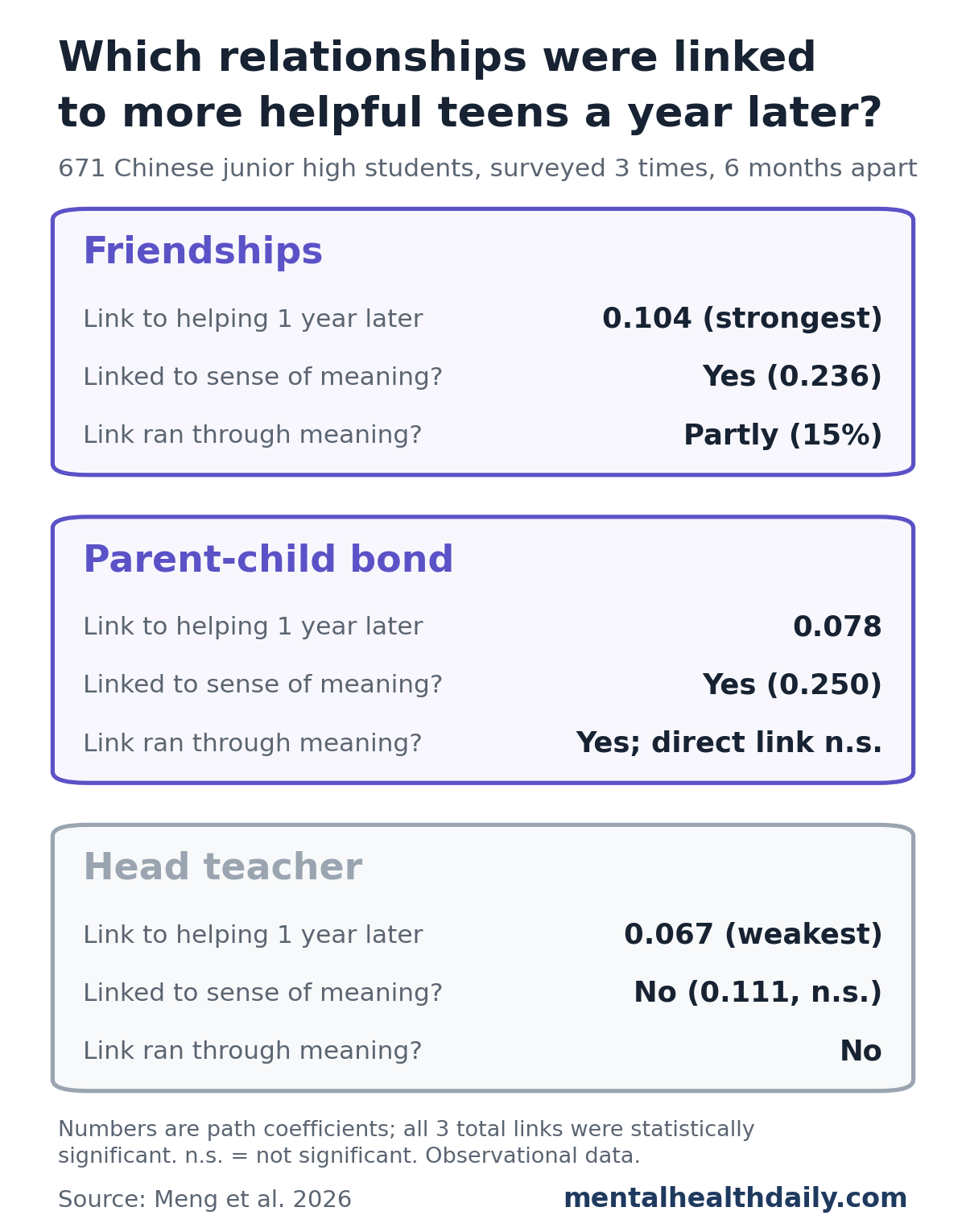
Parents. Closer parent-child relationships in May 2021 were linked to a stronger presence of meaning 6 months later (0.250, p < 0.01), and presence of meaning was linked to more helping 6 months after that (0.067, p < 0.05). Once meaning was in the model, the remaining direct link from parents to helping (0.064) was no longer significant, which the researchers describe as full mediation.1
Friends. Good friendships were also linked to a stronger sense of meaning (0.236, p < 0.01), but most of the friendship link to helping stayed direct (0.092, p < 0.01). The route through meaning accounted for 15.34% of the total.1
The researchers suggest friends shape helping in other ways too: teens copy what their friends do, pick up their group’s norms and get daily chances to practice being kind. They also stress that these mediation patterns are statistical associations and do not by themselves prove a causal pathway.1
Searching for Meaning Showed No Independent Link to Helping
Teens with better friendships (0.318) and closer parent bonds (0.174) reported searching more for meaning 6 months later. In the mediation model, searching showed no independent link to later helping (−0.012, not significant), so it carried none of the relationship links.1
The researchers point to the age group. In early adolescence, searching for meaning tends to be open-ended exploration and identity building, and it can come with uncertainty or distress as well as purpose. Having found some purpose, on the other hand, gives behavior a direction.1
Why Head-Teacher Relationships Showed No Link to Meaning
Ratings of the head teacher were high on average (4.3 out of 5), yet they were not significantly linked to either presence of meaning (0.111) or search for meaning (−0.022). The researchers offer 3 explanations:1
- Less emotional depth: teacher relationships center on schoolwork and discipline and are usually less intimate than ties with parents or friends.
- Cultural role: in Confucian-influenced Chinese schools, teachers are often seen as authority figures and moral guides more than as sources of emotional support.
- Too narrow a measure: the survey asked only about the head teacher, while some students may feel closest to a subject teacher or counselor, and teachers can change from year to year.
That last point is worth weighing. A 2025 survey of 1,153 students in grades 7 to 12 at 6 secondary schools in Tianjin, China, found that teacher emotional support was linked to more prosocial behavior, partly through meaning in life, and its direct link was stronger than that of family cohesion.3 That study captured everything at one time point, but it suggests the question asked about teachers shapes the answer.
Other Research on Meaning in Life and Helping in Teens
The link between purpose and helping seems to run both ways. A 2023 study by Xie et al. followed 764 Chinese junior high students (average age 12.5) through 3 surveys about 6 months apart, using the same meaning-in-life and prosocial questionnaires. Prosocial behavior was linked to a stronger presence of meaning later, and presence of meaning was linked to more prosocial behavior later.2
That two-way pattern supports the middle step in the new study. It also means helping others can build a sense of purpose, not only result from it, and the 2026 study did not measure helping or meaning at earlier time points to rule that out.
Limits of This Observational Study
The 3-wave design adds time order, but it falls short of showing cause and effect:1
- One measurement per factor: relationships, meaning and helping were each measured only once, so the analysis could not account for teens who were already more helpful or purposeful at the start.
- Self-report only: teens rated their own relationships, sense of meaning and helping, which can inflate links and reflect a wish to look good. No parents, teachers or peers were asked.
- Small links: correlations of about 0.13 to 0.16 mean relationships explained only a small share of differences in helping.
- One school: all students came from a single junior high in Hunan Province, so results may differ in other regions, countries and age groups.
- Tendencies, not observed acts: prosocial behavior was a questionnaire about how much each statement sounded like the student, not a record of actual helping.
- Limited reporting: the paper does not list control variables such as age, sex or family income, or confidence intervals for the indirect effects.
What Parents and Schools Can Take From It
The findings fit a common-sense picture: teens who feel close to their parents and have good friends tend to feel their lives have purpose, and those teens tend to help others more. The researchers suggest peer mentoring and cooperative learning at school, family involvement in community activities, and teacher training that pairs authority with emotional warmth.1
None of these were tested in this study. They are reasonable ideas built on an association, and a trial would be needed to show that strengthening relationships actually makes teens more helpful.
References
- Meng L, Li C, Dai T, Zhang S, Zhang B, Yang Q. Longitudinal associations between relationship quality and prosocial behavior in Chinese adolescents: the mediating role of meaning in life. Frontiers in Psychiatry. 2026;17:1915264. doi:10.3389/fpsyt.2026.1915264
- Xie J, Wen Z, Shen J, et al. Longitudinal relationship between prosocial behavior and meaning in life of junior high school students: a three-wave cross-lagged study. Journal of Adolescence. 2023;95(5):1017–1032. doi:10.1002/jad.12172
- Li P, Zhou X, Jiang J, Fu S, Bai X, Feng W. The relationship of family cohesion and teacher emotional support with adolescent prosocial behavior: the chain-mediating role of self-compassion and meaning in life. Behavioral Sciences. 2025;15(8):1126. doi:10.3390/bs15081126