
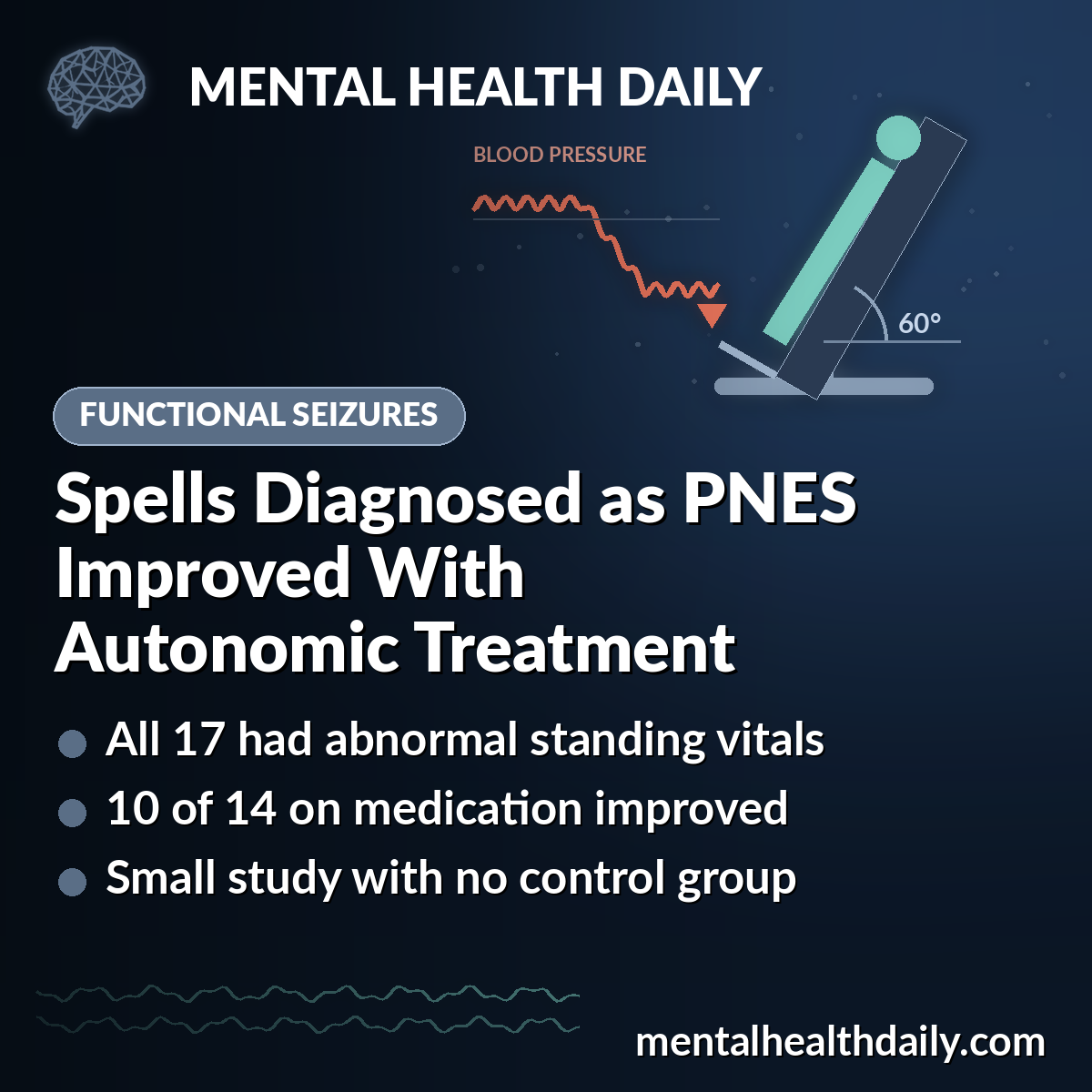
A 2026 chart review of 17 adults whose seizure-like spells were first diagnosed as psychogenic nonepileptic seizures (PNES), now often called functional seizures, found that all of them had abnormal blood pressure or heart rate on standing. Of the 14 who started autonomic medications, 10 reported fewer or no abnormal movements.1
Research Highlights
- 10 of 14 improved on medication: patients treated with drugs such as fludrocortisone, midodrine, pyridostigmine, or a beta-blocker reported a decrease in or end to their abnormal movements, judged at 3 and 6 months.1
- Every patient had abnormal standing vital signs: all 17 showed orthostatic hypotension or postural tachycardia, signs that the body was not regulating blood pressure or heart rate properly on standing.1
- Convulsions were the most common symptom: 11 of 17 patients had convulsions and 10 had a reduced level of consciousness; tremor, myoclonus (sudden jerks), and near-fainting each affected 6.1
- No control group: this was a single-hospital, retrospective case series with no comparison group and no statistical testing, so it cannot show that the drugs caused the improvement.1
- Low brain blood flow can cause jerking: in a classic study of fainting in healthy volunteers, 90% of full faints included muscle jerks.5
Functional Seizures, PNES, and the Older Term “Psychogenic”
Functional seizures are episodes that look like epileptic seizures (shaking, staring, loss of responsiveness) but are not caused by the abnormal electrical bursts of epilepsy. They arise from a problem in how brain networks work rather than from visible brain damage.
For decades they were called psychogenic nonepileptic seizures (PNES). Many patients find “psychogenic” stigmatizing because it can sound like “all in your head,” and researchers have argued for “functional seizures” instead.3 In 2025, an International League Against Epilepsy (ILAE) task force proposed “functional/dissociative seizures” as the new diagnostic label.2
The 2026 paper uses the older acronym, spelled out as “psychogenic non-epileptiform spells.” Below, PNES refers to the diagnosis these patients first received.
How PNES is diagnosed: the gold standard is recording a typical episode on video-EEG (video plus brain-wave monitoring) and seeing no epileptic activity, alongside a history that fits.4 An EEG without epileptic activity does not, by itself, establish a functional seizure diagnosis or rule out physical causes such as fainting.
What the Researchers Mean by “Autonomic Movement Disorder”
The autonomic nervous system runs the body’s automatic functions, including heart rate and blood pressure. When it fails to adjust them on standing (dysautonomia), blood flow to the brain can drop for seconds at a time.
Two common patterns are:
- Orthostatic hypotension: systolic blood pressure falls by at least 20 mm Hg, or diastolic by at least 10 mm Hg, within 3 minutes of standing or tilting upright.
- Postural orthostatic tachycardia syndrome (POTS): heart rate rises by at least 30 beats per minute within 10 minutes of standing, without a large blood pressure drop.
Khoo et al. proposed a new term, autonomic movement disorder (AMD): changes in awareness, with or without tremor, myoclonus, or dystonia (sustained muscle contractions), caused by poor blood flow to the brain’s outer layer during these blood pressure or heart rate problems.1 The label is new and has not yet been tested by other groups.
The idea draws on solid physiology. When Lempert et al. induced fainting in healthy volunteers, 38 of 42 full faints (90%) included irregular muscle jerks, and most included other movements such as head turns or lip smacking.5 Seizure-like movements from low brain blood flow are well documented.
How the Boston Study Found and Followed 17 Patients
Researchers reviewed medical records from St. Elizabeth’s Medical Center in Boston for adults who came to the emergency department with seizure-like movements between January 2022 and April 2025.1
- Who was included: people whose movements were captured on routine or continuous EEG with no epileptic activity, who then received a PNES diagnosis from an epileptologist and were referred to outpatient neurology
- Who was excluded: anyone with epileptic activity on EEG, a structural brain abnormality on imaging, or incomplete records
- Patients: 17 adults (11 women, 6 men), aged 19 to 89, with a median age of 64
- Autonomic testing: blood pressure and pulse lying down, then after 1 and 3 minutes of standing, with tilt-table testing to confirm
A movement disorder specialist then made the AMD diagnosis from the orthostatic findings and the movements themselves.
Symptoms at first presentation: convulsions (11 patients), reduced consciousness (10), tremor (6), myoclonus (6), near-fainting (6), tingling or numbness (2), dystonia (2), and muscle rippling called myokymia (1).1 Episodes ranged from leg shaking and eyelid fluttering to whole-body tonic–clonic activity.
Some patients came to the emergency department up to 7 times before anyone referred them to neurology.1
10 of 14 Patients on Autonomic Medication Reported Fewer Abnormal Movements
According to the text, all patients received conservative measures (fluids, electrolytes and salt, compression stockings), and 14 also started at least 1 medication. 8 took a combination.1 The drugs work in different ways:
- Fludrocortisone: helps the kidneys hold on to salt and water, expanding blood volume
- Midodrine: tightens blood vessels to raise blood pressure when upright
- Pyridostigmine: boosts nerve signaling that helps keep blood pressure up
- Beta-blockers such as propranolol: slow a racing heart, often used in POTS
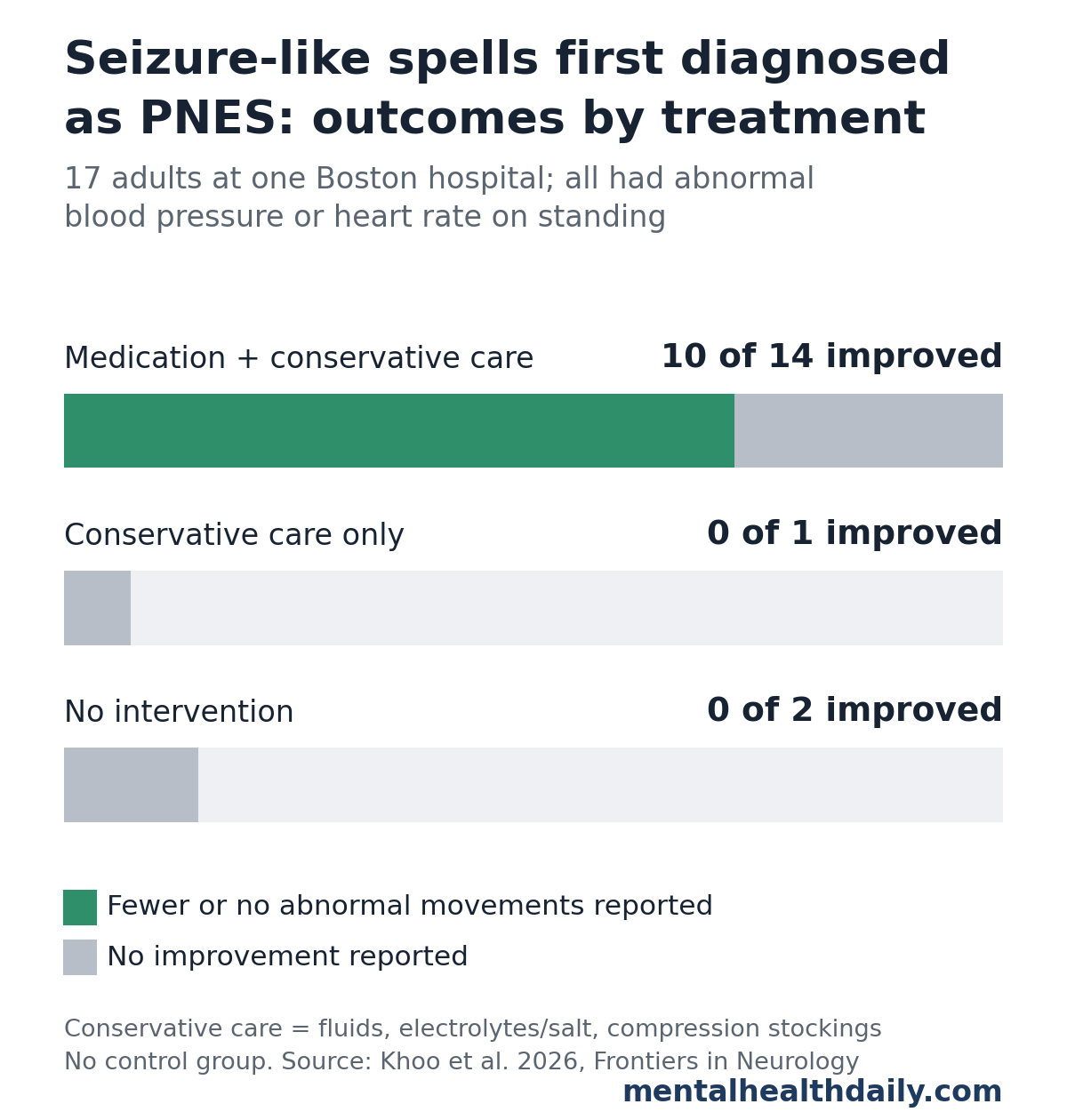
Of the 14 medicated patients, 10 (71%) reported improvement, judged both by the patients and by the movement disorder specialist at 3 and 6 months. Improvement meant fewer or no abnormal movements, fewer autonomic symptoms, and fewer hospital readmissions. Some treated patients also had better orthostatic vital signs.1
One patient said that getting the right treatment “felt like a weight being lifted.” None of the 3 patients who did not take medication reported improvement.1
Why an Uncontrolled Result Cannot Prove the Drugs Worked
The authors call this a cohort study, but with a single group and no comparison it is a case series: a careful description of what happened to a set of patients. It is an early signal in favor of checking autonomic function in people with these spells, with clear limits:
- No control group. Symptoms that bring people to the emergency department often ease on their own. Reassurance, closer follow-up, and the conservative measures could also have helped.
- Same team diagnosed and judged outcomes. There was no blinding and no standardized movement or quality-of-life scale, and the number of readmissions was not reported.
- Selection bias. Only patients referred to neurology and tilt testing were included, as the authors note.
- Loss to follow-up. The patient table lists 6 of 17 as lost to follow-up, so their outcomes are unknown.
- Counts that do not fully match. The text reports 10 of 14 improved, but the patient table marks 11 patients as improved and lists 13 as starting medication. The paper also says all patients received conservative care, while its outcome figure shows 2 with no intervention.
The study also does not show how often a PNES diagnosis is wrong. It describes only patients who were referred on and found to have autonomic problems, and it does not report how many people with a PNES diagnosis were seen in total.
Autonomic Dysfunction and Functional Seizures Can Overlap
Mistaking a physical cause for a seizure disorder has precedent. When Zaidi et al. ran cardiovascular tests on 74 people diagnosed with epilepsy whose attacks continued despite medication or whose diagnosis was uncertain, 31 (42%) turned out to have another explanation. 19 (26%) had a sharp drop in blood pressure or heart rate on tilt testing, consistent with fainting.6
A 2024 opinion paper by autonomic specialists argued that POTS and similar disorders have their own diagnostic criteria and are not functional neurological disorders, and that labeling them as such can block further testing and care.7
Khoo et al. acknowledge that the 2 conditions are not mutually exclusive: a person can have both autonomic dysfunction and functional seizures.1 Finding low blood pressure on standing does not automatically make a functional seizure diagnosis wrong.
What This Means for People Diagnosed With Functional Seizures
- Ask about orthostatic vital signs. Lying and standing blood pressure and heart rate take a few minutes and are cheap. The researchers recommend this check, and tilt testing when warranted, before settling on a functional diagnosis.
- Clues worth mentioning: episodes that start on standing, lightheadedness or vision changes beforehand, or a past POTS diagnosis.
- Do not stop current treatment on your own. Functional seizures are a real condition, and this small study does not show that most PNES diagnoses are mistaken. New test results are best discussed with the treating team.
- Controlled studies are needed. A larger, multi-site study with a comparison group and standard outcome measures would show whether autonomic treatment truly reduces these spells.
References
- Khoo A, Paul M, Rady N, Sunda M, Brik J, Vaou O, Hohler A. Improved outcomes for patients with autonomic movement disorders originally evaluated for psychogenic non-epileptiform spells. Frontiers in Neurology. 2026;17:1839185. doi:10.3389/fneur.2026.1839185
- Hingray C, et al. Functional/dissociative seizures: proposal for a new diagnostic label and definition by the ILAE task force. Epilepsia. 2025;66(11):4162–4182. doi:10.1111/epi.18574
- Asadi-Pooya AA, Brigo F, Mildon B, Nicholson TR. Terminology for psychogenic nonepileptic seizures: making the case for “functional seizures.” Epilepsy & Behavior. 2020;104:106895. doi:10.1016/j.yebeh.2019.106895
- LaFrance WC Jr, Baker GA, Duncan R, Goldstein LH, Reuber M. Minimum requirements for the diagnosis of psychogenic nonepileptic seizures: a staged approach. Epilepsia. 2013;54(11):2005–2018. doi:10.1111/epi.12356
- Lempert T, Bauer M, Schmidt D. Syncope: a videometric analysis of 56 episodes of transient cerebral hypoxia. Annals of Neurology. 1994;36(2):233–237. doi:10.1002/ana.410360217
- Zaidi A, Clough P, Cooper P, Scheepers B, Fitzpatrick AP. Misdiagnosis of epilepsy: many seizure-like attacks have a cardiovascular cause. Journal of the American College of Cardiology. 2000;36(1). doi:10.1016/S0735-1097(00)00700-2
- Blitshteyn S, Treisman GJ, Ruhoy IS, et al. Postural orthostatic tachycardia syndrome and other common autonomic disorders are not functional neurologic disorders. Frontiers in Neurology. 2024;15:1490744. doi:10.3389/fneur.2024.1490744