
A 2026 survey of 196 first-year veterinarians in Germany, Austria, and Switzerland found that most were satisfied with their jobs, and those with a supervising veterinarian reported clearly higher job satisfaction and commitment to their workplace.1
Research Highlights
- Supervision went with higher satisfaction: new vets with a supervising veterinarian scored 11.4 points higher on job satisfaction and 17.9 points higher on workplace commitment (0–100 scales, both p < 0.001).1
- More satisfied than average German workers: contrary to the researchers’ main hypothesis, first-year vets reported higher job satisfaction and lower workload demands than a large German reference sample from many professions.1
- Long hours were common: 53% worked more than 40 hours a week, 80% reported overtime, and half were already on out-of-hours emergency duty.1
- Support mattered more than workload: feedback, leadership quality, and support at work were linked to satisfaction and commitment, while workload and emotional demands were not.1
- Work spilled into free time: blurring of work and private life was higher than in the reference sample, although this scale was unreliable in this survey.1
Why the First Year in Veterinary Practice Gets Attention
Veterinary medicine has a well-known mental health problem. In their background review, the study team note that international research has repeatedly found higher rates of depression, anxiety, burnout, work stress, and suicide among veterinarians than in the general population, including in Germany and Austria.1
Several earlier studies also found more stress among young or less experienced vets. Long hours, on-call work, night shifts, and ethical dilemmas, such as clients who cannot afford the recommended care, are common sources of strain.1
What had been missing was a close look at the first year itself, measured with a validated questionnaire that allows comparison with other workers. Amelie Wetter et al. at Freie Universität Berlin set out to fill that gap with a multi-part survey called “Navigating the transition.” This first report covers working conditions, psychosocial demands, and job satisfaction; burnout, depression, and anxiety results are planned for a second paper.1
How the Survey of New Veterinarians Worked
The online survey ran from October to December 2024 and was shared through Instagram, WhatsApp groups, and an association of independent pet clinics. It targeted vets who graduated in 2024 or had worked as a veterinarian for less than 12 months.1
- Sample: 314 people opened the survey; after removing incomplete, duplicate, and out-of-range responses, 196 remained.
- Country: mostly Germany (184 respondents, about 20% of the 933 German veterinary graduates in 2023); only 11 came from Austria and Switzerland.
- Who answered: 88% women, roughly matching the share of women among German veterinary graduates; 45% had studied in Munich.
- Time in the job: a median of 4 months.
- Type of work: 76% were in clinical practice, about half of them mainly with small animals such as dogs and cats, followed by farm animals and horses.
The core measure was the Copenhagen Psychosocial Questionnaire (COPSOQ III), a widely used workplace survey that scores dimensions such as workload, emotional demands, leadership quality, support, and job satisfaction on 0–100 scales. Its German version comes with a reference database of more than 250,000 employees across many professions, which let the researchers compare new vets with workers in general.1
Long Hours and Little Onboarding for First-Year Vets
The working conditions looked demanding on paper:1
- Hours: 80 of 152 (53%) worked more than 40 hours a week including overtime.
- Overtime: 116 of 145 (80%) worked overtime, mostly up to 10 hours a week; 7 people reported more than 20 extra hours.
- Emergency duty: 50% already took part in out-of-hours emergency services, and another 17% planned to.
- Onboarding: 66% had no structured onboarding plan, and 36% had no supervising veterinarian.
- Job security: 43% were on fixed-term contracts, and 29% had debts such as student loans.
Some had already moved on. About 5% of the 173 respondents working in veterinary medicine had changed jobs within their first year, which the researchers read as a possible sign of a rough transition or a poor fit with a first employer.1
New Vets Were More Satisfied Than Average German Workers
The researchers expected first-year vets to report heavier demands and more role conflict than other workers. The results ran the other way. Compared with the German COPSOQ reference sample, new vets reported:1
- Higher: job satisfaction (average 69.4), commitment to the workplace (69.2), sense of community at work (83.2), support at work (78.8), meaning of work (79.6), and leadership quality (58.1)
- Lower: quantitative demands (the amount of work relative to time), role conflicts (being pulled between incompatible expectations), and unfair treatment
- No different: emotional demands and feedback
One dimension went in the predicted direction. Dissolution, meaning work that spills into free time, was higher than in the reference sample. New vets scored higher on being reachable by work contacts in their free time (average 52.4) than on actually doing work tasks then (35.1).1
That dissolution scale is shaky, though. Its 2 questions did not hang together well (Cronbach’s alpha 0.3, where about 0.6 or higher is usually wanted), so the result is a rough indicator at best. The feedback scale had the same problem (alpha 0.4).
A Supervising Vet Was Linked to Higher Job Satisfaction
To see what went with satisfaction, the researchers built regression models (statistical models that estimate each factor’s link while holding the others constant) in 146 respondents with complete data.1
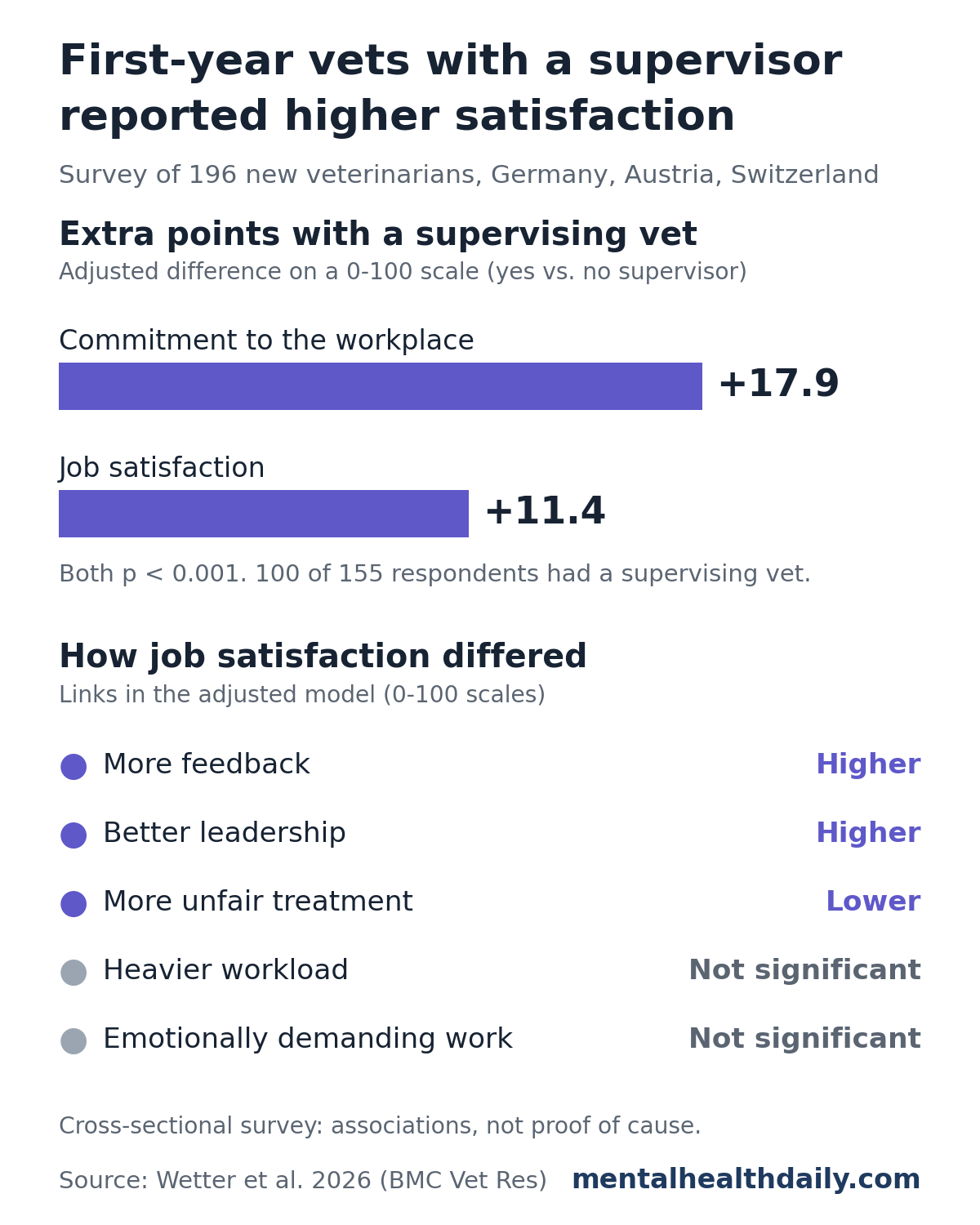
Having a supervising veterinarian stood out. After adjustment, new vets with a supervisor scored 11.4 points higher on job satisfaction and 17.9 points higher on commitment to their workplace, both on 0–100 scales (p < 0.001 for each).1
Most of the measurable job conditions mattered little. Overtime, debts, a probation period, and having an onboarding plan dropped out of the final models, and a fixed-term contract was not significant.1
Emergency duty: taking part in out-of-hours emergency services was linked to 5.1 points lower job satisfaction (p = 0.034). The paper’s discussion describes emergency work as not associated with satisfaction, but the adjusted model shows this modest negative link.1
Feedback and Leadership Mattered More Than Workload
A second set of models looked at the COPSOQ dimensions themselves. Together they explained about half the variation in job satisfaction (adjusted R² 0.55) and about 43% of the variation in commitment.1
- Job satisfaction: higher with more feedback and better leadership quality; lower with more unfair treatment and with more need to hide emotions at work
- Commitment to the workplace: higher with more support at work and more feedback; lower with more unfair treatment
- Not significant: the amount of work (p = 0.10) and emotionally distressing situations (p = 0.36)
The researchers suggest that newly licensed vets may face fewer role conflicts because senior colleagues still make or share many of the hard calls. They also raise a possible “honeymoon” effect: job satisfaction often peaks soon after starting a new job and declines later.1
Time in the job (up to about 12 months) was not linked to satisfaction in this sample, so the survey cannot say whether satisfaction fades. Follow-ups at 6 and 12 months are planned.
Limitations of This Veterinarian Survey
This is a cross-sectional survey: supervision and satisfaction were measured at the same moment, so it shows which things go together, not what causes what. Satisfied vets in good workplaces may simply be more likely to have supervisors. Other limits:
- Who responded: recruitment through social media and personal networks invites response bias in either direction; overworked vets may have skipped the survey, while unhappy ones may have been keen to share.
- Mostly German: only 11 respondents came from Austria and Switzerland, and Munich graduates were overrepresented (the first author studied there).
- Different comparison group: the reference workers were about half female and mostly 35 or older, while the vets were mostly young women.
- Weak scales: the dissolution and feedback scores had poor internal consistency.
- No mental health outcomes yet: burnout, depression, and anxiety scores were collected but are not reported in this paper.
What New Vets and Practice Owners Can Take From This
The first year in practice was not the grim picture many expected. Most new vets in this survey liked their work, felt part of a team, and found it meaningful, despite long hours and frequent overtime.
- For practices: a named supervising veterinarian, regular feedback, and fair treatment were the factors most closely linked to satisfied, committed new hires. The researchers call supervision an essential part of onboarding rather than an optional extra, and they recommend leadership training for vets.
- For new graduates: asking about supervision and feedback during job interviews may tell you more about a first job than the advertised hours.
- For everyone: work that spills into free time is worth watching. The researchers recommend training in boundary management and coping skills early in a career.
If you are a veterinarian or veterinary student struggling with stress, low mood, or thoughts of suicide, help is available. In the US, call or text 988 to reach the 988 Suicide & Crisis Lifeline; elsewhere, contact local emergency or crisis services.
References
- Wetter A, Lorenz T, Doherr MG, Jensen KC. Part I of “Navigating the transition”: early-career working conditions, psychosocial demands, and job satisfaction among German, Austrian, and Swiss veterinarians – a first-year survey. BMC Veterinary Research. 2026;22:553. doi:10.1186/s12917-026-05923-9