
A depression questionnaire built for family doctors’ offices picked out depression about equally well in women and men. In a 2026 study of 431 patients in German primary care, the DESY-PC scored an accuracy (AUC) of 0.85 in women and 0.90 in men, a difference that was not statistically significant.1 The widely used PHQ-9 questionnaire, tested on the same patients, did noticeably worse in women than in men.
Research Highlights
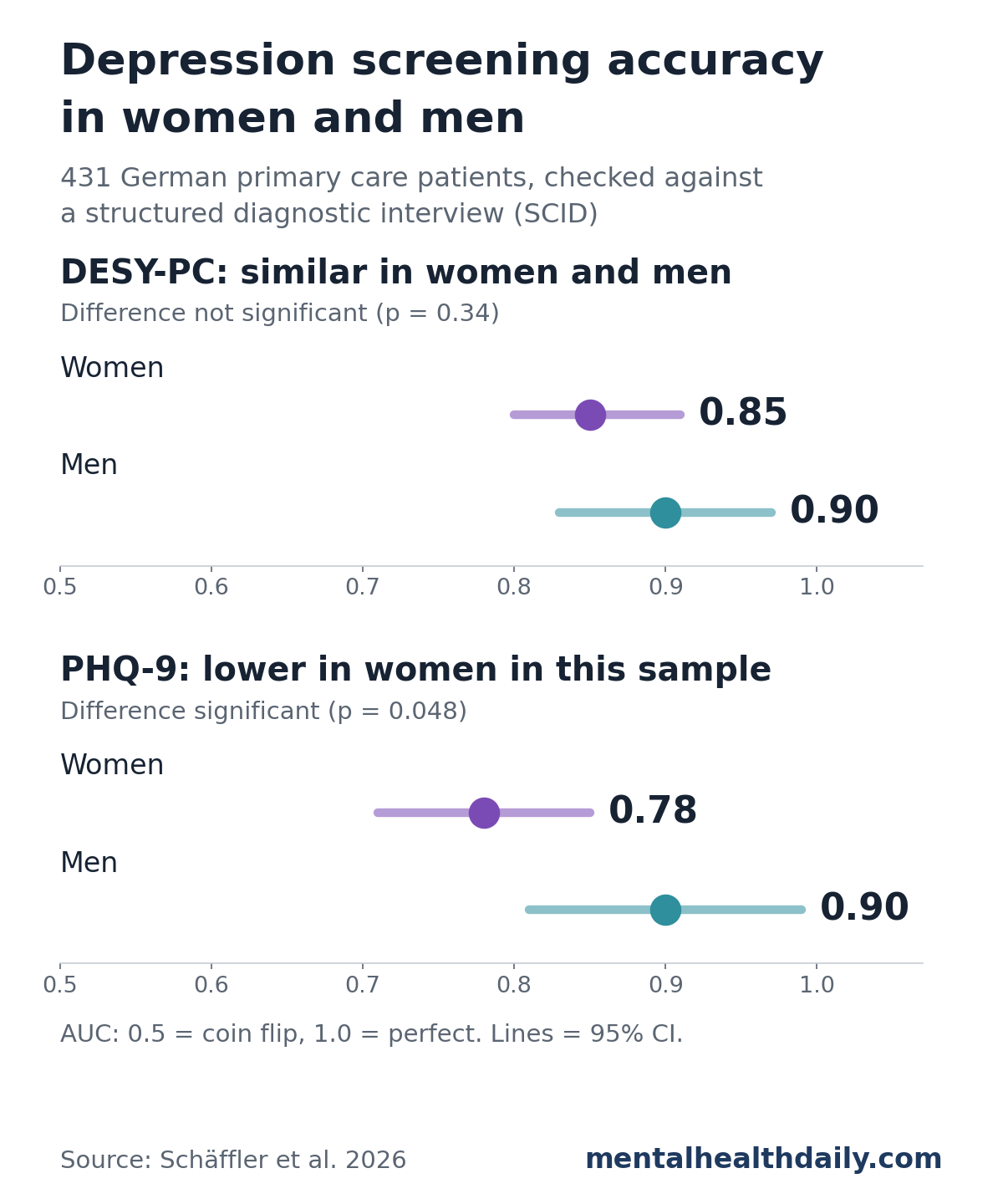
- Similar accuracy by sex: the DESY-PC reached an AUC of 0.85 in women and 0.90 in men (p = 0.34), measured against a structured diagnostic interview.1
- Similar hit and miss rates: at the recommended cutoff, it caught 74% of depressed women and 83% of depressed men, and correctly cleared 82% of women and 87% of men without depression.1
- PHQ-9 gap in this sample: the PHQ-9 had an AUC of 0.78 in women and 0.90 in men (p = 0.048), a larger gap than large PHQ-9 meta-analyses have found.12
- Same questions, same meaning: statistical tests found the questionnaire measured the same underlying traits in women and men.1
- A positive screen is a starting point: about half of the people flagged by the DESY-PC turned out to have depression on interview.1
Why Sex Differences Matter in Depression Screening
Women are diagnosed with depression about twice as often as men. Researchers still debate how much of that gap reflects real differences and how much comes from the way depression is measured. If men more often show depression as irritability, anger, or heavier drinking, a questionnaire built around sadness and loss of interest could miss them. A questionnaire can also go wrong the other way, reading the same answers differently depending on who gives them.1
That is why screening tools get checked separately in women and men. Family doctors are often the first people patients with depression talk to, so a tool used in primary care needs to work for everyone who walks in.
What the DESY-PC Asks, and Who Fills It In
The DESY-PC (Questionnaire for the Assessment of DEpression SYmptoms in Primary Care) was developed by researchers in Munich for general practice. Unlike most depression questionnaires, it has two parts:1
- Patient part (DESY-PAT): 28 yes/no questions. Eight cover the patient’s life circumstances, and 20 cover depression-related thinking, thoughts of death or suicide, and fatigue.
- Doctor part (DESY-GP): 15 yes/no questions the family doctor answers right after the visit, covering observed symptoms and background such as medical history and outside stressors.
Scores come from adding up the “yes” answers. A combined score of 16 or more counts as a positive screen. The idea is to add what a family doctor knows about a patient over years, which a self-report form cannot capture. In the original validation study of 435 patients, the full DESY-PC had an AUC of 0.874, and the patient part alone (0.862) outperformed the PHQ-9 (0.821).3 The new paper reanalyzes that same dataset by sex, leaving out 4 patients who identified as gender diverse because the group was too small to analyze.
How the Study Checked the Questionnaire
Patients were recruited in the waiting rooms of 10 general practices in Germany in 2023. They filled out the patient questionnaire and the PHQ-9, and their doctor completed the doctor part. Within 2 weeks, a trained interviewer who had not seen the questionnaire results called each patient and ran the depression module of the SCID (Structured Clinical Interview for DSM-5).1
The SCID serves as the answer key. It is a semistructured interview: a clinician follows a script but can ask follow-up questions and use judgment. The choice matters, because different interviews label different people as depressed. A pooled analysis of 69,405 participants from 212 studies found that the MINI, a shorter scripted interview, classified major depression more often than the SCID at the same symptom level (adjusted odds ratio 1.46).4 Screening accuracy measured against the SCID is not directly comparable with accuracy measured against another interview.
By the SCID, 50 of 263 women (19%) and 18 of 168 men (11%) had current major depression.1
Women and Men Got Similar Accuracy
The main measure was the AUC (area under the curve). It is the chance that a randomly chosen person with depression scores higher on the questionnaire than a randomly chosen person without it. An AUC of 0.5 is a coin flip; 1.0 is perfect.
- Women: AUC 0.85 (95% CI 0.80 to 0.91)
- Men: AUC 0.90 (95% CI 0.83 to 0.97)
- Difference: not statistically significant (p = 0.34)
Two more everyday terms describe how a screener performs at a set cutoff. Sensitivity is the share of people with depression the test catches. Specificity is the share of people without depression it correctly leaves alone. At the cutoff of 16:1
- Sensitivity: 74% in women (37 of 50) and 83% in men (15 of 18), p = 0.42
- Specificity: 82% in women (175 of 213) and 87% in men (130 of 150), p = 0.22
Men’s figures came out slightly higher, but none of the gaps reached significance. With only 18 depressed men, the uncertainty is wide: men’s sensitivity could plausibly sit anywhere from 59% to 95%.
Each part of the questionnaire also performed similarly by sex. The patient part alone had an AUC of 0.83 in women and 0.90 in men (p = 0.15). The doctor part alone was weaker, at 0.73 in women and 0.71 in men (p = 0.77).1
What a Positive Screen Actually Means
For a patient, the more useful question is what a result means. That is the positive predictive value (PPV): of the people flagged, how many really have depression.
- Women: 75 flagged, 37 with depression (PPV 49%)
- Men: 35 flagged, 15 with depression (PPV 43%)
- Negative screens: 93% of women and 98% of men who screened negative did not have depression
So roughly half of the positive screens were false alarms. That happens because most patients in a general practice are not depressed, so even a fairly accurate test flags many people who are fine. These values depend on how common depression is. In a clinic where it is rarer, more positives would be false alarms; where it is more common, fewer would be. A positive screen is a reason for a follow-up conversation with the doctor, not a diagnosis.1
The PHQ-9 Was Less Accurate in Women in This Sample
The PHQ-9 is a 9-question self-report scale and the most widely used depression screener in primary care. Here, its AUC was 0.78 in women (95% CI 0.71 to 0.85) and 0.90 in men (0.81 to 0.99), a significant difference (p = 0.048).1
That result runs against much larger evidence. An individual participant data meta-analysis of 100 studies and 44,503 people found PHQ-9 sensitivity and specificity of 0.85 each at the standard cutoff of 10, with specificity only about 3% higher in men (median across cutoffs).2 The same analysis showed how much the answer key matters: sensitivity was a median of 21% higher when studies used semistructured interviews like the SCID than when they used fully scripted ones.
The authors suggest the PHQ-9 gap could be chance, or could reflect their particular setting and patients. With a p-value just under 0.05 in one sample, it is a finding worth checking elsewhere. It does not show that the PHQ-9 is biased against women in general. The study was also not designed to show that the DESY-PC beats the PHQ-9 in every practice.
Same Questions, Same Meaning in Women and Men
The second test looked at measurement invariance. In plain terms: does a “yes” to a given question mean the same thing for a woman as for a man? If it does, differences in scores reflect real differences in symptoms rather than quirks in how the questions land.
Using a method called multigroup confirmatory factor analysis, the team checked two levels:1
- Same structure: the questions grouped into the same themes (such as fatigue or depression-related thinking) in women and men.
- Same weight: each question related to its theme about equally strongly in both groups.
Both held up for all four groups of questions tested; one group in the doctor part showed only a slight drop in fit at the second level. A third level, whether the same symptom level yields the same score, could not be tested separately because the questions are yes/no. Average levels on each theme did not differ significantly between women and men.1
A few individual questions behaved differently:
- Burden of raising children and taking medication for a mental illness fit their theme in women but not in men.
- Thoughts of being better off dead were much more strongly linked to a depression diagnosis in men (odds ratio 57.3) than in women (2.9). The confidence interval for men was extremely wide (6.1 to 536.8) because few men answered yes, so the exact figure is unreliable. The authors note that men tend to report such thoughts less often, so when they do, it may signal more severe depression.1
- Loss of pleasure was the single strongest item overall (odds ratio 12.7) and worked similarly in both sexes.
If you are having thoughts of death or suicide, please reach out now. In the US, call or text 988 to reach the 988 Suicide & Crisis Lifeline; elsewhere, contact local emergency services or a crisis line.
Limits of the Study
The design is solid for a screening study: consecutive patients, a blinded interviewer, and a strong reference standard. The sex comparison itself has clear limits:1
- Exploratory analysis. The original study was sized to test overall accuracy, not to compare women and men. Only 18 men had depression, so small real differences could be missed.
- The answer key may share the bias. The SCID focuses on classic symptoms such as low mood. If some men show depression mainly through anger or drinking, both the questionnaire and the interview could miss them together.
- Yes or no only. Depression was scored as present or absent, without severity.
- One country, one language. All patients spoke German and attended 10 practices in Germany.
- Doctor ratings. Whether doctors filled in their part right after each visit could not be verified, and how well each doctor knew the patient was not recorded.
- Binary gender. The results say nothing about nonbinary or gender-diverse patients.
What This Means
In this German sample, the DESY-PC worked about equally well for women and men and measured the same things in both. That is a useful property for a screener meant for general practice, and it held for the patient questions alone. The PHQ-9 gap is a single-study result that larger analyses have not shown, so it is a reason to keep checking tools by sex, not to drop the PHQ-9. Both DESY-PC studies so far come from the same German practices, so studies in other countries and languages would show whether these results carry over.
References
- Schäffler L, Hapfelmeier A, Sterner P, et al. Evaluating gender differences in depression screening: diagnostic accuracy and measurement invariance of the DESY-PC questionnaire in primary care. European Archives of Psychiatry and Clinical Neuroscience. 2026. doi:10.1007/s00406-026-02383-y
- Negeri ZF, Levis B, Sun Y, et al. Accuracy of the Patient Health Questionnaire-9 for screening to detect major depression: updated systematic review and individual participant data meta-analysis. BMJ. 2021;375:n2183. doi:10.1136/bmj.n2183
- Teusen C, et al. Diagnostic accuracy and factorial structure of the questionnaire for the assessment of depression symptoms in primary care (DESY-PC). Psychiatry Research. 2025;354:116807. doi:10.1016/j.psychres.2025.116807
- Wu Y, Levis B, Ioannidis JPA, et al. Probability of major depression classification based on the SCID, CIDI, and MINI diagnostic interviews: a synthesis of three individual participant data meta-analyses. Psychotherapy and Psychosomatics. 2021;90(1):28–40. doi:10.1159/000509283