
More than a third of sexual and gender diverse adults in a large Brazilian online survey reported moderate or worse depression symptoms, with higher rates among Black and Pardo (mixed-race) respondents. Everyday discrimination was linked to more symptoms in every racial group.1
Research Highlights
- High symptom burden: researchers reported that 34.6% scored 10 or more on the PHQ-9 depression questionnaire, including 38.5% of Black, 38.1% of Pardo, and 32.3% of White respondents.1
- Discrimination tracked with symptoms: in every racial group, people who reported more discrimination had higher depression scores (p < 0.0001), and this link was much stronger than the one for internalized homonegativity.1
- Black respondents reported the most discrimination: an average score of 5.2 vs. 3.7 for Pardo and 3.1 for White respondents, and 77.9% of Black respondents named race as a reason.1
- Younger age and lower income: younger respondents had more symptoms in all groups; lower income was linked to more symptoms among White and Pardo respondents only.1
- A symptom screen, not a diagnosis: in validation studies, a PHQ-9 cutoff of 10 flagged about twice as many people as diagnostic interviews confirmed, and the sample was a cross-sectional convenience sample recruited mostly through dating apps.15
Who Took Part in the Brazilian LGBTQ+ Depression Survey
Guimarães et al., a team at Fiocruz in Rio de Janeiro, ran an online survey from November 2021 to January 2022. Invitations went out through the dating apps Grindr, Hornet, and Scruff, and through Facebook and Instagram posts. Results were published in PLOS Global Public Health in September 2026.1
Sexual and gender diverse (SGD) is the umbrella term the researchers used for lesbian, gay, bisexual, transgender, non-binary, and other LGBTQ+ people. In practice, the sample looked like this:
- Size: 6,220 adults living in Brazil
- Recruitment: 90.6% through dating apps
- Gender: 97.8% cisgender men who have sex with men; 110 non-binary people and 29 transgender men, transgender women, or travestis (a Latin American term for people assigned male at birth who have a feminine gender identity)
- Other traits: median age 36; 84.1% gay; 75.4% with a college-level education; 69.1% living in Brazil’s Southeast
Race followed the categories of Brazil’s national statistics agency (IBGE). Pardo is the Brazilian census term for people of mixed race, usually some combination of Black, Indigenous, and White ancestry. The analysis included 3,749 White (60.3%), 1,685 Pardo (27.1%), and 786 Black (12.6%) respondents.1
Asian (103) and Indigenous (73) respondents were left out because the groups were too small to analyze separately.1
Depression Symptoms Were Higher in Black and Pardo Respondents
The PHQ-9 (Patient Health Questionnaire-9) asks how often, over the past 2 weeks, a person had each of the 9 core symptoms of major depression, such as low mood, poor sleep, and trouble concentrating. Scores run from 0 to 27. A score of 10 or more is the usual threshold for moderate or worse symptoms and a reason for further assessment.1
- Average score: 9.6 for Black, 9.3 for Pardo, and 8.4 for White respondents (8.8 overall; p < 0.0001)
- Score of 10 or more: 38.5% of Black, 38.1% of Pardo, and 32.3% of White respondents
- Severe symptoms (20 to 27): 12.7% of Black, 9.9% of Pardo, and 8.8% of White respondents
- No symptoms (0 to 4): 35.1% of White respondents vs. about 30% of Black and Pardo respondents
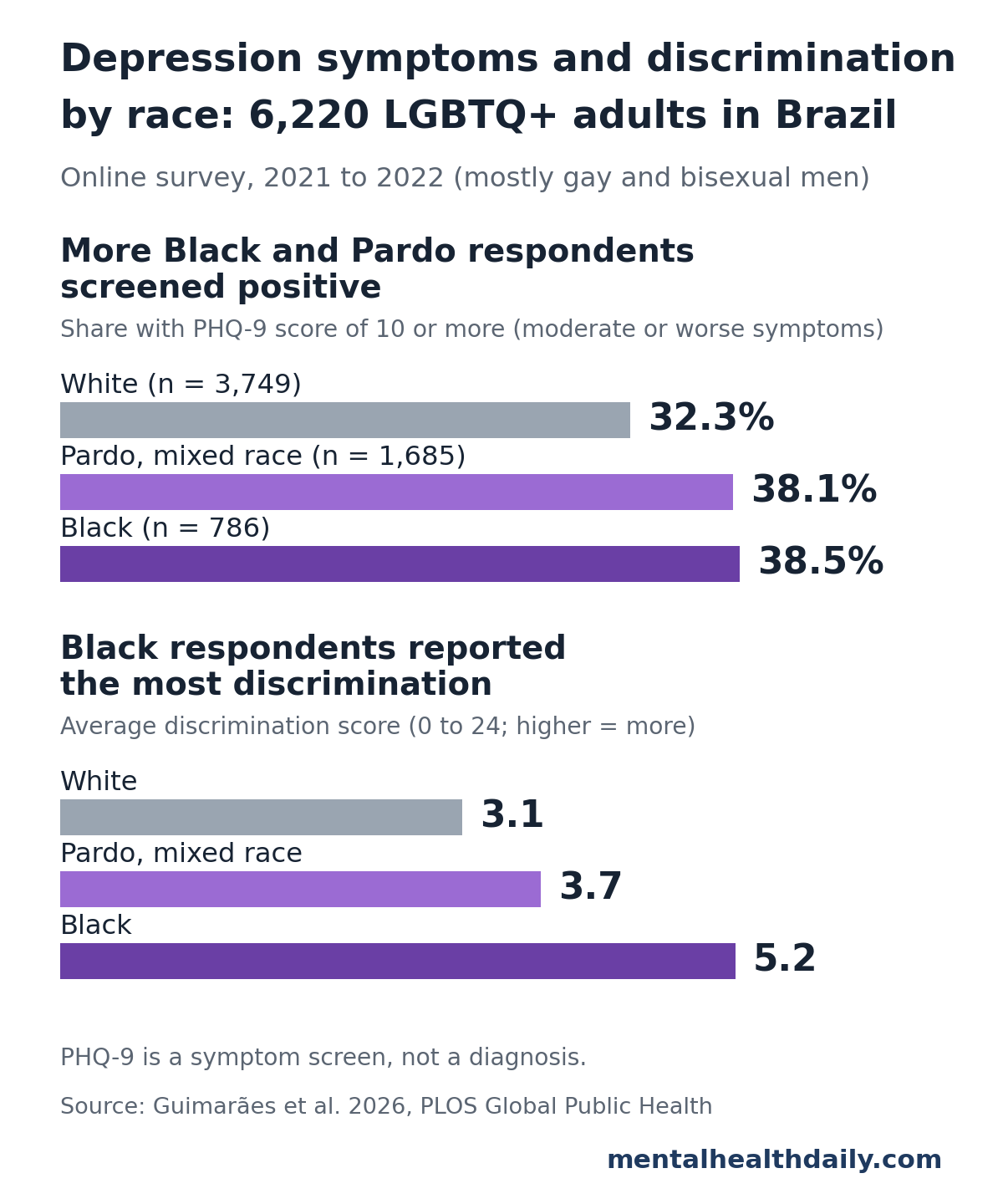
Percentages are as reported in the study. Its PHQ-9 category counts total 6,107, below the overall sample of 6,220; the chart’s group sizes describe the full sample, not the percentage denominators.1
For context, about 10.2% of Brazilian adults reported a clinician’s diagnosis of depression in the 2019 national health survey. The researchers point to 3 reasons their figure is so much higher: the focus on SGD people, data collected during the COVID-19 pandemic, and the use of a symptom screen rather than a diagnosis.1
The screening gap alone is large. A pooled analysis of 44 studies found that a PHQ-9 score of 10 or more flagged 24.6% of participants, while structured diagnostic interviews confirmed major depression in only 12.1%.5 The 34.6% figure describes symptom burden, not the share of people with diagnosable depression.
Safety note: more than half of respondents reported most PHQ-9 symptoms on at least several days. Item 9, which asks about thoughts of being better off dead or of self-harm, was one of 2 exceptions.1 If you are having thoughts like these, contact a crisis line: in Brazil, CVV at 188; in the US, 988.
Discrimination Was Linked to Depression Symptoms in Every Racial Group
Discrimination was measured with a short 8-item version of the Explicit Discrimination Scale, a Brazilian questionnaire about everyday unfair treatment, such as being treated disrespectfully in public, called names, or left out by coworkers or neighbors. An experience counted only if the person saw it as discrimination. Scores run from 0 to 24.1
Black respondents reported the most discrimination (average 5.2), followed by Pardo (3.7) and White (3.1) respondents. The reasons people gave differed by race:
- Sexual orientation: about 63% in all 3 groups
- Race: 77.9% of Black, 32.5% of Pardo, and 2.6% of White respondents
- Social class: 52.8% of Black, 41.9% of Pardo, and 24.8% of White respondents
An earlier analysis of the same survey, covering 8,464 gay, bisexual, transgender, and non-binary respondents, used the full 18-item scale. It found the same pattern: Black respondents scored highest, and race was both the main reason for and the strongest predictor of discrimination.3
The link with depression: the researchers ran separate regression models for each racial group, with all scores standardized so the effects could be compared. After accounting for age, gender, sexual orientation, education, income, region, substance use, binge drinking, and HIV status, each standard-deviation rise in discrimination went with higher PHQ-9 scores:1
- White: 0.36 standard deviations higher
- Pardo: 0.34 standard deviations higher
- Black: 0.30 standard deviations higher
All 3 were highly significant (p < 0.0001) and changed only slightly when the other factors were added.1
Internalized Homonegativity Had a Weaker Link, and No Clear Link in Black Respondents
Internalized homonegativity is negative feeling toward one’s own sexual orientation, absorbed from a hostile society. It was measured with the Reactions to Homosexuality Scale, which asks about comfort with one’s own sexuality, with being seen in public with openly LGBTQ+ people, and with LGBTQ+ social spaces.1
Both discrimination and internalized homonegativity are core parts of minority stress theory, the idea that stigma and prejudice create chronic stress that raises the risk of mental health problems in sexual minorities.2
In the adjusted models, internalized homonegativity had a small link with depression scores among White and Pardo respondents (0.08 standard deviations in each group). There was no clear link among Black respondents (0.01, p = 0.71).1
The researchers suggest the main stressors differ by group. Black respondents, who reported slightly lower internalized homonegativity, carried the heaviest load of racial and class discrimination.1
A US study that followed 448 young Black and Latino sexual minority men in Los Angeles for 2 years found a similar mix: racial discrimination predicted depressive symptoms early on, while discrimination about sexual orientation and internalized homonegativity became significant predictors later.4
Younger Age and Lower Income Also Went With More Symptoms
- Age: each additional 10 years of age went with lower depression scores in all 3 groups, so younger respondents had more symptoms.
- Income: low family income (up to 2 minimum wages a month) was linked to more symptoms among White and Pardo respondents, but not significantly among Black respondents.
- No clear link: education, region, HIV status, and illicit drug use were not significantly linked to depression scores in any group.
Black and Pardo respondents were also more likely to have low incomes (32.4% and 29.7% vs. 17.0% of White respondents). The researchers note that low income is one of the main barriers to mental health care in Brazil, where public mental health services are scarce.1
Limitations of This Brazilian SGD Depression Survey
The study is large and used questionnaires validated in Brazil, but its design limits what it can show:
- Cross-sectional: all data came from one survey, so it cannot show whether discrimination led to depression symptoms or whether people with more symptoms noticed or reported more discrimination.
- Convenience sample: most people were reached through dating apps, and those with internet access and free time were more likely to take part, so the results do not represent all SGD people in Brazil.
- Mostly cisgender gay and bisexual men: cisgender women were excluded by design, transgender and non-binary people made up about 2% of the sample, and all identities were pooled into one group.
- Missing groups: Asian and Indigenous respondents were excluded because of small numbers.
- Screen, not diagnosis: PHQ-9 scores reflect recent symptoms; only a clinical assessment can diagnose depression.
- Pandemic timing: data were collected in late 2021 and early 2022.
What the Findings Mean for LGBTQ+ Mental Health Care in Brazil
- Symptom burden was high: about 1 in 3 respondents screened positive, and more than 1 in 3 Black and Pardo respondents.
- Discrimination stood out: in every racial group, it had a much stronger link to depression symptoms than internalized homonegativity did.
- Race and class add to the load: Black respondents reported the most discrimination, often naming race and social class alongside sexual orientation.
- The researchers’ recommendation: policies that address racism, homophobia, and transphobia together, plus accessible, affirming mental health services.
References
- Guimarães C, Luz PM, Coutinho C, et al. High burden of depressive symptoms among sexual and gender diverse persons in Brazil: the role of discrimination, internalized homonegativity, and race. PLOS Global Public Health. 2026;6(9):e0007276. doi:10.1371/journal.pgph.0007276
- Meyer IH. Prejudice, social stress, and mental health in lesbian, gay, and bisexual populations: conceptual issues and research evidence. Psychological Bulletin. 2003;129(5):674–697. doi:10.1037/0033-2909.129.5.674
- Freitas L, Torres TS, Hoagland B, et al. Discriminatory experiences among gay, bisexual, and other men who have sex with men, and transgender and non-binary individuals: a cross sectional analysis. Lancet Regional Health – Americas. 2024;33:100737. doi:10.1016/j.lana.2024.100737
- DiGuiseppi GT, Davis JP, Srivastava A, et al. Multiple minority stress and behavioral health among young Black and Latino sexual minority men. LGBT Health. 2022;9(2):114–121. doi:10.1089/lgbt.2021.0230
- Levis B, Benedetti A, Ioannidis JPA, et al. Patient Health Questionnaire-9 scores do not accurately estimate depression prevalence: individual participant data meta-analysis. Journal of Clinical Epidemiology. 2020;122:115–128.e1. doi:10.1016/j.jclinepi.2020.02.002