
In a 2026 interview study of 20 U.S. young adults with mental health disabilities, most had already reached key adult milestones, yet every one of them described the COVID-19 pandemic changing their schooling, and 12 described it changing their path to full-time work.1
Research Highlights
- School took the widest hit: all 20 interviewees said the pandemic changed their education, usually for the worse, and 12 of 20 said it affected full-time or career work.1
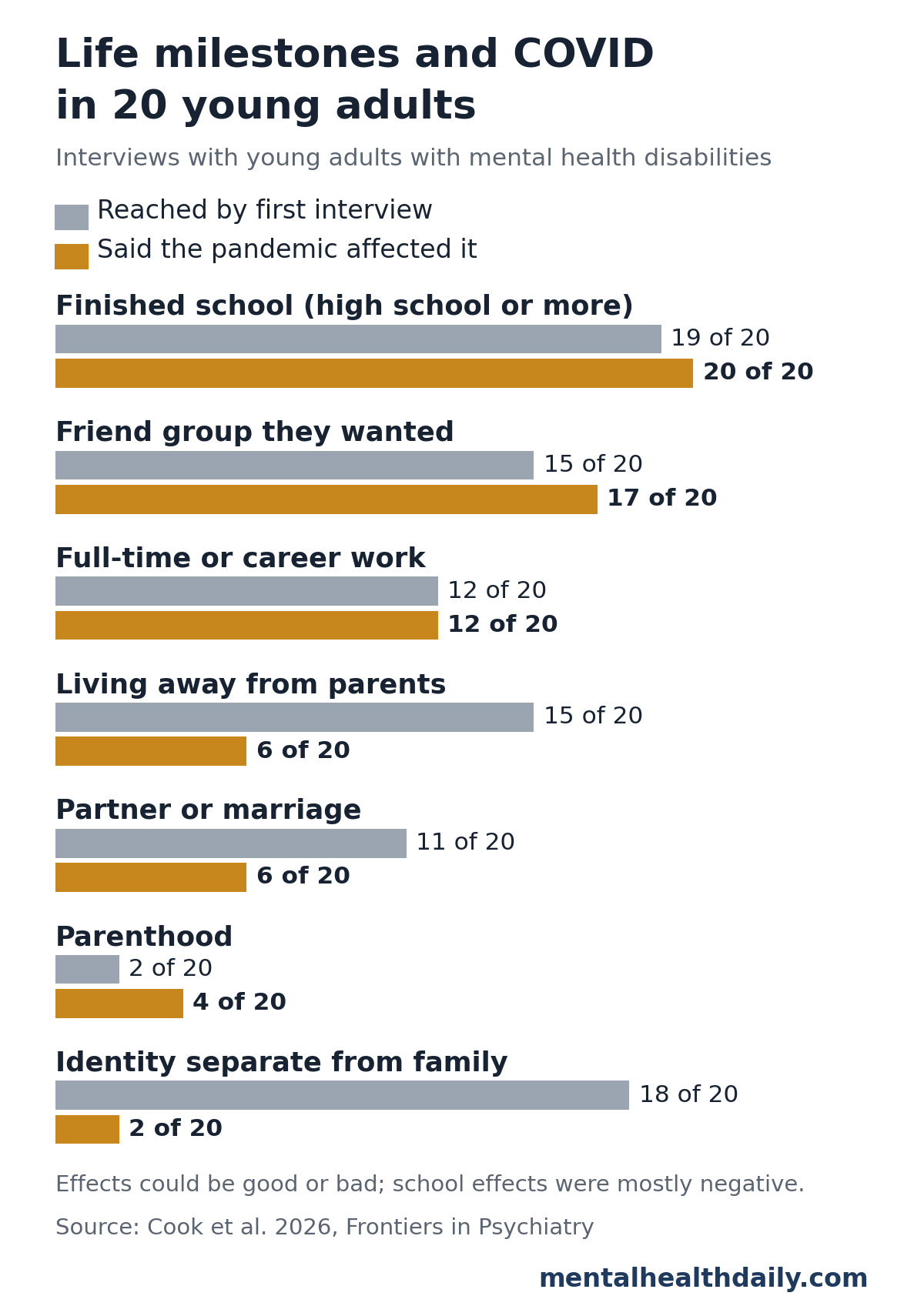
- Most milestones were already in place: by their first interview, 19 of 20 had finished high school, 15 lived away from their parents, and 18 described an identity separate from their family.1
- Ripple effects went beyond class: lost dorm housing, lost campus food, and shrinking work-study pay came up alongside remote learning.1
- Some grew up faster: 5 described the pandemic speeding up their independence, such as getting a first apartment or a job.1
- A larger survey points the same way: in 967 young adults with disabling mental health conditions, 81% reported at least 1 disrupted transition during the pandemic.2
Who Counted as Having a Mental Health Disability
Cook et al., a University of Illinois Chicago team working with UMass Chan Medical School, interviewed young adults age 18 to 25 who met 2 conditions:1
- A diagnosis before the pandemic: a physician or other medical provider had diagnosed at least 1 psychiatric condition from the DSM-5 (the standard U.S. diagnostic manual) before COVID-19 arrived.
- Self-reported disability: the person said their mental health condition impaired or disabled them.
Impairment was substantial. 80% said mental health problems kept them from working or attending school regularly, 50% had been hospitalized for psychiatric care, and 40% had been treated in a residential facility. 65% had received accommodations through a college disability services office.1
Most had more than 1 diagnosis, with an average of 2.8 among the 19 who completed the demographic survey:1
- Anxiety disorders: 18 of 19
- Depressive disorders: 12 of 19
- Eating disorders: 8 of 19
- Bipolar disorder: 6 of 19
- PTSD: 5 of 19
Study design: this was a qualitative interview study, not a national survey. Trained interviewers close in age to the participants, including young people with their own lived experience of mental health challenges, held Zoom interviews averaging 55 minutes between January 2022 and March 2023. Participants described their lives before the pandemic and what changed afterward.1
The team then counted how many people had completed, were working on, or were not pursuing 7 milestones, and looked for recurring themes in how they described the pandemic’s effects.
Most Had Reached Adult Milestones by Their First Interview
Despite serious and overlapping conditions, the group’s path into adulthood looked fairly typical for U.S. young people. By the first interview:1
- School: 19 of 20 had finished high school, and many had a college degree or vocational certificate
- Family: 18 described a life and identity separate from their family
- Living independently: 15 lived outside the parental home
- Friends: 15 had a circle of close friends
- Work: 12 had worked full-time in a career-related job, or held several jobs that added up to full-time
- Relationships: 11 had married or had a committed partner at some point, though only 3 had married
- Parenthood: 2 had children
Parenthood was the milestone people were least likely to be pursuing: 18 of 20 said it was not a current goal, and several said they never wanted children. The researchers saw this as consistent with the broader U.S. trend toward later childbearing, not as a sign of impairment.1
Pandemic Disruptions Ran Through School, Friendships, and Work
Every participant described at least 1 way the pandemic changed their transitions. The effects were concentrated in a few areas:1
- Education (20 of 20): mostly negative changes to schooling
- Friendships (17 of 20): usually negative, though not always
- Full-time or career work (12 of 20): negative effects on getting or keeping a job in their chosen field
- Partners, housing, parenthood, family ties: fewer people, with effects in both directions
School problems spilled into daily life. Classes and internships went remote or were canceled, and teachers gave less personal attention. For some, losing in-person school also meant losing a dorm room, free food at campus events, or part of their work-study pay. One student who needed financial aid had to take 5 online courses at once to stay full-time.1
Friendships changed in both directions. Some lost touch when they could no longer meet in person. Others said extra free time drew their closest friends closer while more distant acquaintances fell away.
Work plans stalled or changed course. 7 participants described stepping back from full-time work in their chosen field. Their reasons included:1
- Mental health: deciding they could not handle work and school at the same time, or needing to finish a day treatment program first
- A thin job market: fewer career openings in their field
- Benefits: pandemic unemployment payments that paid more than their old job, or applying for disability benefits
- Job stress: one kindergarten teacher left the classroom after struggling to enforce mask rules
4 participants rethought their careers entirely, such as a business major who switched to psychology after her internship was canceled.
Falling Behind Schedule Weighed on Some Participants
6 participants described their lives as not where they expected to be. Researchers call this off-timedness: distress at missing milestones that culture says should happen by a certain age.1
Examples ranged from being further behind in college than planned to living in a minivan because rents rose. One participant had expected to be teaching full-time and starting a master’s degree. Another had to pause the process of becoming an adoptive parent when fingerprinting and other steps became impossible.
Some Young Adults Grew More Independent During the Pandemic
The pandemic also pushed some participants forward. 5 described transitions that sped up and left them more independent and mature. One young man who had been living with his mother said he was proudest of getting a job and moving out during the pandemic, while so many others were losing work. A student who lost dorm housing moved into her first apartment and said she “learned a lot” from paying bills.1
The researchers argued these accounts challenge the assumption that young people with serious mental health challenges lack the motivation or resilience to handle major upheaval. Friends and family were a recurring source of emotional and practical help.1
Larger Studies Found Similar Disruptions in Work and School
The same research group ran a web survey in March to June 2021 of 967 U.S. young adults age 18 to 25 with disabling mental health conditions diagnosed before the pandemic. 81.1% reported at least 1 disrupted transition:2
- Finishing school: 38.3%
- Launching a career: 37.6%
- Living independently: 27.7%
- Forming a partner relationship: 22.9%
Work also stood out in a study of 128 patients at a first-episode psychosis clinic in Massachusetts. After the 2020 stay-at-home order, average employment was 33% lower than before the order, compared with the same weeks in 2019, and job losses outpaced the general population. School engagement dropped too and largely recovered by fall 2020, though it stayed below 2019 levels.3
The 2026 interviews add the “how” behind these numbers: lost campus housing and food, financial aid rules, and personal decisions about whether full-time work was manageable.
Limits of a 20-Person Interview Study
Interview studies show what people experienced and how they explain it; they cannot measure how common those experiences are or prove what caused them. The researchers stated that no causal conclusions can be drawn. Specific limits:1
- Small, self-selected group: 20 people recruited online through youth and mental health advocacy groups
- Better resourced than many peers: over half had a bachelor’s degree, over half reported household incomes of $60,000 to $89,999, and about two-thirds identified as White
- Missing groups: few people with schizophrenia and few from the western and southwestern U.S.
- Looking back: pre-pandemic life was recalled during interviews held in 2022 and 2023, and this analysis used only the first interview
- No comparison group: young adults without mental health disabilities were not interviewed, so the study cannot say whether this group was hit harder
- Self-reported diagnoses and disability
Support Ideas for Young Adults With Mental Health Disabilities
Based on these accounts, the researchers recommended:1
- Wraparound transition services: help with housing, jobs, money, and continuing education alongside clinical care, especially during disruptions like a pandemic
- Early intervention: addressing overlapping conditions early, before more develop
- Using informal networks: involving the friends and family members young people already rely on
For schools, the findings point to a practical lesson: closing campus can also cut off housing, food, income, and disability accommodations for students who depend on them.
References
- Cook JA, Aranda F, Jonikas JA, Boker M, Cortez C, Richardson D, Bendtsen B, Julian AE, Sabella K. Transitions to adulthood among U.S. young adults with mental health disabilities before and during the COVID-19 pandemic: traveling multiple pathways in uncertain times. Frontiers in Psychiatry. 2026;17:1911182. doi:10.3389/fpsyt.2026.1911182
- Cook JA, Jonikas JA, Burke-Miller JK, Aranda F, Mullen MG, Davis M, Sabella K. Social determinants, mental well-being, and disrupted life transitions among young adults with disabling mental health conditions. Journal of Behavioral Health Services & Research. 2025. doi:10.1007/s11414-024-09924-0
- Szmulewicz A, Öngür D, Shinn AK, et al. Impact of the COVID-19 pandemic on the employment and educational outcomes of individuals in a first-episode psychosis clinic. Psychiatric Services. 2022;73(2):165–171. doi:10.1176/appi.ps.202100114