
Adults with developmental disabilities who had danced with an inclusive company in Seoul for 9 to 13 years described dance as something that made them feel capable and recognized, and that also brought real pressure. The 2026 interview study followed 3 dancers and their caregivers.1
Research Highlights
- Who took part: 3 adult dancers (a man in his 30s and 2 women in their 20s) and their 3 primary caregivers, with 12 interviews and 10 observation sessions.1
- Feeling capable: repeated practice, feedback, and dancing alongside friends turned an intimidating studio into familiar ground.1
- Recognition came with pressure: being cast or called “teacher” brought pride, along with worry about making mistakes in front of the children they helped.1
- Staying in took support: illness, long sessions, and a caregiver’s after-work pickups all shaped whether the dancers could keep attending.1
- Accounts, not measured outcomes: the qualitative design describes experiences in one company; it cannot show that dance improved wellbeing.1
What Inclusive Dance Is
Inclusive dance adapts teaching, rehearsal, choreography, and roles so that people with different bodies and abilities can dance together, instead of asking everyone to meet one standard of technique or learning pace.1
Developmental disabilities are conditions that begin in childhood. Adults who have them may need different kinds of support with thinking, communication, daily living, and social life. The paper does not list specific diagnoses for its participants.1
Most research on dance in this group measures physical fitness, behavior, or wellbeing scores. Ahn et al. asked a different question: what dancing in public actually feels like to the dancers, and what keeps them coming back.1
How the Seoul Inclusive Dance Study Was Done
Researchers worked with one inclusive dance company in Seoul, Republic of Korea, that runs regular practice, rehearsals, and public performances for adults with developmental disabilities. Data were collected from October to December 2025.1
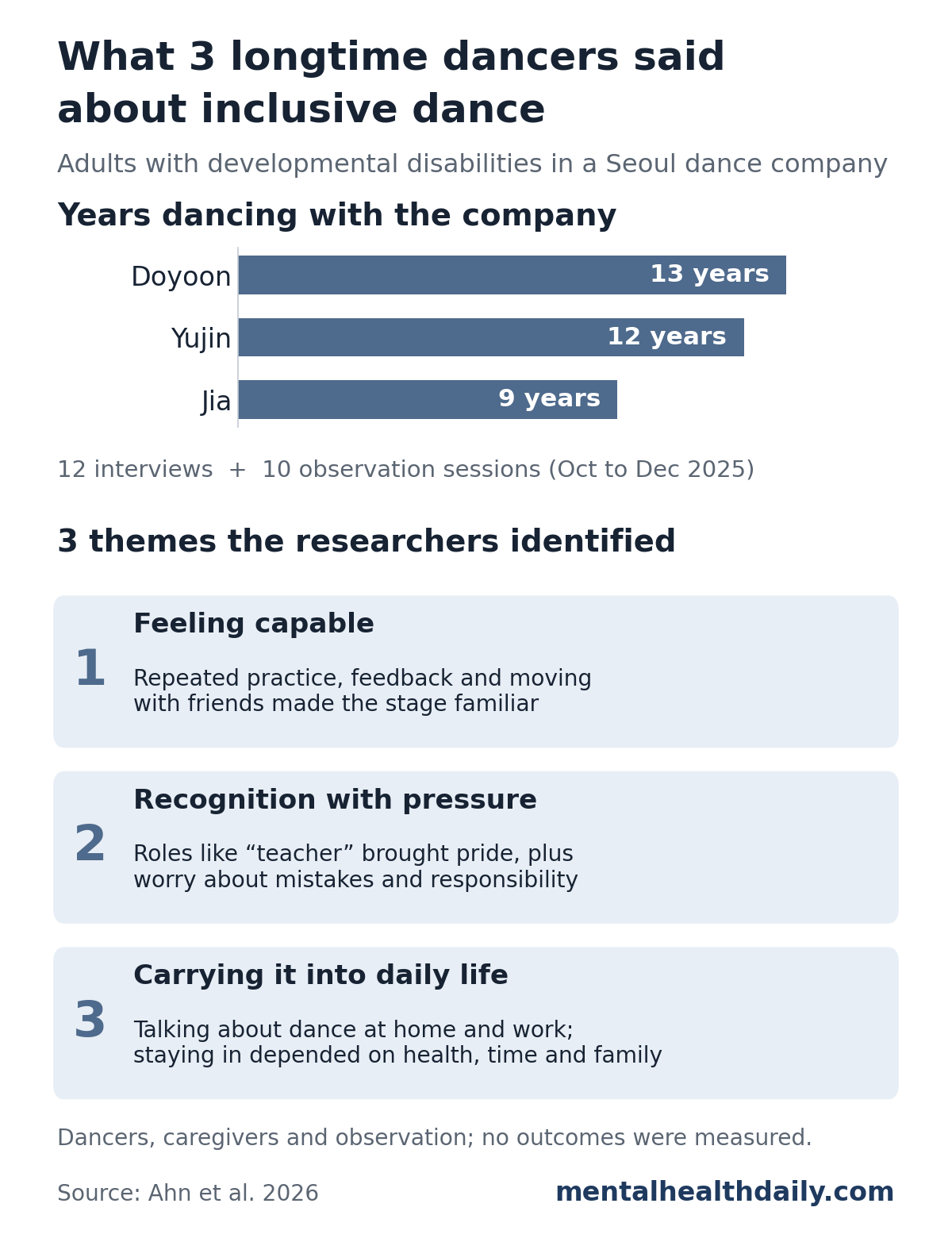
- Dancers: Doyoon (30s, 13 years with the company), Yujin (20s, 12 years), and Jia (20s, 9 years), all able to describe their experiences in speech
- Caregivers: each dancer’s primary caregiver, interviewed once for everyday context
- Interviews: 3 per dancer (about 40–70 minutes each, shortened or split when they got tired) and 1 per caregiver (about 60–90 minutes)
- Observation: 10 sessions of about 2–3 hours watching practice, rehearsal, and performances without taking part
The team used hermeneutic phenomenology, an approach that interprets how people make sense of lived experience, and grouped what they heard and saw into 3 themes. The names above are as reported; the researchers changed identifying details.1
Repeated Practice Made Dancers Feel Capable
None of the dancers described feeling at home on stage from the start. Doyoon put the change simply: “At first, the big mirror felt unfamiliar and scary, but now I’m used to it, and I can dance like a swan.”1
Other moments showed the same pattern:
- Trying again: Yujin described pushing through tension and embarrassment when the teacher said “Let’s try again” and told her to relax.
- Returning after a cramp: observers saw Yujin sit down with a calf cramp, decline the instructor’s offer to rest, and rejoin practice.
- Remembering changes: Jia’s caregiver said she remembers every change in choreography, even when others forget.
Dancing together. The dancers framed dance as a shared activity. “Dance is like speaking,” Doyoon said. “It is speaking with the body with friends who dance together.” Jia said she feels lonely when the group does not dance together, and observers saw her calm a peer who was crying after a sudden loud noise and help that dancer return to practice.1
Being Called “Teacher” Brought Pride and Pressure
Roles and titles carried a lot of weight. Doyoon described being addressed by the children’s mothers as “Teacher Doyoon” rather than just Doyoon: “It felt like being recognized.” Jia said being cast by the professor “felt good” and made her want to teach children who were struggling.1
The same recognition came with a load:
- Yujin: “I didn’t want to be an assistant teacher… I felt burdened.” She worried she might not teach well.
- Jia: “I feel burdened when the children look at me… If I make a mistake, the children might get confused.”
- Doyoon: a volunteer told him the children would not dance if he was not there. His caregiver said praise made him try even harder and that “he seems to feel a lot of responsibility.”
The researchers present this mix as the core of the second theme: recognition was never purely positive, and the dancers became aware that their presence affected others.1
Past Exclusion From Competitions Brought Self-Doubt
The dancers also described where participation stopped. In a previous dance setting, Jia said only non-disabled students were sent to competitions: “So I wondered whether I was not good enough.” Doyoon recalled not being able to wear a costume or stand on the competition stage, and feeling “a little despair.”1
That sense of a boundary had not fully gone away in the current company. Yujin said dancers with disabilities feel embarrassed standing next to non-disabled dancers, adding, “It’s not just me.”1
How teaching is done counts too. Observers saw an instructor correct a dancer forcefully during practice; the dancer, who was sensitive to loud sounds, began to cry and stopped participating for a while.1
Dance Spilled Into Everyday Life
Applause and praise shaped how the dancers judged themselves. “When many people in the audience clapped, I felt really good,” Yujin said. Jia said attention “makes me feel more confident,” and observers saw her arrive early and go around announcing that she had a solo.1
Dance also traveled outside the studio:
- At work: Doyoon’s caregiver said he talks proudly about dancing, including at his job, where coworkers asked for performance photos.
- In preparation: Yujin brought separate dancewear and changed before practice, unlike other dancers.
- In self-presentation: Jia drew a clear line between everyday clothes and performance costumes.
Keeping Dancers Involved Depends on Health, Time, and Family
All 3 wanted to keep dancing, but everyday conditions decided how easily they could. The researchers identified several:1
- Health: Jia said colds and heavy coughing made dancing hard.
- Time: Yujin wished sessions were shorter because she has many other things to do.
- Transportation and family: Yujin’s caregiver picks her up after work and said, “Honestly, it is hard.” Yujin had considered stopping because of it.
- Room to rest: observers saw one of the dancers, tired, sit out, keep watching the practice room, and rejoin.
The researchers argue that wellbeing here is less an outcome of dance than a set of conditions — flexible sessions, care from peers and family, and practical help getting there — that lets people keep participating.1
What Other Research Shows About Dance and Developmental Disabilities
The closest match is a 2024 interview study of 14 adult dancers with neurodevelopmental disabilities in Canada and the US. It found 3 themes: dance as part of who they are, dance as a source of life skills, and the value of inclusive teaching. Dancers described a sense of direction and belonging that motivated them to connect socially.2 That is consistent with the Seoul dancers’ accounts of capability and recognition.
Outcome evidence is broader but thin:
- 2025 scoping review: 15 papers on dance for adults with intellectual disabilities reported gains in body awareness, physical activity, and mental health, and more social interaction.3
- 2024 scoping review: across 14 studies of dance for adults with neurodevelopmental disabilities, few described the dance program or how teaching was adapted in any detail.4
- 2020 randomized trial: 109 Chinese adults with intellectual disabilities were randomly assigned to an expressive arts program or a control group. Effects differed by sex; women in the arts group showed significantly fewer problem behaviors than women in the control group.5
The Seoul study adds detail those reviews call for: what teaching, roles, and support look like from the dancers’ side.
Limitations of This Inclusive Dance Study
- Very small sample. 3 dancers and 3 caregivers from one company in Seoul.
- Long-term, verbal participants only. Everyone had 9 or more years with the company and could describe experiences in speech, so the findings say little about newcomers, people who left, or people who communicate without speech. The researchers flag possible selection bias.
- Possible socially desirable answers. The researchers note that participants may have said what they thought interviewers wanted to hear.
- No outcomes measured. Despite “key effects” in the paper’s title, there was no comparison group or wellbeing measure, so the study cannot show that dance caused any change.
- Translated, theory-led interpretation. Quotes were translated from Korean by the researchers, and the theme labels draw heavily on philosophy of the body.
What This Means for Inclusive Dance Programs
- Real roles count. Being cast, given a solo, or called “teacher” was central to how these dancers felt recognized.
- Roles need support. The same titles brought worry about mistakes and responsibility for others, so dancers who take them on may need backup.
- Teaching style shapes participation. Jia valued kind, detailed instruction; a forceful correction pushed another dancer out of practice for a while.
- Practical support keeps people dancing. Session length, room to rest, and rides to and from class all affected whether these dancers could keep coming, and families carried much of that load.
References
- Ahn H, Shin D, Jang D-J. Key effects of inclusive dance for adults with developmental disabilities: embodied agency, relational self-understanding, and conditions of wellbeing. Frontiers in Public Health. 2026;14:1934739. doi:10.3389/fpubh.2026.1934739
- Ladwig JC, Broeckelmann EM, Sibley KM, Ripat J, Glazebrook CM. “When we dance it’s never just dancing…”: understanding the experiences and perspectives of adult dancers with neurodevelopmental disability. European Journal of Adapted Physical Activity. 2024;17:14. doi:10.5507/euj.2024.011
- Dumitru C. Exploring the transformative power of dance: a scoping review of dance interventions for adults with intellectual disabilities. Journal of Intellectual Disabilities. 2025;29(1):214–232. doi:10.1177/17446295231218781
- Ladwig JC, Broeckelmann EM, Sibley KM, Ripat J, Glazebrook CM. A synthesis of the characteristics of dance interventions engaging adults with neurodevelopmental disabilities: a scoping review. Disability and Rehabilitation. 2024;46(10):1954–1961. doi:10.1080/09638288.2023.2217384
- Ho RTH, Chan CKP, Fong TCT, Lee PHT, Lum DSY, Suen SH. Effects of expressive arts–based interventions on adults with intellectual disabilities: a stratified randomized controlled trial. Frontiers in Psychology. 2020;11:1286. doi:10.3389/fpsyg.2020.01286