
In a 2026 case report from Italy, a 69-year-old woman with long-standing anxiety and depression became confused, slowed, and unable to sit still while taking the cancer drugs pembrolizumab and lenvatinib. After the cancer drugs and several sedating medicines were stopped, she largely recovered.1
Research Highlights
- Brain toxicity on top of a psychiatric illness: about 15 months after starting pembrolizumab plus lenvatinib for recurrent endometrial cancer, she was admitted disoriented, severely slowed, tremulous, and with severe akathisia.1
- No cancer in the brain: CT, MRI, a spinal tap, and EEG found no metastases or brain inflammation. An FDG-PET scan showed low activity across the brain’s outer layer, a pattern the team read as drug-related encephalopathy.1
- Sedatives were part of the problem: she was taking a benzodiazepine, pregabalin, and escitalopram. Tapering them and giving flumazenil, a benzodiazepine blocker, made her more alert within the first week.1
- Recovery without high-dose steroids: the cancer drugs were stopped for good, and pramipexole eased her akathisia. She left the hospital on 2 psychiatric drugs instead of 3 and later walked on her own.1
- One patient: several treatments changed at once, so the case cannot show which step helped or how often this happens.1
Pembrolizumab and Lenvatinib for Endometrial Cancer
Pembrolizumab is an immune checkpoint inhibitor. It blocks PD-1, a “brake” receptor on immune T cells, so the immune system can attack tumor cells more aggressively. The same release of the brakes can also let immune cells attack healthy organs, including the nervous system.
Lenvatinib is a multikinase inhibitor, a pill that blocks several growth-signaling enzymes. Its main target is the VEGF pathway that tumors use to grow new blood vessels, which is why high blood pressure is one of its most common side effects.
The combination works. In a trial of 827 people with previously treated advanced endometrial cancer, median survival was 18.3 months with pembrolizumab plus lenvatinib, compared with 11.4 months with chemotherapy.2 Side effects were heavy, though: 88.9% had a severe (grade 3 or higher) adverse event, and 33.0% stopped at least one drug because of side effects.
A Woman With Depression Who Became Confused on Cancer Treatment
The patient had been treated for an anxious-depressive disorder since 2021. Several antidepressants, anti-anxiety drugs, and low-dose antipsychotic add-ons had helped only partly, and her mood tended to worsen around cancer tests and treatment.1
She started pembrolizumab plus lenvatinib in April 2023, after her endometrial cancer spread through the lining of the abdomen. The tumor responded well enough for surgery in September 2023, and the combination resumed in October.1
Over the following months, Borghesani et al. report, her condition steadily worsened. By July 2024 she needed admission to a psychiatric ward. On arrival:1
- Mental state: disoriented in time and place, drifting between a half-confused state and severe slowing. She understood speech but spoke slowly, softly, and with slurred words.
- Movement: a fine tremor at rest and when holding a posture, plus severe akathisia, an intense inner restlessness that made it impossible for her to stay in one position.
- Blood pressure: on the low side at 105/65 mmHg.
- Absent: no psychotic thinking, no suicidal intent, and no focal signs of a stroke or tumor on the neurological exam.
Daily medicines at admission:
- Cancer drugs: lenvatinib 10 mg a day (a reduced dose) and pembrolizumab 200 mg by IV every 3 weeks.
- Psychiatric drugs: delorazepam 4 mg a day (a long-acting benzodiazepine), pregabalin 75 mg 3 times a day, and escitalopram 15 mg a day.
- Other: olmesartan 40 mg for blood pressure, prednisone 5 mg, and oxycodone with acetaminophen (paracetamol) for pain.
How Doctors Untangled the Causes Over 4 Weeks
The team suspected a multifactorial iatrogenic encephalopathy: brain dysfunction caused by treatment, with several drugs and her physical frailty adding up. They worked through it in stages.1
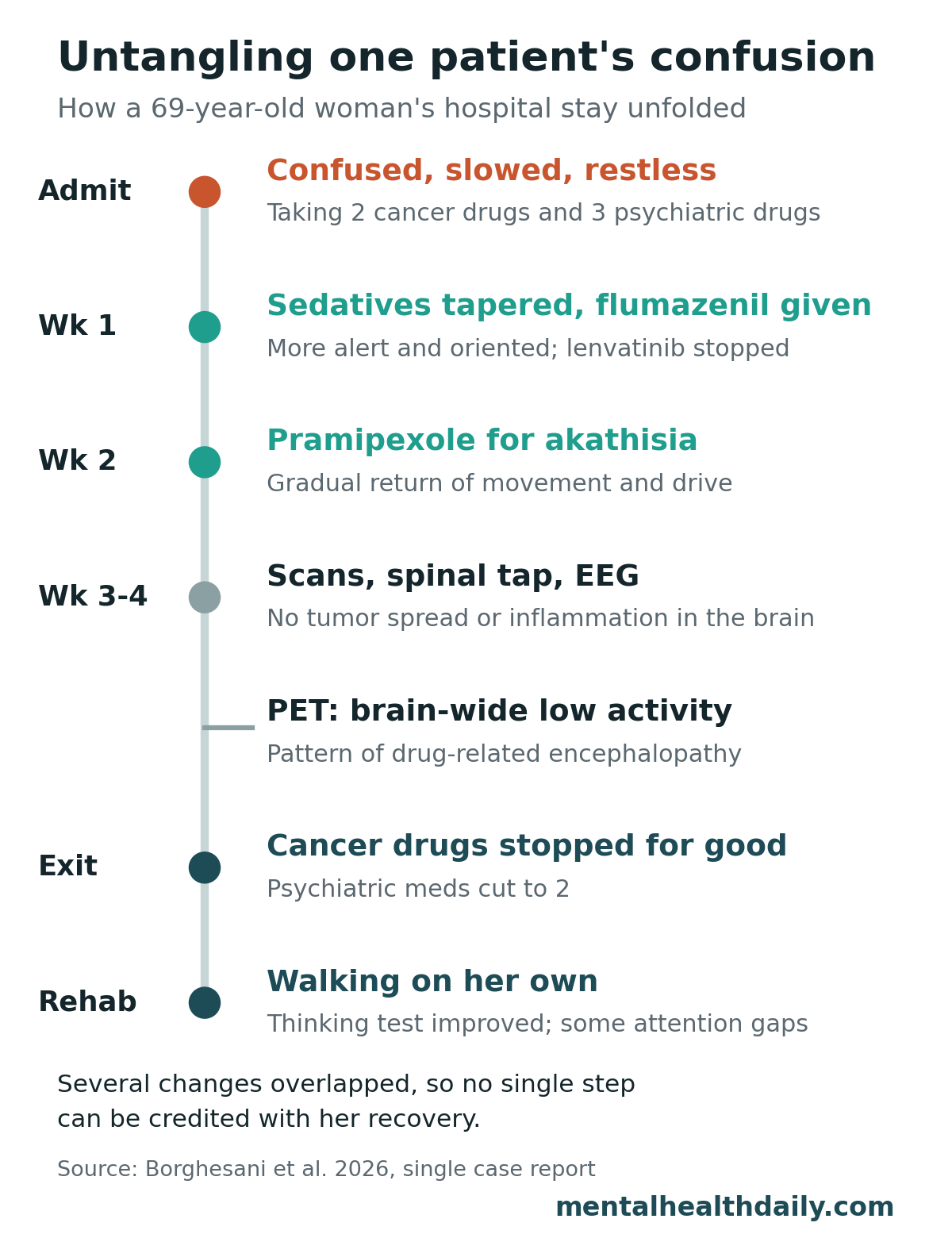
Week 1, sedatives and lenvatinib: a brain CT was normal. The benzodiazepine and pregabalin were switched to diazepam so they could be tapered off in a controlled way, and escitalopram was stopped.
She then received IV flumazenil, a drug that blocks the benzodiazepine binding site on GABA receptors, in divided doses. She became more alert and better oriented, which pointed to lingering benzodiazepine sedation.1 After discussion with her oncologists, lenvatinib was stopped and the next pembrolizumab dose was postponed.1
Week 2, akathisia: once the benzodiazepine taper was finished, the akathisia, tremor, and other movement problems were still there. She started pramipexole, a dopamine-receptor stimulant used for Parkinson’s disease and restless legs, at 0.18 mg a day, raised to 0.18 mg 3 times a day. Her movement and initiative gradually returned.1
Weeks 3–4, the brain workup: movement kept improving, but her thinking stayed slow, with poor attention and memory. Tests done in this period:1
- MRI: scattered white-matter changes described as non-specific scarring (gliosis), with no tumor.
- Spinal tap: no sign of inflammation or degeneration.
- FDG-PET (a scan of how much glucose brain regions use): low activity across the cortex with the deep basal ganglia spared, and no hot spots that would suggest autoimmune or cancer-related inflammation.
- EEG: diffuse slow brain waves, a common finding in encephalopathy.
- Cognitive screening: a Montreal Cognitive Assessment (MoCA) score below the norm for her age and education, although she was too disengaged for the result to be fully reliable.
A 2-day trial of methylphenidate (a stimulant) did nothing. Her blood pressure medicine was tapered off because low pressure might have been reducing blood flow to the brain.1
Recovery After the Cancer Drugs Were Stopped
At discharge, the team and her oncologists decided to stop pembrolizumab and lenvatinib permanently. Her psychiatric medicines were down to pramipexole 0.18 mg 3 times a day and quetiapine 25 mg as needed.1
In an intensive rehabilitation program she regained independent walking, did structured cognitive training, and her anxiety and mood improved. Low-dose quetiapine (75 mg a day) was briefly restarted.1
Cognitive follow-up: her MoCA score improved significantly (the report gives no exact numbers).1
Most thinking skills tested in the normal range, including memory, language, and visual-spatial skills. She was still below normal at switching attention between tasks and somewhat slow on processing-speed tests. At home, she reported thinking clearly enough for daily life.1
She improved without the high-dose corticosteroids usually used for immune-related side effects, which the researchers see as further support for a reversible, drug-related cause.1
How Each Drug Can Affect the Brain
Borghesani et al. propose that several mechanisms stacked up rather than one drug acting alone:1
- Pembrolizumab, immune effects: checkpoint inhibitors can cause rare immune attacks on the nervous system. In a Spanish series of 64 patients with these complications, most involved the brain or spinal cord, and a subgroup had encephalopathy with no inflammatory signs on tests.3
- Lenvatinib, blood-vessel effects: by disrupting the lining of blood vessels and raising blood pressure, it has been linked in case reports to posterior reversible encephalopathy syndrome (PRES), a brain swelling that can cause confusion and seizures.4 In US adverse-event reports, lenvatinib also showed a significant signal for psychiatric side effects.5
- Sedating psychiatric drugs: benzodiazepines roughly tripled the odds of delirium in a systematic review of 14 prospective studies (odds ratio 3.0).6 Pregabalin adds further sedation.
- Low blood pressure and frailty: a 69-year-old with advanced cancer and low blood pressure has less reserve to absorb all of this.
The team’s literature search turned up only a handful of earlier case reports of neurological or psychiatric problems with either drug.1
New Confusion Can Look Like a Psychiatric Relapse
The main lesson from this case is about recognition. In someone already treated for depression or anxiety, slowing, staying in bed, low speech, and agitation can easily be read as a worsening of the psychiatric illness.
The researchers warn that drug-related brain toxicity in people on these cancer treatments can be “subtle, fluctuating, and easily misinterpreted as primary psychiatric disorders.”1
Signs that pointed to a medical cause here:
- Disorientation: not knowing the date or place points toward delirium or another medical cause.
- Fluctuating alertness: swinging between confusion and severe slowing.
- Movement signs: new tremor, slurred speech, and akathisia.
- Timing: steady decline after new cancer drugs were added to a heavy sedative load.
The team recommends routine neuropsychiatric monitoring for people on checkpoint inhibitors and multikinase inhibitors, especially with a psychiatric history and many medications, along with a structured medication review and close psychiatry-oncology teamwork.1
Stopping an effective cancer treatment is a hard decision. Her cancer had responded well, and the choice to stop was made jointly with her oncologists after weighing survival against her loss of independence. Anyone on these drugs who notices new confusion, restlessness, or slowing should report it promptly to the cancer team rather than stopping medicines on their own.
Limits of This Single Case Report
This is one patient, and the report can describe what happened but cannot prove what caused it.1
- Overlapping changes: cancer drugs, sedatives, an antidepressant, and a blood pressure drug were all stopped, while flumazenil, pramipexole, and rehabilitation were added, so no single step can be credited.
- No specific biomarker: no test can confirm immune-related brain toxicity, so the diagnosis rests on ruling other causes out.
- Shaky cognitive baseline: she was too disengaged during the acute phase for testing to be fully valid, and no MoCA numbers were reported.
- Reporting inconsistencies: the paper describes her tumor as both BRCA wild-type and BRCA-positive, and several in-text citations do not match the reference list.
References
- Borghesani A, Trottner K, Wedmann FM, Bertoldi B, Tondulli L, Farsad M, Spimpolo A, Boschello F, Conca A. Case Report: Neuropsychiatric and cognitive phenomena in a highly complex patient affected by psychiatric and oncological diseases. Frontiers in Psychiatry. 2026;17:1904104. doi:10.3389/fpsyt.2026.1904104
- Makker V, Colombo N, Casado Herráez A, et al. Lenvatinib plus pembrolizumab for advanced endometrial cancer. New England Journal of Medicine. 2022;386:437–448. doi:10.1056/NEJMoa2108330
- Fonseca E, Cabrera-Maqueda JM, et al. Neurological adverse events related to immune-checkpoint inhibitors in Spain: a retrospective cohort study. The Lancet Neurology. 2023;22:1150–1159. doi:10.1016/S1474-4422(23)00335-6
- Mahajan A, Ashtekar R, Agarwal U, et al. Atypical posterior reversible encephalopathy syndrome associated with Lenvatinib therapy in a patient with metastatic thyroid cancer—A case report. Cancer Reports. 2022;5(9):e1605. doi:10.1002/cnr2.1605
- Wang X, Yin D, Tang Y, Xiao F, Wang S. Psychiatric adverse reactions to non-selective RET multi-kinase inhibitors: a large-scale pharmacovigilance analysis. Frontiers in Pharmacology. 2023;14:1209933. doi:10.3389/fphar.2023.1209933
- Clegg A, Young JB. Which medications to avoid in people at risk of delirium: a systematic review. Age and Ageing. 2011;40(1):23–29. doi:10.1093/ageing/afq140