
No controlled trial has tested a ketogenic diet for PTSD. A 2026 review of 16 publications found encouraging results in rats and in a handful of patient case reports, but the only placebo-controlled human study, which used ketone supplements, did not beat placebo.1
Research Highlights
- Thin evidence base: of 16 publications, 9 involved people, 4 were rodent studies and 3 were narrative reviews. The human work was 5 case reports, 3 small pilots and 1 diet survey.1
- Ketone salts did not beat placebo: in a 21-person, 6-week randomized pilot, PTSD scores fell within the ketone group (median 58.5 to 54 on an 80-point scale), but the difference from placebo was not statistically significant.2
- Big drops in single cases: one patient on a ketogenic program went from the maximum PTSD score of 80 to 0 after 12 weeks. Case reports have no comparison group.1
- Rats were calmer after trauma-like stress: raising ketone levels by injection, MCT oil or acetate reduced anxiety-like behavior in 3 rat models of PTSD.14
- A model, not a test: the researchers propose that ketones could act on brain energy, inflammation and the GABA-glutamate balance, and call for large randomized trials.1
What Ketogenic Therapy Is and Why Researchers Think It Could Help PTSD
Ketogenic therapy means any treatment that raises blood ketones. The best known is the ketogenic diet: very low in carbohydrates and high in fat, so the liver turns fat into ketone bodies, mainly beta-hydroxybutyrate (BHB), which the brain can burn for fuel in place of glucose.1
Ketones can also be raised without the diet, using ketone salts or esters, or MCT oil (medium-chain triglycerides, a fat the liver readily converts to ketones).1
The diet has been used for epilepsy since the 1920s. Early pilot studies have since tested it in schizophrenia, bipolar disorder and depression.1
The PTSD rationale rests on metabolism. People with PTSD more often have insulin resistance and metabolic syndrome, along with raised inflammatory markers and oxidative stress. Robin Engelhardt et al., a team based mainly in Germany and the US, argue that ketogenic therapy pushes several of these processes in the opposite direction.1
Why look for new options at all: trauma-focused psychotherapy works but is hard to access for many people, and PTSD medications produce remission in only about 20% to 30% of patients, according to the review.1
16 Publications, Mostly Case Reports, Rodent Studies and Reviews
The team searched 6 research databases and 3 clinical trial registries in January 2025, then updated the search in May 2026. They used an integrative review, a format that pulls together very different kinds of studies (lab, animal, case and trial data) rather than pooling numbers in a meta-analysis.1
The 16 eligible publications appeared between 2020 and 2026:1
- 5 human case reports, each describing 1 or 2 patients
- 3 small human pilots: a 3-person ketogenic diet study and 2 reports of a 21-person ketone salt trial, which may describe the same participants
- 1 diet survey of Ukrainian young people, with no treatment given
- 4 rodent studies using trauma-like stress
- 3 narrative reviews that discussed mechanisms
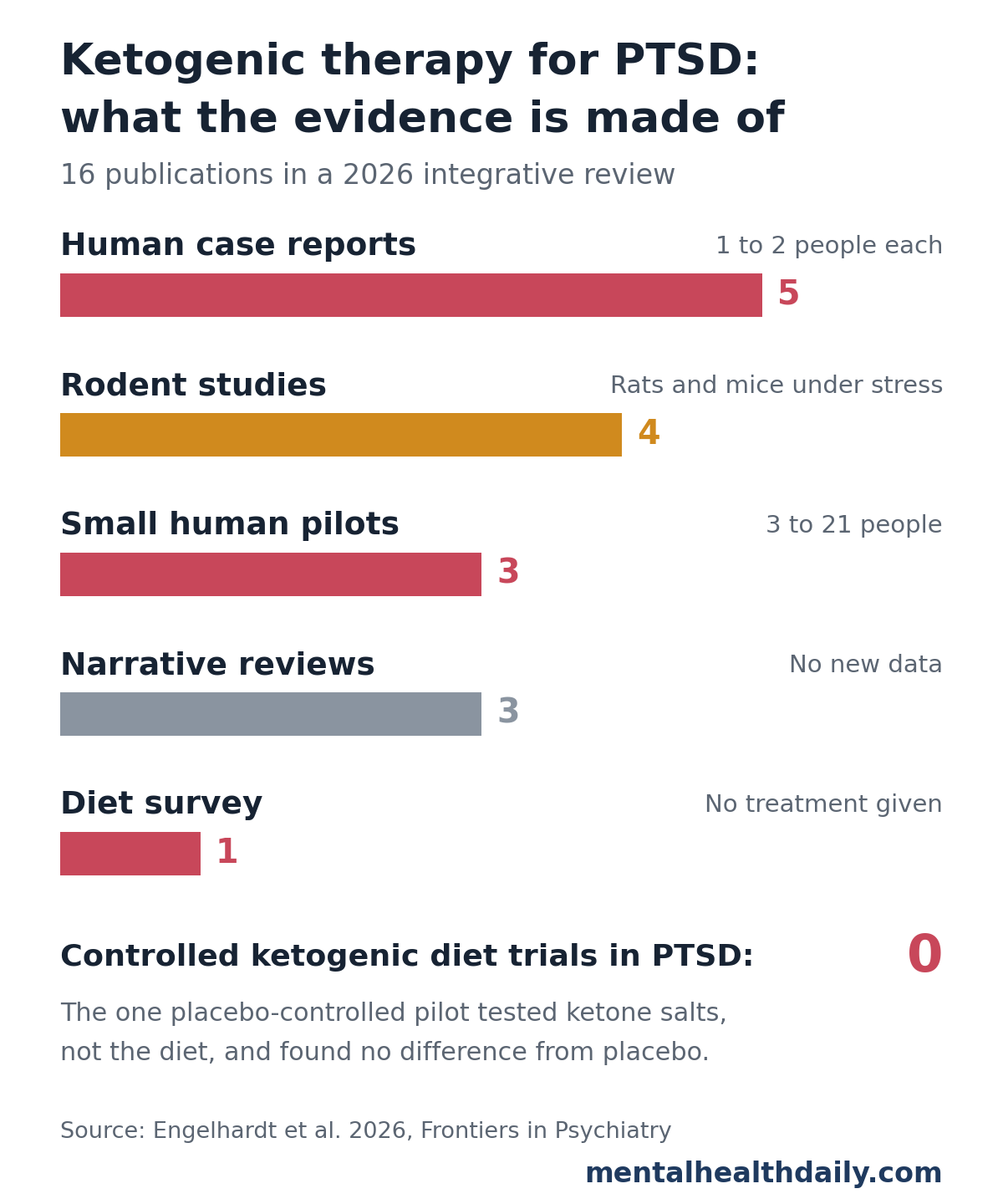
Only the 2 randomized pilot reports counted as high-level evidence by design, the reviewers judged. Most human data came from uncontrolled reports.1
Ketone Salts Did Not Beat Placebo in the Only Controlled PTSD Trial
Nagy Youssef et al. randomized 21 adults with PTSD to ketone salts or placebo for 6 weeks, on top of their usual care. Each dose held 7 grams of BHB, taken twice a day.2
Symptoms were measured with the PCL-5 (PTSD Checklist for DSM-5), a 20-item questionnaire scored from 0 to 80, where higher means worse symptoms.
- Ketone group: median score fell from 58.5 to 54 (p = .0003 for the within-group change)
- Placebo group: median stayed at 34
- Between groups: no statistically significant difference before (p = 1.0) or after treatment (p = .60)
How to read this: a 4.5-point drop is modest, and a within-group change without a difference from placebo does not show that ketones treated PTSD. Engelhardt et al. also note that mean scores fell slightly in the placebo group.12
Safety in the same setting: a separate report of a 21-person, 6-week ketone salt pilot found no group differences in blood pressure, heart rate, blood counts or a standard metabolic panel. The reviewers suspect it describes the same Augusta University participants.1
Case Reports Showed Large PTSD Score Drops Without Controls
The first study to put PTSD patients on a ketogenic diet was a Norwegian feasibility pilot by Edwards et al. 3 outpatients started a ketogenic diet plus BHB salt for 4 weeks; 2 finished. Ketosis held on 87% of intervention days.3
The 2 completers’ PCL-5 scores fell from 70 to 50 and from 50 to 40. The third patient stopped after 2 weeks, citing the combined burden of meal preparation and measurements.1
The case reports show bigger changes:1
- 80 to 0 in 12 weeks: a patient with PTSD, ADHD and binge-eating disorder followed a ketogenic program that also added exercise and intermittent fasting
- 32 to 2 over about 6 months: a patient with treatment-resistant PTSD on a ketogenic diet
- 38 to 8 in 21 weeks: a patient with bipolar II disorder whose PTSD symptoms were also tracked
- 38 to 8 and 8 to 3 by about 24 to 27 weeks: 2 patients with schizoaffective disorder
Evidence strength: case reports cannot separate a diet effect from natural recovery, other treatment, lifestyle changes or the attention that comes with close monitoring. 3 of these patients had no formal PTSD diagnosis, and published cases tend to be the ones that went well.1
The pattern resembles the broader ketogenic psychiatry literature. In a 4-month single-arm pilot of 23 people with schizophrenia or bipolar disorder, Sethi et al. reported a 32% drop in psychiatric symptom scores among those with schizophrenia, along with weight loss and better insulin sensitivity. That trial also lacked a control group.5
Rats Exposed to Trauma-Like Stress Showed Less Anxiety on Ketones
The 3 treatment studies in rats used single prolonged stress, a standard rat model of PTSD in which animals go through restraint, forced swimming and anesthesia in one session, then develop lasting anxiety-like behavior.4
- BHB injections: Takehiko Yamanashi et al. found repeated injections reduced anxiety-like behavior and lowered blood levels of TNF-alpha, an inflammatory signaling protein.4
- Acetate supplement: stressed rats given sodium acetate had 4 times higher blood BHB, less anxiety-like and avoidance behavior, better social behavior and lower stress hormones.1
- MCT oil: raised BHB and reduced anxiety-like behavior on the elevated plus maze, a standard anxiety test.1
Across the 3 studies, the calming effect was specific to trauma-like stress. In unstressed rats, ketones alone did not reduce anxiety-like behavior.1
A fourth study, in mice, found that animals prone to PTSD-like behavior showed signs of an energy shortfall in the cerebellum, alongside higher blood BHB, which the researchers read as the body already reaching for ketones.1
How Ketones Might Act on PTSD, According to the Proposed Model
Engelhardt et al. combined these findings into a 2-pathway model. They describe it as conceptual and meant to generate hypotheses.1
- Signaling route. BHB acts as a signaling molecule. It dampens the NLRP3 inflammasome (an immune switch that releases inflammatory proteins) and activates Nrf2, a pathway that boosts antioxidant defenses. It may also help restore BDNF (brain-derived neurotrophic factor, a growth factor for brain cells).
- Fuel route. Burning ketones may supply more ATP, the cell’s energy currency, while producing fewer damaging reactive oxygen species than burning glucose. It may also shift the balance toward GABA, the brain’s main calming chemical, and away from excitatory glutamate.
The model then maps these changes onto brain regions linked to PTSD: the prefrontal cortex, which helps regulate fear; the amygdala, which drives fear responses; the hippocampus, which places memories in context; plus the insula and cerebellum. Better function in these areas, they propose, could ease intrusive memories, hyperarousal and avoidance.1
Much of this chain comes from epilepsy, general neuroscience and the 3 narrative reviews. Apart from C-reactive protein, an inflammation marker tracked in the 3-person Norwegian pilot, none of it has been measured in people with PTSD on ketogenic therapy.1
Side Effects Reported With Ketogenic Diets in PTSD Studies
Only the 3-person Norwegian pilot formally tracked adverse events. It found no serious events, and mostly mild reactions such as headache and fatigue on 70% of intervention days, which are common in the first weeks of the diet.1
Lab changes appeared in several reports:1
- Liver enzymes and cholesterol: in one self-directed diet case, ALT (a liver enzyme) rose from 18 to 119 U/L and LDL cholesterol from 156 to 209 mg/dL; values normalized 8 months after stopping, alongside a statin, supplements and exercise, and the reviewers question whether the diet caused the changes
- Early spikes: in the Norwegian pilot, liver enzymes, LDL cholesterol and C-reactive protein rose in some patients in the first 2 weeks, then improved by week 4 in the completers
- Carnitine: one patient had low free carnitine (a nutrient involved in fat burning) after 3.5 weeks
The reviewers attribute most of these changes to the adjustment period of the diet and found no PTSD-specific safety signals. With so few patients and no control groups, that is far from a full safety assessment, as the review itself states.1
Limitations of This Ketogenic Therapy Review
- Tiny human evidence: the review counted 25 people with PTSD symptom data across 6 human reports, and the randomized pilot found no difference from placebo.
- Possible double counting: the 2 ketone salt reports may come from one trial, with inconsistent group sizes between them.
- Mixed treatments: diets, ketone salts, MCT oil, acetate and injections differ in how much they raise ketones and how hard they are to stick with.
- Rats are not patients: anxiety-like behavior on a maze captures only part of PTSD, not nightmares or flashbacks.
- Not a full systematic review: it borrowed parts of PRISMA, the standard checklist for systematic reviews, without meeting all of it, and reviewers initially disagreed on which studies to include.
- Author interests: several authors work in metabolic psychiatry, and some disclosed related advisory roles, funding or book royalties.
What This Means for People With PTSD
Current state of evidence: ketogenic therapy for PTSD has a biological rationale, consistent results in rats and some striking single-patient stories. It has not been shown to work in a controlled human trial.1
Proven treatments come first: trauma-focused psychotherapy remains a first-line PTSD treatment. Engelhardt et al. recommend testing ketogenic therapy both on its own and as an add-on to trauma-focused therapy.1
Medical supervision: as these reports show, a ketogenic diet can shift blood lipids and liver enzymes, and it can affect diabetes care and some medications. Anyone considering it should involve their doctor.
What would answer the question: adequately powered randomized trials comparing a ketogenic diet or ketone supplements with a control condition, using wider recruitment and planning for the first 2 weeks of adjustment.1
References
- Engelhardt R, Ogedengbe JO, Millet MS, et al. Ketogenic therapy as a potential novel treatment approach for PTSD: an integrative review and proposed mechanistic model. Frontiers in Psychiatry. 2026;17:1854499. doi:10.3389/fpsyt.2026.1854499
- Youssef NA, Holland-Winkler AM, Phung P, Waller JL, Ponkshe S. A randomized, double-blind, clinical pilot trial of adjunct ketone supplement compared to placebo for treating posttraumatic stress disorder. Annals of Clinical Psychiatry. 2022;34:240–244. doi:10.12788/acp.0088
- Edwards MGP, Furuholmen-Jenssen T, Søegaard EGI, Thapa SB, Andersen JR. Exploring diet-induced ketosis with exogenous ketone supplementation as a potential intervention in post-traumatic stress disorder: a feasibility study. Frontiers in Nutrition. 2024;11:1406366. doi:10.3389/fnut.2024.1406366
- Yamanashi T, Iwata M, Shibushita M, et al. Beta-hydroxybutyrate, an endogenous NLRP3 inflammasome inhibitor, attenuates anxiety-related behavior in a rodent post-traumatic stress disorder model. Scientific Reports. 2020;10:21629. doi:10.1038/s41598-020-78410-2
- Sethi S, Wakeham D, Ketter T, et al. Ketogenic diet intervention on metabolic and psychiatric health in bipolar and schizophrenia: a pilot trial. Psychiatry Research. 2024;335:115866. doi:10.1016/j.psychres.2024.115866