
Two teenage girls in Rome developed catatonia after receiving corticosteroids for a suspected brain inflammation that testing never confirmed, according to a 2026 report on their two cases.1
Research Highlights
- Catatonia followed steroid treatment in both girls: a 13-year-old was mute and unable to move by the day after a 15-day steroid course ended, and a 15-year-old with schizophrenia developed catatonic features during 2 months of steroid cycles.1
- Brain inflammation was suspected but not confirmed: tests found no infectious or autoimmune cause, and both girls’ illnesses proved to be psychotic disorders.1
- Standard catatonia treatment fell short: high-dose lorazepam (15 mg a day), immune treatments, and plasma exchange did not resolve the 13-year-old’s catatonia.1
- Both stabilized on antipsychotics, including clozapine: the younger girl’s catatonia score fell from 26 to 9 after antipsychotic treatment began.1
- Causality scores differed: on a standard drug-reaction scale, steroids were a “probable” cause for the younger girl and a “possible” cause for the older one.1
What Catatonia Looks Like in Teenagers
Catatonia is a syndrome of disturbed movement, behavior, and responsiveness. A person may stop speaking, freeze in one position, or resist being moved, even while awake. It can occur in many psychiatric and medical illnesses, not just schizophrenia.1
Common signs include:
- Mutism: speaking little or not at all.
- Stupor: little movement or response to the surroundings.
- Posturing and rigidity: holding odd positions or stiffening against being moved.
- Negativism: resisting instructions or doing the opposite.
- Echolalia and echopraxia: repeating other people’s words or movements.
- Refusing food or drink: which can make catatonia medically dangerous.
Settings where it appears in young people: De Biase et al. list several:1
- Autism and other neurodevelopmental conditions
- Early-onset schizophrenia and other psychoses
- Mood disorders, and occasionally anxiety, dissociative, or eating disorders
- Medical illnesses such as epilepsy, encephalitis, and metabolic or genetic diseases
- Substances and medications, including antipsychotics, MDMA, PCP, and, rarely, corticosteroids
Doctors often rate severity with the Bush–Francis Catatonia Rating Scale (BFCRS), which scores 23 signs from 0 to 3 each, so higher totals mean more severe catatonia.2
Benzodiazepines are the usual first treatment. In a French cohort of 66 hospitalized catatonic patients aged 9 to 19, 51 received benzodiazepines and 33 of those treated (65%) responded. Electroconvulsive therapy (ECT) was used in 12 as a second option.3
Why Teens With Sudden Psychiatric Symptoms Get Steroids
Autoimmune or infectious encephalitis, inflammation of the brain, can start with psychosis, agitation, or odd behavior that looks psychiatric. When doctors suspect it, they often give high-dose corticosteroids early to calm the inflammation while tests are pending.1
Corticosteroids are synthetic versions of the stress hormone cortisol. Their psychiatric side effects are well known and rise with dose. In a 1972 study of 718 hospitalized adults given prednisone, psychiatric reactions occurred in:4
- 1.3% of those taking 40 mg a day or less
- 4.6% of those taking 41–80 mg a day
- 18.4% of those taking more than 80 mg a day
Most of these reactions are mood changes or psychosis.1 In children, a 2014 systematic review found psychiatric effects both during steroid treatment and after it stopped, with data too inconsistent to set a safe dose.5
Catatonia is far rarer. In the researchers’ review of earlier reports, the only clear pediatric case was an 11-year-old with lupus who became paranoid, mute, and catatonic in the fourth month of prednisone treatment; it resolved when the dose was tapered.61
Patient A: Catatonia Right After a Steroid Course Ended
A 13-year-old girl with no psychiatric history became disinhibited, emotionally unstable, suspicious, and bizarre in her behavior after an ear infection with fever. Over a month she developed frank psychosis.1
Because the illness followed an infection and moved fast, she was admitted to neurology for suspected encephalitis. Brain MRI, EEG, and scans to rule out an ovarian tumor (a known trigger of anti-NMDA receptor encephalitis) were normal. Spinal fluid was negative for infectious and autoimmune markers apart from weak positives for 3 ganglioside antibodies.1
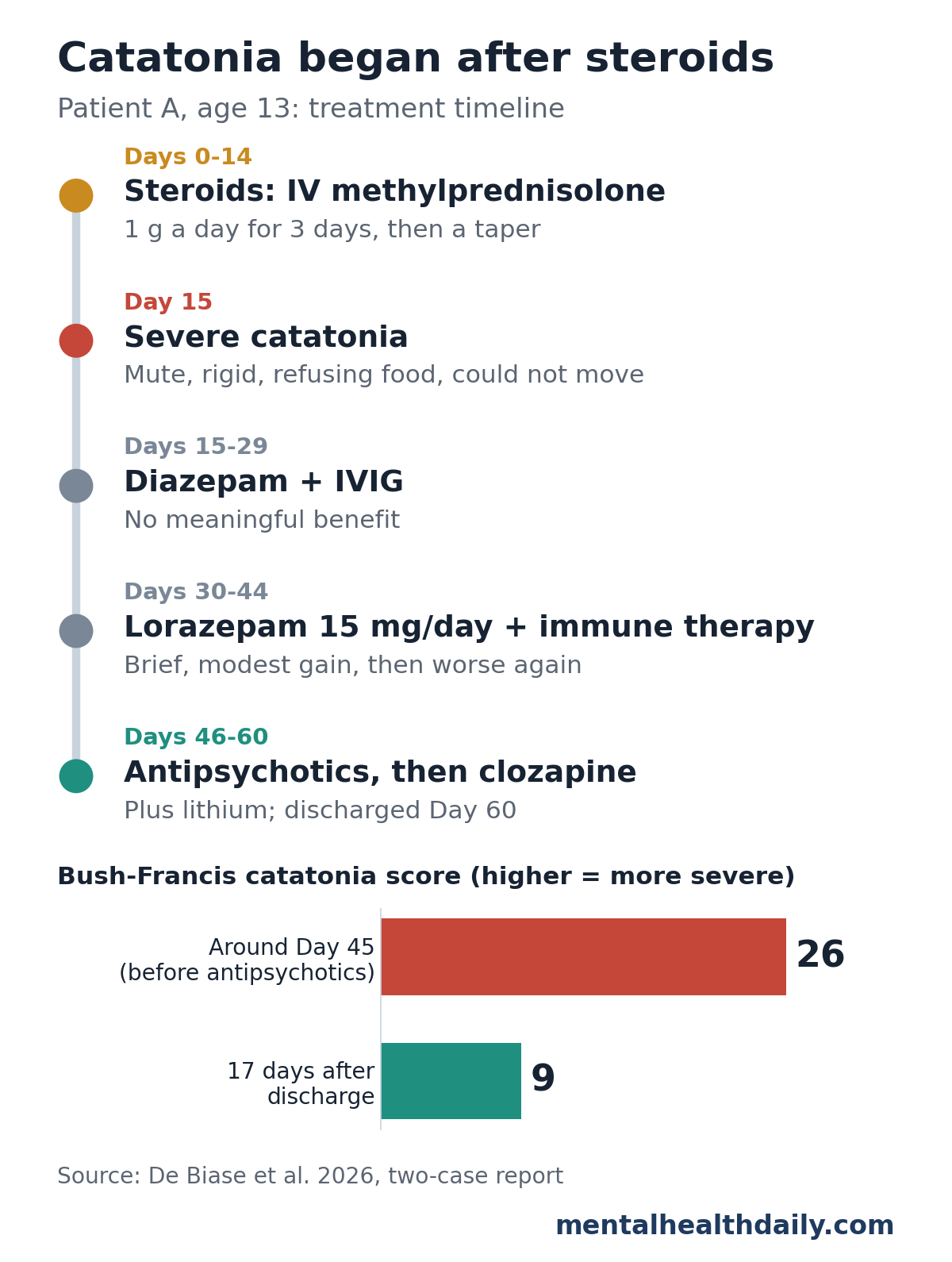
Steroid course: intravenous methylprednisolone 1 g a day for 3 days, followed by a 12-day taper that ended on Day 14. She improved slightly during treatment, then deteriorated sharply once it stopped.1
Day 15: she was unresponsive and could not move on her own. She was mute and rigid, refused food and oral medicine, lost bladder and bowel control, and withdrew completely.1
Days 15–44: doctors kept treating for possible encephalitis:1
- Diazepam and intravenous immunoglobulin (IVIG, pooled donor antibodies used to calm the immune system) for 15 days, with no meaningful benefit.
- From Day 30, oral lorazepam at 15 mg a day, a high dose.
- About 15 more days of IVIG, steroids, and plasmapheresis (filtering antibodies out of the blood), in case of autoimmune encephalitis with negative tests. She improved a little, then worsened again.
Antipsychotics were held back throughout this phase because of the ongoing concern about a neurological disease. Around Day 45 she was perplexed and barely speaking, and her BFCRS score was 26.1
Patient B: Catatonia During Steroid Cycles in a Teen With Schizophrenia
A 15-year-old girl, previously sociable and perfectionistic, withdrew after a distressing personal experience. About 2 months later she began hearing voices, and agitation and anger grew over the following months.1
- About 8 months in: first psychiatric assessment, with psychosis and obsessive-compulsive symptoms. She started risperidone, an antipsychotic.
- About 10 months in: stable on risperidone 1–1.75 mg a day.
- 3 months later: psychosis returned and she was admitted. MRI showed a modest volume reduction in the front of the hippocampus, of unclear meaning. Schizophrenia was confirmed.
Her severe, atypical course and poor response to antipsychotics led doctors to consider brain inflammation. Starting 1 month after admission, she received corticosteroid cycles about every 21 days for 2 months.1
During those cycles she grew more agitated, lost bladder and bowel control, and developed catatonic features: mutism, repetitive movements, a blank face, and slowed movement. Her BFCRS score was 16. Steroids were stopped, and risperidone was replaced with clozapine, titrated to 125 mg a day.1
Recovery was slow. She had been out of school for about 2 years and had lost bladder control she had previously mastered. After discharge she gradually regained daily-life skills.1
How Patient A Recovered on Antipsychotics and Clozapine
On Day 46, Patient A moved to the child and adolescent psychiatry unit and was diagnosed with an unspecified psychotic disorder. As she began to talk, she disclosed persecutory delusions.1
- Day 46: injected aripiprazole plus intravenous diazepam, since she refused pills.
- Day 52: switched to oral risperidone and lorazepam, with partial improvement.
- Day 58: risperidone replaced with clozapine, an antipsychotic usually reserved for treatment-resistant psychosis, raised to 150 mg a day.
- Day 60: lithium added for mood and behavior swings; discharged home.
By 17 days after discharge, she was more responsive and less rigid, and her BFCRS score had fallen to 9. She still had intense delusions, including the belief that her parents had been replaced by impostors (Capgras delusion).1
After clozapine was raised to 200 mg, lithium to 166 mg, and lorazepam to 6 mg a day, her delusions eased markedly within 5 days. Because several drugs changed at once, the researchers say the improvement cannot be credited to any one of them.1
These cases differ from the 1979 lupus case, which cleared with steroid tapering alone. Here, lorazepam and immune treatments did not resolve Patient A’s catatonia, and both girls needed antipsychotics, including clozapine, to stabilize.16
Naranjo Scores: A Probable Steroid Link in One Girl, Possible in the Other
The Naranjo scale is a 10-question checklist for judging whether a drug caused an adverse reaction. Scores of 5–8 mean “probable” and 1–4 mean “possible.”7
- Patient A scored 5 (probable). Catatonia appeared right after a well-documented steroid course.
- Patient B scored 3 (possible). Her underlying schizophrenia is a strong alternative explanation, and details of her steroid exposure were incomplete.
The researchers conclude that these scores support a real link in time between steroids and the worsening, but do not prove that steroids caused it.1
Drug-safety reports: a 2024 analysis of the WHO adverse-reaction database found 421 reports of catatonia in people under 18. In children aged 2 to 11, prednisolone appeared in 8 reports, and steroids stood out as reported more often with catatonia than expected. In teens, most reports involved antipsychotics.8
Proposed mechanism: the researchers suggest that steroids mimic a prolonged stress response, overloading the brain’s stress-hormone system and its receptors in the hippocampus, a memory and emotion hub. In a teen already vulnerable to psychosis, they argue, this lowers the threshold for catatonia.1
Limits of a Two-Case Report
Two cases can show that something can happen. They cannot show how often it happens or prove cause and effect.1
- Psychosis was already developing: both girls had emerging psychotic illness, and catatonia occurs in psychosis without steroids.
- Timing in Patient A: catatonia appeared after the steroids stopped, so withdrawal or the illness’s natural course are alternatives.
- Missing exposure details: Patient B’s steroid drug and dose were not reported.
- No baseline score: neither girl had a BFCRS rating before steroids.
- Many treatments at once: overlapping drug changes make it impossible to say which one helped.
- Retrospective scoring: the treating team applied the Naranjo scale after the fact.
What These Cases Mean for Teens Given Steroids
The researchers stress that early steroid treatment remains important when autoimmune encephalitis is possible, even when blood and spinal fluid tests are negative.1
- Watch for new or worsening catatonia: mutism, freezing, rigidity, or refusing food during or after a steroid course in a teen with psychiatric symptoms deserves prompt psychiatric review.
- Keep psychiatry involved: when the neurological workup is inconclusive, the researchers recommend close teamwork between neurology and psychiatry so a primary psychiatric illness is not missed.
- Do not stop steroids on your own: stopping suddenly can be dangerous. Any change should go through the prescribing doctor.
References
- De Biase M, Averna R, Sesso G, Labonia M, Vicari S. Case Report: Unmasking catatonia in adolescents: a potential triggering role of corticosteroids in two clinical cases. Frontiers in Psychiatry. 2026;17:1945779. doi:10.3389/fpsyt.2026.1945779
- Bush G, Fink M, Petrides G, Dowling F, Francis A. Catatonia. I. Rating scale and standardized examination. Acta Psychiatrica Scandinavica. 1996;93:129–136. doi:10.1111/j.1600-0447.1996.tb09814.x
- Raffin M, Zugaj-Bensaou L, Bodeau N, et al. Treatment use in a prospective naturalistic cohort of children and adolescents with catatonia. European Child & Adolescent Psychiatry. 2015;24:441–449. doi:10.1007/s00787-014-0595-y
- Boston Collaborative Drug Surveillance Program. Acute adverse reactions to prednisone in relation to dosage. Clinical Pharmacology & Therapeutics. 1972;13:694–698. doi:10.1002/cpt1972135part1694
- Drozdowicz LB, Bostwick JM. Psychiatric adverse effects of pediatric corticosteroid use. Mayo Clinic Proceedings. 2014;89:817–834. doi:10.1016/j.mayocp.2014.01.010
- Sullivan BJ, Dickerman JD. Steroid-associated catatonia: report of a case. Pediatrics. 1979;63:677–679. doi:10.1542/peds.63.4.677
- Naranjo CA, Busto U, Sellers EM, et al. A method for estimating the probability of adverse drug reactions. Clinical Pharmacology & Therapeutics. 1981;30:239–245. doi:10.1038/clpt.1981.154
- Merino D, Gérard AO, Lavrut T, et al. Drug-related catatonia in youths: real-world insights from the WHO Safety Database. European Child & Adolescent Psychiatry. 2024;33:1383–1393. doi:10.1007/s00787-023-02234-4