
ADHD medication did not raise final school grades in a study of nearly all Norwegian children diagnosed with ADHD at ages 5 to 15 between 2009 and 2011. A standard regression found treated students finished tenth grade with a grade point average just 0.05 points higher (95% CI 0.02 to 0.09, on a 1-to-6 grade scale), and a stronger causal test put the effect at −0.01 points, essentially zero.1
The study, published in the British Journal of Psychiatry, followed 6,255 young people from diagnosis to graduation, up to 10 years later. It says nothing against the well-established effect of these drugs on ADHD symptoms. It asks a different question: whether years of medication translate into better report cards.
Research Highlights
- No causal effect on grades: the instrumental-variable estimate for grade point average was −0.01 points (95% CI −1.13 to 0.15), about 0.01 of a standard deviation.1
- A small link in ordinary regression: medication was linked to a 0.05-point higher GPA (95% CI 0.02 to 0.09), about 5% of a standard deviation, which the authors call weak.1
- No subject stood out: the causal estimates for all 9 school subjects straddled zero, some slightly positive and some slightly negative, and medication did not change the chance of being exempted or left ungraded.1
- The school gap is real: students with ADHD averaged a GPA of 3.05 vs 4.14 for healthy peers and were 5.8 times as likely to be exempted from at least one subject.1
- Applies to borderline cases: the causal estimate covers children whose treatment depended on which clinic they happened to attend, not children with a clear-cut need for medication.1
What the Norwegian ADHD Registry Study Measured
Norway records nearly every clinic visit and filled prescription in national registries. The researchers, led by Ingvild Lyhmann at Haukeland University Hospital in Bergen, linked those records for children and teens diagnosed with ADHD in child and adolescent mental health clinics from 2009 to 2011.1
- Who: 6,255 young people diagnosed at ages 5 to 15 (average age 10.8), 73% of them boys. Everyone was diagnosed at least 6 months before finishing tenth grade.
- Treatment: the total amount of ADHD medication each child filled between diagnosis and graduation. Methylphenidate made up 87% of prescriptions, followed by atomoxetine (10%) and lisdexamfetamine (2%). Between 74% and 88% of patients filled prescriptions, depending on age group.
- Outcomes: teacher-assigned final grades in 9 required subjects at age 15 or 16, their average, and whether a student was exempted from a subject or left ungraded because teachers had no basis for assessment (often from heavy absence).
Two comparison groups showed how far behind students with ADHD were at graduation: 50,328 other children seen in the same clinics and 51,609 healthy peers.
Why the Causal Estimate Differs From the Regression Result
An ordinary regression compares treated and untreated children while adjusting for things the registries record, like parents’ education and income. The problem is what they don’t record. Symptom severity isn’t in the data. Neither is how organized a family is. The authors point out that staying on medication for years takes a parent who renews prescriptions, attends follow-ups, and manages side effects, and that same parent is often the one checking homework.1 A regression can’t separate the drug from the family.
So the team used an instrumental variable, a way of finding a natural experiment inside observational data. Norway has about 80 public child mental health clinics, each serving a fixed area. Some prescribe ADHD medication freely and some sparingly. Children go to the clinic that covers where they live, and parents have no way of knowing their clinic’s prescribing habits.1 A child at a high-prescribing clinic is more likely to be medicated for reasons that have nothing to do with the child. Comparing grades across clinics then works a bit like comparing groups assigned to more or less medication.
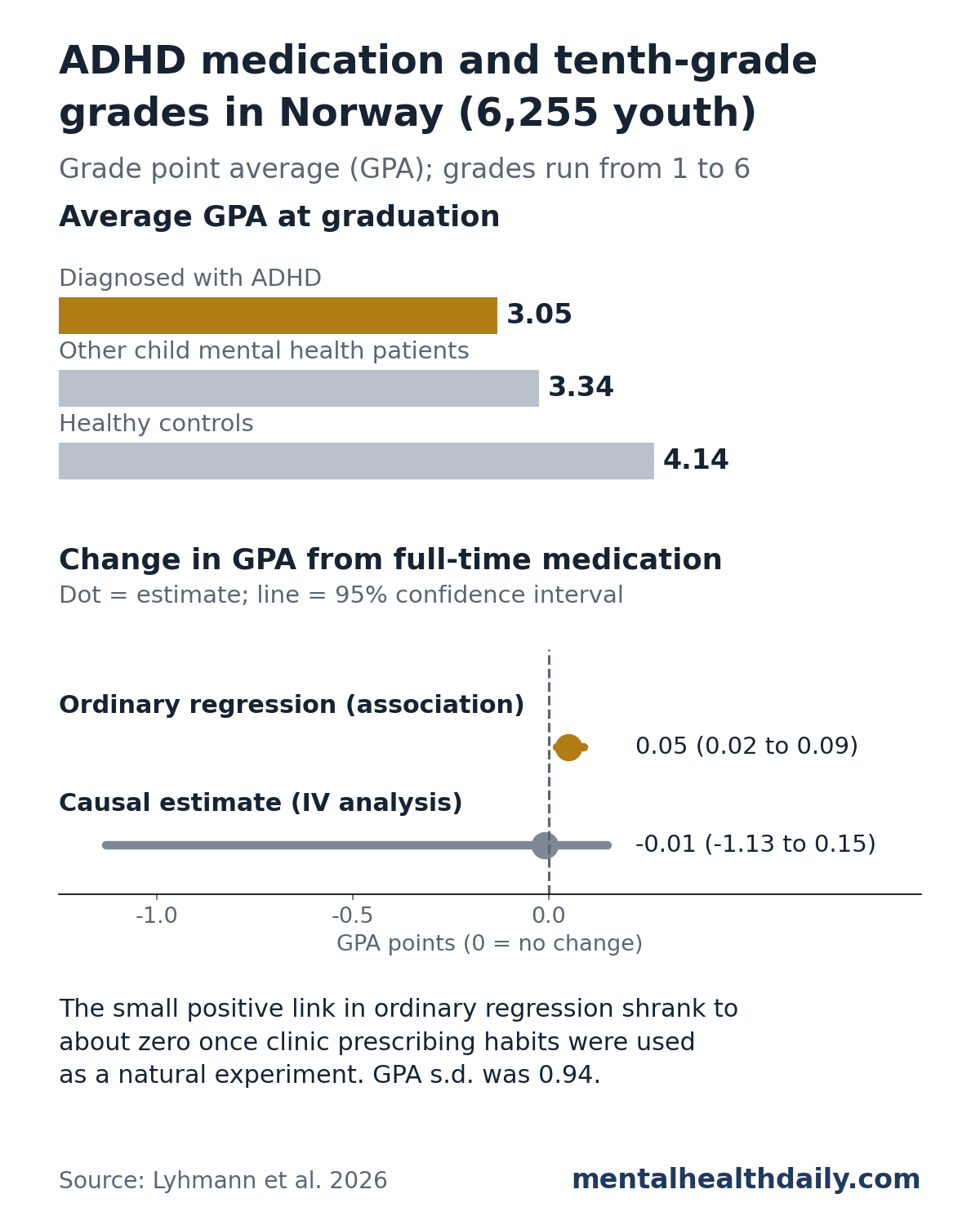
When the team did this, the 0.05-point advantage disappeared. The causal estimate was −0.01 grade points. The same held for single subjects: in ordinary regression, medication was linked to higher grades in every subject except religion and physical education, with the strongest link in math (0.13 points, 95% CI 0.09 to 0.17). In the causal analysis, no subject showed a clear effect in either direction.1
The authors had predicted this pattern in their hypothesis: a small positive regression result driven by confounding, and a small or null causal one.1
Who the Result Applies To
The instrumental-variable method only measures the effect for children on the margin of treatment, whose medication depended on their clinic’s leanings. A child with severe, obvious ADHD would likely be medicated at any clinic, and the study can’t say much about that child. The authors think this borderline group makes up a growing share of patients as ADHD diagnoses rise, which makes it an important group to study.1
The regression data hint at another pattern. The small positive link came from students diagnosed at age 11 or older, especially those treated in the years just before graduation. For children diagnosed before 11, it was not statistically significant. The authors raise fading adherence over the years, changing school demands, and differences between early- and late-diagnosed children as possible reasons.1
How This Fits With Randomized Trials and Other Registry Studies
Randomized trials leave little doubt that ADHD medication reduces symptoms in the short run. A network meta-analysis of 133 double-blind trials found every medication tested beat placebo on clinician-rated symptoms in children and adolescents at about 12 weeks (standardized mean difference −0.78 for methylphenidate and −1.02 for amphetamines). It also found too little data to judge effects at 26 or 52 weeks.2
Better focus doesn’t automatically mean better grades. Studies of school outcomes mostly find small or no academic gains, with one exception:
- Short-term school tasks: a meta-analysis of 34 methylphenidate studies found more math problems completed (7.8% more) and slightly better math accuracy (3.0%), faster reading but not more accurate reading. The authors concluded that academic gains were small compared with symptom gains.3
- Norwegian national tests: a target trial emulation (an observational study designed to mimic a trial) of 8,548 Norwegian children with ADHD found medication start was linked to slightly higher eighth-grade test scores, with standardized differences of about 0.04 to 0.07, which the authors judged not clinically relevant.4
- Danish grades: a natural experiment in Danish registry data found that children who stopped treatment fully had exam grades 0.22 standard deviations lower than those who stayed on it.5 The Norwegian authors note that study had shorter follow-up, and it asked a different question: stopping vs continuing among children who had already started.1
Put together, medication reliably helps symptoms and gives small boosts on short academic tasks, while long-term grades barely move. The Danish study is the main counterexample.
Limitations of the Study
The instrumental-variable result rests on assumptions that can only be partly tested. The main limits:
- Wide uncertainty: the 95% interval for the causal GPA estimate ran from −1.13 to 0.15. The upper end rules out large gains, but the estimate is imprecise. The instrument was only moderately strong (first-stage F-statistic 61.9, enough for the robust test the authors used but below the threshold for standard tests).
- Clinic differences beyond pills: clinics that prescribe more may also differ in therapy, parent training, or school support, none of which the registries record. That could bias the estimate either way.
- Prescriptions filled, not pills taken: the measure is total medication collected. It can’t capture adherence, dose adjustment, or whether children took it on school days.
- Girls: the instrument was too weak to analyze girls alone, and 73% of the sample were boys.
- Place and time: Norway, children diagnosed in 2009 to 2011. Prescribing and schools differ elsewhere and have changed since.
What It Means for Families
The study found no sign that medication harmed grades either. The authors write that better grades are not the only reason to consider medication, and that each child’s response should guide treatment decisions.1
- Symptom relief is its own goal. The randomized evidence that medication eases core ADHD symptoms is strong, and that matters apart from report cards.
- Don’t count on medication alone to lift grades. For children whose need for treatment is borderline, this study found no long-term grade benefit.
- Talk changes through with a clinician. Starting, stopping, or adjusting medication is a decision to make with the prescriber, based on how the individual child is doing.
References
- Lyhmann I, Widding-Havneraas T, Markussen S, et al. Effect of pharmacological treatment of attention-deficit hyperactivity disorder on academic performance: registry-based population study. British Journal of Psychiatry. 2026. doi:10.1192/bjp.2026.10754
- Cortese S, Adamo N, Del Giovane C, et al. Comparative efficacy and tolerability of medications for attention-deficit hyperactivity disorder in children, adolescents, and adults: a systematic review and network meta-analysis. Lancet Psychiatry. 2018;5:727–738. doi:10.1016/S2215-0366(18)30269-4
- Kortekaas-Rijlaarsdam AF, Luman M, Sonuga-Barke E, Oosterlaan J. Does methylphenidate improve academic performance? A systematic review and meta-analysis. European Child & Adolescent Psychiatry. 2019;28:155–164. doi:10.1007/s00787-018-1106-3
- Varnet Pérez T, Øvergaard KR, Frigessi A, Biele G. Long-term effect of pharmacological treatment on academic achievement of Norwegian children diagnosed with ADHD: a target trial emulation. International Journal of Epidemiology. 2025;54:dyaf010. doi:10.1093/ije/dyaf010
- Keilow M, Holm A, Fallesen P. Medical treatment of attention deficit/hyperactivity disorder (ADHD) and children’s academic performance. PLOS One. 2018;13:e0207905. doi:10.1371/journal.pone.0207905