
Only 21 of 90 inpatients with bipolar disorder at a psychiatric hospital in Vietnam had taken their medication as prescribed during maintenance treatment, a 2026 study found.1
Patients who accepted that they had an illness needing treatment, and patients whose families supported their treatment, had far higher odds of sticking with their medication.
Research Highlights
- Low adherence: 23.3% of 90 inpatients took at least 80% of their prescribed medication during maintenance treatment; 76.7% did not.1
- Illness insight: patients who acknowledged having a disorder that needed treatment had about 46-fold higher odds of adherence (95% CI 5.4 to 398).1
- Family support: patients who reported family help with treatment had about 54-fold higher odds of adherence (95% CI 4.8 to 611).1
- Stigma dropped out: perceived stigma was linked to lower adherence on its own, but not after accounting for insight, family support and age at onset.1
- Imprecise estimates: only 21 patients were adherent, so the odds ratios point in a clear direction but their size is uncertain.1
How Researchers Measured Bipolar Medication Adherence in Vietnam
Bipolar disorder is a long-term mood disorder with episodes of mania, hypomania or depression, often separated by stretches of feeling well. Maintenance medication, such as a mood stabilizer, is meant to prevent the next episode.
Stretches of feeling well are also when many people decide they no longer need their pills.1
A team at Hue University of Medicine and Pharmacy, led by Nhu Minh Hang Tran, invited every eligible adult admitted with bipolar disorder to a central psychiatric hospital in southern Vietnam between April 2023 and July 2024.1 That gave a sample of 90 inpatients.
- Who they were: 53.3% men, median age 36, illness for a median of 6 years, and a median of 6 past relapses
- When they were interviewed: about 2 weeks after admission, once acute symptoms had eased enough for a reliable conversation
- Who answered: both the patient and a close family member or caregiver, plus a review of medical records
Adherence meant taking at least 80% of prescribed medication during maintenance treatment (at least 3 months after a manic episode or 6 months after a depressive one). Everyone below that line counted as non-adherent.
Psychosocial factors were measured with short yes-or-no style questions written by the investigators and pilot-tested on 10 patients:
- Illness insight: did the patient acknowledge having a mental disorder that needs treatment?
- Family support: did family members help with treatment, such as reminders, going to appointments or encouragement?
- Perceived stigma: in the past 12 months, had the patient been teased, judged or treated unfairly because of mental illness?
- Medication beliefs and health care guidance: did the patient see medication as necessary, and were treatment instructions clear?
Only 23% of Inpatients Took at Least 80% of Their Bipolar Medication
Of the 90 patients, 21 (23.3%) met the adherence definition. The other 69 (76.7%) did not.1
Other answers suggest why so few were adherent:
- 58.9% said they had no disorder at all
- 74.4% held negative beliefs about their medication
- 74.4% reported perceived stigma
- 72.2% reported side effects, and 68.9% took 3 or more medications
- 44.4% had no family support for treatment
Low adherence is common in bipolar disorder. A 2021 systematic review of 57 studies with 32,894 participants cited an earlier estimate that around 40% of people with bipolar disorder were nonadherent.2
The Vietnam figure is worse, though definitions differ across studies and these patients were sick enough to need a hospital stay.
Illness Insight and Family Support Had the Strongest Links to Adherence
Researchers first tested each factor on its own, then put the 4 that reached significance into one model. That model adjusted each factor for the others.
Results are odds ratios: how much higher the odds of adherence were in one group than in another. An odds ratio of 1 means no difference.
- Good illness insight: adjusted odds ratio 46.2 (95% CI 5.4 to 397.8, p < 0.001)
- Family support: adjusted odds ratio 53.9 (95% CI 4.8 to 611.4, p = 0.001)
- Older age at onset: adjusted odds ratio 0.79 per year (95% CI 0.67 to 0.93, p = 0.003)
- Perceived stigma: adjusted odds ratio 0.33 (95% CI 0.07 to 1.63, p = 0.174), not significant
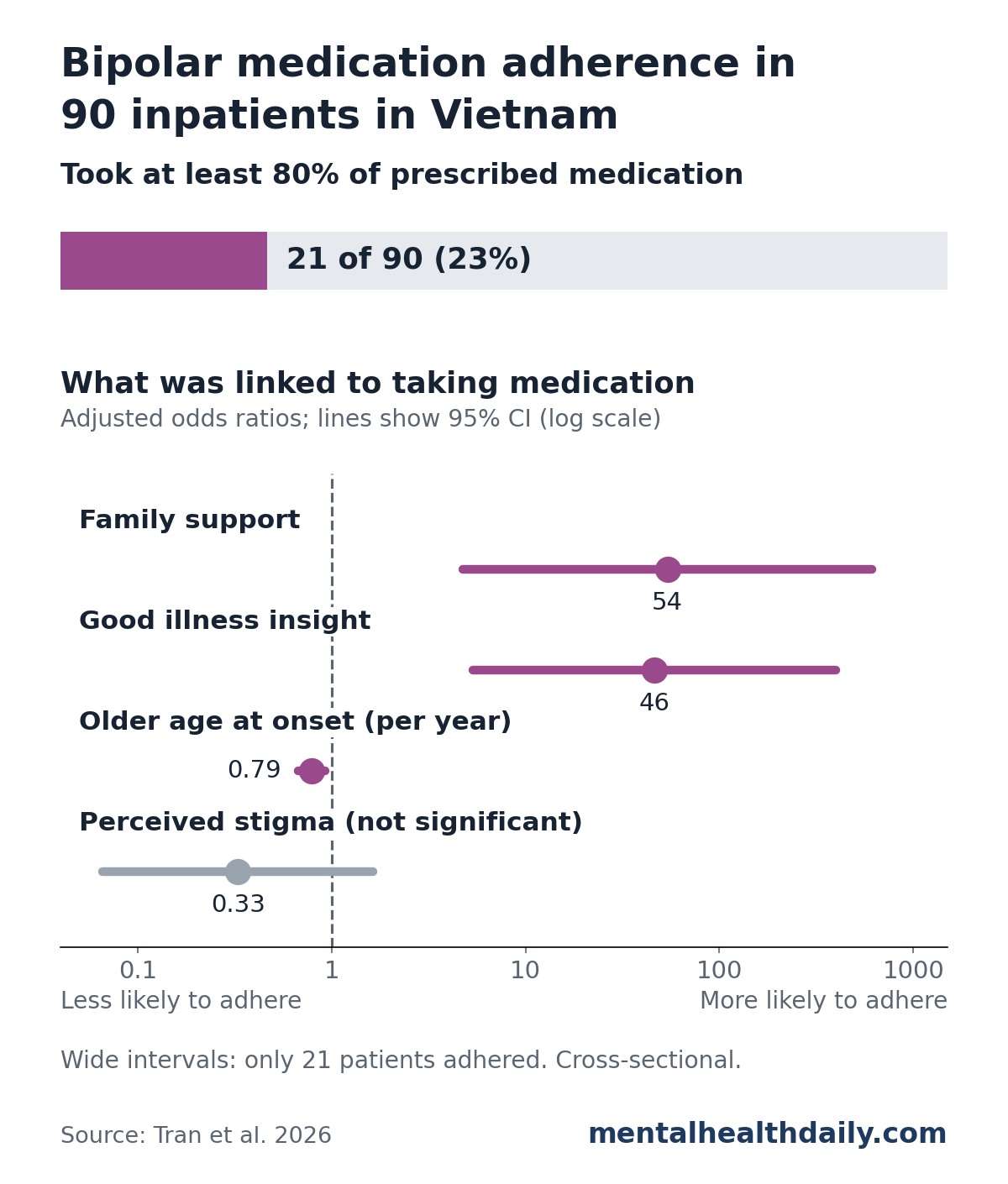
Odds ratios as large as 46 and 54 need care. They do not mean patients with insight were 46 times as likely to adhere; odds and probability diverge when the outcome is this uneven.
Researchers say the estimates likely carry sparse-data bias, an inflation that happens when a small group (here, 21 adherent patients) is split across several factors.1 Their own reading: a strong association in a clear direction, without a precise size.
Even the low ends of the intervals, about 5 for both factors, point to a substantial link.
Other factors showed no significant link to adherence on their own: sex, age, education, employment, number of relapses, illness duration, number of medications, side effects and medication beliefs.1
Why Was Later Bipolar Onset Linked to Poorer Adherence?
Each extra year of age when bipolar disorder began went with about 21% lower odds of adherence (adjusted odds ratio 0.79).1
Researchers did not offer a clear explanation, and other studies have not found a consistent age-at-onset effect. One 2019 study they cite found no link at all.1 With 90 patients, this result needs replication before anyone reads much into it.
Stigma followed a different path. On its own, perceived stigma was linked to lower odds of adherence (odds ratio 0.34, p = 0.043).
After adjustment, that link was no longer significant. Researchers suggest stigma may work through insight: people who absorb stigmatizing beliefs may be more likely to deny they are ill.1
Health care guidance showed a borderline link before adjustment (p = 0.052) and was not entered into the final model.
Family-Inclusive Care Has Raised Adherence in a Bipolar Trial
Researchers point to Vietnamese family life to explain the family-support link. Relatives often go to follow-up visits, store the medication, give daily reminders and watch doses being taken.1
In that setting, taking medication is partly a family task, not just an individual choice.
Other research points the same way:
- Common determinants: the 2021 review found that beliefs about the consequences of treatment, knowledge about the illness and social influences such as family were among the most frequently reported adherence factors. Patients named 11 of 14 types of factors; clinicians named only 6.2
- A family-inclusive trial: a 2017 randomized trial in 270 people with bipolar disorder tested 5 sessions of motivational interviewing (counseling that helps people resolve mixed feelings about change) and psychoeducation, with family members attending.3
- That trial’s result: adherence scores rose from 6.03 to 9.55 over 6 months with the program, compared with 6.17 to 6.67 with usual care.3
- Why adherence matters: a 2002 study of 98 patients on mood stabilizers found that 13 of 16 partially adherent patients with low blood drug levels were admitted to a psychiatric hospital within 18 months, compared with 4 of 46 adherent patients with adequate levels.4
Limitations of This Vietnam Bipolar Adherence Study
- Cross-sectional design: everything was measured at one time, so the study cannot show that insight or family support causes adherence. Taking medication steadily could also improve insight.
- Few adherent patients: with 21 adherent patients and 4 factors in the final model, the analysis had about 5 events per factor, below the usual target of 10. No sample size was planned in advance.
- Single-question measures: insight, family support and stigma were each one investigator-written question, not validated scales.
- Inpatients only: patients came from one hospital and were likely sicker than people treated as outpatients.
- No objective adherence check: the study reported no pill counts or blood drug levels.
Bottom line: most patients in this hospital sample were not taking their maintenance medication as prescribed, and accepting the diagnosis and having family help were the strongest links to taking it.
That points to 2 practical targets: helping patients understand bipolar disorder as a long-term illness, and bringing families into treatment planning. Both are things clinicians can work on, unlike age or illness history.
Anyone thinking about stopping or cutting back a bipolar medication should talk it through with the prescriber first, since stopping can raise relapse risk.
References
- Tran NMH, Le TT, Nguyen QNL, Nguyen VQH. Medication adherence and its clinical and psychosocial correlates in inpatients with bipolar disorder in Vietnam: a cross-sectional study. Frontiers in Psychiatry. 2026;17:1819739. doi:10.3389/fpsyt.2026.1819739
- Prajapati AR, Dima A, Mosa G, et al. Mapping modifiable determinants of medication adherence in bipolar disorder (BD) to the theoretical domains framework (TDF): a systematic review. Psychological Medicine. 2021;51(7):1082–1098. doi:10.1017/S0033291721001446
- Pakpour AH, Modabbernia A, Lin CY, et al. Promoting medication adherence among patients with bipolar disorder: a multicenter randomized controlled trial of a multifaceted intervention. Psychological Medicine. 2017;47(14):2528–2539. doi:10.1017/S003329171700109X
- Scott J, Pope M. Self-reported adherence to treatment with mood stabilizers, plasma levels, and psychiatric hospitalization. American Journal of Psychiatry. 2002;159(11):1927–1929. doi:10.1176/appi.ajp.159.11.1927