
About 1 in 3 adults with PTSD after sexual abuse said memories of the abuse can set off an automatic genital response, in a Dutch study of 1,057 patients starting trauma treatment.1
Most of them felt shame, disgust or self-hatred about it, and more than a third said it strongly affected daily life.
Research Highlights
- About 1 in 3 reported it: 364 of 1,057 patients (34.4%) said sexual abuse memories trigger an automatic genital response.1
- Mostly negative feelings: among those 364 patients, 91.8% felt shame, 87.6% disgust and 70.6% self-hatred about the response.1
- Real burden for many: 38.2% rated the impact on daily life as strong or very strong.1
- Slightly worse PTSD: patients with these responses had somewhat higher PTSD scores, a small difference that held after adjusting for age at abuse and repeated abuse.1
- A reflex, not consent: researchers stress that automatic bodily reactions do not mean consent or pleasure.13
What Did the Dutch PTSD Study Measure?
A genital response is an automatic physical reaction, such as an erection, vaginal lubrication or stiffened nipples. It can happen without any wish for sex and without feeling sexually aroused.
Laboratory research shows how automatic this reflex can be. In a 2011 study of 15 women and 15 men, women showed similar genital responses to every recorded story involving sexual activity, including stories describing a sexual assault.2
A 2004 review of clinical reports reached a clear conclusion: arousal or even orgasm during forced sexual contact does not indicate that the person consented.3
A 2026 study by Bicanic and colleagues asked a related question. Do memories of sexual abuse trigger these responses years later in people with PTSD, and how do survivors feel about it?1
The team at PSYTREC, a specialized Dutch clinic offering 4-day intensive trauma-focused treatment, analyzed routine intake assessments collected between August 2024 and May 2025.1
- Patients: 1,057 adults with a PTSD diagnosis and a history of sexual abuse; 84.7% were women, and the average age was about 39.
- PTSD severity: measured with the CAPS-5, a clinician interview scored from 0 to 80, where higher scores mean more severe symptoms.
- Genital responses: measured with a new 6-item questionnaire the team wrote for this study, because no validated tool exists.
The first question asked whether sexual abuse memories bother the person partly because they trigger an automatic sexual response. Anyone who said yes then answered whether the response brought shame, self-hatred, disgust or positive feelings, and how much it affected daily life.
How Common Were Genital Responses to Abuse Memories?
364 of 1,057 patients (34.4%) reported genital responses linked to their sexual abuse memories.1
Patients with and without these responses looked alike in gender, education, other trauma exposure, mood and anxiety disorders, and suicide risk.
Abuse history differed, though. Patients who reported genital responses were more likely to have been abused before age 12 and more likely to have been abused repeatedly:
- Abuse before age 12: 59.6% with genital responses vs. 43.9% without
- Repeated abuse: 91.5% with genital responses vs. 75.6% without
Researchers suggest classical conditioning as one explanation. Sights, smells or sensations present during early, repeated abuse may become cues that later trigger the same automatic reflex. They call this idea preliminary, since the data cannot show cause.
Shame, Disgust and Self-Hatred Were the Most Common Feelings
Among the 364 patients with genital responses, negative feelings dominated.1
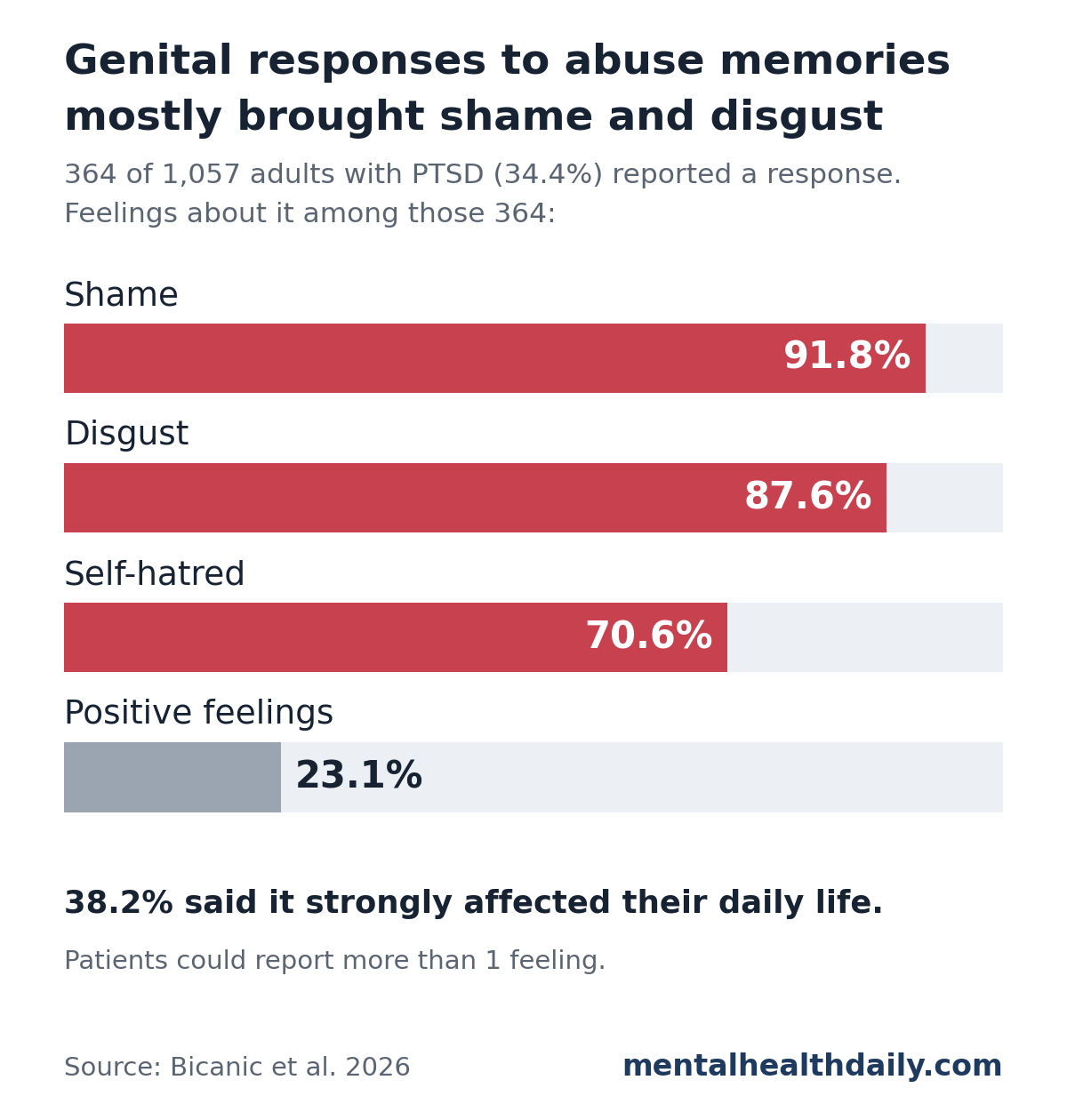
Most of them (75.8%) felt only negative emotions about the response. Another 21.4% had mixed feelings, 1.6% felt only positive feelings and 1.1% felt neither.
Disgust and self-hatred were linked to more severe PTSD symptoms. Shame was not, even though it was the most common feeling.
Patients who reported some positive feelings about the response had slightly lower PTSD severity. All of these correlations were weak (r between −0.11 and 0.16).
Researchers connect these feelings to a common misreading. Survivors, and the people around them, can take a reflex as a sign of pleasure or consent, which feeds self-blame.1
How Much Did Genital Responses Affect PTSD and Daily Life?
On the 0-80 CAPS-5, patients with genital responses averaged 42.0, compared with 40.1 for patients without them, a small difference (Cohen’s d = 0.23).1
After adjusting for age at first abuse and repeated abuse, the gap shrank to about 1 point (41.8 vs. 40.7). It was still statistically significant, but the model explained only 2% of the differences in PTSD severity.
Daily life was a different story. When asked how much the response influenced daily life on a 1-5 scale, answers spread across the whole range:
- Very little (1): 18.4%
- Middle scores (2-3): 43.4%
- Strong or very strong (4-5): 38.2%
For more than a third, these responses were a major part of living with PTSD.
Limits of the Dutch PTSD Study
- Snapshot design: the data come from a single point in time, so they cannot show that genital responses worsen PTSD or the reverse.
- New questionnaire: the 6-item survey has not been validated, and most items were yes-or-no questions.
- One specialized clinic: patients were referred for intensive treatment of severe PTSD in the Netherlands, so rates may differ in other settings.
- Mostly women: about 85% of patients were women, which limits conclusions about men.
- Missing details: information about the perpetrator, abuse severity and family context was not available for everyone.
What This Means for Survivors and Therapists
Genital responses to abuse memories are not rare in people seeking PTSD treatment, and they often bring intense shame. That shame can keep people from mentioning them in therapy.1
Bicanic and colleagues recommend that clinicians ask about these responses routinely, using neutral and normalizing language. They also recommend explaining to patients that automatic physical reactions are normal and do not reflect consent or pleasure.13
If you have experienced this, you are far from alone. A body’s reflex is not a choice, and it says nothing about what you wanted.
Support Resources
If you are a survivor of sexual abuse and need support in the US, call the RAINN National Sexual Assault Hotline at 800-656-4673 or chat at rainn.org, 24 hours a day.
If you are in crisis or thinking about suicide, call or text 988.
Outside the US, local sexual assault services or a doctor can help you find support.
References
- Bicanic I, Kaptein R, Both S, Rozendaal L, De Jongh A. Prevalence and emotional valence of genital responses related to sexual abuse memories in patients with PTSD. European Journal of Psychotraumatology. 2026;17(1):2716440. doi:10.1080/20008066.2026.2716440
- Suschinsky KD, Lalumière ML. Prepared for anything? An investigation of female genital arousal in response to rape cues. Psychological Science. 2011;22(2):159–165. doi:10.1177/0956797610394660
- Levin RJ, van Berlo W. Sexual arousal and orgasm in subjects who experience forced or non-consensual sexual stimulation – a review. Journal of Clinical Forensic Medicine. 2004;11(2):82–88. doi:10.1016/j.jcfm.2003.10.008