
Depression and anxiety symptoms fell sharply in a small 2026 Colorado pilot study of BIPOC and Latina parents who received about 24 hours of in-home postpartum doula care. With no comparison group, though, the study cannot say how much of that drop came from the doulas.1
Research Highlights
- Depression scores fell 6 points: among 24 parents who finished the study, PHQ-9 depression scores dropped by an average of 6.03 points (95% CI 3.94 to 8.15; p < .001) from before the first home visit to the end of care.1
- Anxiety scores fell about 5 points: GAD-7 anxiety scores dropped by an average of 4.92 points (95% CI 3.19 to 6.64; p < .001) over the same period.1
- Parents liked the care: at the end, 96% said doula care improved their mood and 84% said they would seek it again with a future child.1
- No control group: every participant got doula care, so natural recovery after birth and other changes could explain part of the improvement. Nine of 33 enrolled parents were lost to follow-up.1
What a Postpartum Doula Does
A postpartum doula is a trained, non-medical support worker who comes to a family’s home in the weeks and months after birth. Birth doulas support people through pregnancy and labor; postpartum doulas pick up after delivery and focus on the parent’s recovery and the household.1
Doulas in this study were not therapists and did not deliver mental health treatment. Their work fell into 5 areas:1
- Recovery and emotional support for the birthing parent, including physical healing.
- Sleep and rest, such as watching the baby so the parent can sleep.
- Newborn care and feeding education to build parenting confidence.
- Household help: meals, laundry, light housekeeping, and errands.
- Resource navigation, including referrals to medical, mental health, and community services when needed.
The idea is that easing exhaustion, isolation, and daily strain could lift some of the load that feeds postpartum depression and anxiety. The doulas did not see participants’ symptom scores, so their care was based on what each family needed during the visit.1
Who Took Part in the Colorado Doula Pilot
Jessica Hanlin et al. recruited parents in the Denver/Boulder area between January 2024 and August 2025, with all materials offered in English and Spanish. To join, parents had to identify as Black, Indigenous, Asian, Native Hawaiian/Pacific Islander, or Hispanic, be within a year of giving birth, and report depression or anxiety symptoms.1
- Enrolled: 33 parents; 24 completed all 3 assessments.
- Background: 48.5% Latina/Hispanic, 27.3% Black, 12.1% Asian, 3.0% Indigenous/Native American, and 9.0% other or multiracial.
- Insurance and work: 63.6% had Medicaid (US public insurance for people with low incomes) and 39.4% were unemployed.
- Mental health at entry: 42.4% reported a current depression diagnosis and 66.7% current anxiety. During the study, 18% were in psychotherapy and 30% took psychiatric medication.
- Timing: parents were on average about 96 days postpartum when they enrolled.
The PHQ-9 is a 9-question depression questionnaire scored 0 to 27, and the GAD-7 is a 7-question anxiety questionnaire scored 0 to 21. On both, higher scores mean more symptoms, and 5 points is the usual line for mild symptoms.1
Depression and Anxiety Scores Dropped Over About 12 Weeks
Parents received an average of 23.67 hours of doula care, close to the planned 24 hours, usually as 6 4-hour visits. About 82 days passed between the first and last assessment.1
Among the 24 parents with complete data, scores fell steadily:1
- Depression (PHQ-9): down 3.54 points by mid-study and 6.03 points by the end (Cohen’s d = 1.21).
- Anxiety (GAD-7): down 3.25 points by mid-study and 4.92 points by the end (d = 1.20).
Cohen’s d expresses a change in standard-deviation units; anything above 0.8 is usually called large. All comparisons stayed statistically significant after a Bonferroni correction for running several tests.1
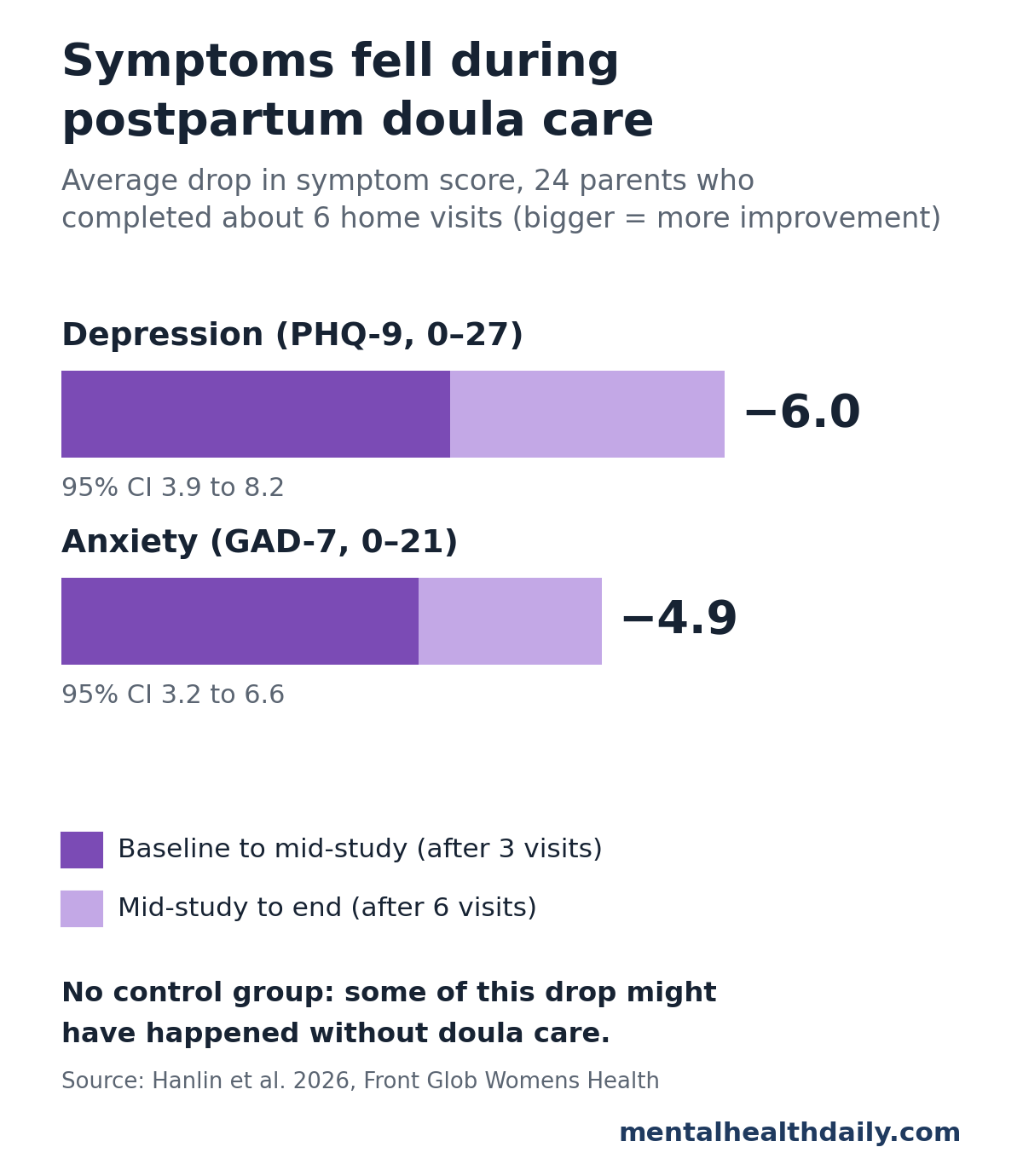
Average scores moved from the mild-to-moderate range at the start to below the mild cutoff by the end. Reported group averages went from 9.55 to 3.44 on the PHQ-9 and from 8.39 to 3.56 on the GAD-7.1
Parents Rated Household Help as the Most Useful Doula Support
Satisfaction was high at both check-ins. At the end of care:1
- 96% agreed doula care had a positive effect on their postpartum experience.
- 96% said it improved their overall mood, and 92% said it eased their anxiety.
- 84% would seek postpartum doula support with a future child, and 88% would be very likely to if insurance covered it.
Asked which kind of help mattered most, parents most often picked household support at both mid-study (33.3%) and the end (27.3%). Newborn care and feeding education rose to second place by the end (24.2%), while referrals to outside services were most often rated least helpful.1
Practical barriers: delays between screening and the first visit were common, mostly because of spotty phone or internet access, scheduling conflicts, and sometimes unstable housing.1
Limitations of This Postpartum Doula Pilot
Evidence strength: this was a small, uncontrolled pilot. It shows that symptoms fell while parents received doula care and that families found the care acceptable. It cannot show that doula care caused the improvement or how big its effect would be against usual care.
- No comparison group. Some postpartum depression and anxiety eases with time. Regression to the mean (people enrolled when symptoms were high tend to score lower later anyway) could also explain part of the drop, as the researchers acknowledge.1
- Other treatment. About a third of parents were taking psychiatric medication and some were in therapy during the study.
- Dropout. Nine of 33 parents left without giving a reason, and those who stayed may have differed from those who left.
- Self-reported outcomes. Symptoms and satisfaction were both self-reported, and the doula organization that delivered the care was also part of the research team.
- One region. All participants lived in one Colorado metro area, which limits how far the results apply.
Doula Care and Maternal Mental Health: What Other Studies Show
Most doula research has focused on birth doulas and outcomes like cesarean rates, not on mental health after birth.1 A 2024 scoping review of 100 US doula studies and reports, co-authored by one of this pilot’s researchers, found that evidence for better outcomes was limited by small samples, study methods, and conflicting results.3
A 2026 systematic review in JAMA Network Open covered 21 doula studies. Doula care was most consistently associated with improved maternal anxiety and breastfeeding initiation, while results for postpartum depression were mixed.2
This pilot fits that picture: an encouraging signal from an often underserved group that still needs a randomized trial to show whether doula care itself made the difference. The researchers call for adequately powered randomized trials before drawing conclusions about effectiveness.1
Practical Takeaways for New Parents
- Doula care is support, not treatment. It can sit alongside therapy or medication but is not a replacement for care from a clinician when symptoms are significant.
- Practical help may count. Parents in this study valued household help like meals and laundry more than any other kind of support.
- Coverage varies. Medicaid programs and state policymakers are increasingly looking at paying for doula services, and most parents here said insurance coverage would make them very likely to use a postpartum doula again.
If you need help now: in the US, the National Maternal Mental Health Hotline (call or text 1-833-852-6262) offers free, confidential support for pregnant and new parents 24/7. If you are having thoughts of harming yourself, call or text 988 to reach the 988 Suicide & Crisis Lifeline.
References
- Hanlin J, Hicks LM, Alvarado G, Batwin A, Holland M, Greenwell E. Postpartum doula care and symptoms of depression and anxiety among BIPOC and Latina birthing parents: a longitudinal pilot intervention study. Frontiers in Global Women’s Health. 2026;7:1869956. doi:10.3389/fgwh.2026.1869956
- Groves P, Williams H, Salter CL, et al. Doula care and health outcomes: a systematic review. JAMA Network Open. 2026;9(4):e268416. doi:10.1001/jamanetworkopen.2026.8416
- Alvarado G, Schultz D, Malika N, Reed N. United States doula programs and their outcomes: a scoping review to inform state-level policies. Women’s Health Issues. 2024;34(4):350–360. doi:10.1016/j.whi.2024.03.001