
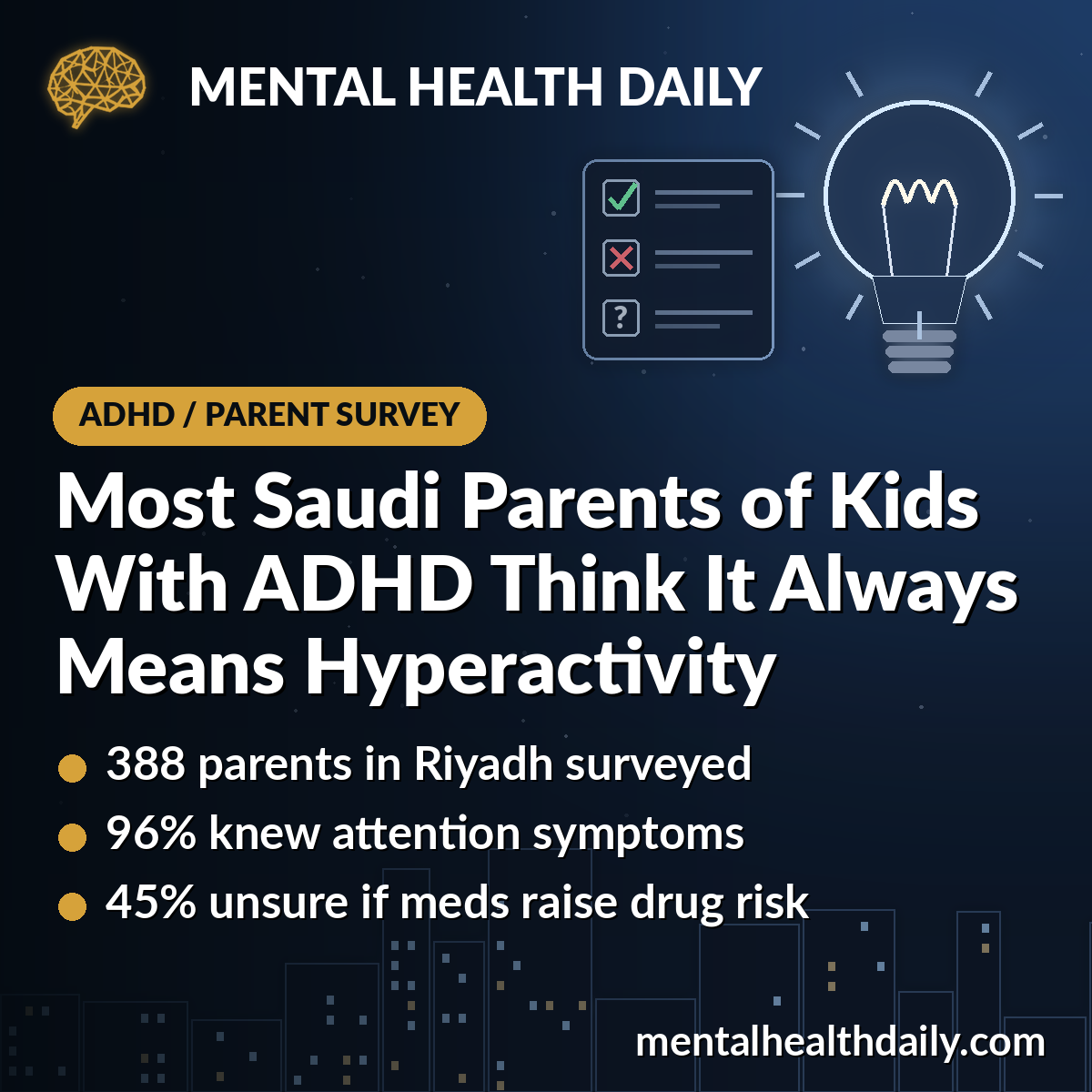
Parents of children with ADHD in Saudi Arabia’s Riyadh Region recognized the core symptoms of attention problems almost universally, but many still believed that ADHD always involves hyperactivity or were unsure whether ADHD medication raises later drug risk, a 2026 survey of 388 parents found.1
Research Highlights
- Attention symptoms were well known: 95.6% of parents agreed that people with ADHD have trouble keeping attention, and 92.8% that they struggle to stay on one task.1
- The hyperactivity myth was common: 68.3% agreed that people with ADHD are always hyperactive; only 29.1% disagreed.1
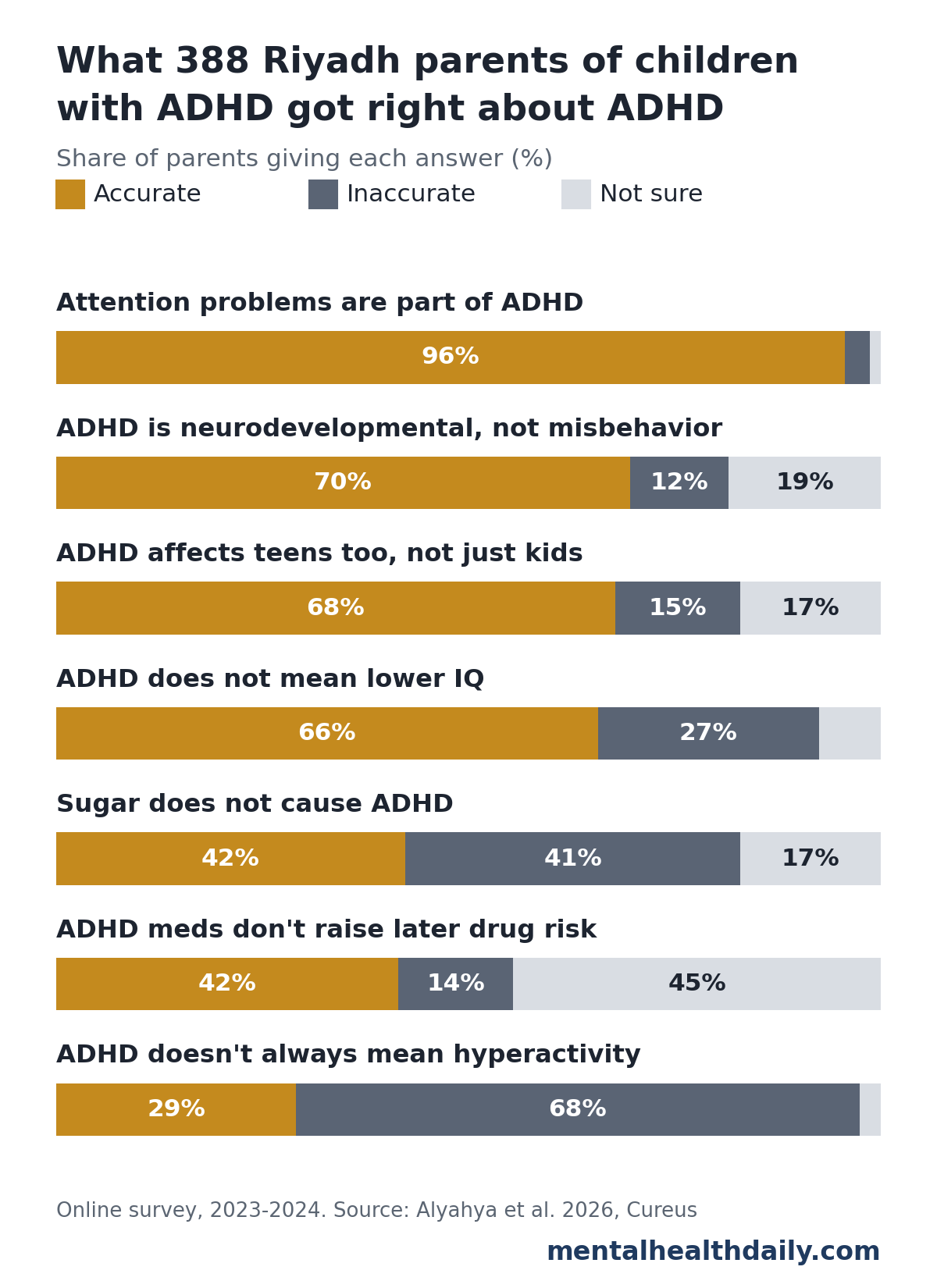
- Medication and drug risk caused the most uncertainty: 41.5% knew childhood ADHD medication does not raise the risk of drug abuse in adolescence, 13.9% thought it does, and 44.6% did not know.1
- Sugar split parents: 40.7% thought eating lots of candy and sugar puts children at risk of ADHD, and 42.3% did not.1
- Parents wanted better information: 51.0% said their sources did not answer all their questions, and 94.6% called for more ADHD awareness campaigns.1
How the Riyadh Survey of Parents of Children With ADHD Was Done
ADHD (attention-deficit/hyperactivity disorder) is a neurodevelopmental condition, meaning it reflects differences in how the brain develops. It shows up as ongoing inattention, hyperactivity and impulsivity, or a mix, beyond what is typical for a child’s age.
Alyahya et al., a team at King Saud University, ran an anonymous online questionnaire from September 2023 to May 2024. They shared it mainly through Telegram and WhatsApp groups.1
- Who answered: 388 parents living in the Riyadh Region who reported that their child, aged 1 to 18, had a clinical ADHD diagnosis.
- Mostly mothers: 327 mothers (84.3%) and 61 fathers; 64.2% had a college education.
- Children: 66.8% were boys, and 84.3% were 12 or younger.
- What it asked: 32 items covering knowledge of ADHD symptoms and features, beliefs about causes and treatment, and where parents got their information.
Knowledge of ADHD Symptoms: Attention Problems Were Almost Universally Recognized
Parents knew the everyday signs well. Agreement with each statement about ADHD:1
- Trouble keeping attention, easily distracted: 95.6%
- Trouble staying on one task: 92.8%
- Often interrupts others: 85.6%
- Hard to sit still when asked: 84.8%
- More trouble getting along with classmates: 84.3%
Most parents also held hopeful, accurate views: 70.9% agreed that people with ADHD can be as successful in life as anyone else, and 65.7% rejected the idea that ADHD means a lower IQ.1
About 7 in 10 (69.8%) said they knew enough about ADHD to handle their child appropriately. That leaves close to a third who either disagreed (17.5%) or were unsure (12.6%).1
Beliefs About Hyperactivity: 68% Thought ADHD Always Means a Hyperactive Child
Just over two-thirds of parents (68.3%) agreed that people with ADHD are always hyperactive.1 That belief leaves out the predominantly inattentive presentation of ADHD, in which a child mainly struggles with focus, organization and forgetfulness without obvious restlessness.
These quieter children are easy to miss. A parent or teacher who expects ADHD to look like constant motion may not suspect it in a dreamy, distracted child.
Parents here were answering about a child already diagnosed, so many may have been generalizing from the child they live with.
Knowledge of ADHD Medication and Later Drug Risk: Fewer Than Half Knew the Answer
The medication item drew the most “don’t know” answers. Asked whether using ADHD medication in childhood increases the risk of drug abuse in adolescence:1
- 41.5% correctly said no
- 13.9% said yes
- 44.6% did not know
Uncertainty, not a firm wrong belief, made up most of the gap: more parents said they did not know than gave either answer.
What the evidence shows: a 2013 meta-analysis of 15 studies with 2,565 participants found that children with ADHD who took stimulant medication had substance use outcomes similar to those who did not, across alcohol, nicotine, marijuana, cocaine and other drugs. Stimulants neither raised nor lowered later risk.2
Beliefs About the Causes of ADHD: Sugar, Parenting and Genes
Answers about causes were more mixed than answers about symptoms:1
- Sugar: 40.7% thought eating lots of candy and sugar puts a child at risk of ADHD; 42.3% did not; 17.0% were unsure.
- Parenting: 55.7% did not think the way a child is raised causes ADHD; 28.1% thought it could.
- Genetics: 51.3% saw ADHD as a genetic disorder; 26.8% did not know.
- Brain vs. behavior: 69.6% called ADHD a neurodevelopmental disorder; 11.9% called it a misbehavior disorder.
The sugar belief has been tested directly. A 1995 meta-analysis of blinded studies, in which children got either sugar or a sugar-free sweetener without anyone knowing which, found no effect of sugar on children’s behavior or thinking, though a small effect in some children could not be ruled out.3
Beliefs About ADHD Treatment and Its Long-Term Course
Views on treatment were more settled. Most parents (81.2%) said behavioral therapy and medication can both work depending on the child’s situation; only 1.8% picked medication alone and 6.7% therapy alone.1
On the long-term course, 70.4% described ADHD as a lasting condition whose symptoms can be managed, while 13.1% thought it can be cured completely. About two-thirds (67.5%) knew that children with ADHD often have other conditions such as anxiety or depression.1
Which Parents Scored Higher on ADHD Knowledge
The researchers grouped parents as having “more favorable” knowledge if they answered at least half of the knowledge items correctly. By that cutoff, 180 of 388 parents (46.4%) landed in the more favorable group.1
- Mothers vs. fathers: 50.2% of mothers vs. 26.2% of fathers scored in the more favorable group.
- Education: 59.7% of parents in the highest education group vs. 35.1% of those with high school or less.
- Child’s sex: 53.7% of parents of boys vs. 31.8% of parents of girls.
- Parent age: parents aged 30 to 39 scored highest.
Belief scores followed a similar pattern for parent sex and education. About 80% of fathers (80.3%) and of parents with high school or less (80.5%) fell into the less favorable belief group.1
The survey could not say why these gaps exist. Fathers were a small group (61), and each factor was compared on its own, so overlapping influences such as parent sex and education were not separated.
Parents Wanted More Reliable Information About ADHD
Parents were looking for more. Almost all (91.0%) said their understanding of ADHD grew after their child’s diagnosis, yet many felt let down by what was available:1
- 51.0% said their sources did not answer all their questions
- 56.4% said there were not enough accessible resources on ADHD
- 94.6% wanted more ADHD awareness campaigns
The researchers recommend parent education programs delivered through health care and community settings, focused on causes, symptoms and medication.1
Limitations of This Riyadh Parent Survey
Evidence strength: a single cross-sectional online survey can describe what these parents believed at one point in time. It cannot explain why some parents knew more or show what would change their views.
- Convenience sample: parents were reached through messaging groups, and no response rate was reported. Parents active in ADHD groups online may differ from others.
- Unvalidated questionnaire: the team wrote and pretested the questions but did not formally test their reliability or validity.
- Unverified diagnoses: children’s ADHD diagnoses were reported by parents, not confirmed from records.
- Unadjusted comparisons: group differences used simple chi-square tests, so overlapping factors like parent sex and education were not untangled.
- Some items lack a clear right answer: for example, 54.4% agreed that children with ADHD should not be punished like other children, which is a parenting view more than a fact.
- One region: results may not hold elsewhere in Saudi Arabia or in other countries.
What Parents of Children With ADHD Can Take From This
- ADHD is not always hyperactive. A child who mainly struggles with focus and organization can have ADHD without being restless.
- Childhood stimulant treatment has not been linked to later drug problems in pooled long-term studies.2 Parents with this worry can raise it directly with their child’s doctor.
- Sugar has not been shown to cause ADHD symptoms in blinded challenge studies.3
- Asking questions is normal. Half the parents here felt their sources fell short; clinicians can help by covering causes, medication and long-term outlook early.
References
- Alyahya K, Alshabani SM, Alageel LA, et al. Assessment of ADHD knowledge, awareness, and beliefs among parents of children and adolescents with ADHD in the Riyadh Region, Saudi Arabia. Cureus. 2026;18(9):e115587. doi:10.7759/cureus.115587
- Humphreys KL, Eng T, Lee SS. Stimulant medication and substance use outcomes: a meta-analysis. JAMA Psychiatry. 2013;70(7):740–749. doi:10.1001/jamapsychiatry.2013.1273
- Wolraich ML, Wilson DB, White JW. The effect of sugar on behavior or cognition in children: a meta-analysis. JAMA. 1995;274(20):1617–1621. doi:10.1001/jama.1995.03530200053037