
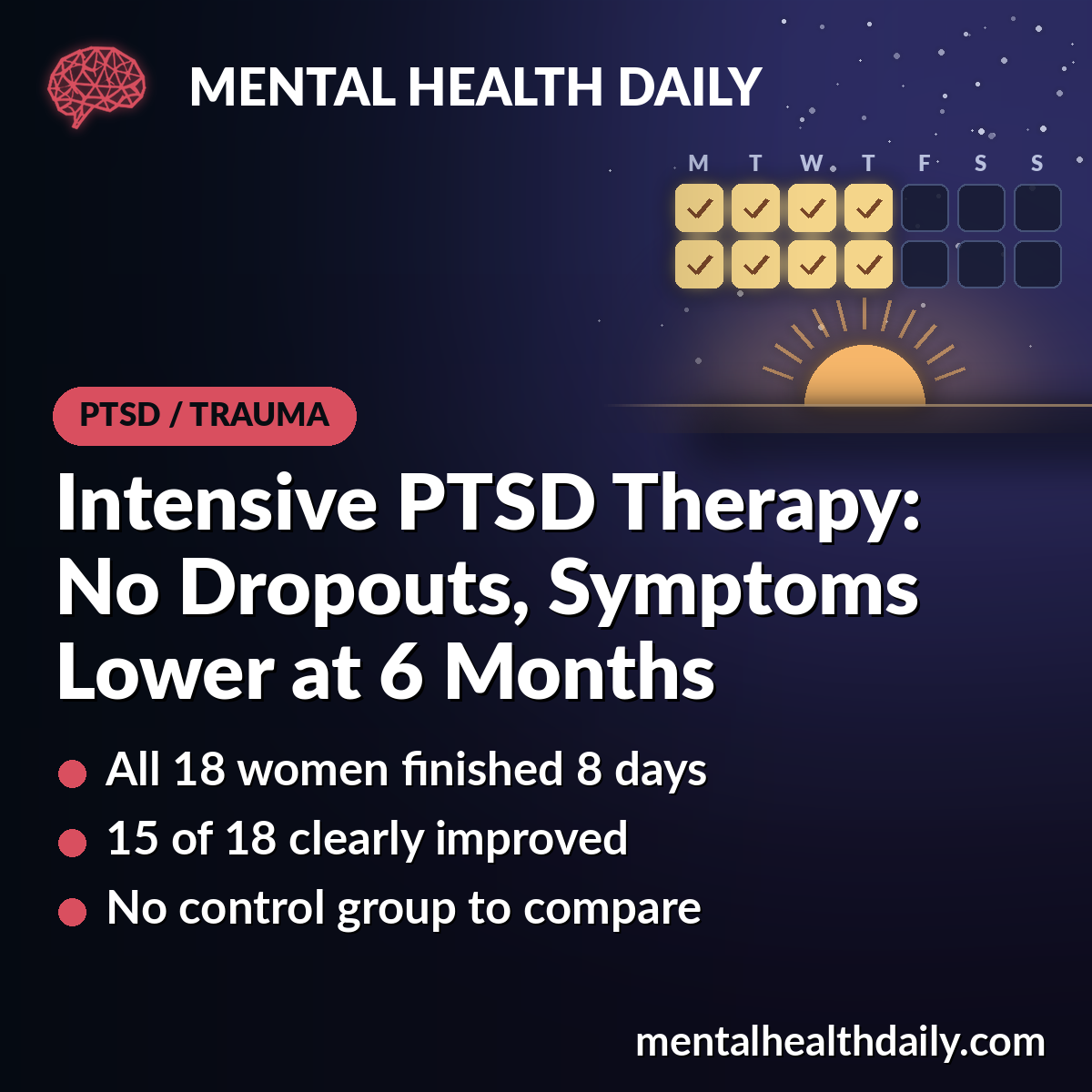
An 8-day intensive trauma therapy program ran smoothly in an ordinary public psychiatric clinic in Norway: all 18 women with PTSD or Complex PTSD finished it, and their PTSD symptoms were much lower 6 months later.1
Research Highlights
- No dropouts: all 18 participants completed treatment and both follow-ups, and only 1 person missed any sessions.1
- No serious problems reported: staff saw no significant adverse effects, no suicide attempts, and nobody needed a higher level of care. No one’s PTSD score got worse overall.1
- Large, lasting symptom drop: the average PTSD checklist (PCL-5) score fell from 57.5 to 35.7 at 6 months, and 15 of 18 (83%) improved by at least 10 points.1
- Diagnoses: 7 of 14 women with Complex PTSD and all 4 with PTSD no longer met diagnostic criteria at 6 months.1
- No control group: the study was built to test whether the program could be delivered, so the symptom change cannot be credited fully to the treatment.
What Intensive Trauma-Focused Treatment Is
Intensive trauma-focused treatment packs a full course of trauma therapy into days instead of months. Rather than 1 session a week, patients have several sessions a day, which leaves less time to avoid the work or lose momentum between appointments.
Weekly trauma therapy works for many people, but dropout is common, and some patients describe heavy distress in the days between sessions. Reviews of intensive formats have found higher completion rates, which is the main reason clinics are interested.1
The Norwegian program copied a model developed at the Psychotrauma Expertise Center (PSYTREC) in the Netherlands. It ran for 2 weeks, 4 days each week (8 treatment days), with patients staying on an inpatient ward. Each day included:
- Prolonged exposure (PE): patients recount the trauma memory in detail and gradually face safe situations they have been avoiding, so fear can fade instead of being reinforced by avoidance. Sessions were recorded for patients to listen to afterward.
- EMDR (eye movement desensitization and reprocessing): patients hold a trauma memory in mind while following a side-to-side task, such as eye movements, which is meant to make the memory less vivid and less upsetting.
- Physical activity and psychoeducation groups between therapy sessions.
- Therapist rotation: each patient saw several different therapists across the program instead of one. The team shares responsibility, which is meant to keep therapists from going easy on hard material.
Who Took Part: Women With Complex PTSD and Long Trauma Histories
Evensen et al. recruited 18 women aged 19 to 45 (average 29) from the clinic’s own outpatients, treating them in 3 groups of 6.1 Everyone had lived through multiple traumas and had already tried at least 1 course of therapy lasting more than 3 months.
Complex PTSD (CPTSD) is a diagnosis in the World Health Organization’s ICD-11. It includes the core PTSD symptoms (reliving the trauma, avoidance, feeling under threat) plus lasting problems with emotional control, relationships, and a deeply negative view of oneself. It usually follows repeated or prolonged trauma, such as childhood abuse.
- Diagnoses: 14 had Complex PTSD (78%) and 4 had PTSD.
- Trauma history: 14 (78%) had experienced sexual trauma; histories also included childhood abuse, domestic violence, and terrorist attacks.
- Other conditions: 10 (56%) had another psychiatric diagnosis, most often depression; half were taking antidepressants.
- Daily life: 13 (72%) were living on social security benefits and only 1 was working.
People with psychotic or bipolar disorder, current substance abuse, an ongoing abusive situation, or a serious suicide attempt in the previous 3 months were not eligible. Of 26 people referred, 7 decided not to take part, mostly because of child care, exams, or work, and 1 was not suited to the group activities.1
The clinic was not a trauma center. About half of the 18 therapists were still in specialist training, and all had only basic training in PE, EMDR, or both. Qualified supervisors were on site, and the team met for an hour every day.1
All 18 Finished the Program, With No Serious Adverse Events Reported
The main question was whether this kind of program could be run safely in a regular public clinic. On that question the answers were strong:1
- Completion: 18 of 18 finished, with no dropouts during treatment or follow-up.
- Attendance: only 1 patient missed sessions (4 in total, because of a family emergency).
- Safety: no significant adverse effects, including suicide attempts or transfers to a higher level of care, were reported or observed.
- Satisfaction: overall rating 4.47 out of 5 from 17 respondents. EMDR (4.59) and imaginal exposure (4.53) scored highest; listening to recorded sessions scored lowest (3.76).
Zero dropout is notable because many patients in weekly trauma therapy stop early. A common fear among therapists is that people with complex histories and other diagnoses cannot tolerate this kind of work. This group did.
PTSD Symptoms Dropped and Stayed Lower at 6 Months
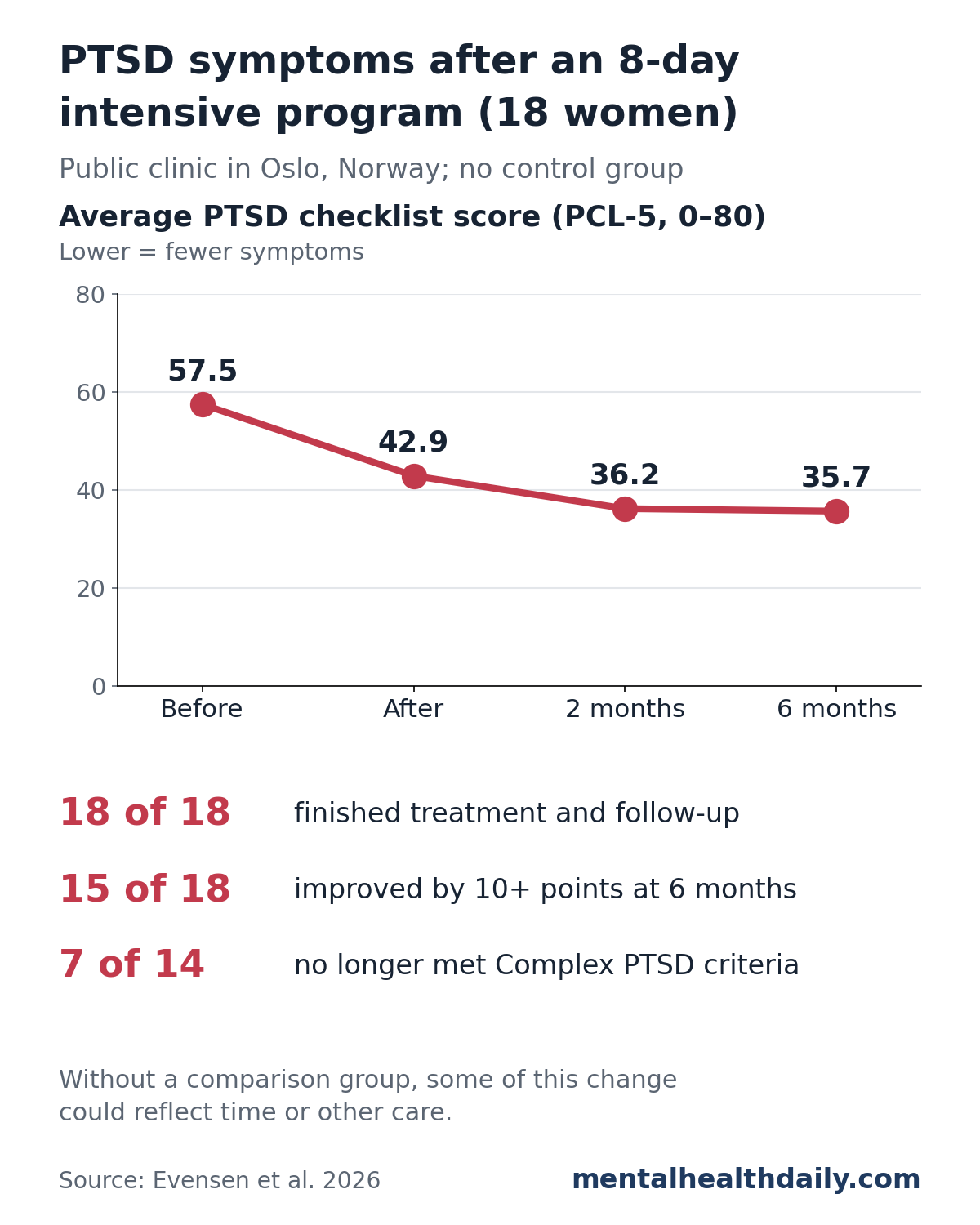
On the PCL-5, a 20-item self-report PTSD checklist scored from 0 to 80, the group average was 57.5 before treatment, 42.9 right after, 36.2 at 2 months, and 35.7 at 6 months.1 The improvement held through the last follow-up.
The researchers counted a drop of at least 10 points as reliable change, a threshold suggested by the US National Center for PTSD. By that standard, 16 of 18 (89%) improved at 2 months and 15 of 18 (83%) at 6 months.1
Diagnosis: on the International Trauma Questionnaire, 7 of the 14 women with Complex PTSD and all 4 with PTSD were below the diagnostic cut-off at 6 months. Both symptom groups fell: core PTSD symptoms dropped more (from 17.2 to 9.3) than the emotional, relationship, and self-image problems specific to Complex PTSD (from 16.5 to 11.6).1
Other measures:
- Trauma-related beliefs such as self-blame and seeing the world as dangerous decreased significantly by 6 months.
- General distress on the CORE-OM, a 34-item distress questionnaire, fell from 72.9 to 60.7, though its everyday-functioning and risk subscales did not change significantly.
- Work and social functioning improved modestly, from 26.6 to 21.3 on a 40-point impairment scale.
Half of the women with Complex PTSD still met criteria at 6 months, so the program did not resolve symptoms for everyone. The researchers say clinics need a better sense of who suits intensive treatment and who needs something else.1
How These Results Compare With Other Intensive PTSD Programs
The Norwegian numbers look similar to results from larger intensive programs using the same model:
- Dutch specialist center, 347 patients: 82.9% had a clinically meaningful response and 54.9% lost their PTSD diagnosis after the 8-day program; only 2.3% dropped out.2
- Complex PTSD at the same center: 87.7% of patients with an ITQ-based Complex PTSD diagnosis lost it after treatment, with no suicides, suicide attempts, or hospital admissions.3 That is a higher rate than the 7 of 14 in Oslo.
- Swedish comparison with regular therapy, 101 patients: an 8-day program and traditionally spaced treatment reduced PTSD symptoms by a similar amount, with about 73% to 74% in each group free of PTSD at follow-up. Dropout was 4.3% in the intensive program vs 24.1% with spaced treatment. Patients chose their treatment rather than being randomized.4
Put together, the clearest advantage of the intensive format is that more people finish it. In the Swedish comparison, symptom relief was similar to regular weekly-style therapy, and no randomized trial of this combined program has settled which works better.
Staff Felt More Ready to Offer Trauma Therapy
The study also surveyed 10 therapists and 10 ward staff afterward. All 10 therapists and 9 of 10 staff said they were now more likely to offer exposure-based trauma treatment, even to patients with other diagnoses.
Seven of 10 therapists and 9 of 10 staff said they were already providing more of it outside the project.1
Most also said they were less afraid of making patients worse. That fear is a well-known reason clinicians delay trauma-focused work in favor of long “stabilization” phases.
Limitations of This Feasibility Study
This was a pilot designed to test delivery, not to prove the treatment works better than something else. The main limits:
- No control group. Symptoms can ease with time, and people often enroll when they feel worst, so some improvement would be expected anyway. Outpatient care continued after discharge, although therapists were asked to avoid trauma-focused therapy for 6 months.
- Small and narrow sample. 18 women, mostly of European background. Results may not apply to men or to people with psychosis, active substance use, or recent suicide attempts.
- Self-reported outcomes. Symptoms were measured with questionnaires, and the satisfaction and staff surveys were not validated tools.
- Safety monitoring. Staff watched closely for adverse events during treatment, but these were not systematically tracked through follow-up.
- Setting requirements. The program depended on trained supervisors, an inpatient ward, and daily team meetings, so it may not transfer to clinics without those resources.
Within those limits, the evidence that this clinic could deliver the program, keep everyone in it, and see no serious harms is solid.
What This Means for People With PTSD
- Intensive formats are an option to ask about. For people who have stalled in weekly therapy, a 1- to 2-week program may be easier to finish.
- Complex PTSD did not rule people out. Women with long trauma histories and other diagnoses completed the program without serious setbacks.
- It is demanding. Several trauma sessions a day is hard work, and half of the women with Complex PTSD still met criteria at 6 months.
If trauma symptoms include thoughts of suicide, help is available now. In the US, call or text 988 to reach the 988 Suicide & Crisis Lifeline, or contact local emergency services.
References
- Evensen JH, Engeset J, Jakobsen M, Malkomsen A, Vaage-Kowalzik V. Intensive trauma-focused treatment for PTSD and Complex PTSD in a public clinic: a feasibility study. Frontiers in Psychology. 2026;17:1869412. doi:10.3389/fpsyg.2026.1869412
- Van Woudenberg C, Voorendonk EM, Bongaerts H, et al. Effectiveness of an intensive treatment programme combining prolonged exposure and eye movement desensitization and reprocessing for severe post-traumatic stress disorder. European Journal of Psychotraumatology. 2018;9:1487225. doi:10.1080/20008198.2018.1487225
- Voorendonk EM, De Jongh A, Rozendaal L, Van Minnen A. Trauma-focused treatment outcome for complex PTSD patients: results of an intensive treatment programme. European Journal of Psychotraumatology. 2020;11:1783955. doi:10.1080/20008198.2020.1783955
- Gahnfelt H, Carlsson PFG, et al. 8-day intensive treatment programme for PTSD and complex PTSD vs treatment as usual: a clinical trial. European Journal of Psychotraumatology. 2025;16:2553422. doi:10.1080/20008066.2025.2553422