
In interviews, 24 Chinese parents of autistic children said short-video apps like Douyin gave them practical know-how and hope, but also fed confusion, comparison and fear about their child’s future. Over time, many learned to filter what they watched rather than quit.1
Research Highlights
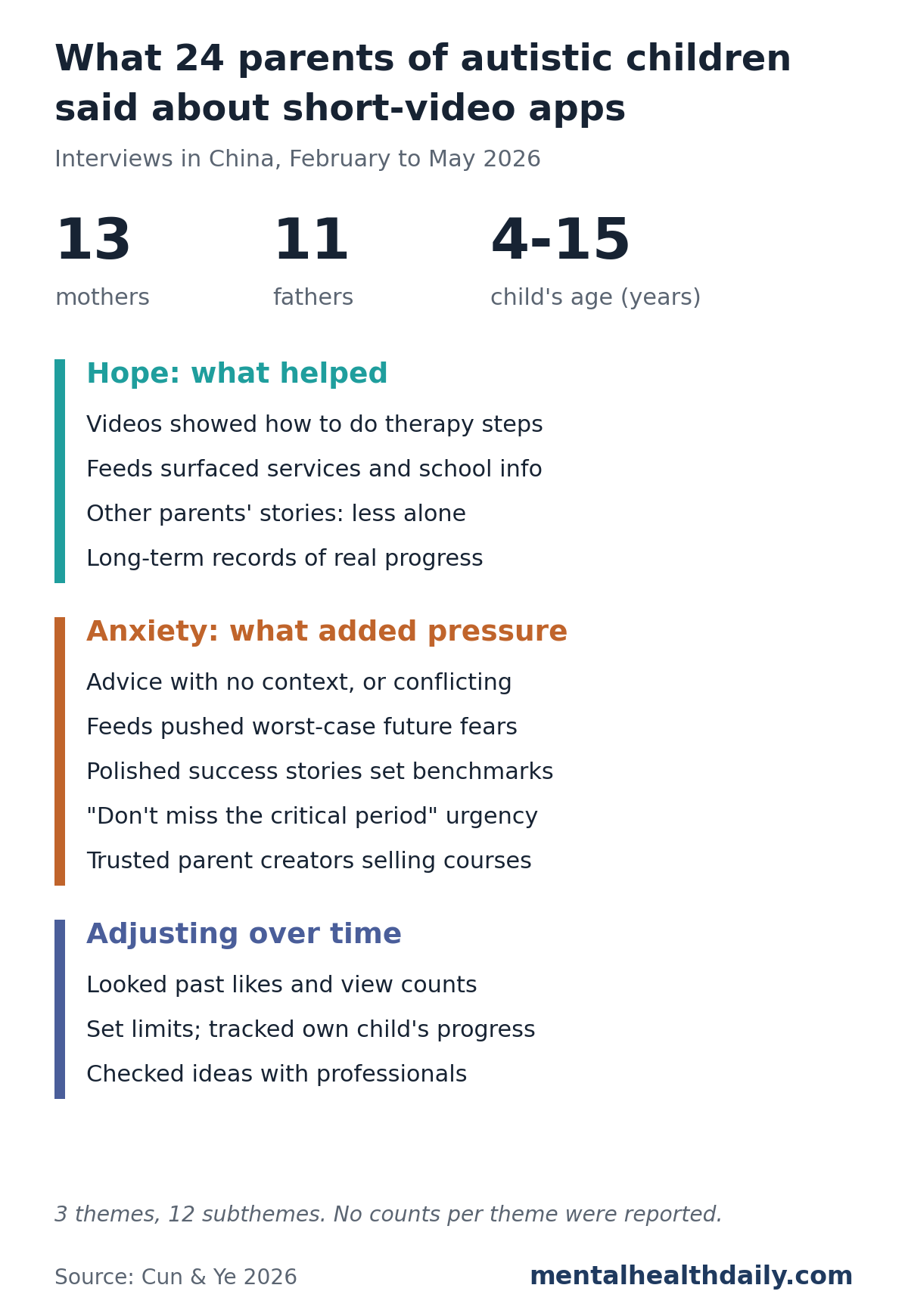
- Interview study of 24 parents: 13 mothers and 11 fathers of autistic children aged 4 to 15, interviewed in China in early 2026.1
- Demonstrations made therapy clearer: videos showed how to prompt, wait and reward a child, which written advice had not made clear.1
- Feeds also raised fear: a search about one immediate concern could lead to a stream of videos about school failure and care after parents grow old.1
- Polished success stories hurt: edited “before and after” clips led parents to doubt their child’s progress and their own effort, and some parent creators later sold courses.1
- Parents adapted: they looked past likes and views, set viewing limits, compared their child with his or her own past, and checked ideas with professionals.1
Who Was Interviewed About Short Videos and Autism Parenting
Autism spectrum disorder is a developmental condition marked by differences in social communication and by restricted or repetitive behaviors and interests. Raising an autistic child often means years of therapy decisions, school planning and daily care, and parents report more parenting stress than other parents.1
Short-video platforms are apps built around brief clips served by a recommendation algorithm, such as Douyin (the Chinese version of TikTok), Kuaishou, WeChat Channels and Xiaohongshu (Rednote). The algorithm picks the next video based on what a person has already watched, liked or saved.1
Cun and Ye recruited parents through 4 autism rehabilitation and family support groups in 4 Chinese provinces, plus social media ads and referrals. Of 35 parents contacted, 24 completed an interview.1
- Parents: 13 mothers and 11 fathers, aged 29 to 48, each from a different family and each the main caregiver.
- Children: aged 4 to 15, 22 boys and 2 girls, diagnosed 1 to 11 years earlier.
- Viewing: 1 to 6 years of watching autism-related short videos, mostly on Douyin, WeChat Channels, Xiaohongshu and Kuaishou.
- Interviews: 45 to 75 minutes each (about 58 on average), February to May 2026; 17 online and 7 in person.
The researchers used thematic analysis, a qualitative method in which interview transcripts are coded line by line and grouped into broader patterns. They found 3 themes with 12 subthemes. Like most interview studies, it describes the range of experiences and does not count how many parents held each view.1
How Short Videos Gave Autism Parents Hope
Seeing it done. Parents said clinical explanations and written handouts left them unsure how to carry out home training. Videos showed when to speak, when to pause and how long to wait for a child, and they could replay a clip as often as they needed.1
“I understood the terms, but I did not know exactly how to do them,” one mother said. Another said a video simulating sensory overload helped her see that her son covered his ears because of real discomfort, not disobedience.1
Finding what to look for. Most parents first found autism content by searching. Recommendations then widened the view to home training, school preparation, subsidies, school admissions and parent-training programs, which helped most soon after diagnosis and for parents with few local services.1
Not the only one. Videos by other parents about diagnosis, setbacks and exhaustion let viewers recognize their own feelings. One mother felt relieved after another mother admitted losing her temper: “having one breakdown did not mean I was a bad mother.”1
Slow progress felt more believable. Parents placed more trust in families who posted over many months or years, showing gradual gains and setbacks, than in dramatic promotional results. “Even though our progress is slow, it does not mean there is no possibility for improvement,” one mother said.1
5 Ways Short Videos Added to Parents’ Anxiety
The same features that helped could also raise pressure. Parents described 5 sources:1
- Advice without context. Clips often left out the child’s age, starting abilities and other details needed to judge whether a strategy fit. Conflicting claims made it worse: “The more I watch, the less I know what to do.”
- Feeds that jumped ahead. One mother searched for how to teach her child to respond to his name; her feed filled with videos about older children who could not attend school and what happens when parents grow old. “Watching them repeatedly made me afraid in advance.” Autoplay and endless scrolling kept some parents watching despite anxiety and lost sleep.
- Selective success stories. Editing and music can squeeze months of uneven progress into a neat story. Parents compared their child with same-age children shown talking or attending mainstream school, and compared their own patience and effort with other caregivers.
- Urgency messages. Lines like “Do not miss the critical period” and “One mistake by a parent could delay a child for life,” sometimes set to tense music, pushed parents toward nonstop intervention, even when their child already had regular support.
- Sales mixed with support. Some parent creators built trust by sharing familiar struggles, then promoted courses, training materials, nutritional products or services. One father bought a course that did not deliver the advertised results and blamed himself for not persisting enough.
How Parents Learned to Filter Autism Videos
With more experience, parents described changing how they used the apps rather than giving them up.1
- Looking past popularity: they realized a video kept showing up because of their own viewing habits, not because it was correct, and grew wary of absolute claims and dramatic before-and-after clips.
- Setting boundaries: some limited viewing time, unfollowed accounts that raised their anxiety or avoided autism videos before bed. “I do not watch autism-related videos after 10 p.m.,” one father said.
- Changing the yardstick: one mother stopped comparing her son with children in videos and now looks at “how he is doing compared with a few months ago.”
- Checking with professionals: parents treated other families’ experiences as ideas, not prescriptions, and some consulted clinicians or therapists before big decisions.
Worry did not go away. “I still feel worried when I see a video that makes me anxious, but I no longer immediately enroll my child in a course,” one father said. “I pause first.”1
Autism Video Accuracy in Earlier Research
Studies that rated the videos themselves fit what these parents described.
- TikTok accuracy: among the 133 most-viewed informational autism videos on TikTok, 27% were rated accurate, 41% inaccurate and 32% overgeneralized. Accurate videos got no more engagement, and those by healthcare professionals were more likely to be accurate.2
- Chinese platforms: an analysis of 279 pediatric autism videos on Douyin, Bilibili and Rednote rated overall quality as moderate, with wide differences between platforms and more low-quality videos on Rednote.3
Cun and Ye suggest clinicians and social workers treat short-video use as part of a family’s information diet, and help parents check creator credentials, spot missing context and recognize sales pitches. They also call on platforms to disclose qualifications and commercial ties and to restrict fear-based treatment claims. Their study did not test any of these steps.1
Limitations of This Autism Parent Interview Study
- Experiences, not prevalence: 24 interviews can show what parents go through, but not how common each experience is or whether short videos raise or lower parental anxiety overall.
- Recruited sample: parents came mainly through rehabilitation groups and online channels, and all used short-video apps.
- Self-report only: no viewing histories, screen time or recommended-content data were collected.
- One interview each: changes over time were recalled, not followed, and platforms were not compared directly.
- Parents only: autistic children, clinicians, therapists and video creators were not interviewed.
Tips for Parents Watching Autism Videos
Based on what these parents described, a few habits stand out:
- Use videos to see how a technique is done, then ask your child’s therapist whether it fits your child.
- Treat views and likes as popularity, not proof that advice is correct.
- Be wary of urgency and sales: “too late” warnings paired with a course or product are a reason to pause.
- Measure progress against your own child’s past, not edited clips of other children.
References
- Cun Z, Ye Y. Scrolling into hope and anxiety: a qualitative study of how short-video platforms shape psychological adjustment among Chinese parents of children with autism. Frontiers in Psychology. 2026;17:1952061. doi:10.3389/fpsyg.2026.1952061
- Aragon-Guevara D, Castle G, Sheridan E, Vivanti G. The reach and accuracy of information on autism on TikTok. Journal of Autism and Developmental Disorders. 2025;55(6):1953–1958. doi:10.1007/s10803-023-06084-6
- Ou J, Sun C, Zhang L. A cross-sectional study on the quality of pediatric autism-related videos on short video platforms. Scientific Reports. 2026;16:22627. doi:10.1038/s41598-026-53838-0