
Routine screening at a regional Korean hospital flagged anxiety symptoms in nearly 1 in 4 women after childbirth, and depression symptoms in a similar share. Yet only 7 of the 66 women referred to the hospital’s psychiatry department went to a first appointment.1
Research Highlights
- Few referrals reached psychiatric care: 66 women were referred to the hospital’s psychiatry department, and 7 (10.6%) attended an initial consultation.1
- Positive screens were common after birth: all 445 women were screened about 6 weeks after birth; 23.6% screened positive for anxiety and 22.9% for depression.1
- Pregnancy screening reached about half: 235 women (52.8%) were screened at least once during pregnancy, and 33.2% of them screened positive for anxiety and 17.9% for depression.1
- Very low birth weight linked to positive depression screens: mothers of babies under 1,500 g had about 4 times the odds of a positive postpartum depression screen in an exploratory adjusted model.1
- Single-hospital records: the retrospective design counted only psychiatry visits at the same hospital, so care received elsewhere was missed.1
How Pregnancy and Postpartum Screening Worked at Jeju National University Hospital
Kim et al. reviewed records from the obstetrics department of Jeju National University Hospital on Jeju Island, Korea, covering women seen from December 2021 to January 2023.1 Screening was part of routine care: it was recommended at outpatient visits, ideally once each trimester and again at the postpartum checkup.
Two short self-report questionnaires were used:
- Edinburgh Postnatal Depression Scale (EPDS): a 10-item questionnaire about the past week, scored 0 to 30. It was built to screen for postpartum depression but is also validated during pregnancy. A score of 10 or higher counted as positive.
- Beck Anxiety Inventory (BAI): 21 items scored 0 to 63, covering worry and physical symptoms such as a racing heart or dizziness. A score of 8 or higher counted as positive; 16 or higher meant moderate-to-severe anxiety.
A positive screen flags symptoms for a closer look. Women with moderate-to-severe anxiety or a positive EPDS got counseling about perinatal mental health and were told about psychiatric consultation. Obstetricians referred them to the hospital’s psychiatry department when they judged an evaluation clinically warranted.1
Who was included: 445 Korean women who delivered at the hospital at 23 weeks of pregnancy or later, with a mean age at delivery of 35.2. Women with a psychiatric diagnosis before pregnancy, twins or other multiples, or care that moved to another hospital were excluded.1
After Birth, 23.6% Screened Positive for Anxiety and 22.9% for Depression
Postpartum screening reached everyone, on average 5 weeks and 5 days after delivery. Pregnancy screening was patchier, because it depended on women showing up for routine visits at the right time.1
- First trimester (24 women screened): 50.0% positive for anxiety, 29.2% for depression
- Second trimester (190): 26.8% anxiety, 15.3% depression
- Third trimester (90): 31.1% anxiety, 17.8% depression
- Postpartum (445): 23.6% anxiety, 22.9% depression
The first-trimester group was too small to compare with the others, and the researchers did not formally test differences between stages. Most positive anxiety screens were mild: after birth, 81 of the 105 women who screened positive scored in the mild range, and 24 scored moderate or severe.1
Only 12 women completed all 4 screenings. In that small group, average anxiety and depression scores fell from early pregnancy to the postpartum visit, a pattern the researchers called exploratory.1
Only 7 of 66 Referred Women Attended a First Psychiatry Visit
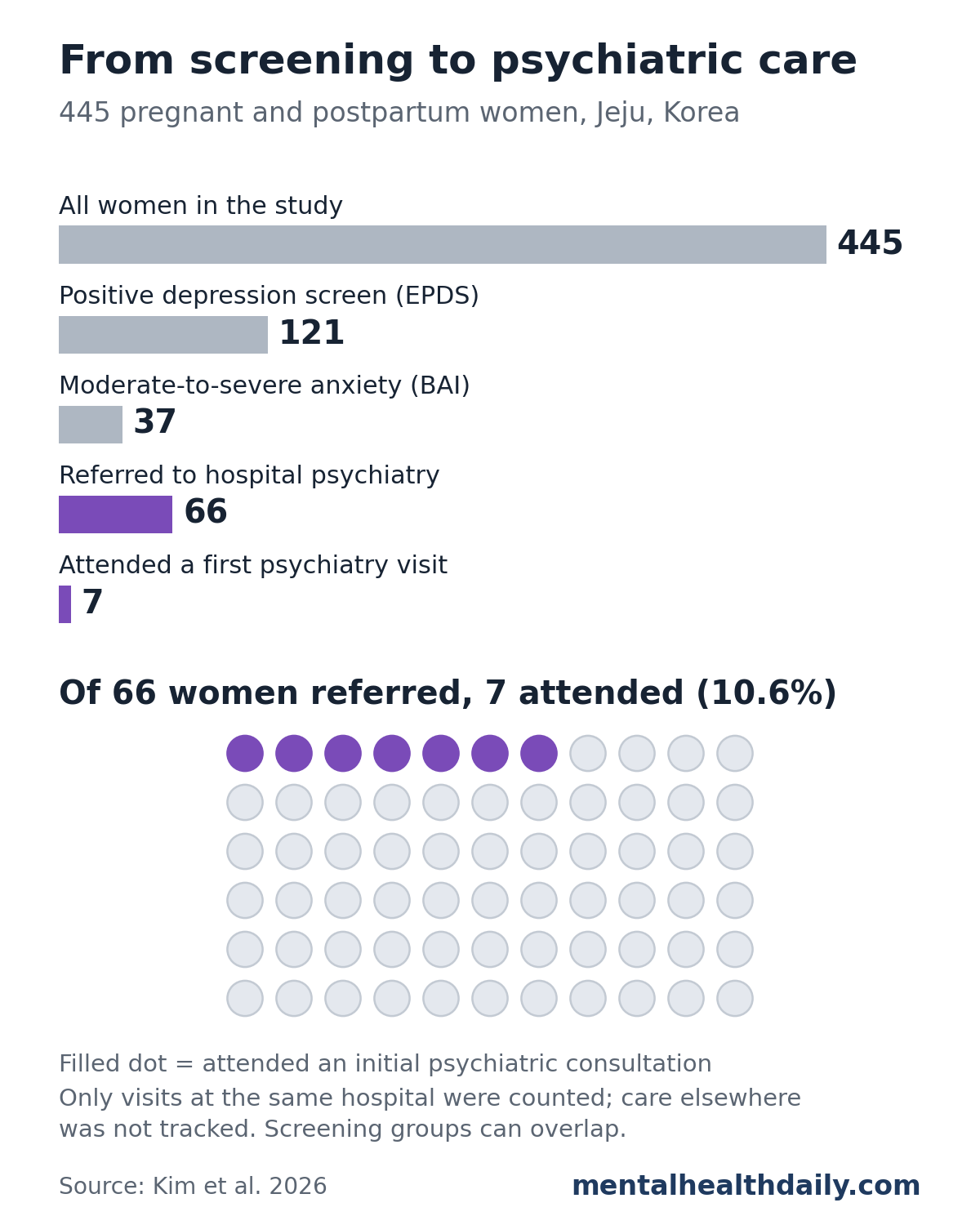
Across the study, 121 women had a positive EPDS depression screen and 37 had moderate-to-severe anxiety on the BAI; the paper does not say how much those groups overlapped. Obstetricians referred 66 women to psychiatry, and the hospital’s records showed that 7 of them (10.6%) came to an initial consultation.1
The study did not ask referred women why they stayed away. The researchers pointed to barriers reported in earlier research:1
- Knowledge and stigma: limited mental health literacy, and negative views of mental illness that still discourage psychiatric care in Korea
- Care-system gaps: limited provider training, unclear referral pathways, and long waits
- Practical hurdles: transportation, childcare, and access to mental health services
Consistent with larger reviews: a 2016 systematic review of the “perinatal depression treatment cascade” estimated that 15.8% of women with postpartum depression received any treatment and 3.2% reached remission, with losses at every step after detection.2 The Jeju data show that drop-off at a single step: from a referral to the first visit.
Very Low Birth Weight Linked to Positive Postpartum Depression Screens
Women with positive postpartum screens more often had a hard pregnancy or delivery. In unadjusted comparisons, they more often had a history of miscarriage, preterm premature rupture of membranes (the waters breaking before 37 weeks and before labor), and a baby admitted to the neonatal intensive care unit (NICU).1
- Miscarriage history: 44.1% of depression-positive vs 30.9% of depression-negative women
- NICU admission: 23.5% vs 13.2%
- Baby under 1,500 g: 9.8% vs 2.0%
Once preterm birth, low Apgar score (a quick newborn health rating) and NICU admission were added to the same model, only very low birth weight stayed significant: adjusted odds ratio 4.22 (95% CI 1.19–14.94) for a positive EPDS.1 The interval is wide, and the researchers labeled the model exploratory because these newborn problems tend to occur together.
During the second trimester, anxiety-positive women more often used anti-nausea medicine (21.6% vs 5.8%), were unemployed (52.9% vs 30.9%), or had conceived with fertility treatment (41.2% vs 25.9%).1
Limitations of This Jeju Perinatal Screening Study
Evidence strength: a retrospective review of one hospital’s records. It can describe how often women screened positive and how many referrals turned into visits there, but it cannot explain why women did not attend or show what caused positive screens.
- Psychiatry visits elsewhere were invisible: only the same hospital’s records were checked, so 10.6% may underestimate how many women got care.
- Only the first visit counted: later treatment and outcomes were not followed.
- Screening was opportunistic: about half the women were screened during pregnancy, and only 24 in the first trimester.
- Screens are not diagnoses: the BAI includes physical symptoms such as palpitations and shortness of breath that can come from pregnancy itself.
- Missing context: household income, family relationships, and social support were not fully measured.
- Narrow population: women with a prior psychiatric diagnosis and non-Korean women were excluded, and all came from 1 regional hospital.
What the Referral Gap Means for Pregnancy and Postpartum Care
Screening found many women with symptoms, but a referral slip rarely became a psychiatry appointment. The researchers called for integrated perinatal mental health referral systems in which obstetricians, psychiatrists, nurses and social workers work together.1
For women who screen positive, a referral is the start of the process, not the end. It is worth asking the obstetric team who will follow up, how soon, and whether care can happen near prenatal or postpartum visits.
References
- Kim R, Shim SS, Kang HS. Perinatal anxiety and depression screening and psychiatric care linkage in a regional Korean obstetric setting. Obstetrics & Gynecology Science. 2026;69(5):317–327. doi:10.5468/ogs.26124
- Cox EQ, Sowa NA, Meltzer-Brody SE, Gaynes BN. The perinatal depression treatment cascade: baby steps toward improving outcomes. Journal of Clinical Psychiatry. 2016;77(9):1189–1200. doi:10.4088/JCP.15r10174