
People higher in neuroticism were quicker to look at fearful and sad faces in a 2026 eye-tracking study of 103 Norwegian university students.1 Anxiety and depression symptoms showed their own, broader patterns, and neither pointed specifically at threatening or sad faces.
Research Highlights
- Neuroticism and negative faces: higher neuroticism scores went with faster first looks at fearful (p = .002) and sad faces (p < .001), plus longer viewing of emotional faces in general (p = .04).1
- Anxiety and speed: higher anxiety symptoms went with faster first looks at every type of emotional face, not just angry or fearful ones (p = .040).1
- Depression and lingering: higher depression symptoms went with longer looking at all emotional faces (p = .03), with no special pull toward sad faces.1
- Other traits mostly flat: extraversion, conscientiousness and openness showed no links; agreeableness showed only a weak pattern that did not hold up for any single emotion.1
- Nonclinical sample: participants were students, not patients, although 54% scored at or above a common screening cutoff for elevated anxiety and depression symptoms.1
What the Eye-Tracking Study Measured
Carolien Konijnenberg and Svein Åge Kjøs Johnsen at the University of Inland Norway recruited 103 students (56 women, 47 men; ages 18 to 36, average about 23) for a 20-minute lab session. Participants were recruited on campus rather than from clinics, and nobody was paid.1
Each person first watched 36 pairs of photographed faces on a screen. One face in each pair was neutral; the other showed anger, disgust, fear, happiness, sadness or surprise. Each pair stayed up for 8 seconds, and participants were told simply to look freely.1
An infrared eye tracker recorded where their gaze landed 300 times a second. Afterward, participants filled out 2 questionnaires:
- Big Five Inventory (BFI): a 44-item personality survey covering extraversion, agreeableness, conscientiousness, neuroticism and openness. Neuroticism is the tendency to experience worry, tension and other negative emotions easily.
- Hopkins Symptom Checklist (HSCL-25): a 25-item self-report screen asking how often anxiety and depression symptoms bothered the person in the past week. It is a screening tool, not a diagnosis.
Two Ways of Measuring Attentional Bias
Attentional bias is a habit of attention: some kinds of information grab or hold a person’s eyes more than others. Psychologists have long suspected that anxious people get pulled toward threats and depressed people get stuck on sad material.
The researchers split attention into 2 parts:
- First look (initial orienting): how much sooner the eyes landed on the emotional face than on the neutral one. This is the fast, early grab.
- Looking time (sustained attention): what share of total viewing time went to the emotional face. This is the slower question of what holds attention.
Across the whole group, emotional faces won on both counts. On average, eyes reached the neutral face after about 1,027 milliseconds but reached emotional faces after about 676 to 804 milliseconds, depending on the emotion. Emotional faces also got about 57% to 60% of the viewing time in each pair.1
Neuroticism, Anxiety and Depression Each Had a Different Pattern
The main question was which questionnaire scores predicted a stronger bias. All 5 personality traits and both symptom scores were entered into the same models, so each result reflects that measure’s link after accounting for the others.1
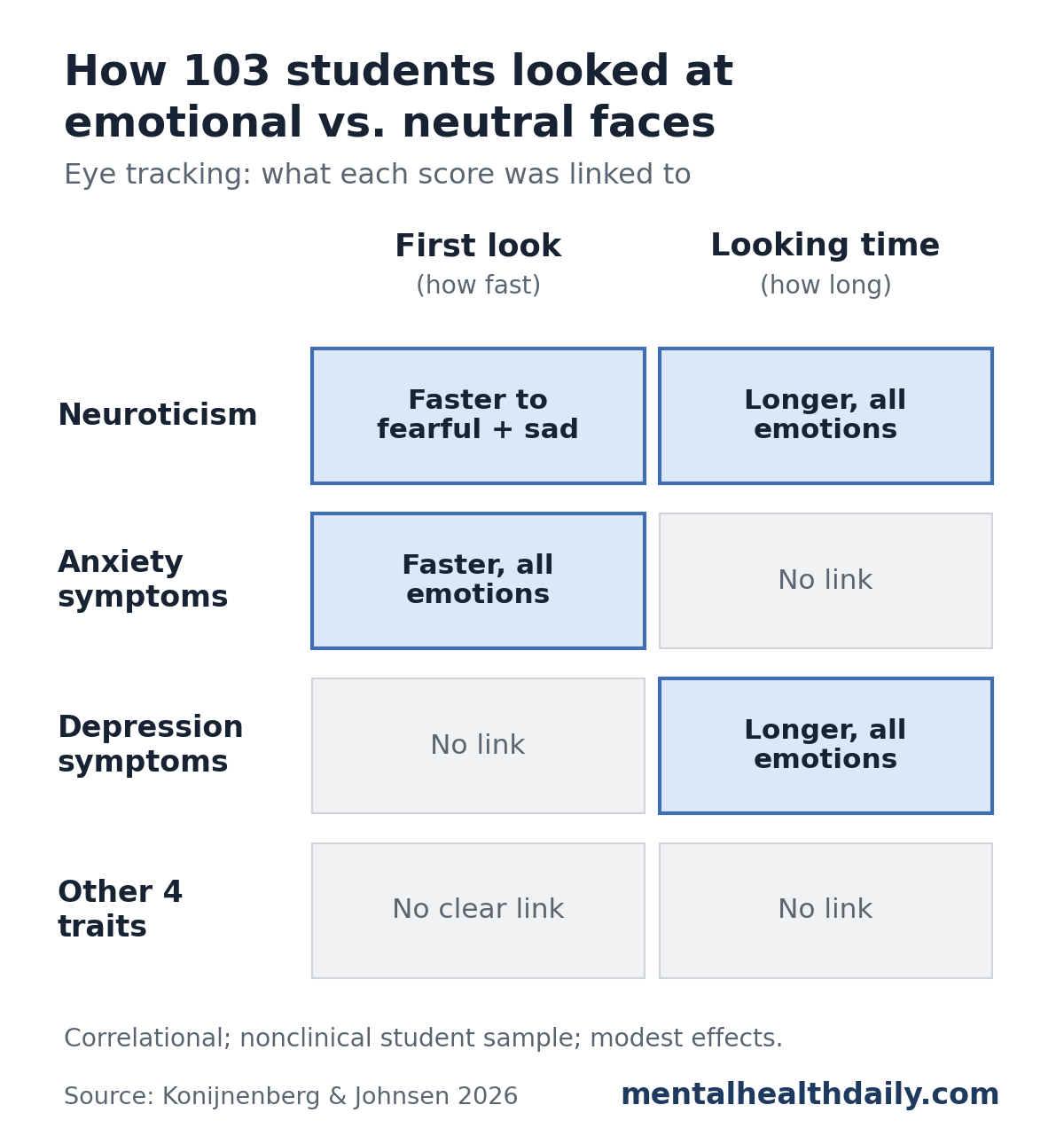
Neuroticism: the only measure linked to both parts of attention. Overall, higher scores went with faster orienting to emotional faces (p = .010) and a larger share of viewing time on them (p = .04).1
For first looks, the neuroticism link depended on the emotion. Checked one emotion at a time with a strict correction for 6 comparisons, it held for fearful faces (p = .002) and sad faces (p < .001), but not for angry, disgusted, happy or surprised faces.1
Anxiety symptoms: linked to faster first looks at emotional faces (p = .040) but not to longer looking. The speed-up did not differ by emotion, so happy and surprised faces counted as much as angry or fearful ones.1
Depression symptoms: linked to longer looking at emotional faces overall (p = .03) but not to faster first looks. Sad faces did not draw extra attention compared with other emotional faces.1
Predictions That Did Not Hold Up
The researchers expected anxiety to sharpen attention to threats, depression to favor sad faces, and extraversion to favor happy faces. Several of those predictions failed:1
- No mood-congruent bias: depression symptoms were not linked to extra attention to sad faces. The researchers state plainly that this result does not support the mood-congruent hypothesis.
- No threat-specific anxiety bias: anxious participants were quicker to look at all emotional faces, not only angry or fearful ones.
- No extraversion effect: extraverts did not look more at happy faces.
- Agreeableness unclear: it changed orienting across emotions overall (p = .02), but no single emotion passed the corrected threshold.
Gender: women scored higher on neuroticism and anxiety, but gender was not linked to either attention score. Men were faster than women to first look at angry faces (about 624 vs. 785 milliseconds).1
How the Results Compare With Clinical Studies
A 2022 meta-analysis of eye-tracking studies found that anxiety and fear-related symptoms were linked to both faster orienting toward threat (r = 0.13) and longer attention on threat (r = 0.15).2 Both links were small, and the Norwegian study adds that, in students, the anxiety-related speed-up was not limited to threatening faces.
Depression looks different in people with a diagnosis. A 2020 systematic review and meta-analysis of eye-tracking studies found that depressed patients looked longer at negative material and less at positive material than healthy people did, with no clear difference in first looks.3
The Norwegian results fit the timing part of that picture: depression symptoms went with longer looking, not faster looking. The sad-specific pull seen in patients was missing, which the researchers suggest may only appear at higher symptom severity.1
Limitations of This Student Eye-Tracking Study
Evidence strength: a single-session, correlational lab study. It can show which traits and symptoms travel with certain viewing habits, not whether those habits cause anxiety or depression.
- Students only: a convenience sample from one Norwegian university, mostly in their early 20s.
- Not a clinical group: no one was diagnosed, though 56 of 103 scored at or above the HSCL-25 screening cutoff. Results may differ in both calmer community samples and patients.
- Small effects: each significant link accounted for roughly 4% to 11% of the variation in attention scores.
- Overlapping measures: neuroticism, anxiety and depression scores were strongly correlated with one another (r = .56 to .65), which makes their separate roles harder to pin down.
- Many tests, no preregistration: the analysis plan was set before data analysis but not publicly registered, and only the per-emotion follow-ups were corrected for multiple comparisons.
- Noisy bias scores: difference-based attention scores are known to be unreliable for comparing individuals, and total looking time does not isolate trouble disengaging from a face.
Can Attention Training Help Anxiety or Depression?
Attention bias modification is a computer training task that tries to steer attention away from negative material, often by repeatedly rewarding looks at neutral stimuli. The patterns in this study resemble what those tasks target.1
Treatment evidence is weak, though. A 2020 network meta-analysis of 85 trials found that attention bias modification showed benefits only in a post hoc analysis that excluded PTSD trials, and the depression evidence was too inconsistent to draw conclusions.4
The researchers say their findings are best used to guide future intervention research, not as support for clinical use.1 For people with persistent anxiety or low mood, established treatments such as therapy or medication remain the place to start.
References
- Konijnenberg C, Johnsen SÅK. The effects of personality, anxiety and depression on the attentional processing of emotional faces. Journal of Cognition. 2026;9(1):46. doi:10.5334/joc.519
- Clauss K, Gorday JY, Bardeen JR. Eye tracking evidence of threat-related attentional bias in anxiety- and fear-related disorders: a systematic review and meta-analysis. Clinical Psychology Review. 2022;93:102142. doi:10.1016/j.cpr.2022.102142
- Suslow T, Hußlack A, Kersting A, Bodenschatz CM. Attentional biases to emotional information in clinical depression: a systematic and meta-analytic review of eye tracking findings. Journal of Affective Disorders. 2020;274:632–642. doi:10.1016/j.jad.2020.05.140
- Fodor LA, Georgescu R, Cuijpers P, et al. Efficacy of cognitive bias modification interventions in anxiety and depressive disorders: a systematic review and network meta-analysis. The Lancet Psychiatry. 2020;7(6):506–514. doi:10.1016/S2215-0366(20)30130-9