
Young adults with more symptoms of depression and social anxiety were more likely to give up rewards to avoid demanding judges, according to a 2026 brain-scan study of 135 university-age volunteers in Uruguay.1 Their brains also responded more strongly to the threat of harsh judgment and less strongly to the reward.
Research Highlights
- More avoidance of tough judges: higher combined depression–social anxiety scores were linked to avoiding 3- and 4-star (most demanding) judges and approaching 1- and 2-star judges (symptom × judge rank interaction, χ² = 24.2, p < 0.001).1
- More dread of the upcoming speech: higher scores went with more embarrassment (ρ = 0.61), more nervousness (ρ = 0.46), and lower expectations for their own performance (ρ = −0.55).1
- Stronger threat signal in the brain: the dorsomedial prefrontal and dorsal anterior cingulate cortex (dmPFC/dACC) responded more to rising judge rank in people with higher symptom scores.1
- Weaker reward signal: brain responses to bigger payments in value-related areas were smaller at higher symptom levels, although symptoms did not change how strongly payment drove choices.1
- Preliminary brain findings: the researchers did not apply the strictest voxel-level correction and called the brain–symptom links preliminary.1
How the Social Approach-Avoidance Task Worked
An approach-avoidance conflict is a choice where the same option brings both a reward and something unpleasant. Agreeing to give a talk at work is a familiar example: it can help your career, but it also means being judged.
Researchers think excessive avoidance in these situations is a core part of social anxiety and depression. Few lab tasks recreate this kind of conflict with a social threat, so this team built one.1
Setup. Before the brain scan, each participant recorded a 2-minute speech about a book or movie they liked. They were told that judges ranked from 1 to 4 stars (more stars meaning more demanding) would grade it from 1 to 10.
They were also told they would later give a second live speech over videocall to some of those judges.
Each choice. Inside the MRI scanner, every trial showed a judge rank and an offer of 1 to 4 points:
- Yes (approach): take the full offer, but that type of judge becomes more likely to appear in the live audience
- No (avoid): take 1 point, and that type of judge becomes less likely to appear
Participants made 144 choices across 3 scanning sessions, and points were to be traded for a non-monetary prize.
In reality, no judges existed; the grades shown were preset, with 4-star judges always giving 1 to 3 out of 10. No participant reported disbelieving the cover story at debriefing.1
To measure symptoms, the team combined 6 questionnaires on depression, social anxiety, fear of negative evaluation, public-speaking confidence, rejection sensitivity, and self-critical rumination into one depression–social anxiety (D-SA) score. The scores were closely related, and the first combined component captured 65.3% of the variation across all 6 scales.
Higher Symptom Scores Linked to Avoiding Demanding Judges
Across the whole group, the task worked largely as planned. Bigger payments led to more Yes choices, and higher-rank judges led to more No choices and more negative feelings.1
Symptom level did not change overall approach rates. It changed which judges people accepted:
- Low-rank judges: people with higher D-SA scores said Yes more often to 1- and 2-star judges
- High-rank judges: they said No more often to 3- and 4-star judges, giving up points to keep them out of the audience
- Total points: people with higher scores tended to finish with fewer points, but this trend was not significant (ρ = −0.16, p = 0.07)
After the scan, participants rated how each judge rank made them feel. Higher D-SA scores went with less happiness and more nervousness, embarrassment, sadness, and anger toward the most demanding judges.1
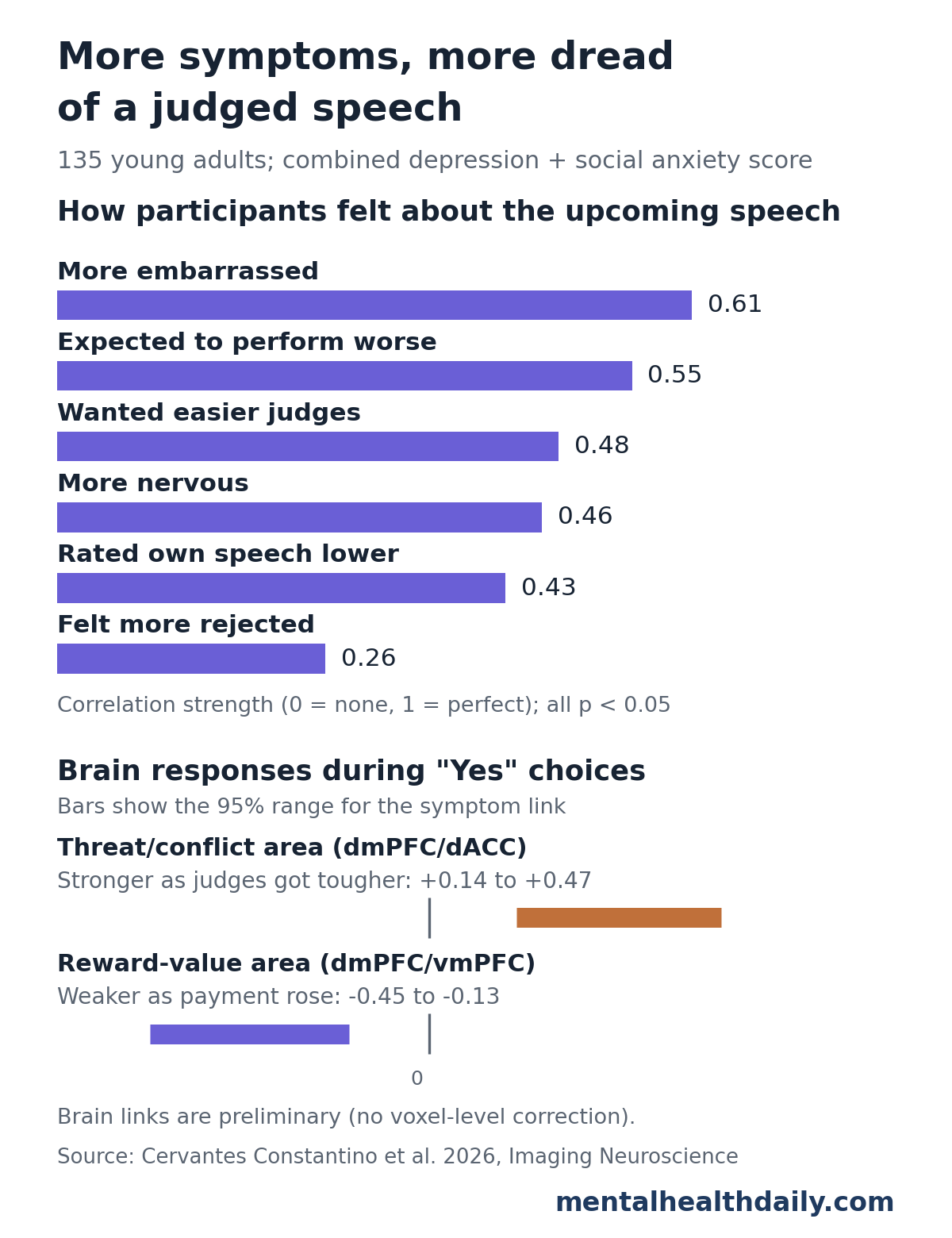
Feelings about the upcoming videocall speech followed the same pattern. People with higher scores felt more embarrassed, nervous, and rejected in advance, rated their recorded speech lower, expected to do worse, and preferred an easier audience.1
One surprise: 2-star judges, not 1-star judges, were accepted most often overall, though only narrowly. The researchers suggest people may not want to look like they picked the easiest audience, or that a moderately tough judge felt like a worthwhile challenge.
Brain Regions Linked to Social Threat and Reward
Functional MRI (fMRI) tracks changes in blood oxygen as an indirect measure of brain activity. The team looked at how activity changed as judge rank or payment went up during each decision.
Threat and conflict. The dmPFC/dACC sits along the midline of the frontal lobe, just above the front of the corpus callosum. It is linked to unpleasant feelings, pain, and monitoring conflict between competing goals.
When people said Yes, dmPFC/dACC activity rose as the judge got tougher. At higher D-SA scores, that response was stronger.1 The researchers read this as more perceived threat, more internal conflict, or both.
The same broad region showed up in a classic 2003 brain-imaging study of social exclusion, where anterior cingulate activity rose when people were left out of a virtual ball-tossing game and tracked how distressed they felt.2 Anterior cingulate activity also rose during conflict choices in a 2015 brain-imaging study of 15 healthy adults that used a different approach-avoidance task.3
Reward. Bigger payments during Yes choices activated areas linked to how much people value a reward:
- dmPFC/vmPFC (dorsomedial and ventromedial prefrontal cortex): front midline areas that track the subjective value of choices
- Posterior cingulate cortex (PCC): a midline region thought to link rewards with context and memory
- Posterior insula: a body-sensing area that also responds to pleasant input such as food, music, and touch
In all of these areas, the response to bigger payments was weaker at higher D-SA scores.1 Choices did not show the same pattern: symptoms did not change how much payment drove decisions, which the researchers list as a limitation.
Limitations of This Depression and Social Anxiety Brain Study
This was a single cross-sectional study, so it shows associations at one point in time. It cannot show that symptoms cause these choices or brain responses, or the reverse.
- Not a clinical sample: participants were 18 to 30, mostly women (92 of 135), recruited through a university, and not taking psychiatric medication. Symptoms were measured on a continuum, with no diagnoses.
- Preliminary brain results: the team used a cluster-level threshold rather than the stricter voxel-level correction. In a leave-one-out check (rerunning the analysis while holding out each person in turn), 2 of the 6 brain–symptom clusters did not hold up.
- Wide uncertainty: 132 people had complete questionnaire data, and the 95% ranges for the brain–symptom links are wide, with some reaching from moderate (about 0.4) down to near zero (0.05).
- Lab setup: the judges were fictional and the prize was non-monetary, so real-world stakes may differ.
What the Findings Suggest About Social Avoidance
The study gives a lab model of a familiar pattern: passing up something you want because it means being judged. In this group, higher depression and social anxiety symptoms were linked to dreading tough judges, avoiding them at a cost, and a brain response that leaned toward threat and away from reward.
The task could be useful for future studies of treatments that target avoidance, such as exposure-based therapy. It is a research tool, not a diagnostic test. Anyone whose fear of judgment keeps them from work, school, or relationships can talk with a doctor or therapist about effective treatments for social anxiety and depression.
References
- Cervantes Constantino F, et al. Social approach-avoidance conflict: behavioural, emotional, and neural correlates along a depression–social anxiety spectrum. Imaging Neuroscience. 2026;4. doi:10.1162/IMAG.a.1363
- Eisenberger NI, Lieberman MD, Williams KD. Does rejection hurt? An fMRI study of social exclusion. Science. 2003;302(5643):290–292. doi:10.1126/science.1089134
- Aupperle RL, Melrose AJ, Francisco A, Paulus MP, Stein MB. Neural substrates of approach-avoidance conflict decision-making. Human Brain Mapping. 2015;36(2):449–462. doi:10.1002/hbm.22639