
In a study involving 93 adults with HIV whose virus was controlled by treatment, the strength of their immune response to cytomegalovirus (CMV) was not linked to developing cognitive impairment over an average of 6.5 years.1
Research Highlights
- Similar CMV antibody levels: 48 people who later developed cognitive impairment averaged 9.57 EU/mL of CMV IgG at baseline vs 9.37 EU/mL in 45 matched people who did not (adjusted odds ratio 1.07, 95% CI 0.61–1.92).1
- No link for CMV-reactive T cells either: baseline ELISpot responses were not associated with later impairment (adjusted odds ratio 1.00, 95% CI 0.98–1.01).1
- Changes over time did not predict decline: antibody levels fell slightly and T-cell responses rose in both groups, and neither change was linked to a change in thinking scores.1
- Hints in a small subset: some immune cells thought to protect against CMV tended to be lower in people who developed impairment, but only 14–17 people per group had these tests, and no significance testing was done.1
- Different from earlier snapshots: 2 cross-sectional studies had linked stronger CMV immune responses to worse cognition in people with HIV.2,3
Why Researchers Suspected CMV in HIV-Related Cognitive Problems
Cytomegalovirus (CMV) is a common herpes virus. After the first infection it stays in the body for life, mostly dormant, and the immune system works constantly to keep it in check. Most adults carry it, and nearly everyone in this study did.
With modern treatment, people with HIV now have a near-normal life expectancy, and more than half are over 50. Severe HIV-associated dementia has declined, but milder cognitive impairment has stayed common or even increased.1
One proposed reason is chronic immune activation. Keeping CMV suppressed for decades may add to the background inflammation that people with HIV already carry, and some studies have linked stronger CMV immune responses to frailty, heart disease, and Alzheimer’s-type brain changes.1
How the CMV and Cognition Study Was Designed
Chauhan et al. drew on 2 long-running US observational cohorts from the AIDS Clinical Trials Group (ACTG), with stored blood samples and repeated thinking tests going back to the early 2000s.1 They used a case-control design: they picked people who went on to develop a problem (cases) and compared them with similar people who did not (controls).
- Participants: adults with HIV whose virus had been suppressed by treatment for at least 6 months, with no viral rebounds during follow-up. Average age was about 42; 83% were men.
- Cases: 48 people with normal cognition at baseline who developed cognitive impairment later.
- Controls: 45 people who stayed free of impairment, matched on age, sex, CD4 count category, and years of follow-up.
- Cognitive testing: every 48 weeks, using 3 timed tests (Trail Making A and B and the Digit Symbol test) that mainly measure processing speed, attention, and mental flexibility.
Impairment meant scoring at least 1 standard deviation below the norm on 2 tests, or at least 2 standard deviations below on 1 test, after adjusting for age, sex, race, and education.1
Three kinds of CMV immune measures were compared at baseline and follow-up:
- CMV IgG: the level of antibodies against CMV in the blood. Higher levels are sometimes read as a sign of more immune activity against the virus.
- ELISpot: a lab test that exposes white blood cells to CMV and counts how many T cells respond by releasing interferon-gamma, an immune signaling molecule. It measures the cell-based arm of immunity.
- Flow cytometry: a method that sorts and counts individual immune cell types, such as natural killer (NK) cells and regulatory T cells, by the markers on their surface. This was exploratory and done at baseline only.
CMV Antibodies and T-Cell Responses Were Not Linked to Later Impairment
At baseline, CMV antibody levels were nearly identical: 9.57 EU/mL in people who went on to develop impairment and 9.37 EU/mL in those who did not. After adjusting for age, race, sex, education, CD4 count, HIV viral load, and neuropathy, the odds ratio was 1.07 (95% CI 0.61–1.92).1
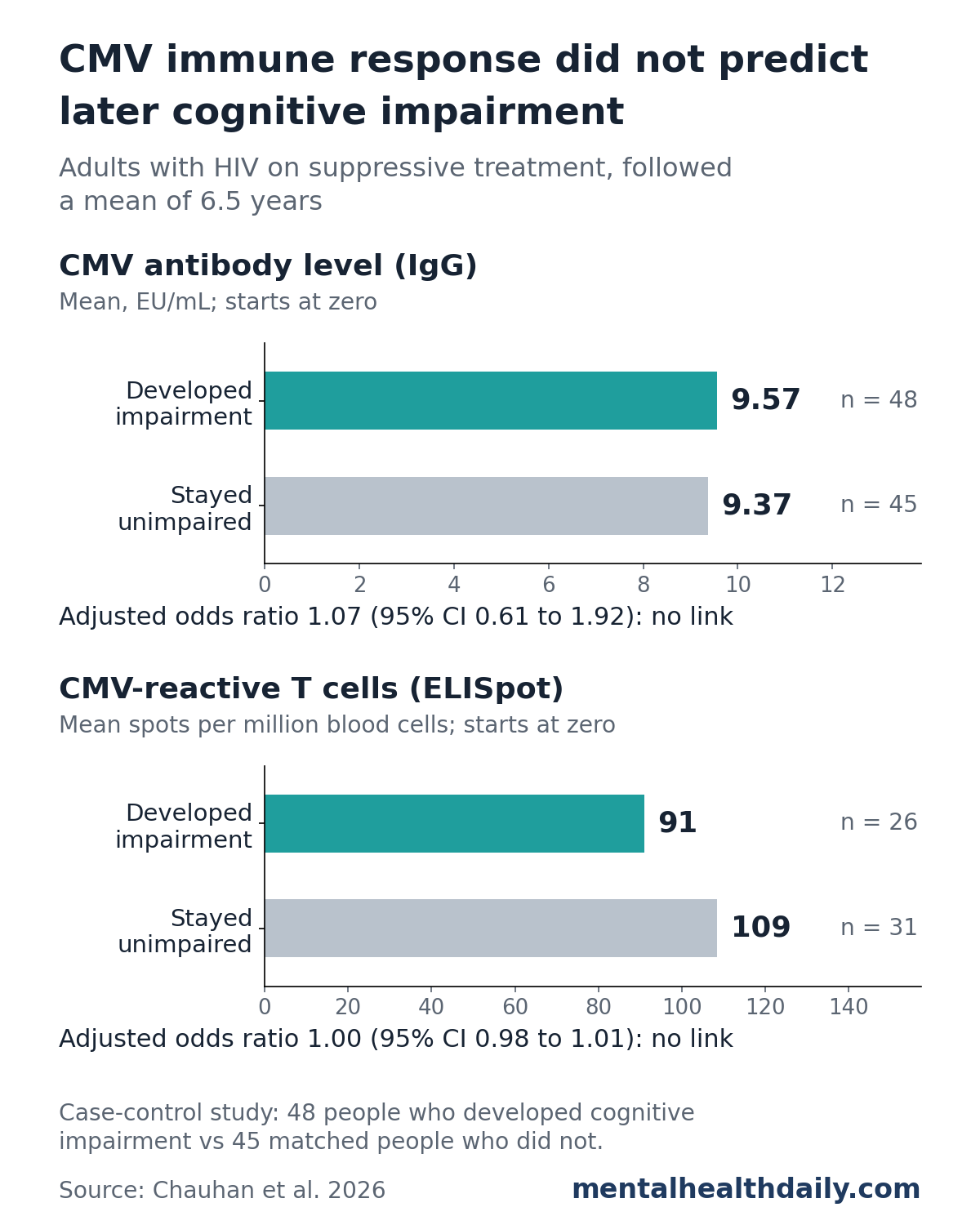
T-cell responses on the ELISpot test showed the same pattern. Baseline averages were 91 responding cells per million in 26 people who developed impairment and 109 in 31 who did not, with an adjusted odds ratio of 1.00 (95% CI 0.98–1.01).1
Over time: average antibody levels dipped slightly in both groups (by 1.10 EU/mL in cases and 0.59 in controls), while ELISpot responses rose in both, which the researchers say likely reflects silent CMV reactivations. Neither the baseline value nor the change in either test was linked to a change in cognitive scores.1
The 2 tests also barely tracked each other (r = 0.07 at baseline and 0.02 at follow-up). Antibody levels and T-cell responses seem to capture different parts of CMV immunity, so neither works as a stand-in for the other.1
Other factors did show up. Neuropathy (nerve damage, usually in the feet and hands) was twice as common in people who developed impairment (35.4% vs 17.8%), and neuropathy, White race, and Hispanic ethnicity were linked to cognitive change in the antibody analysis.1
Exploratory Immune Cell Patterns in People Who Developed Impairment
In the small flow cytometry subset (14–17 people per group), a few cell types differed between groups. The CMV-responsive share of NK cells releasing interferon-gamma averaged 3.36 in people who developed impairment vs 6.92 in those who did not.1
- Tended to be lower in cases: NK cells that help protect against CMV reactivation, and CMV-responsive CD8 T cells.
- Tended to be higher in cases: CMV-responsive regulatory T cells (2.59 vs 1.39) and CD4 T cells carrying PD-1, both previously linked to CMV-related organ disease. Unexpectedly, a type of CMV-fighting gamma-delta T cell was also higher.
The researchers did not run significance tests on these markers and describe the differences as small. Treat them as leads for larger studies.1
Earlier Studies Linked CMV Immunity to Worse Cognition in HIV
The researchers describe this as the first longitudinal study of CMV immune responses and cognitive impairment in people with HIV. Earlier studies measured both things at a single point in time and found a link:
- US CHARTER cohort: in 80 adults with HIV, higher CMV antibody levels correlated with worse overall cognitive performance among the 38 on suppressive treatment (r = −0.45), but not among those off treatment.2
- Danish study: in 52 people with HIV on stable treatment, stronger CMV-specific CD4 T-cell responses raised the odds of neurocognitive impairment, and higher CMV antibody levels were linked to worse scores, mainly in processing speed.3
A single-time-point link cannot show which came first. Cognitive problems and CMV immune activity could both reflect a third factor, such as overall immune aging. Following people forward, as Chauhan et al. did, is a better test of whether CMV immunity comes first, and here it did not predict who developed impairment.
Limitations of This CMV and HIV Cognition Study
- Small numbers: 93 people in the main antibody analysis and 26–40 per group for the ELISpot test. A modest link could have been missed; the antibody result’s confidence interval runs from about 40% lower odds to nearly double.
- Missing cell samples: some stored blood cell samples were not usable, so the cell-based analyses used smaller, possibly unrepresentative subsets.
- Narrow cognitive testing: the 3 tests mainly capture speed and mental flexibility. Memory, language, and other domains were not well measured.
- Cases started lower: people who went on to develop impairment already had lower baseline thinking scores (median −0.35 vs 0.73), even though they were not impaired.
- Nearly everyone had CMV: only 3 samples were CMV-negative, so the study compared strength of immune response, not infected vs uninfected people. CMV viral levels were not measured.
- Who was studied: mostly middle-aged men with well-controlled HIV in US research cohorts. Results may differ in older adults, women, or people with less controlled HIV.
Evidence strength: this was an exploratory observational brief report. It can show that these CMV measures did not predict impairment in this group; it cannot rule out a smaller role for CMV in cognitive aging with HIV.
What This Means for People With HIV
- CMV immune tests did not predict impairment. Antibody level and T-cell response did not flag who would develop cognitive impairment in this study.
- The CMV question is still open. Larger studies with more detailed immune profiling, and trials of CMV-suppressing drugs, would give a clearer answer.
- Known risk factors still apply. Blood pressure, diabetes, mental health conditions, substance use, and viral coinfections all contribute to cognitive problems in people with HIV and are worth discussing with a clinician.1
References
- Chauhan L, Ghosh D, Ances B, Tassiopoulos K, Wu K, Weinberg A, Erlandson KM. Cytomegalovirus immune responses and cognitive impairment in people with human immunodeficiency virus. The Journal of Infectious Diseases. 2026;234(3):e461–e465. doi:10.1093/infdis/jiag239
- Letendre S, Bharti A, Perez-Valero I, et al. Higher anti-cytomegalovirus immunoglobulin G concentrations are associated with worse neurocognitive performance during suppressive antiretroviral therapy. Clinical Infectious Diseases. 2018;67(5):770–777. doi:10.1093/cid/ciy170
- Ballegaard V, Pedersen KK, Pedersen M, et al. Cytomegalovirus-specific CD4+ T-cell responses and CMV-IgG levels are associated with neurocognitive impairment in people living with HIV. Journal of Acquired Immune Deficiency Syndromes. 2018;79(1):117–125. doi:10.1097/QAI.0000000000001753