
Children and teens whose parent has schizophrenia or bipolar disorder had more emotional and behavioral problems than children from comparison families, according to a 2026 study of 62 young people in Turkey.1 Children in the two parent-diagnosis groups looked much alike, and family hardship likely explains part of the gap.
Research Highlights
- Higher overall problem scores: average parent-rated total problems scores were 63.1 for children of a parent with schizophrenia and 60.5 for children of a parent with bipolar disorder, vs. 54.2 for controls (p < 0.001).1
- Gap held after adjustment: accounting for age, sex, earlier child psychiatry visits and parental separation, scores were 7.94 points higher in the schizophrenia group and 5.88 points higher in the bipolar group than in controls.1
- Anxiety and low mood stood out: the anxious/depressed scale showed the largest elevation (64.5 and 61.9 vs. 54.0), with withdrawal, aggression, social and attention problems also higher.1
- Two parent diagnoses, similar children: scores did not differ significantly between the schizophrenia and bipolar groups on any scale.1
- Harder family circumstances: parental separation, low income and earlier child psychiatry visits were all more common in both clinical groups than in control families.1
How Researchers Compared Children of Parents With Schizophrenia, Bipolar Disorder or Neither
Balatacı et al. recruited families through the adult psychiatry outpatient clinic of Karabük Training and Research Hospital in Turkey. A parent’s schizophrenia or bipolar disorder diagnosis was confirmed by an adult psychiatrist with the SCID-5, a structured diagnostic interview.1
- Schizophrenia group: 21 children with a parent treated for schizophrenia
- Bipolar group: 20 children with a parent treated for bipolar disorder
- Control group: 21 children of parents who attended the same clinic for other reasons and had no major psychiatric disorder on the SCID-5
- Ages: 6 to 18, with average ages of 11.3 to 11.8 years and similar sex balance and schooling across groups
Children with conditions that would prevent a reliable assessment, such as moderate-to-severe intellectual disability, were excluded. Two child and adolescent psychiatrists evaluated every child.1
The main measure was the Child Behavior Checklist (CBCL/6–18), a widely used questionnaire in which a parent rates more than 100 problem behaviors, from worry and sadness to fighting and trouble concentrating.2
Scores are converted to T-scores, where 50 is the average for children of the same age and sex, every 10 points is about one standard deviation, and higher means more problems.
Emotional, Behavioral and Attention Scores Were Higher in Both Groups
All 11 CBCL scales differed across the 3 groups at the usual p < 0.05 level. Because so many scales were tested, the researchers used a stricter Bonferroni cutoff (p < 0.0045) to guard against chance findings. Eight scales passed it:1
- Emotional (internalizing) problems: anxious/depressed, withdrawn/depressed, and the overall internalizing score
- Behavioral (externalizing) problems: aggressive behavior and the overall externalizing score
- Other areas: social problems, attention problems, and total problems
On each of these, both groups of children scored higher than controls. Somatic complaints (physical complaints without a clear medical cause), rule-breaking behavior and thought problems were also numerically higher but did not pass the stricter cutoff.1
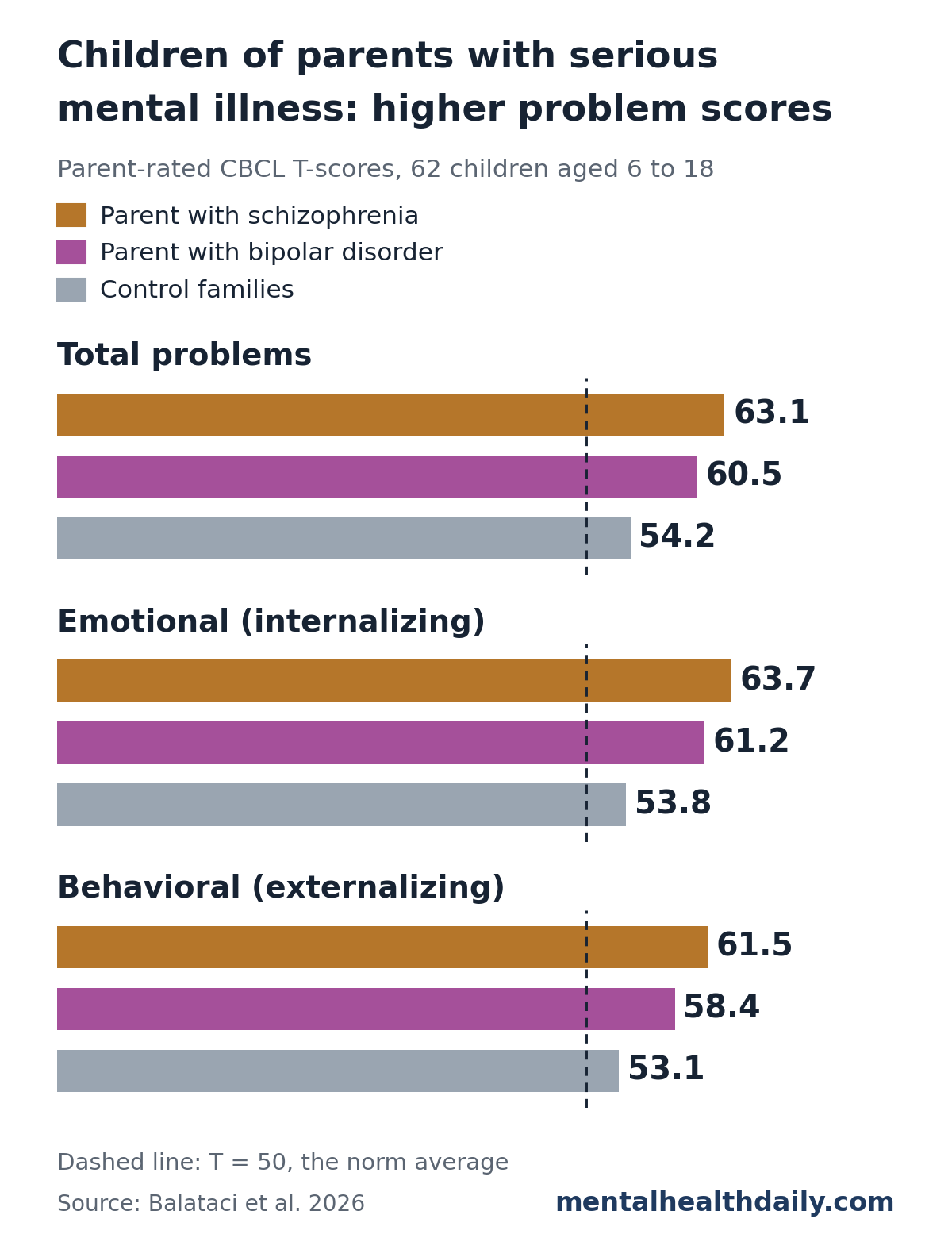
Size of the difference: the 8.9-point gap in total problems between the schizophrenia group and controls is close to one standard deviation on the CBCL scale. Spread within each group was wide (standard deviations of about 6 to 9 points), so scores overlapped considerably between groups.1
Higher Problem Scores Held After Adjusting for Age, Sex and Family Separation
A regression model tested whether group membership was still linked to total problems scores once 4 background factors were held constant: the child’s age, sex, any earlier child psychiatry visit, and whether the parents were separated.1
- Parent with schizophrenia: 7.94 points higher than controls (95% CI 3.71 to 12.17, p < 0.001)
- Parent with bipolar disorder: 5.88 points higher than controls (95% CI 1.76 to 10.00, p = 0.006)
- Background factors: none was significantly linked to scores once group was in the model
The model explained 39% of the variation in total problems scores. It did not include family income, parental education or employment, or illness in the other parent, so it cannot separate a parent’s diagnosis from the wider hardship that often comes with it.1
Children of Parents With Schizophrenia vs. Bipolar Disorder Looked Similar
The two clinical groups did not differ significantly on any CBCL scale. Children of a parent with schizophrenia scored a few points higher on nearly every scale, a pattern the researchers say could be a real but modest difference that a 41-child comparison was too small to detect.1
A much larger Danish study points the same way. The Danish High Risk and Resilience Study (VIA 7) assessed 522 seven-year-olds, with reports from parents, teachers, testers and the children themselves. Lifetime psychiatric diagnoses were found in 38.7% of children of a parent with schizophrenia spectrum psychosis and 35.6% of children of a parent with bipolar disorder, vs. 15.2% of controls.2
VIA 7 also found a gradient in day-to-day problems: highest in the schizophrenia group, intermediate in the bipolar group, lowest in controls.2 Both studies fit the researchers’ view of a broad early vulnerability that shows up as anxiety, low mood, attention and social difficulties, rather than as early versions of the parent’s specific illness.
Family Hardship Was More Common in Both Clinical Groups
Compared with control families, households in the clinical groups faced more practical strain:1
- Parents separated: 47.6% (schizophrenia), 35.0% (bipolar), 9.5% (controls)
- Low household income: 42.9%, 30.0%, 9.5%
- Earlier child psychiatry visit: 38.1%, 35.0%, 9.5%
- Parental employment and education: lower in the clinical groups for both mothers and fathers
The researchers concluded that the higher CBCL scores probably reflect inherited vulnerability and a tougher home environment working together, not inherited risk alone. Family conflict, chronic stress and financial strain have each been linked to worse outcomes in children of parents with serious mental illness, and those factors can change.1
Limitations of This Cross-Sectional Study
This is a cross-sectional study, meaning children were assessed once. It can show that higher problem scores are linked to having a parent with schizophrenia or bipolar disorder, but not why, or how these children will do later.
- Small, single clinic: 62 children from one Turkish hospital; results may not apply elsewhere.
- One informant: all scores came from a parent. In VIA 7, teachers and testers saw smaller differences than parents did for children of a parent with bipolar disorder, and some studies suggest a parent’s own mood can shape how they rate a child’s behavior.2
- Limited adjustment: income, education, employment and illness in the other parent were not in the regression model.
- Too small to compare diagnoses: the study was powered for the 3-group comparison, not for differences between the two clinical groups.
- Averages, not individuals: group means were higher, but the groups overlapped and the study did not report how many children reached a clinical range.
What This Means for Families Living With Schizophrenia or Bipolar Disorder
The researchers recommend that adult psychiatry services ask parents how their children are doing, including school, family stress and any earlier mental health contact, and refer children for assessment when needed.1
Risk is not destiny. A 2014 meta-analysis of 33 family high-risk studies estimated that about 1 in 3 children of a parent with severe mental illness develops a severe mental illness by early adulthood, which also means most do not.3
Prevention programs are still being tested. In a Danish randomized trial of 113 children of parents with schizophrenia spectrum disorder, bipolar disorder or recurrent depression, a family-based preventive program (VIA Family) did not improve children’s overall functioning more than usual care at the end of the intervention.4 Screening can identify children who need support now, while the best way to lower long-term risk is still an open question.
References
- Balatacı U, Ay B, Tarhan R, Ay A. Emotional and behavioral problems in the offspring of parents with schizophrenia or bipolar disorder: a controlled comparative study. Frontiers in Psychiatry. 2026;17:1847199. doi:10.3389/fpsyt.2026.1847199
- Ellersgaard D, Plessen KJ, Jepsen JR, et al. Psychopathology in 7-year-old children with familial high risk of developing schizophrenia spectrum psychosis or bipolar disorder – The Danish High Risk and Resilience Study – VIA 7, a population-based cohort study. World Psychiatry. 2018;17(2):210–219. doi:10.1002/wps.20527
- Rasic D, Hajek T, Alda M, Uher R. Risk of mental illness in offspring of parents with schizophrenia, bipolar disorder, and major depressive disorder: a meta-analysis of family high-risk studies. Schizophrenia Bulletin. 2014;40(1):28–38. doi:10.1093/schbul/sbt114
- Müller AD, Gjøde ICT, Thams N, et al. Family-based preventive intervention for children of parents with severe mental illness: a randomized clinical trial. JCPP Advances. 2024;4(3):e12216. doi:10.1002/jcv2.12216