
University students with high depression scores, but no diagnosed depression, got the same memory boost from spotting a target as students with almost no symptoms, according to a 2026 lab study involving 81 students in China.1 A brief warning cue changed how emotional words were handled, mostly in the same way for both groups.
Research Highlights
- Memory boost held up in both groups: words shown at the moment of a target were remembered better than words shown with a distractor (F = 208.07, p < 0.001), and the boost was statistically equivalent between 42 depression-prone and 39 control students.1
- Moderate evidence for no group difference: Bayes factors favored “no difference” by about 3 to 7 times across the main analyses.1
- A warning cue sped detection and evened out emotion effects: with an orange cue before each target, reaction times dropped from roughly 380–410 ms to 210–240 ms, and accuracy no longer differed by word type.1
- Positive words gained the most from the cue: the memory boost for positive words was larger with the cue than without it (p = 0.042).1
- Nonclinical lab sample: participants had elevated symptoms but did not meet criteria for depression, and the task used Chinese words in a single session.1
What the Attentional Boost Effect Is
Doing two things at once usually hurts memory. The attentional boost effect is a well-known exception: when you spot a target you were told to watch for, whatever else is on screen at that instant gets remembered better.
Swallow and Jiang first described it in 2010. People memorized a stream of photos while pressing a key whenever a target signal appeared, and photos that appeared alongside a target were recognized better later than photos that appeared alongside a non-target.2
The usual explanation is a brief burst of alertness. Detecting a target is thought to trigger a short spike of activity in the locus coeruleus, a small brainstem hub that releases norepinephrine, the brain’s alerting chemical. That spike briefly strengthens the recording of anything happening at the same moment.
Why Researchers Tested It in Depression-Prone Students
Depression is linked to a negative bias: attention is drawn to sad or threatening information, and negative memories come back more easily. Zhang et al. asked whether that bias also reaches a more basic alerting system that does not depend on emotion, or whether the two run separately.
They studied a depression-prone group: people with clear depressive symptoms who do not meet the threshold for a diagnosis. This group avoids the confounds of antidepressants, hospital stays and years of illness.
- Screening: 1,184 undergraduates completed the Beck Depression Inventory-II (BDI-II), a 0-to-63 symptom questionnaire
- Depression-prone group: 42 students scoring 14 or higher (average 20.7), confirmed by structured clinical interview not to have major depression or another psychiatric diagnosis
- Control group: 39 students scoring 13 or lower (average 1.1)
- Exclusions: any prior psychiatric diagnosis, psychiatric medication, head injury, color blindness or left-handedness
How the Word Memory Task Worked
Students silently read Chinese two-character words that flashed on screen for half a second each. A small colored circle appeared under each word for 100 ms: they pressed the spacebar for a red circle (the target) and did nothing for a green one (a distractor).
Words were positive (such as “lively”), neutral (“body”) or negative (“despair”). Positive and negative words were matched for how arousing they were, so any difference between them reflects how pleasant or unpleasant they were.
After a short counting task, students picked out the studied words from a mix of old and new ones.
Each student did the task twice. In the second run, an orange alerting cue appeared just before every target, signaling that a red circle was coming next. The no-cue run always came first.
Depression-Prone Students Kept a Normal Memory Boost
Both groups recognized target-paired words more often than distractor-paired words, both with and without the cue (all p < 0.001).1 The size of that boost ran from about 10 to 19 percentage points.
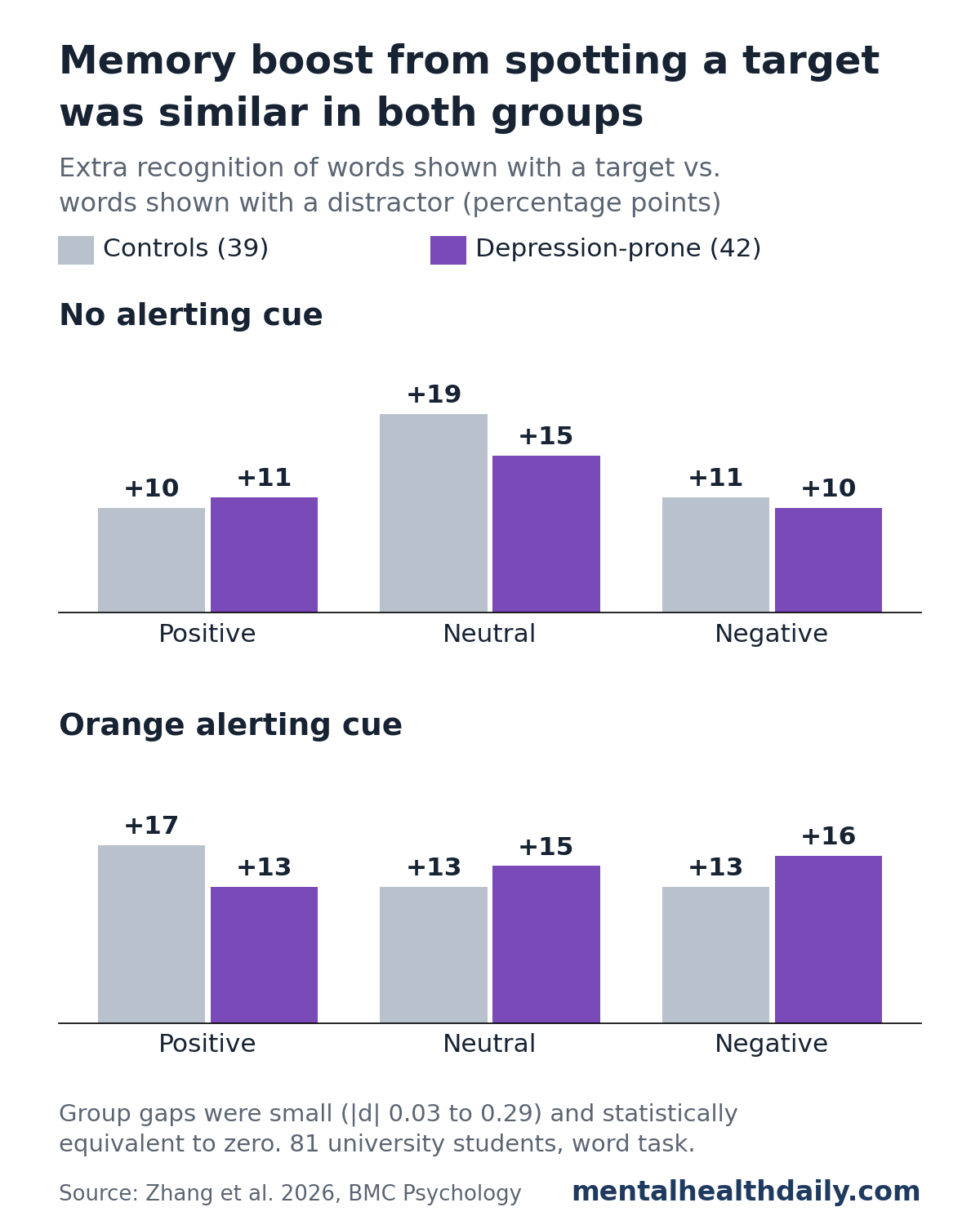
No group difference. Group gaps in boost size were small in all 6 conditions (Cohen’s d from 0.03 to 0.29). An equivalence test, which checks whether a gap is small enough to treat as zero, passed in every condition using a d = 0.40 cutoff.1
Bayesian support. A Bayes factor compares how well the data fit “no difference” against “a difference.” Here the data were 4.17 times more likely under no group difference for boost size, and 6.67 times more likely for the full group-by-condition pattern in recognition. Both count as moderate evidence.1
The result is consistent with a 2025 study from the same lab. That study, involving 60 students, found a significant boost in both depression-prone and control groups, with a weaker boost in the depression-prone group only for positive pictures.3
An Orange Warning Cue Evened Out Emotional Word Effects
Without the cue, word type shaped how well students caught targets. Accuracy was highest with positive words and lowest with negative ones: 0.91 vs. 0.81 in controls and 0.88 vs. 0.76 in depression-prone students.1
With the cue, those differences disappeared. Accuracy sat between 0.83 and 0.87 for every word type in both groups, and reaction times fell sharply:
- Controls: about 378–394 ms without the cue vs. 210–216 ms with it
- Depression-prone students: about 383–409 ms without the cue vs. 233–238 ms with it
Neither detection accuracy nor speed differed reliably between groups (Bayes factors of 3.23 and 3.57 in favor of no difference).1
Memory effects of the cue. Without the cue, neutral words got the largest memory boost. With the cue, the three word types evened out, and the boost for positive words grew (p = 0.042). Negative words showed a similar trend that did not reach significance (p = 0.078).1
A hint that depression-prone students responded differently to the cue (a group-by-cue-by-emotion interaction) was only marginal (p = 0.094), and the Bayes factor leaned slightly toward no difference.1
What the Findings Suggest About Depression and Attention
The researchers read the results as evidence that the negative bias in depression and the brief alerting burst behind the memory boost are separate systems. Elevated symptoms did not weaken the alerting burst.
They also suggest that depression-prone thinking is context-dependent: emotional biases showed up more when the task gave no warning, and less when an external cue organized attention. Their proposed application is to add brief tones or flashes to cognitive training so helpful content is encoded more strongly. The researchers describe this as tentative, and the study did not test any training or treatment.
Limitations of This Depression-Prone Memory Study
- No clinical depression. Everyone in the depression-prone group was interviewed and found not to have major depression, so results may not hold for people with diagnosed depression.
- Unusually calm controls. The control group’s average BDI-II score was 1.1, far below the cutoff, which the researchers say limits how far the group comparison generalizes.
- Fixed order. The cue run always followed the no-cue run, so practice or fatigue could account for part of the cue effects.
- Moderate, not strong, evidence. Bayes factors of 3 to 7 support no group difference, but the researchers call this a preliminary conclusion. Several emotion and cue effects were marginal.
- No brain measures. Locus coeruleus and norepinephrine activity were inferred from behavior, not measured.
- Narrow task. One session of Chinese word recognition, with one type of cue; pictures, faces and real-life memory were not tested.
- Some reporting inconsistencies. A few reported statistics in the recognition analysis do not match each other, though the main boost and group results are consistent across tests.
Persistent low mood, loss of interest or trouble functioning is worth raising with a doctor or mental health professional, whatever a lab memory task shows.
References
- Zhang M, Li X, Xie Q, et al. Transient arousal-driven or valence-driven? The effects of alerting cues on the attentional boost effect in depression-prone individuals. BMC Psychology. 2026;14:1296. doi:10.1186/s40359-026-05313-8
- Swallow KM, Jiang YV. The attentional boost effect: transient increases in attention to one task enhance performance in a second task. Cognition. 2010;115(1):118–132. doi:10.1016/j.cognition.2009.12.003
- Xie Q, Zhang M, Wang Y, Wang D, Huang F. The attentional boost effect in individuals prone to depression: a Remember/Know analysis based on emotional valence and material type. Frontiers in Psychiatry. 2025;16:1661870. doi:10.3389/fpsyt.2025.1661870