Autistic doctors run into avoidable barriers as they move from medical school into their first hospital jobs, according to a 2026 UK review that also proposes a 7-part plan to support them.1
Research Highlights
- 7 recurring barriers: unspoken social rules, communication exams built around neurotypical styles, noisy wards, unpredictable shift schedules, fast verbal handovers, risky disclosure and supervisors with little autism awareness.1
- Masking takes a toll: hiding autistic traits through long shifts is linked to exhaustion and autistic burnout.15
- Protections exist on paper: UK law requires workplace adjustments for disabled staff, but trainees often have to ask, explain and push for them themselves.1
- Survey data back this up: in a 225-person survey of autistic doctors, 29% had told no one at work, and only about half of those who asked for adjustments got them.2
- The SUPPORT framework is a proposal: it lists low-cost changes such as written task lists and quiet work spaces, but it has not yet been tested.1
What UK Foundation Training Means for New Doctors
In the UK, medical school is followed by foundation training, a 2-year paid training program. First-year (FY1) and second-year (FY2) doctors rotate through hospital jobs under supervision, roughly like an American intern year and the start of residency.
Chloë Groenewald, an FY2 doctor in an NHS hospital trust, wrote the review. It combines a narrative review (a summary of published research chosen by the author, without the formal search rules of a systematic review) with a positionality statement drawing on her own clinical experience.1
The review collects no new data. It describes barriers, lays out UK law and policy, and proposes a framework.
The paper uses identity-first language (“autistic doctors”), which most autistic doctors in a 2023 survey preferred.2 A few UK terms come up often:
- Rota: the work schedule of shifts and on-call duties
- Bleep: a hospital pager
- Reasonable adjustments: changes an employer makes so a disabled worker is not disadvantaged, roughly what Americans call workplace accommodations
7 Barriers Autistic Medical Students and Junior Doctors Face
The move from student to working doctor is hard for everyone. Within weeks, new doctors are prescribing, managing unwell patients and finding their way around a busy hospital, often with less supervision than before.1
For many autistic doctors, the review argues, the main strain comes from the environment around the clinical work rather than the work itself. It groups the barriers into 7 areas:1
- Unspoken social rules: hospital hierarchies and professional norms are rarely explained, so they are easy to misread. Educators call this the hidden curriculum.
- Communication exams: objective structured clinical examinations (OSCEs), the timed role-play exams used to test clinical skills, often reward eye contact and a certain rapport style. They may end up measuring how well a student masks, not how competent they are.
- Sensory load: busy wards, noise, interruptions and smells can add up to sensory overload, which drains energy and makes it harder to talk, interact and learn.
- Shift work: rotating shifts, short-notice rota changes and constant bleeps disrupt the routine many autistic people rely on to manage stress.
- Fast team communication: rapid verbal handovers and corridor updates from nurses, pharmacists and other staff are hard to follow in real time.
- Disclosure risk: fear of being seen as less capable leads many to keep their diagnosis private, which means no adjustments.
- Supervisor awareness: direct speech, little small talk or a preference for written feedback can be misread as unprofessional or disengaged.
The review also points to the double empathy problem: the idea that misunderstandings between autistic and non-autistic people run in both directions, so communication trouble on a team is a 2-way problem rather than the autistic doctor’s failing alone.1
Masking, Late Diagnosis and Autistic Burnout
Masking means suppressing or changing autistic traits to fit neurotypical expectations. On a ward, the review says, that can mean watching your own facial expressions on rounds, hiding discomfort in a loud corridor and rehearsing what to say before talking with the team, for a full 12.5-hour shift.1
Over time, that effort can lead to autistic burnout. Raymaker et al. defined it as long-lasting exhaustion, loss of function and lower tolerance for sensory input, typically lasting 3 months or more, resulting from chronic stress and a mismatch between what is expected and what a person can manage without adequate support.5 They described it as distinct from ordinary job burnout and from depression.
Late diagnosis is common. Many autistic doctors learn they are autistic only after years of training. In the 2023 survey, 74% did not know or suspect they were autistic while in medical school.2
The review describes a late diagnosis as a lens that reframes past struggles: what once looked like personal failure turns out to have been a poor fit between the person and the system.1
Workplace Adjustments Are Required but Unevenly Provided
Under the UK’s Equality Act 2010, NHS employers must make reasonable adjustments for disabled staff, and autism counts as a disability when it has a substantial, long-term effect on daily life. For employment, the duty applies when an employer knows, or could reasonably be expected to know, that a worker has a disability; formal disclosure is not always necessary.1 Acas guidance sets out this knowledge requirement.
Guidance from the General Medical Council, the UK’s medical regulator, also states that disability does not prevent safe practice. In reality, the review argues, the burden falls on the trainee to disclose, explain and advocate, often again at each new rotation.1
What surveys show: a 2023 online survey of 225 members of Autistic Doctors International, a peer-support group, found:2
- 29% had disclosed being autistic to no one at work.
- 46% had requested workplace adjustments, and only 49% of those had them put in place.
- 75% of those who received adjustments found them helpful.
- 75% said sensory issues were a challenge at work, while 73% said being autistic helped them as doctors.
Mental health in that group was poor. Three-quarters (77%) had considered suicide at some point. The sample was self-selected from a support group, so these figures cannot be applied to all autistic doctors.2
If you are struggling or thinking about suicide, help is available. In the US, call or text 988 (Suicide & Crisis Lifeline). In the UK and Ireland, Samaritans are available at 116 123.
The SUPPORT Framework for Autistic Trainee Doctors
The review proposes SUPPORT as a practical checklist for supervisors, training programs and hospitals. It is modeled on Autistic SPACE, an earlier framework from Autistic Doctors International for meeting autistic patients’ needs in healthcare (Sensory needs, Predictability, Acceptance, Communication and Empathy).16
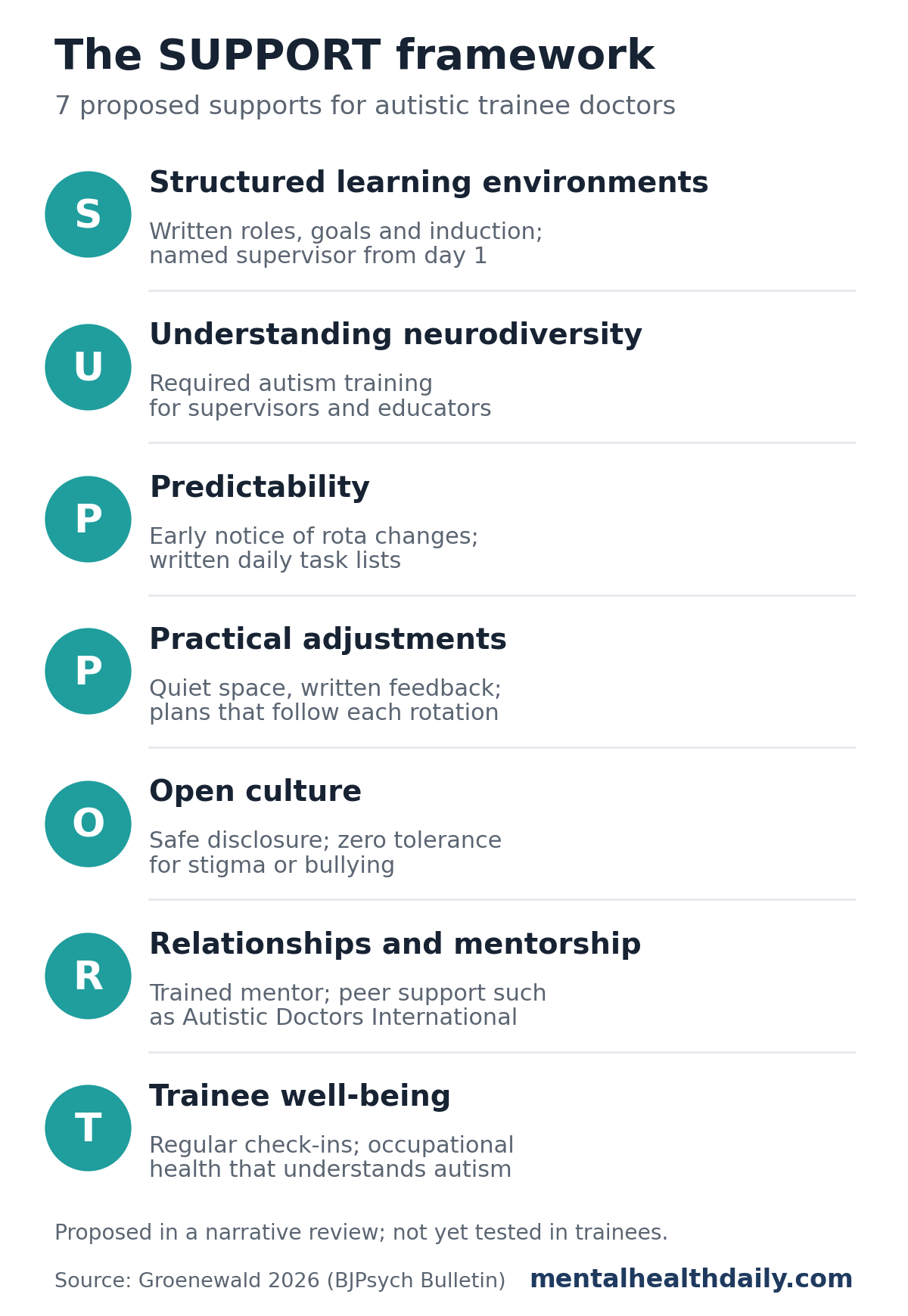
Most of the suggested changes cost little:1
- Written task list: a short summary of the day’s tasks at the start of each shift, since spoken instructions on a noisy ward are easy to lose.
- Specific feedback: “Lead with the working diagnosis during handover” instead of “work on your communication.”
- Advance notice: rota changes shared early, induction material sent before day 1 and a brief email naming the supervisor and describing the ward.
- Quiet space: a quieter room for writing notes and flexibility on breaks.
- Adjustments that travel: plans that carry over between rotations so the trainee does not have to start over.
- Named contacts: a trained mentor and access to occupational health staff who understand neurodiversity from the first day.
The review argues that many of these changes would help every trainee, not only autistic ones. It also calls for mandatory neurodiversity training for supervisors and for NHS workforce data on how many trainees are autistic.1
A clinical example: the review describes Dr A, an FY1 doctor diagnosed during medical school, who did not disclose, grew more anxious and exhausted, and heard secondhand that colleagues felt they did not “fit in.” A supervisor who had attended a brief neurodiversity session made disclosure feel safe. With written task summaries, a quieter space and direct feedback, Dr A’s anxiety eased and performance improved.1 The vignette illustrates the idea; it is not evidence that the framework works.
Research on Autistic Medical Students Shows the Same Problems
The barriers in the review match what autistic students and doctors have reported in their own words:
- Interviews with students: in a 2023 study of 5 autistic medical students at 5 UK medical schools, students described sensory strain in learning environments, felt pushed to appear non-autistic and wanted more understanding and support from their schools.3
- Systematic review: a 2025 review of UK research found only 6 eligible papers out of 400 screened. Common themes were differences in how autistic students navigate medical school and a lack of meaningful support.4
Together, these studies are small. They describe the problem consistently, but they cannot say how common each barrier is or which fixes work best.
Limitations of This Review on Autistic Doctors
- No outcome data: SUPPORT has not been tested. There is no evidence yet that it reduces burnout or improves performance or retention.
- Narrative, not systematic: the review does not report how studies were found or selected, and part of it draws on one doctor’s experience.
- No prevalence figures: nobody knows how many autistic junior doctors work in the NHS, as the review itself notes.
- UK-specific law and policy: the legal duties described apply to the NHS; US medical schools and residencies work under different rules.
- Individual differences: autistic doctors vary widely, so not every trainee will face every barrier or need the same adjustments.
The review calls for anonymous surveys to count autistic trainees, long-term studies that follow doctors through the transition into practice, and trials of structured adjustments that track well-being, performance and whether doctors stay in medicine. It also asks that autistic doctors help design that research.1
What Autistic Trainees and Supervisors Can Take From This
For autistic students and new doctors: written instructions, a quiet space and advance notice of schedule changes are reasonable requests, not special treatment. Peer groups such as Autistic Doctors International offer support from people who have been through the same training.
For supervisors and programs: the simplest steps in SUPPORT, like clear written expectations and specific feedback, take minutes and help every trainee. Making disclosure feel safe is what lets those steps reach the doctors who need them.
References
- Groenewald C. From medical school to foundation training: supporting autistic doctors in early medical careers. BJPsych Bulletin. 2026. doi:10.1192/bjb.2026.10282
- Shaw SCK, Fossi A, Carravallah LA, Rabenstein K, Ross W, Doherty M. The experiences of autistic doctors: a cross-sectional study. Frontiers in Psychiatry. 2023;14:1160994. doi:10.3389/fpsyt.2023.1160994
- Shaw SCK, Doherty M, Anderson JL. The experiences of autistic medical students: a phenomenological study. Medical Education. 2023;57(10):971–979. doi:10.1111/medu.15119
- Aitken D, Hodge G, Page M, et al. Navigating medical school with autism: a systematic review exploring student experiences & support provision in the United Kingdom. BMC Medical Education. 2025;25:927. doi:10.1186/s12909-025-06866-9
- Raymaker DM, Teo AR, Steckler NA, et al. “Having all of your internal resources exhausted beyond measure and being left with no clean-up crew”: defining autistic burnout. Autism in Adulthood. 2020;2(2):132–143. doi:10.1089/aut.2019.0079
- Doherty M, McCowan S, Shaw SCK. Autistic SPACE: a novel framework for meeting the needs of autistic people in healthcare settings. British Journal of Hospital Medicine. 2023;84(4):1–9. doi:10.12968/hmed.2023.0006