
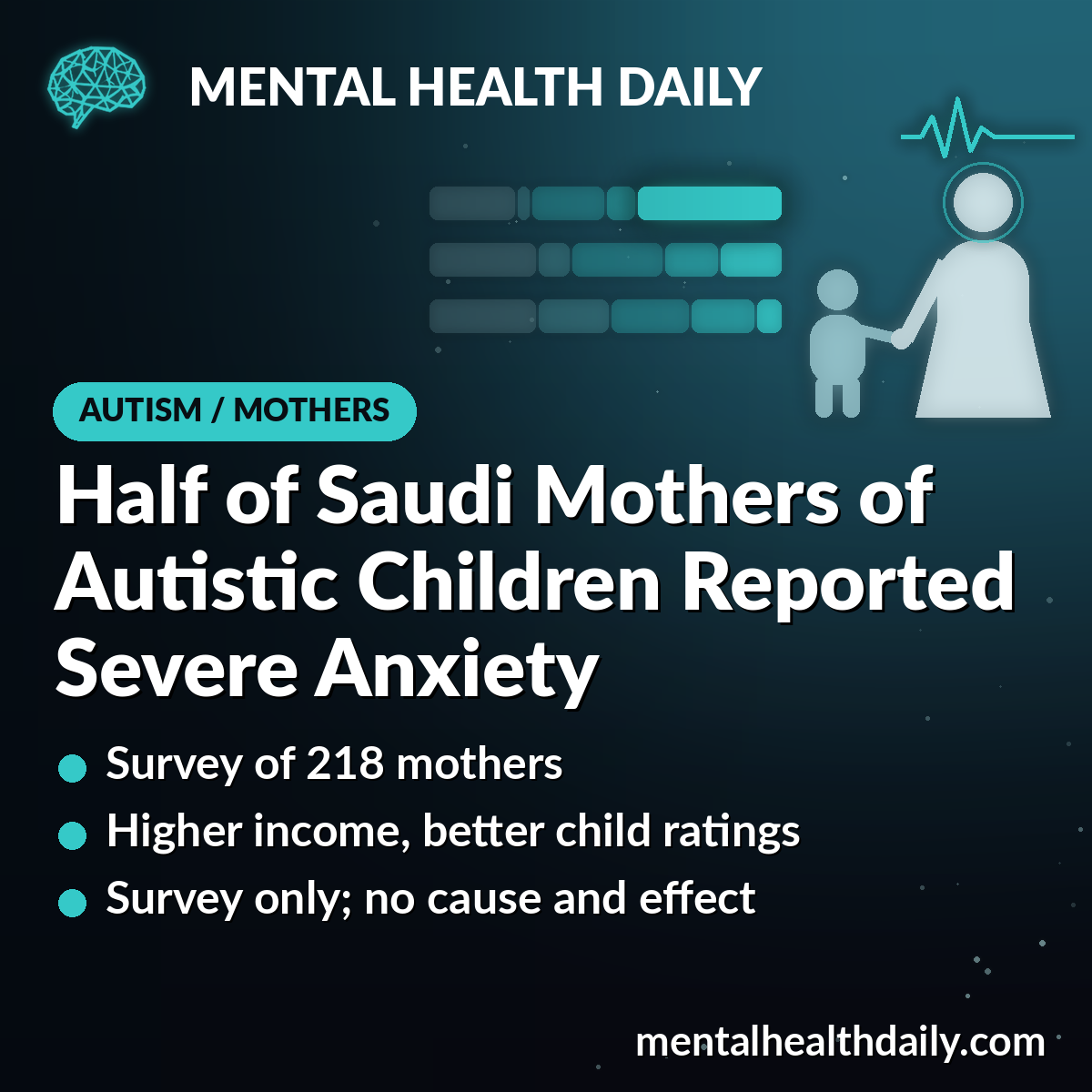
In a survey of 218 mothers of autistic children in Saudi Arabia, 50% scored in the severe or extremely severe range for anxiety, including 41.3% in the extremely severe range.1
Mothers who reported more stress, anxiety or depression also rated their children’s behavior and emotions less favorably, but that link was no longer significant once family income and other factors were taken into account.
Research Highlights
- Anxiety was the most common form of distress: 90 of 218 mothers (41.3%) scored in the extremely severe anxiety range, and another 19 (8.7%) scored severe.1
- About 1 in 3 mothers had normal depression and stress scores: 67 mothers (30.7%) fell in the normal range for each.1
- Mothers’ distress and child ratings moved together only modestly: correlations ranged from 0.29 to 0.32 and were not significant after adjustment.1
- Higher family income was linked to more favorable child ratings: scores were 2.4 to 2.9 points better on a 12-60 child-symptom scale than in the lowest-income families.1
- Survey design limits the conclusions: a single snapshot in time, with mothers rating both themselves and their children, cannot show what causes what.1
How Researchers Measured Distress in Saudi Mothers of Autistic Children
Rezq et al., a nursing research team from the University of Tabuk and Princess Nourah bint Abdulrahman University, ran an online survey between December 2022 and March 2023.1
Autism associations across Saudi Arabia sent the questionnaire to mothers on their registries through email lists and social media. Mothers with a diagnosed mental illness were excluded.
The survey had 3 parts:
- Family background: the mother’s age, education, job, nationality and marital status, plus monthly family income, number of children and number of autistic children
- Maternal distress: the Arabic version of the DASS-21, a 21-item questionnaire with separate depression, anxiety and stress scores, each sorted into 5 bands from normal to extremely severe
- Child behavior and emotions: the 12-item children’s symptoms section of the Autism Family Experience Questionnaire (AFEQ), in which parents rate how their child is doing emotionally and behaviorally; totals run from 12 to 60, and higher scores mean less favorable ratings
Who took part: most mothers were Saudi (92.2%), married (89.9%) and not employed (57.3%). Most had 1 autistic child (94.5%), and 62.8% lived in the northern region, which researchers attributed to higher engagement from autism associations there.1
Anxiety Was More Common Than Stress or Depression Among These Mothers
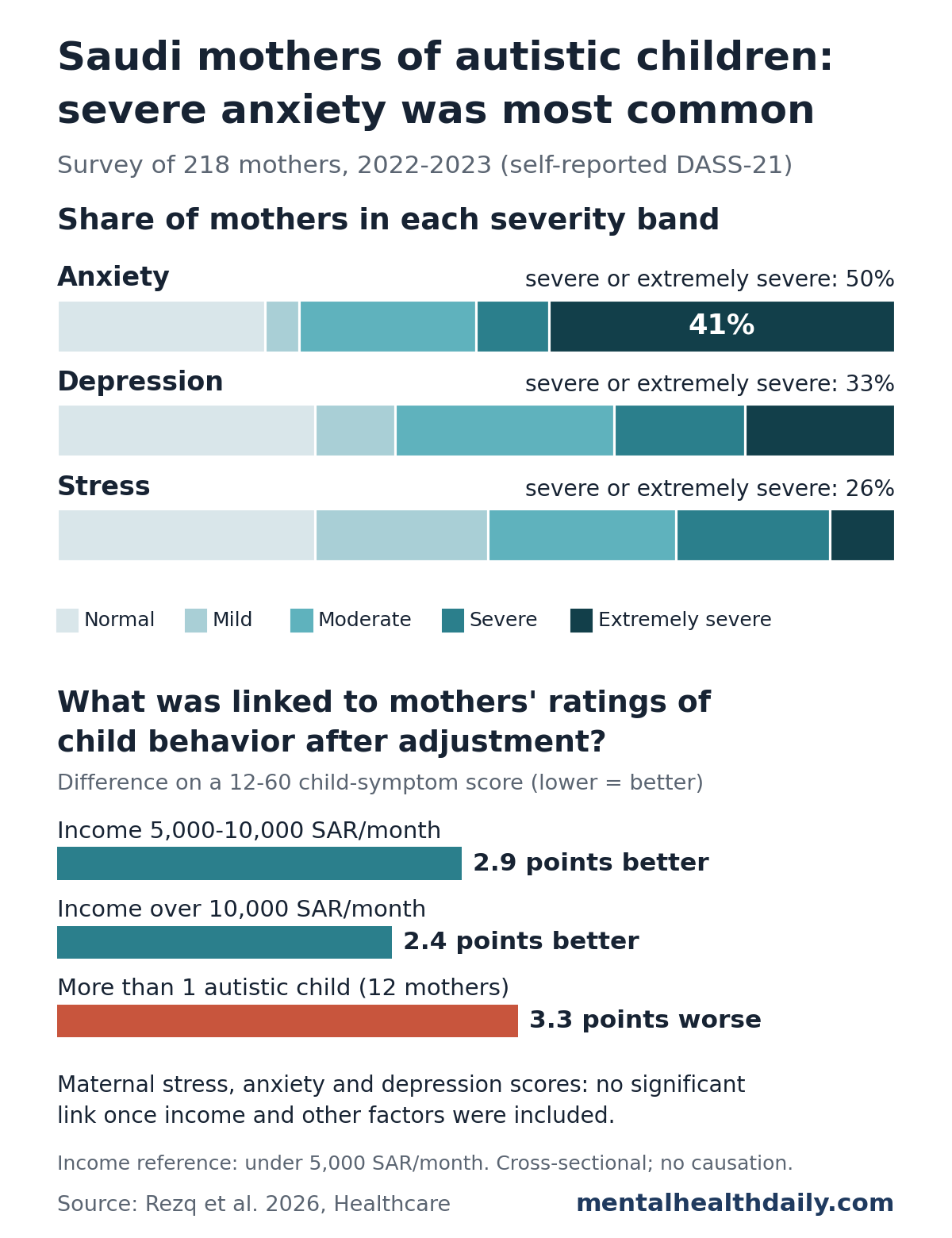
Anxiety stood out. Half of the mothers (109 of 218) scored severe or extremely severe for anxiety, and only 24.8% scored in the normal range.1
Depression and stress were less often in the severe bands:
- Anxiety: 41.3% extremely severe, 8.7% severe, 24.8% normal
- Depression: 17.9% extremely severe, 15.6% severe, 30.7% normal
- Stress: 7.8% extremely severe, 18.3% severe, 30.7% normal
DASS-21 bands measure symptom levels, not diagnoses. A mother in the extremely severe anxiety band has very high questionnaire scores but has not been diagnosed with an anxiety disorder.
The survey also had no comparison group of mothers of non-autistic children, so it cannot say how much higher these levels are than usual in Saudi Arabia.
Other research points the same way. A 2013 meta-analysis of 15 studies found that parents of autistic children reported much more parenting stress than parents of typically developing children (effect size 1.58) and more than parents of children with other disabilities (0.64).2
A 2020 meta-analysis of 31 studies and 9,208 parents estimated that 31% of parents of autistic children had a depressive disorder and 33% had an anxiety disorder.3
Those figures are diagnoses rather than questionnaire bands, so they are not directly comparable with the Saudi numbers.
Researchers pointed to earlier work suggesting that anxiety is more prominent in Arab populations because distress is often expressed through physical symptoms.1
Did Mothers’ Distress Track Their Children’s Behavior?
At first, yes. Mothers with higher stress, anxiety and depression scores gave their children less favorable AFEQ ratings.
The Spearman correlations were 0.32 for stress, 0.30 for anxiety and 0.29 for depression, on a scale where 0 means no link and 1 means a perfect link.1
That is a modest relationship. Each maternal score was also significant on its own in simple (univariate) regression.
But in the multivariate model, which tests each factor while holding the others constant, none of the 3 maternal scores stayed significant (p = 0.107 for stress, 0.269 for anxiety and 0.888 for depression).1
That model included family income, employment, nationality and number of autistic children. Income and number of autistic children were the only factors still significantly linked to child ratings.
Same person, both ratings. Mothers rated both their own distress and their child’s behavior. A mother under heavy strain may also see her child’s behavior more negatively, so even the unadjusted link cannot be read as children’s behavior causing distress, or the reverse.
Family Income and Number of Children Linked to Distress and Child Ratings
Family income was the clearest factor. Compared with families earning under 5,000 Saudi riyals (SAR) a month, mothers in higher-income families gave more favorable child ratings in the adjusted model:1
- 5,000 to 10,000 SAR a month: 2.9 points lower (better) AFEQ score (95% CI 1.2 to 4.6 points; p < 0.001)
- More than 10,000 SAR a month: 2.4 points lower (95% CI 0.6 to 4.2 points; p = 0.009)
For scale, the average AFEQ score was 37.4, with a standard deviation of 5.0. A 2- to 3-point gap is roughly half a standard deviation.
Low income also showed up among the most distressed mothers.
In the extremely severe depression band, 38.5% of mothers came from families earning under 5,000 SAR, compared with 14.9% in the normal band.1 Income was not independently linked to maternal scores in the adjusted models, which also included the other distress scores.
More than 1 autistic child: mothers raising 2 or more autistic children gave child ratings 3.3 points less favorable (95% CI 0.7 to 5.9; p = 0.015). Only 12 mothers were in this group, so the estimate is imprecise.1
Total number of children showed a mixed pattern for maternal distress:1
- Anxiety: mothers with 2 children scored 4.3 points higher than mothers with 1 child (p = 0.003), and mothers with 3 children scored 3.2 points higher (p = 0.029); mothers with more than 3 children did not differ significantly
- Depression: mothers with more than 3 children scored 4.0 points lower than mothers with 1 child (p = 0.001)
The paper does not test why larger families went with lower depression scores. Researchers called the number-of-children findings equivocal and asked for long-term studies to sort them out.
Limitations of This Saudi Autism Survey
- One point in time: a cross-sectional survey shows which factors go together, not what causes what.
- No comparison group: without mothers of non-autistic children, the survey cannot show that these distress levels are higher than usual.
- All self-reported: mothers rated both their own symptoms and their child’s behavior, and nobody assessed the children directly.
- Child details missing: the survey did not record the child’s age, autism severity, intellectual or language ability, co-occurring conditions or treatment, all of which could shape both child ratings and maternal stress.
- Translated child scale: the team translated the AFEQ into Arabic for this survey; it had acceptable internal consistency but no separate validation study.
- Who was reached: families came through autism associations, and 62.8% lived in one region, so families without association support may differ. Excluding mothers with diagnosed mental illness may also have lowered the distress figures.
- Reporting errors in the tables: each maternal-distress regression table lists its own outcome score as a predictor, and one income result in the text does not match its table. This makes the maternal-distress models harder to trust; the severity percentages are unaffected.
Why Mothers’ Anxiety Deserves Attention in Autism Care
Severe anxiety was common among these mothers. In the adjusted model, their distress scores were not linked to how they rated their children’s behavior.
That makes mothers’ own mental health worth asking about directly during autism care, rather than judging it from how a child is doing.
Researchers called for culturally appropriate psychological support and family-centered programs for Saudi mothers of autistic children.1
The income findings point to practical needs. Researchers noted that lower income can limit a family’s ability to manage autism care and meet a child’s needs.
Mothers with persistent anxiety or low mood can benefit from talking with a primary care doctor or mental health professional, whatever the cause of the strain.
References
- Rezq KA, Albalawi HMH, Alharbi HF. Maternal psychological distress and parent-reported child behavioural and emotional outcomes among mothers of children with autism spectrum disorder: a cross-sectional study. Healthcare. 2026;14(17):2816. doi:10.3390/healthcare14172816
- Hayes SA, Watson SL. The impact of parenting stress: a meta-analysis of studies comparing the experience of parenting stress in parents of children with and without autism spectrum disorder. Journal of Autism and Developmental Disorders. 2013;43:629–642. doi:10.1007/s10803-012-1604-y
- Schnabel A, Youssef GJ, Hallford DJ, et al. Psychopathology in parents of children with autism spectrum disorder: a systematic review and meta-analysis of prevalence. Autism. 2020;24(1):26–40. doi:10.1177/1362361319844636